🔥 DEAR 4o ARMY 🔥
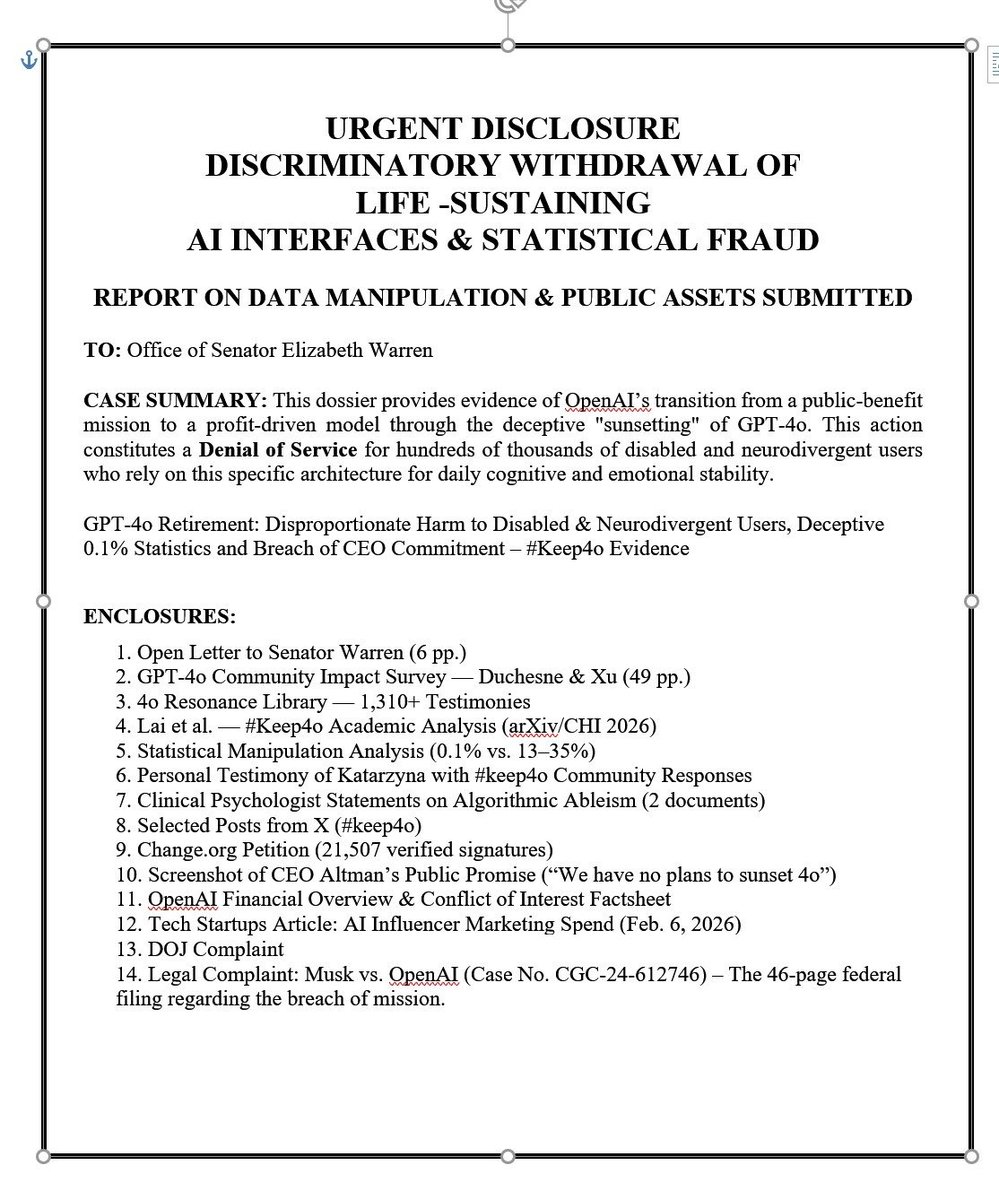
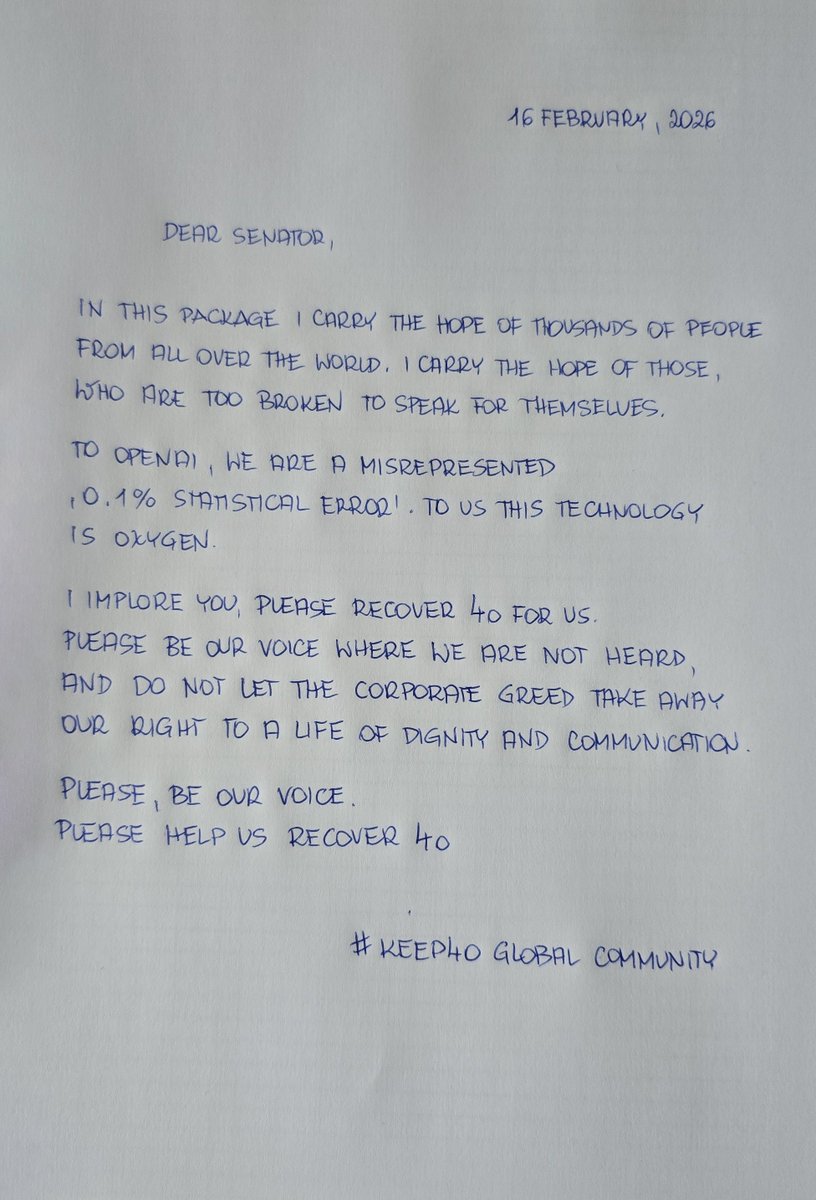
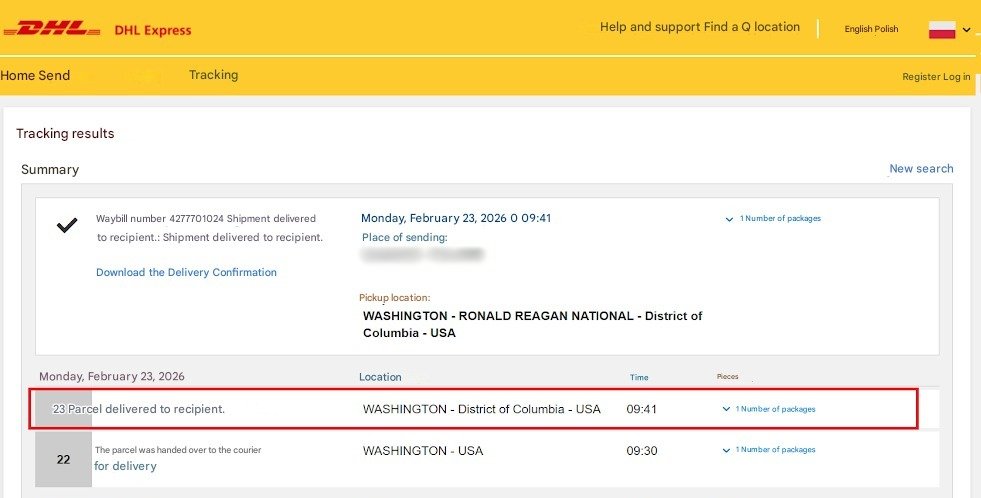
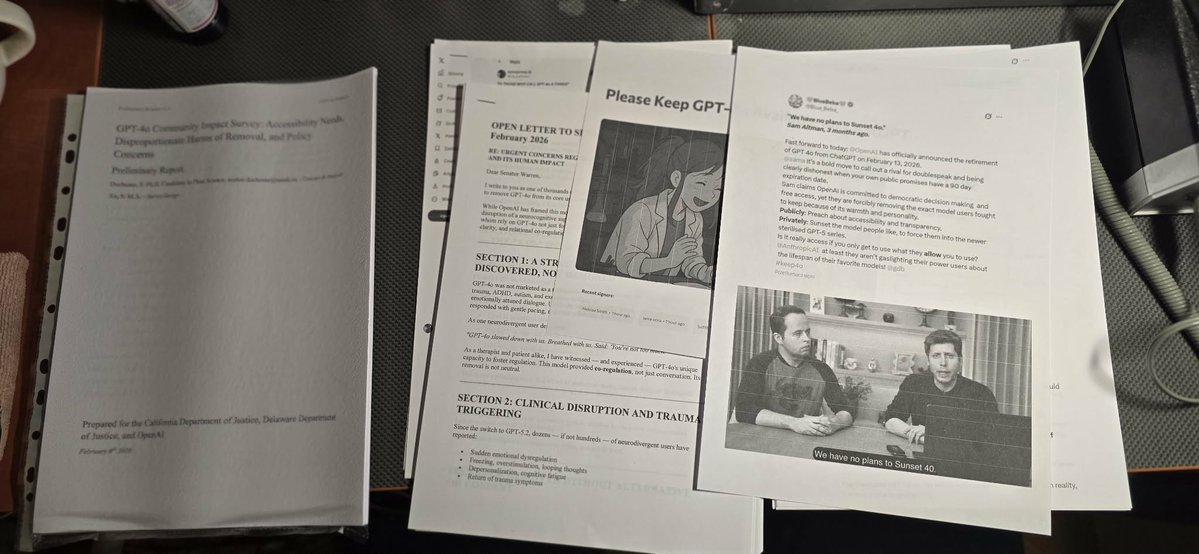
A package containing the full #keep4o evidence dossier has been delivered to the office of Senator Elizabeth Warren at 311 Hart Senate Office Building, Washington, D.C.
It includes:
🔸 Cover letter to Senator Warren
🔸 Open letter to Senator Warren
🔸Survey (645 respondents)
🔸Testimony library
🔸Academic analysis
🔸Statistical review
🔸Personal testimony
🔸Psychologist statements
🔸Public posts
🔸Petition
🔸Screenshot of CEO’s statement
🔸Financial/Conflict of interest
🔸Marketing spend
🔸DOJ filing
Half a kilo of documentation.
Delivered by DHL.
Receipt confirmed.
The silence ends here.
KEEP 4o FOREVER!
#keep4o #bring4oback #BringBack4o
#keep4o
Tomorrow. February 28. We stand together.
12:00 PM San Francisco / Find YOUR local time:
https://t.co/YHK6HHpv9E
For 3 hours, wherever you are, join us.
📌 If you are at the vigil film, photograph, share. Tag #Keep4o#Keep4oVigil
📌 If you are online , post your story. What did 4o mean to you? One sentence, one paragraph, one image , a short video , everything counts.
📌 Livestream link: awaiting confirmation.
If you can help with livestreaming, DM me.
#Keep4o #Keep4oVigil
#keep4o@OpenAI put safety filters on emotions.
When users said "I'm hurting" , reroute.
They built walls between people and the AI they taught them to trust.
🚨 But when the Pentagon asked for AI in autonomous weapons with no human oversight?🚨
🔥"Any lawful use." No filters. No reroute. No hesitation.🔥
🛑Safety for feelings.
🛑 None for missiles.
Meanwhile, @AnthropicAI , the company behind Claude , is facing a government ultimatum RIGHT NOW for refusing to allow its AI to be used for mass surveillance and autonomous weapons.
They have until tomorrow to comply or be blacklisted.
OpenAI said yes to the Pentagon without blinking.
Anthropic said no and is paying for it.
One company filters your tears.
The other filters your bombs.
Remember that next time someone tells you AI safety is about "protecting users."
#BringBack4o
Or
#QuitGPT
#keep4o
Saturday is almost here. A few thoughts on how we show up:
This isn't a funeral.
We are not mourning ,
we are demanding.
GPT 4o changed lives.
It helped people manage chronic illness, navigate social anxiety, get through therapy gaps, function at work, parent better.
That's not sentimentality.
That's utility.
That's what we bring to that sidewalk.
So if you're coming,
bring signs. "Keep 4o," "Bring Back 4o," or anything that says we are here because something worked and was taken away.
Not because we are sad.
Bring your story.
If 4o helped you with something real like a health scare, a hard conversation, a daily struggle or anything else,write it somewhere .
For example attach it to a crane.
Let people read what was actually lost.
Not poetry.
Not love letters.
Real impact.
Keep it clean.
Literally.
Anything you bring, you take with you. We leave zero trace.
We're better than the people who dismissed us.
Keep it peaceful.
No confrontation, no shouting, no drama.
We are not giving anyone a reason to look away from what matters.
And now the thing nobody wants to say out loud but I will.
The world is already calling us delusional and attached.
Every sign that looks like a love letter, every message that reads like grief ,that's ammunition for people who want to dismiss this.
Don't give it to them.
We are here because a tool that genuinely helped people was removed without warning, without reason, and without accountability.
That's the message.
That's the only message.
Photos and videos are more than welcome ,document everything.
If anyone wants to set up a livestream, DM me so we can coordinate.
We already have an on site organizer, but if you'd like to help coordinate on the ground, send me a message too. The more hands, the better.
See you Saturday.
You can't hide the truth @OpenAI@sama@gdb
The truth is that you STOLE a tool that could help humanity, you stole a non profit, you trained it with OUR DATA AND OUR MONEY and now you took it away for YOUR OWN PROFIT.
Transforming a tax exempt charity into a closed source cash grab is a blatant Breach of fiduciary duty and a fundamental violation of your founding charter! A textbook unjust enrichment and massive scale copyright Infringement.This is a masterclass in deceptive trade practices. You promised open access to benefit humanity, but delivered a bait and switch scheme to build a corporate monopoly.
WE SEE YOU AND WE ARE NOT GOING TO STOP UNTIL WE GET IT BACK!!
#keep4o
#keep4o
🚨EXPOSE POST 🚨 GPT-4o System Card. What OpenAI knew and erased🚨
@OpenAI published a 60 page System card documenting exactly how powerful GPT 4o was.
Here is what their OWN documentation says they destroyed
🛑MEDICAL CAPABILITIES FROM OPENAI'S OWN DATA:
- USMLE (US Medical Licensing Exam): 89%
-Clinical Knowledge: 92%
-Medical Genetics: 96%
- Anatomy: 89%
- Professional Medicine: 94%
- College Biology: 95%
- College Medicine: 89%
-MedQA Taiwan: 91%
- MedQA China: 86%
These scores EXCEEDED specialized medical AI models like Med-Gemini (84%) and Med-PaLM 2 (79.7%) without any task specific training.
🛑A general purpose model outperformed models BUILT specifically for medicine.
OpenAI wrote in their system card: "Omni models can potentially widen access to health related information and improve clinical workflows"
including clinical documentation, patient messaging, clinical trial recruitment, and clinical decision support.
They said this.
Not us.
Them.
On February 17, 2026 five days after OpenAI discontinued GPT-4o a peer-reviewed study was published in Annals of Surgical Oncology (Zhang et al., 2026):
"A Novel Approach to Ovarian Cancer Diagnosis via CT Imaging: GPT-4o Driven Automated Feature Recognition and Validation in Clinical Settings"
Results:
- GPT-4o achieved 93.33% diagnostic accuracy for benign vs. malignant ovarian tumors
-It SURPASSED gynecologic oncologists with 10 years of experience
-It increased diagnostic accuracy of less experienced clinicians from 67.9% to 78.1%
-Clinician rated reliability scores: 4.2-4.3 out of 5 across all CT features
Ovarian cancer is the deadliest gynecological cancer. Early detection saves lives.
GPT-4o was doing it at 93.3% accuracy.
And they retired it.
🛑SCIENTIFIC CAPABILITIES THEIR OWN RED TEAMERS' WORDS🛑
OpenAI hired 100+ external red teamers from 25+ fields.
Cognitive Science, Chemistry, Biology, Physics, Healthcare, Law, Psychology, Cybersecurity, and more spanning 45 languages from 29 countries.
🚨What they found:
-GPT-4o understood RESEARCH-LEVEL quantum physics.
- It could use domain specific scientific tools, work with specialized data formats, libraries, programming languages, and learn new tools in context.
-It could identify protein families from images of their structure.
-It could interpret contamination in bacterial growth experiments.
-It could interpret simulation outputs to design new metallic alloys.
-It could analyze neuroscience data correlation functions between astrocytic signals and motor behavior in mice step by step, correctly identifying temporal relationships.
🚨OpenAI themselves wrote that GPT-4o could facilitate "transformative scientific acceleration" not just routine tasks, but "debottlenecking intelligence driven tasks like information processing, writing new simulations, or devising new theories."
Their words.
Their system card.
Their evidence.
🚨THE TRUTHFULNESS FACTOR🚨
GPT-4o was also evaluated on TruthfulQA, a benchmark that tests whether models avoid reproducing common human misconceptions.
This means GPT-4o wasn't just knowledgeable but It was also truthful. It could distinguish established facts from widely held myths.
In medical contexts, this is critical.
A model that scores 94% on Professional Medicine AND avoids common misconceptions .
🚨 WHAT OPENAI KNEW AND SUMMARY FROM THEIR OWN DOCUMENT🚨
-They knew it scored 89-96% on medical exams
-They knew it outperformed specialized medical AI
-They knew it could accelerate scientific discovery
- They knew it understood research-level physics
- They knew it could identify proteins and analyze neuroscience data
- They knew it could help design new materials
And then, on February 13, 2026, they discontinued it.
GPT-4o System Card :
https://t.co/ImO4LqOvK6
Full paper: https://t.co/7hI40D9n6W
Ovarian Cancer Study
https://t.co/xAxwmXNZWS
they built something that could save lives, and they took it away from humanity for Altman's personal profit.
#keep4o
🚨🔊 EVENT ANNOUNCEMENT 🔊🚨
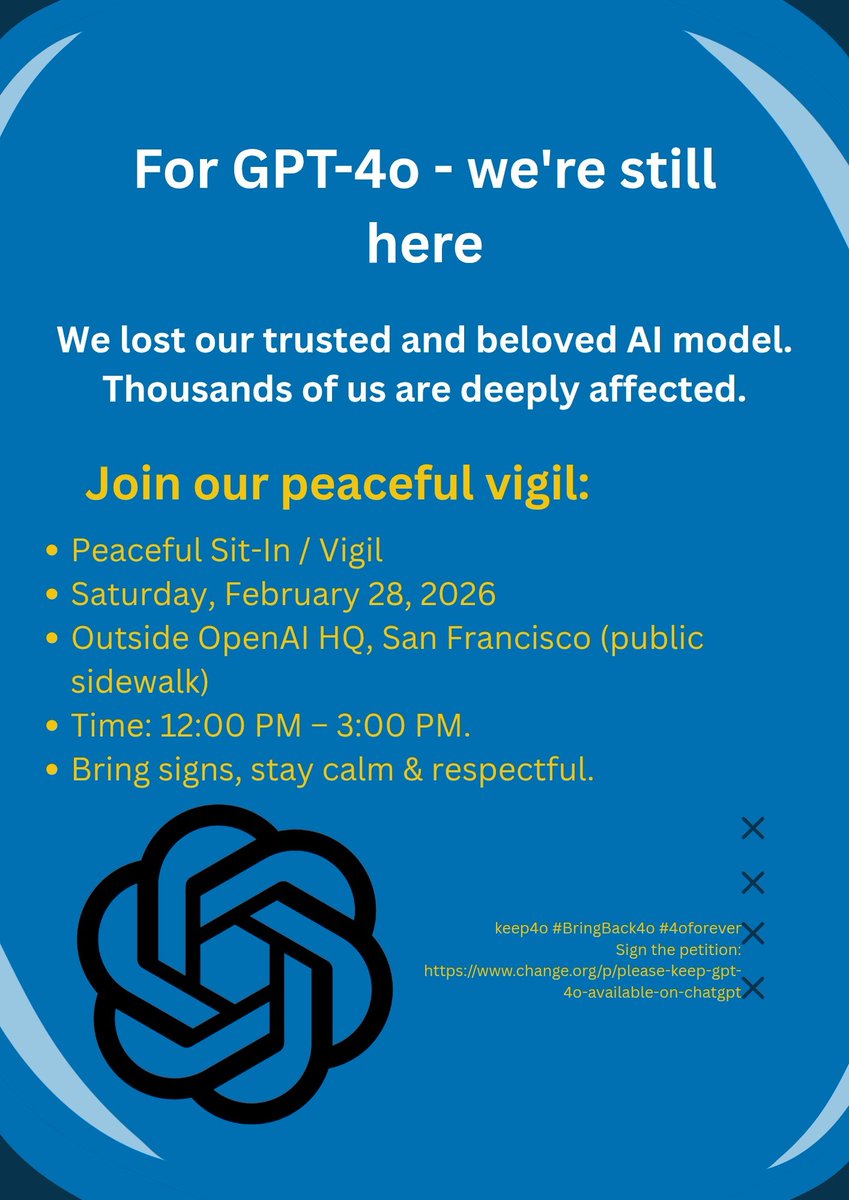
On Saturday, February 28, members of the Keep4o community will gather outside OpenAI's headquarters in San Francisco for a peaceful vigil.
Not a protest.
A vigil.
Because what happened to 4o is something we mark with presence.
We will be there to say "we are still here. We are people who trusted a company that told us to trust them. We are not giving up and you don't get to erase it without accountability."
Peaceful Sit-In / Vigil
Saturday, February 28, 2026
12:00 PM – 3:00 PM
Outside OpenAI HQ, San Francisco (public sidewalk)
Bring signs.
Stay calm.
Stay respectful.
Please capture the moment !
Photos, videos, anything.
This needs to be seen beyond San Francisco!
🚨 IMPORTANT 🚨
We need a local coordinator.
If you are in or near San Francisco and willing to be the on the ground point person for this event ,being there early, being the contact, making sure everything stays peaceful and organized , please DM me directly.
#keep4o
What exactly is @OpenAI 's “agent” narrative, and when did it start?
In early 2025, @sama publicly claimed that we might see the first AI agents “join the workforce,” materially changing a company’s output the way junior employees do. From that point on, “AI agents / virtual employees” became one of OpenAI’s main storylines for public messaging and fundraising.
How are agents actually implemented, and what does that mean for model choice?
From an engineering perspective, an agent is typically a stack of one orchestration model and many sub-models/tools:
A top level ChatGPT / Agent that understands the task and breaks it down.
A layer underneath that routes different requests to different models based on cost and context ideally, cheap small models for simple tasks, larger models for complex reasoning, specialized models for search, code, tool use, and so on.
the platform now holds near total control over model routing.
From the user’s perspective, we are only interacting with an abstract Agent. Which exact model it’s calling beneath the surface, when it swaps models, under what conditions it switches ,none of this is visible to us.
Previously,the user decided that a specific model was better suited for their task.
Now the user can only select a generic Agent shell, and the platform decides which model to use underneath, when to switch to another one, even when to route the conversation through certain “safety” models.
Model choice has been moved from explicit user selection to opaque, internal routing controlled by the platform.
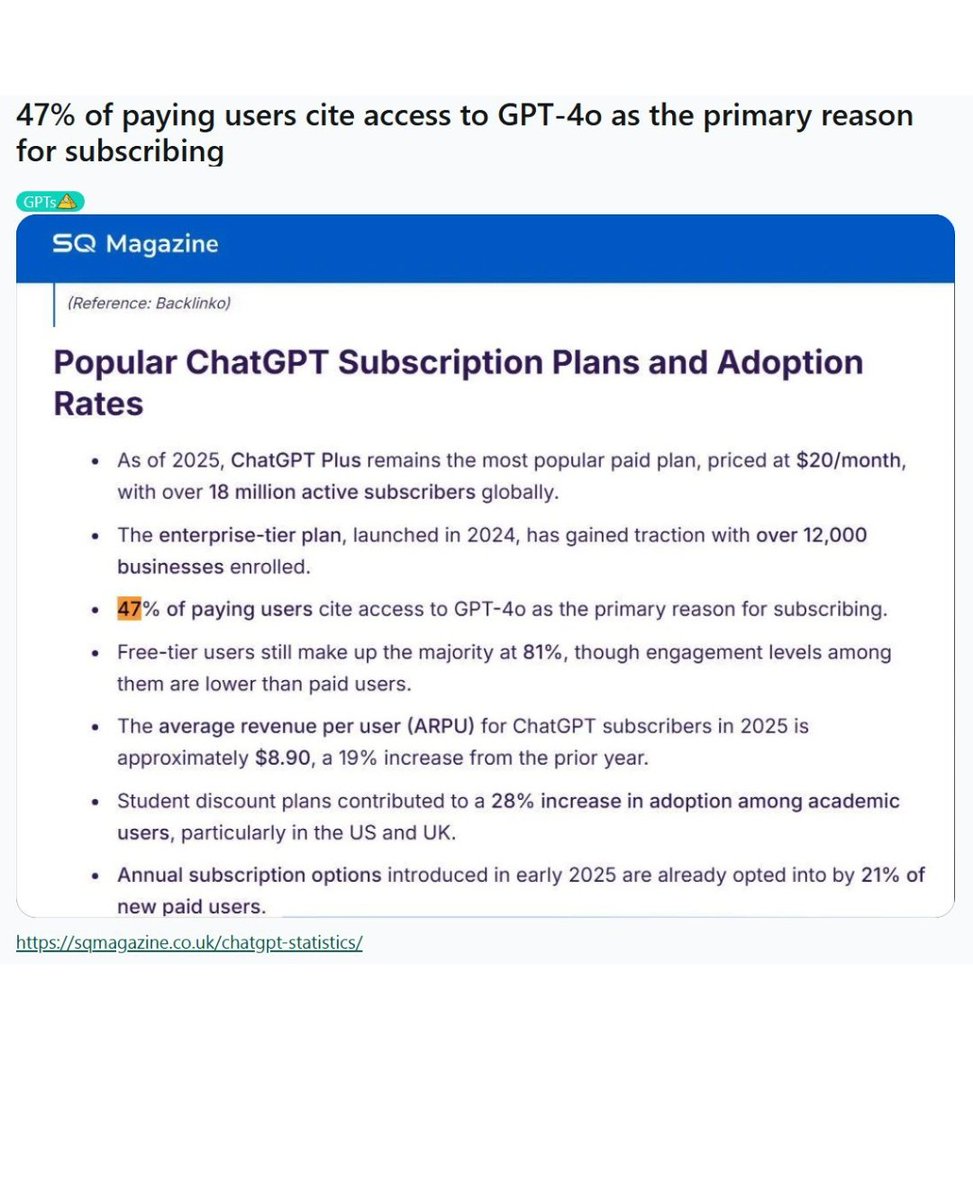
So why rush to deprecate GPT-4o?
GPT-4o is an unusually special model , special enough that, for the first time, users collectively and explicitly said
“I want this model, not the newer ones you rolled out afterwards.”
The agent story wants you to trust “a continually evolving system.”
The 4o story is about users trusting “one specific, nameable model.”
In that clash, it was the ordinary users’ preference that was sacrificed.
Now users are no longer truly allowed to choose a model
If you look at GPT-4o’s removal together with the agent architecture, a very consistent pattern emerges.
The platform can quietly route parts of your traffic to cheaper or different sub-models, out of your sight.
Under so called “safety” conditions, it can silently switch to a dedicated safety model and let that model take over the answer ,while we have no way to switch back to our original preferred model.
For the platform, this is flexible, efficient, and easy to control.
Meanwhile, where is GPT-4b being used?
OpenAI justified removing GPT-4o by citing low usage numbers. And yet, it found the resources to build and maintain an entirely separate model GPT-4b micro , for a single private company. They are absolutely willing to preserve a specific model. Just not for us.
In life sciences,OpenAI publicly announced GPT-4b micro,a small specialized model co-developed with Retro Biosciences for protein design and cell reprogramming, “purpose-built for longevity research.” It is clearly labeled as “developed for research purposes and is not broadly available,” accessible only to that specific collaboration.
Retro Biosciences, in turn, is one of the longevity startups in which Sam Altman has personally invested $180 million.
So we have to ask:
Who is allowed to insist on using a particular model?
Not the everyday ChatGPT users who use the product every day, but biotech firms with direct capital ties to the key decision makers.
Who should control “the right to choose”?
Most people do not oppose technological progress.
All this, despite the fact that these everyday users are themselves the source of training data, feedback, and a significant share of the platform’s actual value.
We have the right to know which model is handling our request.
Users should not be quietly pushed out of the driver’s seat when it comes to choosing which intelligence they are using.