@LSValue@JerryCap @nosunkcosts For 2) the moat is insurmountable in my view. V/MA basically built their two-sided networks over 60+ years, and were not commerially/profit driven entities until the last 10(ish). They were owned by the very endpoints they connected (banks) who all built large profit centers ...
@IrnestKaplan@JerryCap No single answer, really depends on what the merchant is solving for. If US domestic in-person transactions only, it’s mostly price. If challenge is cross-border auth rates, online merchant liability (fraud), single connection across many jurisdictions, then price matters less
@compound100x 3) All payment service providers essentially compete on 5 things: functionality, coverage, performance, ease of integration and price
Each merchant will prioritize these 5 things differently, e.g. SMB selling only in US vs Uber operating globally with more sophisticated needs
@JerryCap Btw, I’m not sure their pricing strategy is necessarily to be at the premium end of the market—more that their product is designed to solve complexity and they are choosing to price for value delivered (for profitability) vs chasing market share for share’s sake (for growth)
@JerryCap Need to consider what Adyen is selling: a service that is effectively zero marginal cost, with lowest fixed cost base. The former is no different for any competitor in payments, once they reach a certain level of scale, the latter is a byproduct of focus and management discipline
@JerryCap@IntrinsicInv@borrowed_ideas You guys have looked at more companies, but my experience is those that are egregious with SBC simply don’t care to offset dilution (feature not bug in their algorithm). Those that are conscious of dilution have capital allocation frameworks that include buybacks but put it last
@JerryCap@IntrinsicInv@borrowed_ideas Not sure any company really forgoes highest/best uses though. Most pause buybacks if they need to stretch balance sheet for large M&A. For smaller acq’n and organic investments there’s typically enough FCF to also buy back to neutralize SBC (and then some)
@IntrinsicInv@JerryCap@borrowed_ideas Agree, not capital allocation decision as much as it’s a mechanical output, pretty much always executed as part of 10b5-1 plan put in place by corporate treasury depts or 10b-18 delegated to brokers, both are daily dribbles over the quarter with amounts dictated by a grid/formula
@WTCM3 $FISV = “Steady Eddie”
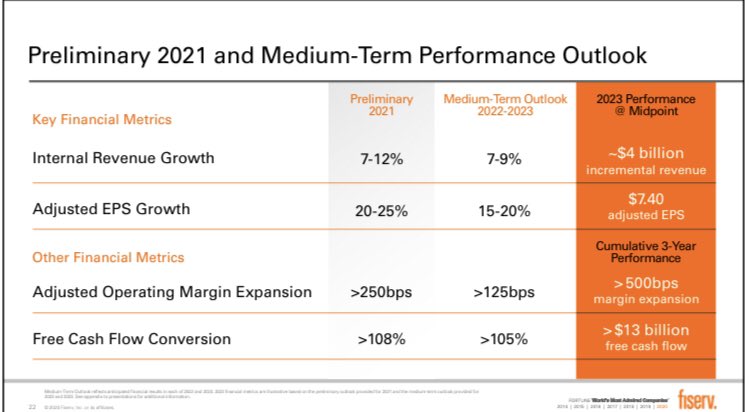
Pretty impressive execution vs outlook from 3 yrs ago
At current 2023 guide, they’ll have over delivered on revenue growth (impressive vs expectations), hit margin/EPS targets (no fanfare) and come up a tad short on FCF ($11B vs $13B+ goal)
3) Fast forward to today and the outlook $FISV is committing to here is impressive on all levels
High single digit compounded revenue growth + 500+ bps margin expansion + 105%+ FCF conversion = $13B+ of cumulative FCF over next 3 yrs and a $7.40 EPS in 2023 at midpoint of guide
@bizalmanac@arampell@jkwade@noyesclt@JerryCap@InnocenceCapit1 Lots of skirmishes in a wide and dynamic arena of competition between the two. Most interesting area where strategies had diverged (starting around 2015) is probably approach to capturing new flows (i.e. B2B and other uses of the network beyond core consumer payments)
@rafaelcattley @FoolMCochrane @LibertyRPF@MinionCapital@TravisWiedower B2B is an interesting one and point of differentiation between $V and $MA. Strategies diverging recently, but I think ultimately boils down to POV on 2 things: A) timing, B) serviceability and C) yield/profitability of the B2B opportunity.
Parsing through what each has said:
@bizalmanac@arampell@jkwade@noyesclt@JerryCap@InnocenceCapit1 A bit dated, but this ramble below probably/mostly still true today. Duopoly economics and incentives will continue to play out, so strategies for the larger (V) will at times differ from those pursued by the smaller (MA)
@LibertyRPF@MinionCapital@TravisWiedower Can’t go wrong with either as other have commented, all points already mentioned valid. Ultimately difference boils down to 1) growth vs resiliency and 2) degree of willingness to disrupt vs. preserve the status quo. Some of it is structural, some is due to strategic decisions
For those interested in $V here’s a really enjoyable read by @MarcRuby
Captures perfectly the passing of the guard and evolution over past 15 yrs
Favorite part: “One way of thinking about $V ‘s edge is that you could never get so many parties to agree”
https://t.co/PCBGJHjLob
@LuisVSanchez777 $TPL at 85%+ EBIT margins (GAAP)
Aside from water business (< 1/4 of revenue), it’s effectively a 100% margin business
Probably $600M+ EBIT this year with < 100 employees (most tied to water), historically only needed < 10 heads to basically sit around to collect royalty checks
@abdullaefakhro@310Value $TPL has an effective monopoly on 3 revenue streams from its 900k acres of land interests in Permian Basin:
1) Royalties on driller production of oil/gas on its land
2) Easement/leases on pipeline/well use of its land
3) Water service operations to drillers operating on its land
@mikulaja “In a battle between merchants and a big bank/card network partnership, public officials will always side with small merchants, especially since another protected class, consumers, are too unorganized/uninformed to understand how they are being net harmed by resulting measures”
@scuttleblurb “If your understanding of card networks is limited to news articles and click-bait editorials, you will come away with a simplistic and distorted understanding of how payments work, overlooking trade-offs and flavors of coopetition that allow it to function as well as it does”
@scuttleblurb “Rather than expound upon V/MA’s moats, which are widely understood and appreciated by now, it’d be more useful to discuss potential challenges. This is conviction by subtraction, seeing how much is left after chipping away the excess stone of competitive threats”
— so perfect 👍
@scuttleblurb “If your understanding of card networks is limited to news articles and click-bait editorials, you will come away with a simplistic and distorted understanding of how payments work, overlooking trade-offs and flavors of coopetition that allow it to function as well as it does”