Great to see this published in @NatureSynthesis!
https://t.co/FEbEq8gPtz
(or https://t.co/bufvDPZeaI )
Now that it's peer reviewed, I am comfortable talking about it and doing a tweetorial (to come).
First, let me tell you about the reaction lost to time...
1/
If we managed to map the causal structure aka "the data generating process", we are on track to refine the models.
I believe what we presented is approaching that; imprecisions remain e.g. treating CN as exposure and not modeling S -> CN. Hopefully these are eventually resolved.
Great to see this published!
In short, we introduced causal inference logic to test which of metal electronics, ancillary ligand sterics and metal coordination number (CN) directly affect the rate of reductive elimination at Pd(II) (and presumably other metals...)
1/
As one of my favourite papers puts it:
As a consequence, linear regression results are notoriously unstable – even minor changes in model specification can lead to coefficient estimates that bounce around like a box full of gerbils on methamphetamines.
https://t.co/7DgsHSP9hq
6/
#ProcterPOW: @morandilab present a TM-free approach to cross-E+ coupling 🔀 after coupling of alkyl P+ salts and alkyl iodides using bis(TMS)amide, C-P is cleaved by SET in a frustrated ion pair between alkyl P+ salts and (bisTMS)amide, with HAT from the leaving PPh3. 🔗👇
I am very happy that our study was published in Nature! Please check it out!
Thanks a lot to my co-authors @emilien_ls and Philip and my PhD supervisor @morandilab!
Many Congrats to @sevenroediger, Emilien Le Saux and Philip Böhm for uncovering a new mechanistic approach to alkyl-alkyl coupling using frustrated ion pairs. Now @Nature@ETH_DCHAB@ETH_en.
https://t.co/ROub7mu3pt
10 Great Books on Trade and Globalisation (seems relevant)
1)The Globalisation Paradox- @rodrikdani
Great work on the nuances of globalisation. Recognizing its wide benefits, but also how tradeoffs: national self-determination, democracy and economic hyper globalisation conflict.
A new paper about AI in Materials Discovery has gained a lot of attention - it reports a big increase in productivity of scientists using AI tools, and interesting secondary effects of using AI for science.
But do the technical claims stack up? Let's see...
And that overall is my problem again here. There is lots on how AI was integrated into the process, but much less on verifying that AI gave results that were actually useful.
🔥 We have two open full prof positions at our institute (LOC) at @ETH_DCHAB@ETH_en
1. Synthetic Organic Chemistry
2. (Bio)Analytical Chemistry
Apply until Nov 15 and be our colleague!
https://t.co/Nv9gV91KVm
Come be our colleague 👇. Two positions (synthetic organic and (bio)analytical) open at our institute (LOC). Amazing students and staff, colleagues, facilities, location, and long-term funding perspectives. What are you waiting for? Apply today 😀. @ETH_DCHAB#chemjobs
My first paper from the Morandi group. Shuttle catalysis greatly simplifies Co–H formation for MHAT reactivity – now all you need is a C–H bond. The final version is now available https://t.co/LIUN8viMl0
Congrats to @sevenroediger, Adriana Neves Vieira, Cosima Brudy, Mischa Trabesinger and Jan Hübscher - Olefination of Activated Alkyl Halides with Phosphonium Salts. @thiemechemistry in honor of @CarreiraGroup. https://t.co/f0Ivssgg8H
Congrats to Tanner @W0TangClan, Philip Blank, Andrea Brugnetti, Philip Boehm and Françoise Aouane - introducing the concept of shuttle HAT for mild catalytic transfer hydrohalogenation of alkenes. @NatureComms. Previously on @ChemRxiv. https://t.co/xilZ7etEQG
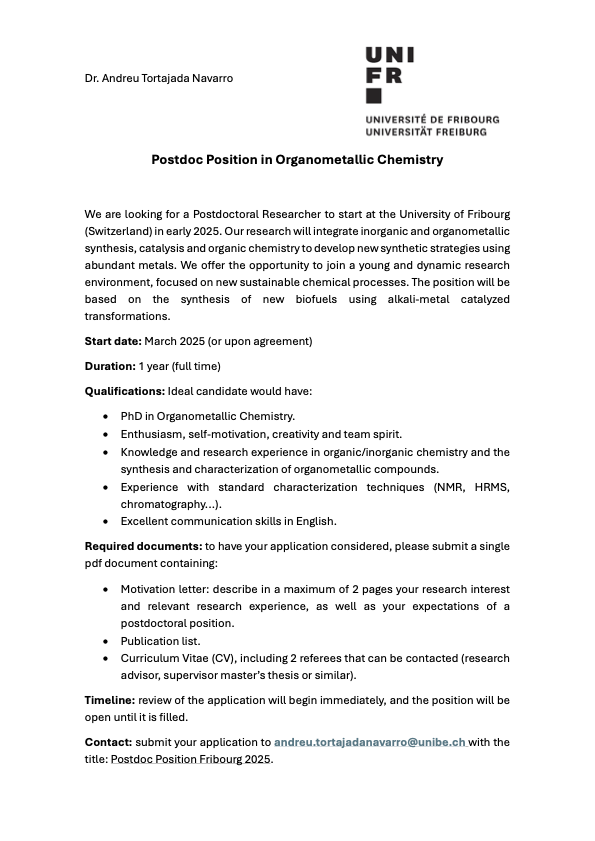
Last week we got the news that our Spark project has been funded by the @snsf_ch 😃🥳 I am looking therefore for a Postdoctoral Researcher to work with me to develop new biorenewable fuels, using organometallic chemistry and designing new catalysts!
#NewPI#chempostdoc