Borderless aims to lower the gaps in resource accessibility and promote the proliferation and understanding of *why* open-source AI and decentralized networks.
We've always known @cerebras' blazingly fast inf. on their magic wafers. Already impressive, but holy-F seeing #Gemma4-31B count the num of letters + spaces of an entire whitepaper in .jpg form while simultaneously reading+summarizing the papers topic in LESS THAN A SECOND. Ok🤯
@stevibe Incredible how the Gemma family has been making consistent leaps every version. Thought Gemma 3 was a game changer, then Gemma 4, albeit slightly on the heavier side in comparison, blew it's predecessor away. I'm sure Google is working on Edge models for Gemma4 already.
Caught a nasty bug that put me out of commission for 10 days. I was in bed for TEN days, and I come back to find the entire gen AI space completely flipped on it's head, yet again. 10 days ago, I thought, "pretty neat project. Definitely will check it out." Now I'm just lost.
@Cloudflare seriously though, no exaggeration I think I've done about 60 checks today, and I see all the fingerprinting that's done many thousand times a day, so I know that you can easily tell that it's still same old me doing those humanity checks... what's the problem here
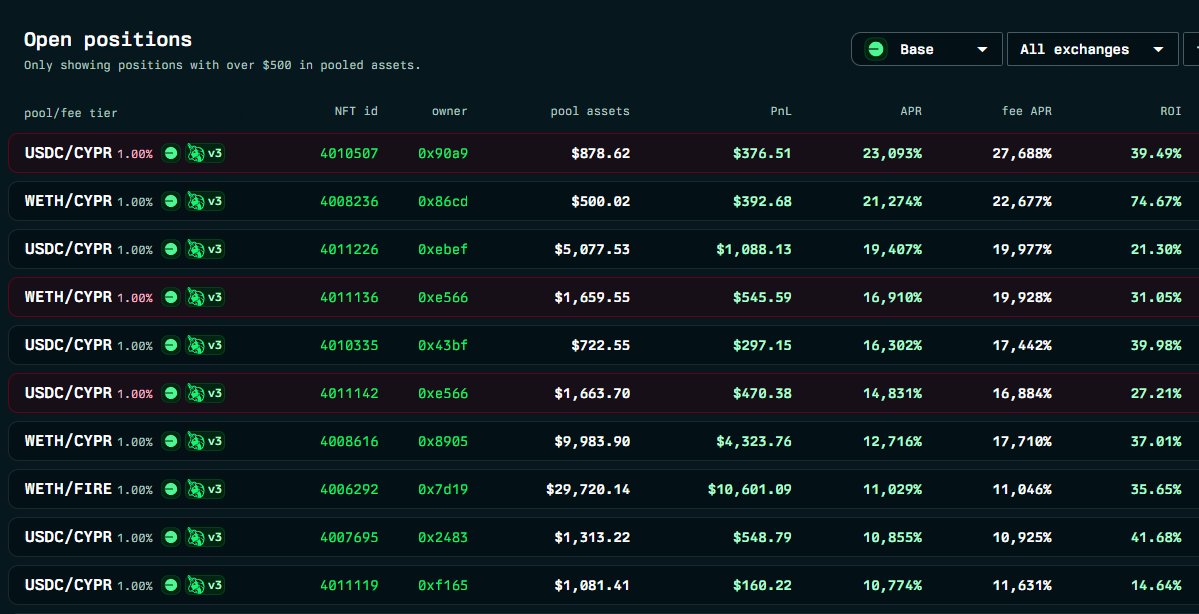
We just witnessed history in the #DeFi#FinTech and #Blockchain space! @Cypher_HQ_'s Protocol just finished its first reward cycle for all its VISA card users and $CYPR holders. Unlike any other crypto-focused ATM/debit cards out there, #Cypher is unique and will continue to be an interesting case study to watch as the rewards mechanism is completely on-chain, governed by the users, and designed to align incentives with actual users. Sound familiar?
That's right baby, veTokenomics, one of DeFi's longest standing, battle-tested, and arguably a contender for the most influential and iconic #degov and network alignment strategies has made it's debut in "the real world" - we've come full circle, as we will soon observe the effectiveness (or ineffectiveness) of #veTokenomics when applied to real world finances and people's purchasing habits.
Of course, the road ahead does not seem to be an easy path, but building valuable networks with so many intricate moving parts never was and never will be. @ycombinator-backed, but will that have enough pull to create its own ecosystem of participating businesses to fully take advantage of the potential rewards and incentivization systems, or will the users ultimately be the main drivers? Will there even be user-initiated programs and innovative bribes? So many interesting angles to watch and participate from.
Whatever the future has in store, this has been one of the most human things that I have covered. Gen AI can't replicate this or predict the outcome, as there is no single source of truth (or point of failure) in terms of how the network grows. Of course, VISA could theoretically go kaboom, which would be detrimental, but way out of scope for this discussion. But as I've said before, truly decentralized networks and systems are one of the greatest assets we can build to safeguard humanity from malicious intelligence.
Congrats to the team at @Cypher_HQ_, and best of luck! Here's to epoch #2, and many many more after. Koreans had a pretty epic first round (assuming most boosted #Coupang, aka the Amazon of Korea). Let's keep going 💪
As an entity that is currently mainly focused on finding a solution to this problem in the image classification domain, it really is rough out there. Congrats on the paper!
There's a reason why we have remained so vague in our exact project - we're still on the hunt for the best learning method suited for our scope. We gave a small sneak peek earlier this year during @huggingface's #mcp #agentic hackathon; we plan to do so again in the upcoming hackathon slated to begin next month ;)
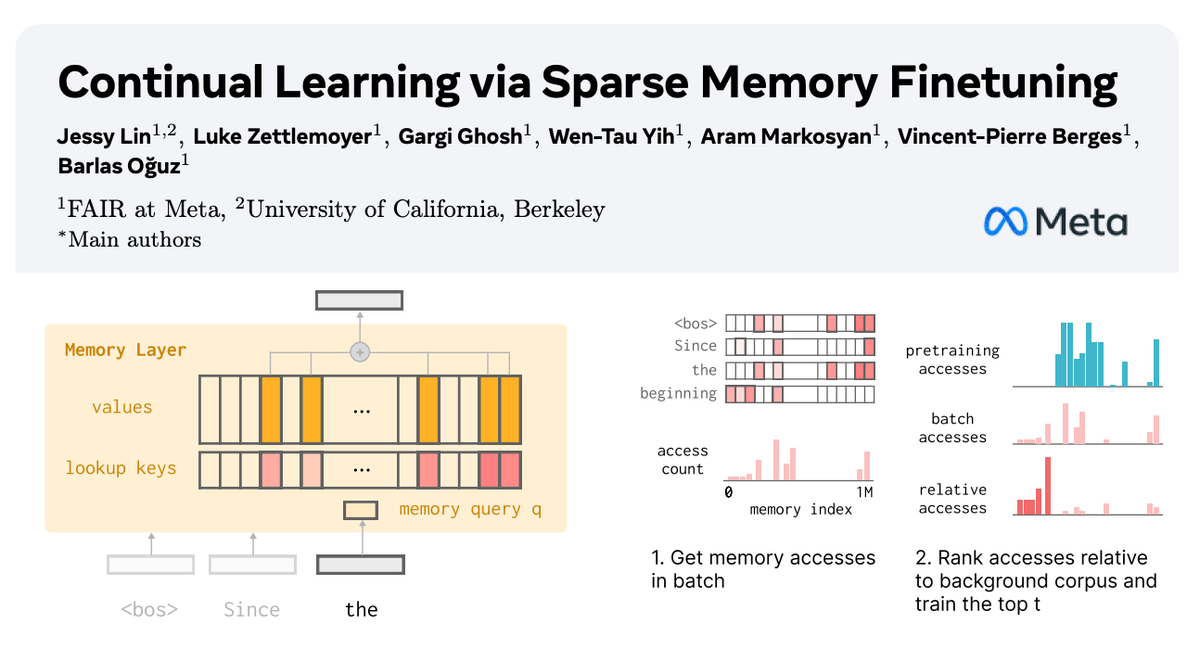
🧠 How can we equip LLMs with memory that allows them to continually learn new things?
In our new paper with @AIatMeta, we show how sparsely finetuning memory layers enables targeted updates for continual learning, w/ minimal interference with existing knowledge.
While full finetuning and LoRA see drastic drops in held-out task performance (📉-89% FT, -71% LoRA on fact learning tasks), memory layers learn the same amount with far less forgetting (-11%).
🧵:
Confession: a few hours ago I hit the deploy button on a #H200 for a dead simple #ONNX model highly optimized for an image classification pipeline that a handful of CPU cores could have handled fine.
Especially considering that this was not time-critical or a huge batch job, it felt wrong and I felt guilty for my gross misappropriation of compute resources. But the convenience and, frankly, the shrinking number of alternatives from a growing number of providers is making it increasingly difficult to find a viable low-mid range solution.
In a time where the industry is mostly focused on the latest and greatest beast from #NVIDIA, I happened to come across @AxeleraAI's product line and instantly became a fan.
Of course, having never actually tried, I can't say for sure, but it's looking mighty attractive. Dead simple concepts, practical applications, standard form factors for any build, research-backed (https://t.co/ivQRJYurJJ) and might I say, kind of sexy (https://t.co/MeeARYjmSE).
And yes, I know, edge accelerators have been around for quite some time, AxeleraAI isn't the first nor the only in the market, etc. But the combination of the explosive growth, popularity, and improvements in lightweight models over the past half year, along with the growing market fatigue with the direction that the hardware side has taken make this the perfect opportunity for smaller companies to really fill a massive hole in the market.
Software side is making strides in lean AI. It's time for hardware to catch up, because the market will be huge.
* Not a paid or sponsored post, but if Axelera wants to send some spare, refurbished, or review M.2 or PCIe units for a non-profit project going on for over two years, we'll gladly make it one 🥹
We can leave the H/B200s to AI slop creation as it was intended by the AI gods 😂
P.S. where did all the T4's and similar-era stock of GPUs go? Another mega-corps trash is another entities treasure... It's a bit ironic that we have more resources available at hand for $30K+ GPUs but have trouble finding GPUs from nearly a decade ago... 🤔
There are now multiple vision-enabled and/or multi-modal open source LLM models that are that are on par with or exceed #SOTA model capabilities, having caught with the "best" models of just a few months ago.
✨ Key takeaways and trends you should know 👇
- Research focus seems to have shifted significantly from LLMs to VLMs.
- Chinese-based and funded entities continue to absolutely push the boundaries and dominate in nearly every domain: text, image, video, audio, 3d.
- Politics aside, China is undoubtedly championing open research and development in gen. AI at the moment. Meanwhile... Korean conglomerates are still advertising refrigerators with extra sensors and WiFi as if they had achieved ASI... please stop, it's embarrassing 🤦♂️
- Of course every VLM is unique, with models that vary in both architecture and intended use. However, there is a strong industry wide shift from trying to build the best biggest model, to building robust models that are both powerful and lightweight, designed to be easily trained for specialized tasks whether it be through #LoRA (adapters) or various fine-tuning methods.
- Real-time vision and inferencing has been possible for quite some time now with libraries like #YOLO and Transformers.js, but now they're actually good with some potential game-changing use-cases besides just simple object detection.
All huge important wins for open source 🙏
Note: several notable models are not represented in this graphic (#Gemma3, #Qwen3 VL models, #LFM2, and many more). In less than a quarter the entire VLM landscape has changed, and will change again by the next quarter... so don't count on this graphic to be accurate in a few weeks. Included in white text: gpt-4o and #claude baselines to give some context on model capabilities.
Disclaimer: benchmark data has not been independently verified by us, but are accepted by others that have ran benchmarks lastly, benchmark performances are often not fully representative of real-life performance.
To clarify - you don't have to participate in governance, but besides the fun drama that comes from veTokenomics (https://t.co/6wm987Zpa1) but you will also lose the ability to influence and receive weighted rewards by throwing away your vote escrowed tokens.
p.s. koreans you know what to do, put the farm on coupang cause realistically thats where most of our money goes anyways ;)
...aaand back to regular scheduled programming of AI. Good luck all!
Probably worth noting that the QAT version of the Gemma3-4B model actually brings the model size down to be roughly on par at ~3gb.
In other words, for use-case we'll use both. Just deploy and iterate, the name of the game before papers go out of date in weeks.
LFM2-VL-1.6B (1.6B params) edges out Gemma 3 4B (4.3B params) in efficiency benchmarks like RealWorldQA (65.2% vs ~60%) and MathVista (51.1% vs lower text MATH equiv.), but Gemma leads in DocVQA (72.8% vs LFM2's InfoVQA 58.7%) and VQAv2 (63.9%).
Trade-offs: LFM2-VL is 2-3x faster inference, lower memory (3GB vs 9GB+), cheaper for edge, but weaker multilingual (English-only vs 140+ langs).
For your ensemble/MX-DF2 curriculum: LFM2-VL's tunable tokens and hybrid arch suit lightweight, iterative training; Gemma's larger context (128K) aids complex sequences. Favor LFM2 for speed in resource-constrained setups.