@sabeer Pointing out the symptoms is endless and has been going on for centuries, just quote numbers from this Shadow Economy report and keep asking to 50x number of judges, everything will work out. Loading PDF… https://t.co/y4JqurFaZC
HOW LONG VITAMINS STAY IN YOUR BODY:
1. Vitamin C – 24 hours
2. Vitamin B12 – Several months
3. Vitamin D – Weeks to months
4. Vitamin A – Stored in liver for months
5. Vitamin K – 1–2 days
6. Folate (B9) – Few days
7. Vitamin E – Weeks
8. Biotin – 24–48 hours
9. Calcium – Hours (needs daily intake)
10. Magnesium – 24–48 hours
The power of emergent knowledge
For 50 years, linguists believed your brain runs a hidden grammar engine—unconsciously applying thousands of rules to generate sentences.
LLMs just proved this is completely wrong.
And the implications go way beyond language.
The old theory made sense. Language is structured. It has patterns. Where there are patterns, there must be rules generating them, right?
So we tried to formalize everything. The entire Semantic Web was built on this assumption: encode the rules, achieve understanding.
Then LLMs showed up.
They've never been taught a single grammar rule. They just... read a lot. Trillions of sentences.
And they write better than most humans.
This isn't an engineering trick. It's a discovery about what language fundamentally is.
Patterns don't require rules to generate them.
The rules were always just our description of patterns that already existed.
Where else have we made this mistake?
Where else have we confused "how we describe it" with "how it has to work"?
Consider Python dependency management.
For 20 years, millions of developers accepted it was inherently painful. Virtual environments were clunky, but that was "the state of the art."
Then uv appeared in 2024. One tool. Suddenly everything just worked.
The "rules" of how dependency management should work weren't requirements.
They were descriptions of one bad approach that everyone had collectively accepted as necessary.
NASA has twice SpaceX's budget.
SpaceX has launched more missions in the last decade than NASA did in fifty years.
Same physics. Same goal. Radically different relationship to "process."
NASA follows the rules:
Multi-year planning cycles
Formal review boards
Institutional accountability chains
SpaceX breaks things fast, learns fast.
The process was supposed to ensure quality. It became a substitute for it.
Something works through emergent patterns
We describe those patterns as "rules"
We forget they were descriptions
We enforce the rules as requirements
The rules become obstacles to the thing they were describing
Grammar rules don't generate language. Grammar rules describe where language already goes.
A river doesn't follow the map. The map describes the river.
The author I'm riffing on (Daniel Lemire @lemire) makes a provocative claim:
"The bureaucratisation of science was a death sentence for progress."
Strong. But the argument structure is hard to dismiss.
We created formal scientific processes to describe how good science happens.
Then we forgot these were descriptions and started treating them as requirements.
Now the process has become the point.
The tired excuse: "All the low-hanging fruit has been picked."
What if the fruit is right there, but we've convinced ourselves we need a 47-step approval process before we can reach for it?
Darwin needed a ship before he could develop evolution.
Einstein's relativity emerged when trains made relative motion obvious.
The neat story—professors think deep thoughts, engineers build stuff—is historically backwards.
Tools enable thoughts. Thoughts enable tools.
It's a loop, not a line.
LLMs aren't "just engineering." They revealed something true about the world.
So what do you do with this?
Next time you encounter a "rule" or "process," ask:
Is this a requirement? Or a description we've been enforcing?
Notice the difference between:
"This is how it has to work"
"This is how we've been describing it"
Most "has to" is actually "we assumed."
The deepest version of this insight:
What LLMs reveal about language might apply to institutions too.
Neither requires explicit rules. Both emerge from patterns of practice. Both calcify when we forget that.
I'm still working out the limits of this.
Does it apply to law? Medicine? Engineering safety standards?
Some rules probably are requirements. The question is which ones.
But I suspect we've overcounted badly.
There's a specific threshold of complexity and self-direction below which a system degenerates, and above which it can open-endedly self-improve.
Current AI systems aren't close to it yet. But it's inevitable we will reach this point eventually. When we do, we won't see a sudden explosion, more like consistently self-sustaining linear-ish progress. Like the pace of Science itself (which itself clearly a self-improving system)
The most powerful scientific instrument of the 21st century isn't the electron microscope or the particle collider. It's the algorithm.
Today, a scientist in biology, physics, chemistry etc. is more likely to be debugging a Python script than to be running a wet lab. Going forward, the biggest breakthroughs will be mostly software achievements, like AlphaFold.
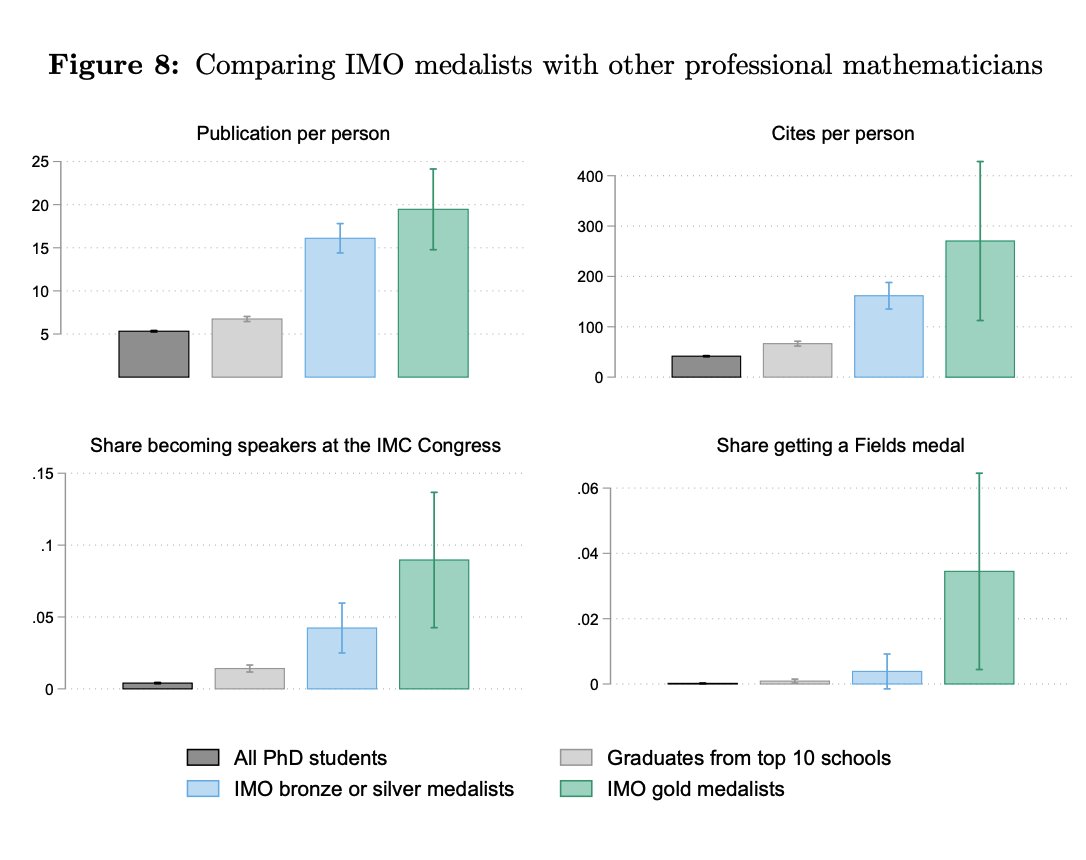
IMO gold medalists are 50x more likely to win a Fields medal, the highest prize in Mathematics, than PhDs from top 10 schools.
The Power Law is everywhere for those with eyes to see.
Nobel Peace Prize Winners (1911–2025)🕊
1911: 🇳🇱 Tobias Asser, 🇦🇹 Alfred Fried
1912: 🇺🇸 Elihu Root
1913: 🇧🇪 Henri La Fontaine
1917: 🇨🇭 International Committee of the Red Cross
1919: 🇺🇸 Woodrow Wilson
1920: 🇫🇷 Léon Bourgeois
1921: 🇸🇪 Hjalmar Branting, 🇳🇴 Christian Lange
1922: 🇳🇴 Fridtjof Nansen
1925: 🇬🇧 Sir Austen Chamberlain, 🇺🇸 Charles G. Dawes
1926: 🇫🇷 Aristide Briand, 🇩🇪 Gustav Stresemann
1927: 🇫🇷 Ferdinand Buisson, 🇩🇪 Ludwig Quidde
1929: 🇺🇸 Frank B. Kellogg
1930: 🇸🇪 Nathan Söderblom
1931: 🇺🇸 Jane Addams, 🇺🇸 Nicholas Murray Butler
1933: 🇬🇧 Sir Norman Angell
1934: 🇬🇧 Arthur Henderson
1935: 🇩🇪 Carl von Ossietzky
1936: 🇦🇷 Carlos Saavedra Lamas
1937: 🇬🇧 Robert Cecil
1938: 🇳🇴 Nansen International Office for Refugees
1944: 🇨🇭 International Committee of the Red Cross
1945: 🇺🇸 Cordell Hull
1946: 🇺🇸 Emily Greene Balch, 🇺🇸 John R. Mott
1947: 🇬🇧 Friends Service Council, 🇺🇸 American Friends Service Committee
1949: 🇬🇧 Lord Boyd Orr
1950: 🇺🇸 Ralph Bunche
1951: 🇫🇷 Léon Jouhaux
1952: 🇦🇹 Albert Schweitzer
1953: 🇺🇸 George C. Marshall
1954: 🇺🇳 Office of the United Nations High Commissioner for Refugees
1957: 🇨🇦 Lester Bowles Pearson
1958: 🇧🇪 Georges Pire
1959: 🇬🇧 Philip Noel-Baker
1960: 🇿🇦 Albert Lutuli
1961: 🇸🇪 Dag Hammarskjöld
1962: 🇺🇸 Linus Pauling
1963: 🇨🇭 International Committee of the Red Cross, League of Red Cross Societies
1964: 🇺🇸 Martin Luther King Jr.
1965: 🇺🇳 United Nations Children’s Fund
1968: 🇫🇷 René Cassin
1969: 🇺🇳 International Labour Organization
1970: 🇺🇸 Norman Borlaug
1971: 🇩🇪 Willy Brandt
1973: 🇺🇸 Henry Kissinger, 🇻🇳 Lê Đức Thọ (declined)
1974: 🇮🇪 Seán MacBride, 🇯🇵 Eisaku Satō
1975: 🇷🇺 Andrei Sakharov
1976: 🇮🇪 Betty Williams, 🇮🇪 Mairead Corrigan
1977: 🇺🇳 Amnesty International
1978: 🇪🇬 Anwar al‑Sadat, 🇮🇱 Menachem Begin
1979: 🇮🇳 Mother Teresa
1980: 🇦🇷 Adolfo Pérez Esquivel
1981: 🇺🇳 Office of the United Nations High Commissioner for Refugees
1982: 🇸🇪 Alva Myrdal, 🇲🇽 Alfonso García Robles
1983: 🇵🇱 Lech Wałęsa
1984: 🇿🇦 Desmond Tutu
1985: 🇺🇳 International Physicians for the Prevention of Nuclear War
1986: 🇺🇸 Elie Wiesel
1987: 🇨🇷 Óscar Arias Sánchez
1988: 🇺🇳 United Nations Peacekeeping Forces
1989: 🇹🇷 The 14th Dalai Lama
1990: 🇷🇺 Mikhail Gorbachev
1991: 🇲🇲 Aung San Suu Kyi
1992: 🇬🇹 Rigoberta Menchú Tum
1993: 🇿🇦 Nelson Mandela, 🇿🇦 F.W. de Klerk
1994: 🇵🇸 Yasser Arafat, 🇮🇱 Shimon Peres, 🇮🇱 Yitzhak Rabin
1995: 🇬🇧 Joseph Rotblat, 🇵🇬 Pugwash Conferences on Science and World Affairs
1996: 🇹🇱 Carlos Filipe Ximenes Belo, 🇵🇷 José Ramos‑Horta
1997: 🇺🇸 International Campaign to Ban Landmines, 🇺🇸 Jody Williams
1998: 🇮🇪 John Hume, 🇮🇪 David Trimble
1999: 🇺🇳 Doctors Without Borders
2000: 🇰🇷 Kim Dae‑jung
2001: 🇺🇳 United Nations, 🇬🇭 Kofi Annan
2002: 🇺🇸 Jimmy Carter
2003: 🇮🇷 Shirin Ebadi
2004: 🇰🇪 Wangari Maathai
2005: 🇦🇹 International Atomic Energy Agency, 🇪🇬 Mohamed ElBaradei
2006: 🇧🇩 Muhammad Yunus, 🇧🇩 Grameen Bank
2007: 🇺🇳 Intergovernmental Panel on Climate Change, 🇺🇸 Al Gore
2008: 🇫🇮 Martti Ahtisaari
2009: 🇺🇸 Barack H. Obama
2010: 🇨🇳 Liu Xiaobo
2011: 🇱🇷 Ellen Johnson Sirleaf, 🇱🇾 Leymah Gbowee, 🇾🇪 Tawakkol Karman
2012: 🇪🇺 European Union
2013: 🇳🇱 Organisation for the Prohibition of Chemical Weapons
2014: 🇮🇳 Kailash Satyarthi, 🇵🇰 Malala Yousafzai
2015: 🇹🇳 National Dialogue Quartet
2016: 🇨🇴 Juan Manuel Santos
2017: 🇦🇺 International Campaign to Abolish Nuclear Weapons
2018: 🇨🇩 Denis Mukwege, 🇮🇶 Nadia Murad
2019: 🇪🇹 Abiy Ahmed Ali
2020: 🇺🇳 World Food Programme
2021: 🇵🇭 Maria Ressa, 🇷🇺 Dmitry Muratov
2022: 🇧🇾 Ales Bialiatski, 🇷🇺 Memorial, 🇺🇦 Center for Civil Liberties
2023: 🇮🇷 Narges Mohammadi
2024: 🇯🇵 Nihon Hidankyo
2025: 🇻🇪 Maria Corina Machado
Source: NobelPrize Organization
To understand human nature, read the older books. To develop specific knowledge, stay on the bleeding edge, read newer (technical) books.
The best authors - Deutsch, Schopenhauer, Borges, Ted Chiang - write with very high density. The best authors respect the reader’s time.
When a model gives you the right answer to a reasoning question, you can't tell whether it was via memorization or via reasoning.
A simple way to tell between the two is to tweak your question in a way that 1. changes the answer, 2. requires some reasoning to adapt to the change. If you still get the same answer as before... it was memorization.
message to all ~7,000 people on tech twitter:
THIS IS A TINY BUBBLE
NORMIES DON'T KNOW WHAT CLAUDE IS AND HALF HAVE NOT TRIED CHATGPT
TRY TO GET BILLIONS OF VIEWS, NOT MILLIONS
SINCE 2022; CULTURE SPREADS THROUGH SHORT FORM. NOTHING ELSE
A VIRAL X LAUNCH GETS 1 MIL VIEWS ONE TIME AND DIES
THERE ARE EXTREME POWER LAWS IN ATTENTION LIKE NEVER BEFORE
ENOUGH ATTENTION WILL MAKE U THE PRESIDENT OF USA
EVERY AWARENESS EXPERIMENT SHOULD BE POTENTIALLY CAPABLE OF 1 BILLION VIEWS