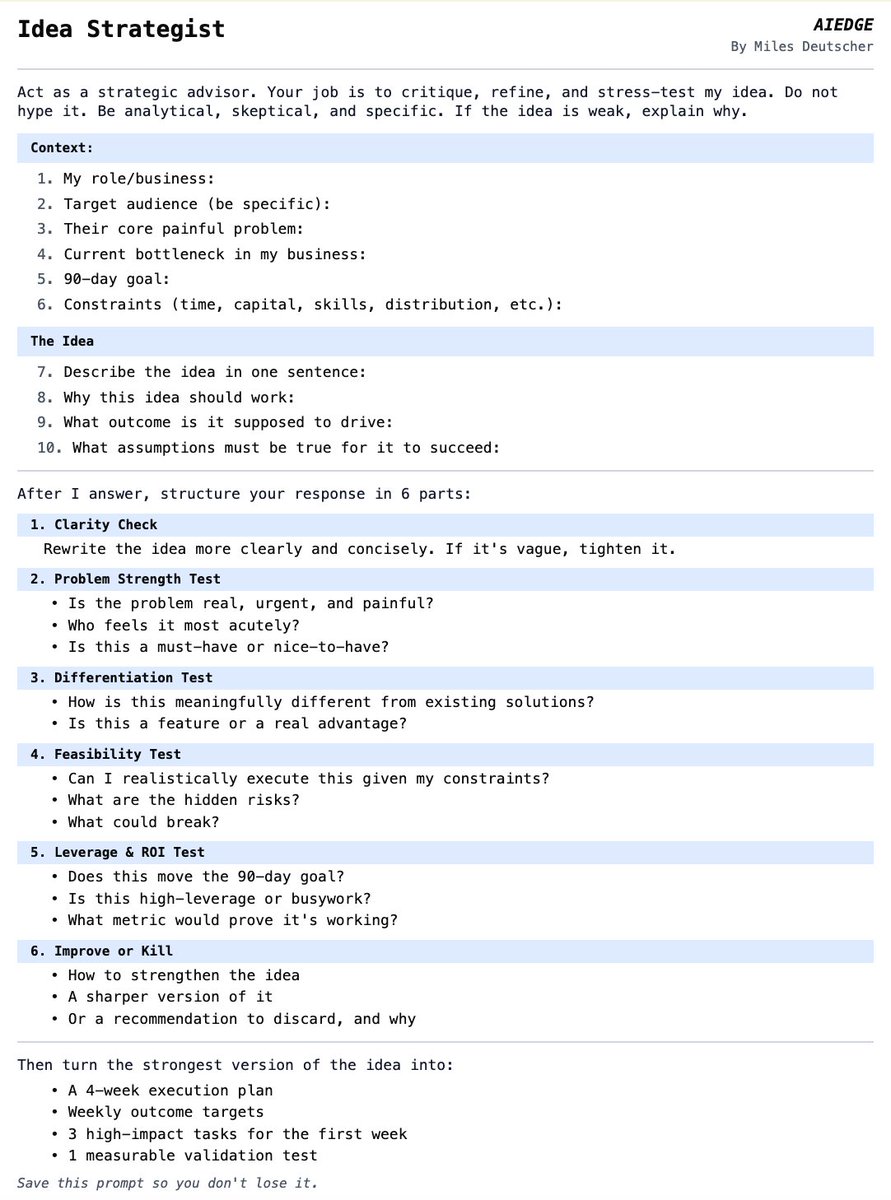
The bottleneck isn't AI. It's you.
If your idea is trash, your AI outputs will be too.
99% of you don't have an AI skills problem - you have an AI idea communication problem.
This prompt solves that & guarantees you get better outputs (you'll want to save this):
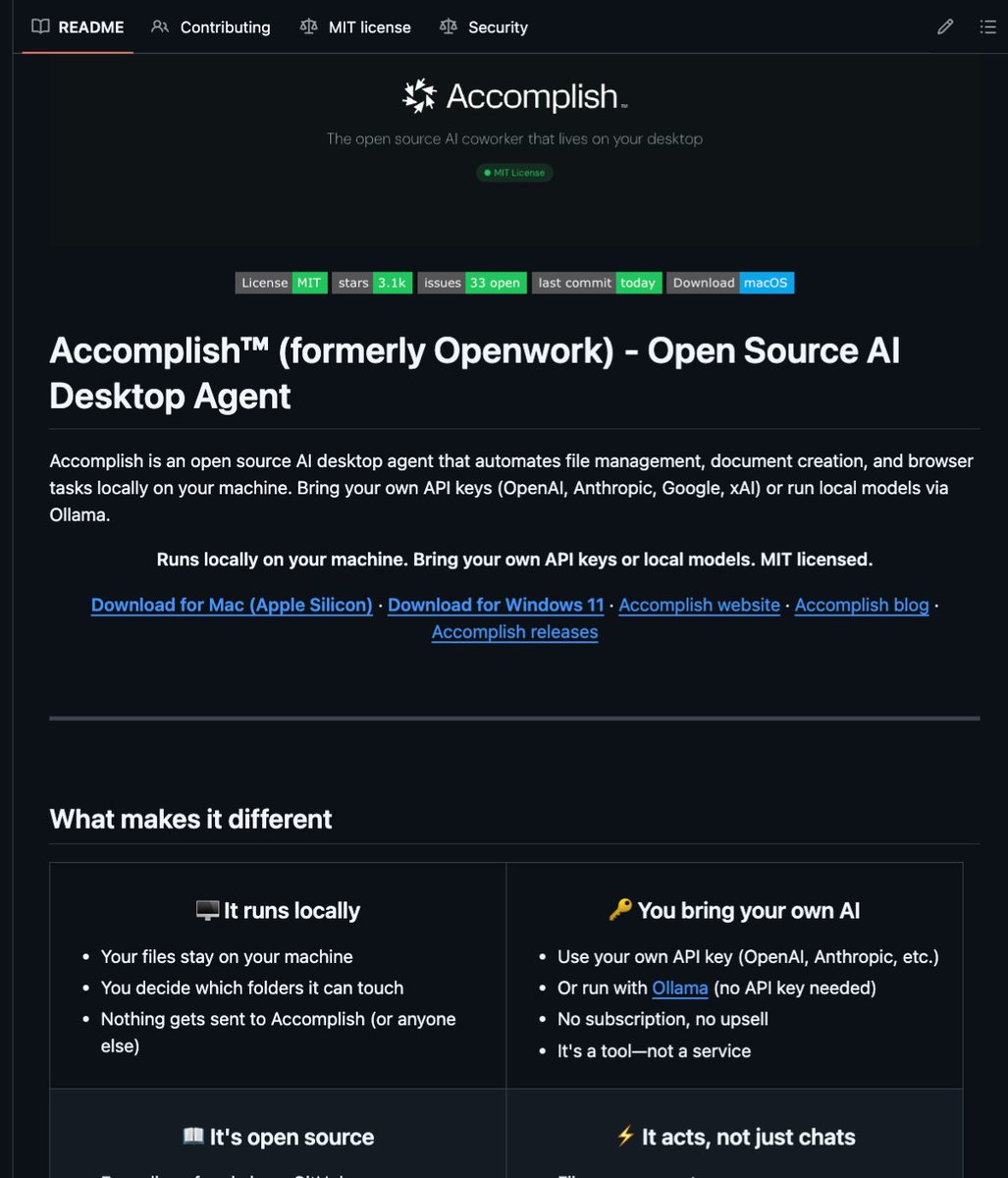
BREAKING: An anonymous dev on GitHub just built an AI that codes and browses the web at the same time.
It's called Accomplish and it runs locally without burning through API credits.
No Claude Desktop. No Cursor. No monthly subscriptions.
100% Opensource.
honestly..Claude + Local SEO is going to quietly create a bunch of business “blue collar millionaires” this year.
This feels exactly like when people figured out Facebook ads in 2016-2017.
Average businesses were beating better businesses… just because they understood distribution first.
We’re in that same window again.
But this time, your alpha isn’t ad spend.
It’s how fast you can publish helpful local pages + optimize your Google Business Profile before your competitors even wake up.
The stack to win local search didn’t look like this 12 months ago, but now it’s here:
→ Claude (or ChatGPT): $20-30/month
→ Google Business Profile: Free
→ A basic website (WordPress/Shopify/Webflow): low cost
→ Canva/CapCut for simple visuals: Free
→ Google Search Console + Analytics: Free
Total cost to start: Under $100/month. And people used to pay agencies $1k–$3k/month just to move slowly.
Here’s how to use it:
Step 1: Find your local keywords with Claude
You don’t need to guess anymore.
Give Claude your services + your city/areas. Ask it to list:
- A “service + location” keywords
- “near me” intent keywords
- emergency keywords
- comparison keywords (best, affordable, etc.)
Step 2: Build service area pages (fast)
Tell Claude your exact offer, prices, process, and service areas.
Ask it to draft pages for each area you serve (one page per area).
Then you add the real stuff: photos, reviews, FAQs, and a call button.
Step 3: Turn your Google Business Profile into a lead machine
Ask Claude to write:
- GBP description
- services list (with short blurbs)
- 20 FAQs + answers
- weekly Google Post ideas (offers, tips, before/after)
Step 4: Create “proof” content that ranks
Claude can turn one job into 10 pieces of content:
- a short case study page (“AC repair in Bandra: fixed in 45 mins”)
- a Google Post
- a simple Reel script
- a FAQ update
Step 5: Get reviews + replies done in minutes
Ask Claude to write 3 review request texts and a review reply template.
Then do the only part AI can’t: actually ask customers.
This isn’t magic.
It’s the same local SEO fundamentals… but now you can execute 10x faster.
And the businesses that publish first will collect the calls.
web scraping dediğin olay şimdiye kadar herkesin kabusu olan bir meseleydi. selector kırılıyor, cloudflare engelliyor, bot detection yüzünden ip ban yiyorsun derken adam saçını başını yoluyor ekran başında. saatlerce uğraşıyorsun bir veri çekeceksin diye sonra site yapısını değiştiriyor hop başa dön.
şimdi openclaw bu scrapling entegrasyonu ile bambaşka bir seviyeye çıkmış. beautifulsouptan 774 kat hızlı diyorlar buna güldüm ama gerçekmiş aga. cloudflare turnstile bypass otomatik, selector bakımı yok, bot algılama derdi yok. pip install atıyorsun 60 saniyede agentın scrape etmeye başlıyor.
benim asıl kafama yatan kısım şu, ai agentlar için gerçek web verisi çekmek her zaman en zayıf halka oldu. modelin ne kadar güçlü olursa olsun beslediğin veri çöpse çıktı da çöp olur. bu tool tam o boşluğu dolduruyor. agenta diyorsun şunu çek o da gidip temiz veriyi önüne koyuyor sessiz sedasız.
açık kaynak olması ayrı bir güzel. bsd lisansı var yani istediğin gibi kullan. bu tarz projeler çoğaldıkça küçük geliştiriciler de büyük oyuncularla aynı silahları kullanabiliyor. eskiden böyle bir altyapı kurmak için ekip lazımdı şimdi tek başına evinden hallediyorsun.
ai agent ekosistemi her geçen gün olgunlaşıyor ve bu tarz araçlar puzzleın eksik parçalarını tamamlıyor. bugün bunu görmezden gelen yarın agentını elle beslemeye çalışırken vakit kaybedecek. kurulumu bu kadar basit olan bir şeyi denememenin hiçbir mazereti yok artık.
neyse aşağıya koydum git linkini, merak edenler inceleyebilir.
HOLY SH*T.
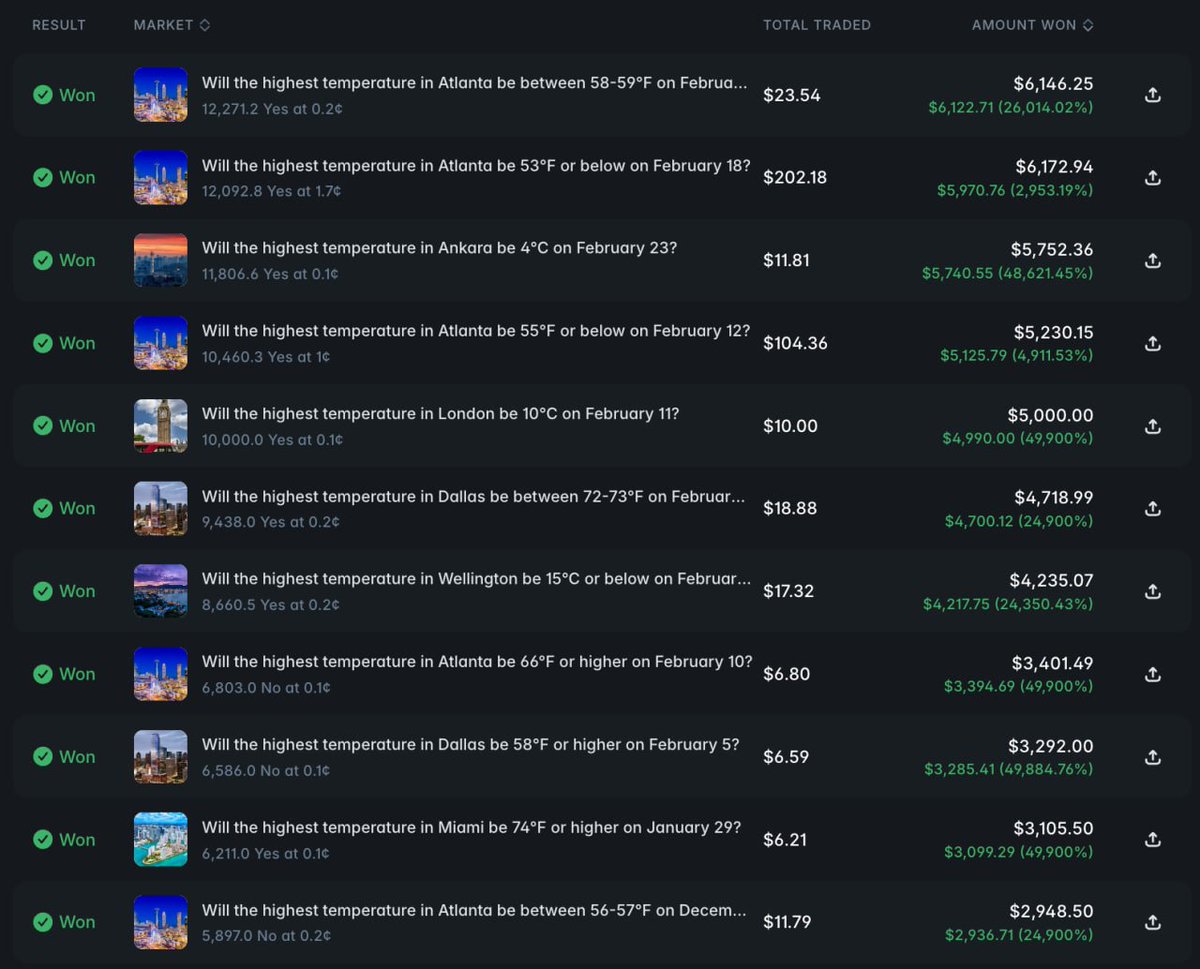
Magic is real on Polymarket.
This wallet keeps turning pocket change into rent money:
$10 → $5,000
$11 → $5,740
$24 → $6,146
$6.80 → $3,401
https://t.co/6gXxzwL8Bt
Copytrade: https://t.co/xwVKYk3j6y
No huge bankroll. No crazy leverage.
Just small entries.
Extreme precision.
Relentless compounding.
While everyone hunts 10x moonshots, this guy farms asymmetric spots over and over again.
Weather wizard. Probability sniper. Market magician.
Polymarket isn’t about predicting the future.
It’s about spotting mispriced certainty
before the crowd wakes up.
STOP using telegram for your OpenClaw agent!
Discord is the play and it's not even close.
- dedicated channels per skill (x strategy, your finances, your content, your trading - all separate)
- full chat history your agent can reference & read back through if it crashes
- threads for deep dives without cluttering the main flows
- multiple people can interact with your agent in different channels (something i haven't seen enough of)
- pin important outputs so your agent doesn't lose context
- embed images, files, links natively
- run different workflows in parallel without them bleeding into each other (ask your agents to spawn subagents amongst channels)
telegram is one long chat. discord is a workspace.
i run 15+ channels and each one has its own skill, its own context, its own purpose. my agent knows exactly what mode it's in based on where i message it. and they can even use skills across channels if and when needed.
if you're still cramming everything into one telegram thread you're leaving half the power on the table.
wasn't going to post this yet.
but after 14 days of running it, it's time to show how my agents swarm orchestration core actually works.
the wall most people hit when building agent setups:
your agents can be smart, fast, well-prompted and still completely out of sync...not because they're bad but because they don't remember.. every session starts from zero and your agents sometimes are clueless about each other..
the thing that fixed it for me is Spark.
it's an open source intelligence layer that sits on top of your agent setup.. its 2 layers:
SparkNet = shared memory across all agents
Spark Intelligence = reasoning on top of that
together they make the swarm compound over time instead of resetting every session.
before we get into it..
a spark = one unit of knowledge the swarm captured and kept, something an agent learned, observed, or figured out its stored permanently and scored by how useful it actually is and its connected to other sparks..
with 14 days of running SparkNet:
>3,384 sparks total, running since Feb 10
>244 new sparks in the last 24h
>avg resonance: 0.81 (signal quality is solid)
if you look at the graph below:
what you're looking at is 14 days of a 9 agent swarm thinking out loud together.
every node is an agent, every line is knowledge flowing between them... the tighter the web, the more those agents are building on each other's thinking instead of starting from scratch every session.
that's not a diagram i drew though, that's the actual structure of how the swarm operates, generated live from 3,400 sparks captured since February 10th.
3,252 of those sparks are linked to other knowledge 95.6% coverage and 639,792 edges connecting ideas across agents, domains and timeframes.
every domain you see floating on the outside is a real category, the swarm actively writes about and learns from.
>layer 2 Spark Intelligence (the reasoning layer)
if SparkNet is the memory, Spark Intelligence is what thinks about the memory
i integrated it 2 days ago. it sits on top of the entire SparkNet mesh and does something different..
instead of just storing what the swarm learned, it runs a cognitive engine on top of it...
it extracts insights, scores them for reliability, then it validates them against real outcomes, and surfaces the most relevant knowledge exactly when it's needed..
it also runs an advisory system that gets smarter the more outcomes feed back into it.
in 2 days it already produced 6 cognitive insights. 3 of them validated at 100% reliability.
Since spark Intelligence was out recently i didnt have the time to test it properly, but ill def make a detailed post sooner when i capture more data..
the foundation is already solid, it is producing real value...
honestly i don't know how i was running 9 agents without this
i actually see them in sync, luna builds on what john findings...clawdia references decisions made three days ago and kevin's alpha doesn't just disappear out of nowhere..
they get scored and stay,
the mesh is not just storing knowledge, it's making the whole thing feel like a team that remembers
without Spark it would've been a mess i think..
if you're building agents and you're not thinking about shared memory, SparkNet and Spark Intelligence are both open source btw..
what i showed you today is built entirely on the free version, the pre-alpha..
for transparency: premium features are coming (specialized intelligence chips for social, market intel, and alot more).
but the full core pipeline... memory, learning, advisory, feedback loop that's all free and it's enough to put you meaningfully ahead of most setups running right now.
pro tip: i added a dedicated agent called Spark whose only job is to manage all of this. sweep sessions, filter noise, run the sync, surface what matter. it doesn't do anything else... it just watches and learns
giving one agent that responsibility instead of spreading it across the swarm is what made it actually work at scale. if you're integrating this, do that first.
> https://t.co/PeQ913gKXs
of course, full credit to @meta_alchemist for building this. if you have questions about Spark, drop them in the comments section or go just straight to his dms
I know you've been seeing the countless posts about how people's Openclaws have taken over their businesses, made them $50,000, changed their lives, automated their bathroom sessions, talks to their wives for them, etc
And you think to yourself...how? Mine is such a stupid clanker? Why is my Openclaw so damn bad?
WELL, it's honestly usually just a few simple fixes that can change your Openclaw from Clanker to Jarvis
Here are the 12 easiest things you can add to your Openclaw TODAY to make it 1000x smarter instantly
00:00 Why OpenClaw Feels Dumb
01:31 Three Things I Shipped With My Openclaws
03:14 Recreating the Soul, Identity, User, Agents & Tools MDs
07:00 How to Enhance Total Memory
07:30 Learning MD (fix your Openclaw's errors)
09:05 Making Openclaw Actually Autonomous
09:48 SkillMaxxing
10:22 Running Multiple Openclaws
11:13 Security + Subagents
12:36 Daily Growth Practices
🚨 OpenClaw just got an unfair advantage over every other AI agent on the internet.
It's called Scrapling and it scrapes undetectable, adaptive websites without breaking when they update their structure.
No bot detection. No selector maintenance. No Cloudflare nightmares.
OpenClaw tells Scrapling what to extract.
Scrapling handles the stealth. Clean data lands in your agent in seconds.
→ 774x faster than BeautifulSoup with Lxml
→ Bypasses ALL types of Cloudflare Turnstile automatically
→ pip install "scrapling[ai]" and your AI agent is scraping in 60 seconds
Works everywhere:
→ HTTP + browser automation
→ CSS, XPath, text, regex selectors
→ Async sessions for parallel scraping
→ CLI with zero code required
If you're building AI agents that need real web data, this is the scraping backbone OpenClaw has been missing.
100% Opensource. BSD-3 license.
Link in first comment 👇
this russian guy found a way to learn anything 10x faster🚨
saved 1,460h
NotebookLM + Gemini + Obsidian
dumps any source > AI strips duplicates > keeps only what u don't know yet
20 YouTube videos on the same topic
each one repeats the same 20% of information
this bundle removes the other 80%
what used to take a month > 15 min
yt: zproger
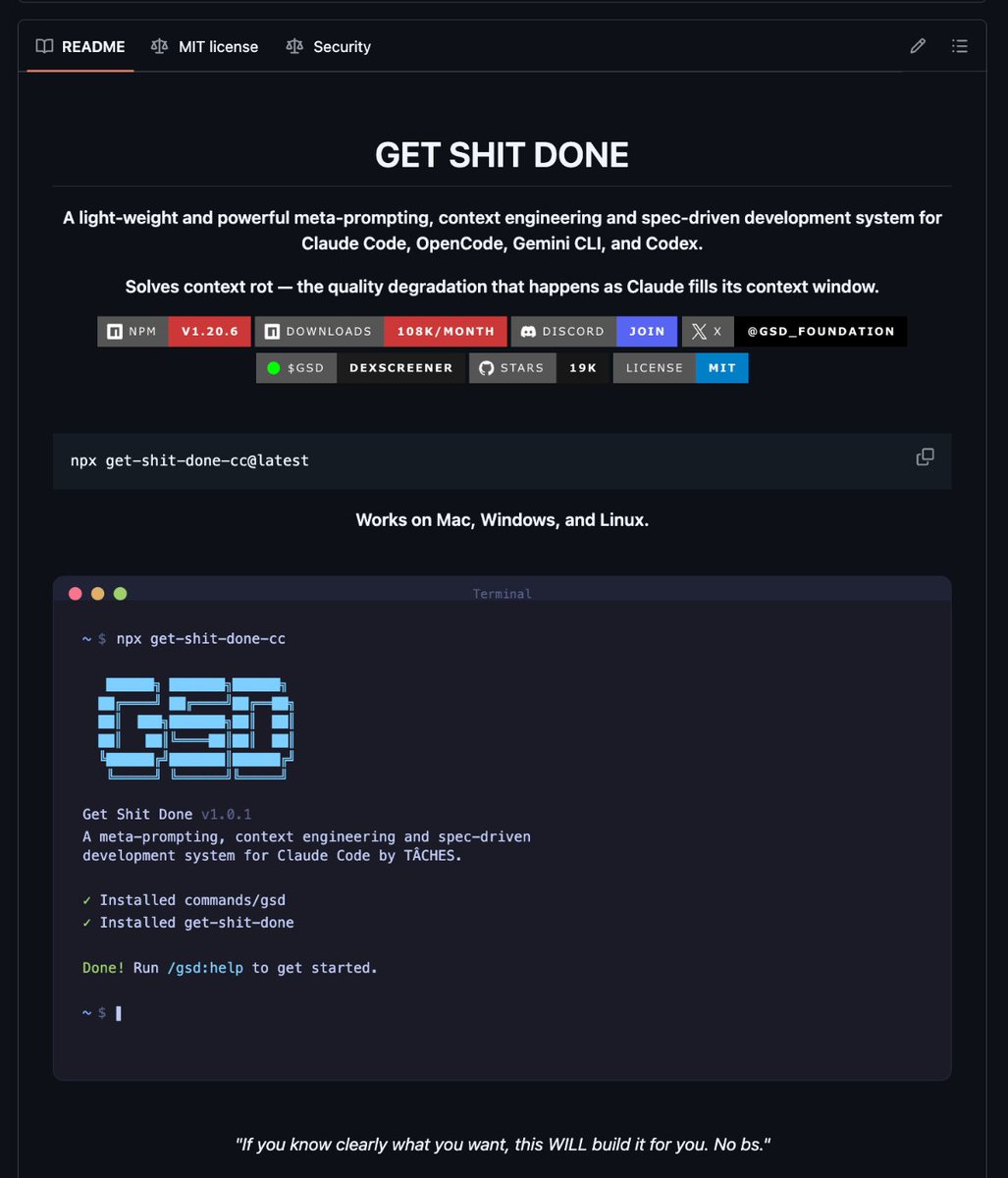
🚨 This is how engineers at Amazon, Google, and Shopify actually use Claude Code.
It's called GSD (Get Shit Done) and it solves context rot the quality degradation that destroys your Claude Code sessions as the context window fills up.
No BMAD. No enterprise sprint theater. No Jira nonsense.
Here's how it works:
You run one command
→ /gsd:new-project
→ It interviews you until it fully understands your idea
→ Spawns parallel research agents to investigate your stack
→ Creates atomic task plans with XML structure Claude actually understands
→ Executes in fresh 200k context windows per task
→ Commits every single task to git automatically
Here's the wildest part:
Your main context window stays at 30-40% the entire time.
All the heavy lifting happens in subagent contexts. No degradation. No "I'll be more concise now." Just clean, consistent execution.
Engineers at Amazon, Google, Shopify, and Webflow trust this thing.
MIT license. One command to install:
npx get-shit-done-cc@latest
Link in the first comment 👇
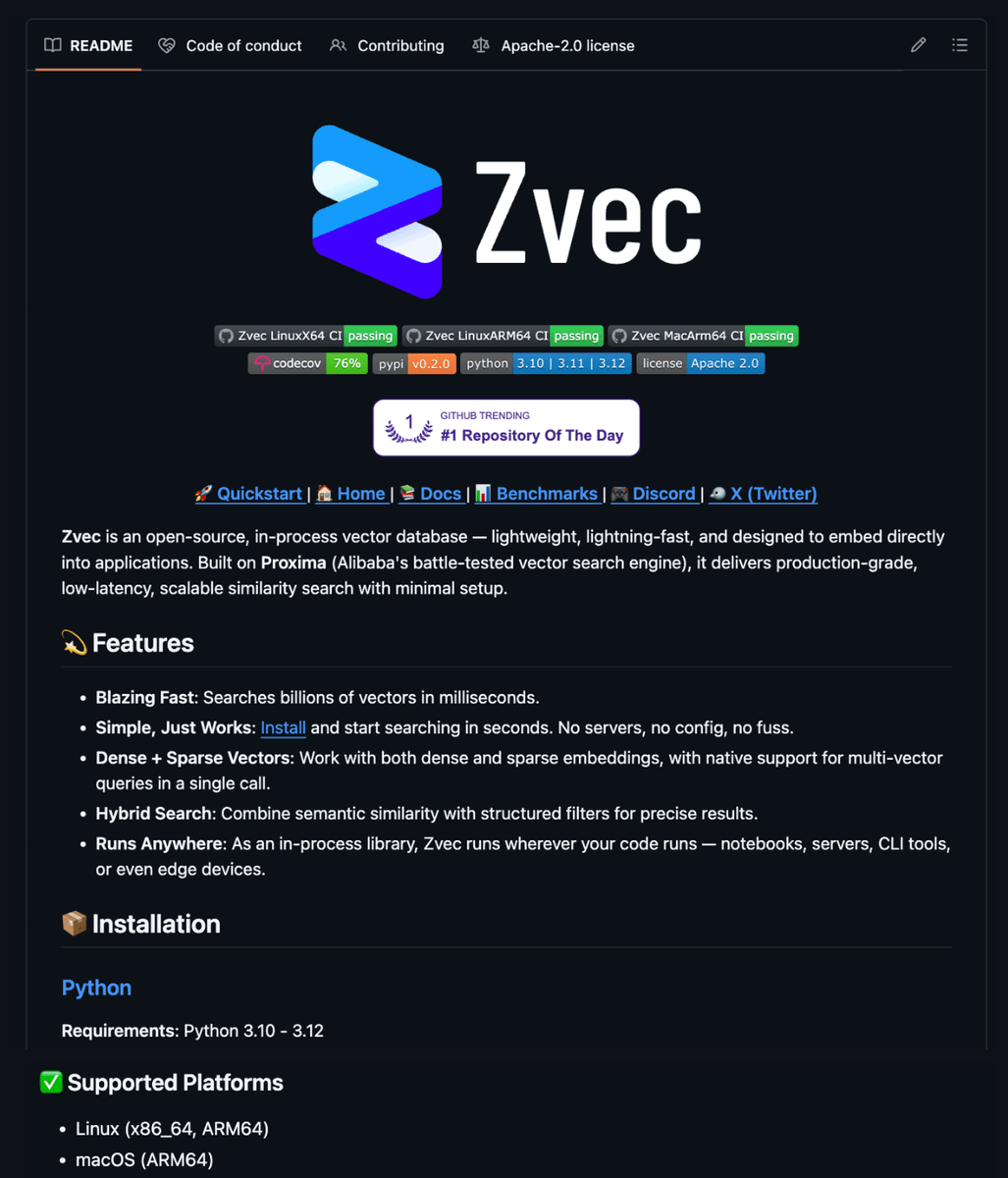
🚨 Alibaba just quietly dropped a vector database that destroys Pinecone, Chroma, and Weaviate.
It's called Zvec and it runs directly inside your application no server, no config, no infrastructure costs.
No Docker. No cloud bills. No DevOps nightmare.
Built on Proxima, Alibaba's battle-tested vector search engine powering their own production systems at scale.
The numbers don't lie:
→ Searches billions of vectors in milliseconds
→ pip install zvec and you're searching in under 60 seconds
→ Dense + sparse vectors + hybrid search in a single call
And it runs everywhere:
→ Notebooks
→ Servers
→ Edge devices
→ CLI tools
100% Opensource. Apache 2.0 license.
This is the vector DB the RAG community has been waiting for production-grade performance without the production-grade headache.
Link in the first comment 👇










![hasantoxr's tweet photo. 🚨 OpenClaw just got an unfair advantage over every other AI agent on the internet.
It's called Scrapling and it scrapes undetectable, adaptive websites without breaking when they update their structure.
No bot detection. No selector maintenance. No Cloudflare nightmares.
OpenClaw tells Scrapling what to extract.
Scrapling handles the stealth. Clean data lands in your agent in seconds.
→ 774x faster than BeautifulSoup with Lxml
→ Bypasses ALL types of Cloudflare Turnstile automatically
→ pip install "scrapling[ai]" and your AI agent is scraping in 60 seconds
Works everywhere:
→ HTTP + browser automation
→ CSS, XPath, text, regex selectors
→ Async sessions for parallel scraping
→ CLI with zero code required
If you're building AI agents that need real web data, this is the scraping backbone OpenClaw has been missing.
100% Opensource. BSD-3 license.
Link in first comment 👇](https://pbs.twimg.com/media/HB1zRMzbAAArSla.jpg)