@EliasNahB@piersmorgan In India double standard works differently, if anyone jokes about muslims there throat is cut but muslims jake on Hindus openly without any repercussions
@SilentThe41134 Another issue is the producers have mentioned that they incorporated parts of different versions of Ramayana not just the Valmiki Ramayana, not sure Ravana has a bigger role in any of those versions
@InvestRepeat Yes, wait and see. Revenue increased due to crack down on sharing passwords but reports suggest that people accessing the app, watching have reduced
This is Taylor Perkins explaining Sanatan Dharma to western audiences
One thing I live about US education system is their communication skills they learn in school
Look how easy he makes for closed minded monotheistic people understand Hindu culture and thought
@SouravSenguptaI@deepigoyal Lot of builders in India, bakthi is fine, andh bhakti is a problem. Yes he built it doesn't mean he should be arrogant. Taking criticism is part of the game
@deepigoyal Indians are intelligent and many have lot of disposable income now. Ur high price is not the issue, if it works and solves a problem people will buy. Good luck internationally. Some humility is wanted
The Dance of BamaKali.
We don’t celebrate Halloween and petty ghosts.
We celebrate Maa Kali, who is Devi of time, death, destruction, and ultimate liberation (moksha). Her very name comes from the Sanskrit word Kala, which means ‘time.’ As time consumes all things, Maa Kali represents the force that devours the universe, destroys illusions, and ends cycles.
#LestWeForget
The Kothari Brothers Ram Kumar(23) and Sharad Kumar(20) were killed in police firing at Ayodhya on this date in 1990.
The brothers had grown up in Kolkata and were associated with the RSS. When the call for Kar Seva went out, they decided to travel to Ayodhya to participate in the Ram Janmabhoomi movement.
Their father, Hiralal Kothari, was initially reluctant to let them go. Their elder sister Purnima was getting married in December, and the boys promised they would return in time for the wedding.
They left home on October 22, 1990.
With railway services disrupted and roads blocked, they eventually travelled nearly 200 kilometres on foot to reach Ayodhya on October 30.
That day, they were among the Kar Sevaks who reached the disputed structure and hoisted a saffron flag on its dome.
Two days later, on November 2, tragedy struck.
During the second round of police firing, both brothers were killed. Accounts of the circumstances of their deaths describe police firing and the alleged killing of the brothers after they had taken shelter in a house.
Their bodies were subsequently recovered near Hanuman Garhi.
They never returned home. They never attended their sister's wedding.
Their deaths became an important rallying point for the Ram Janmabhoomi movement, and their names continued to be remembered by its supporters.
Years later, their sister Purnima would speak about the loss and the long wait to see the Ram Temple become a reality.
Two brothers, aged 23 and 20, who left home promising to return for a family wedding, but whose journey ended in Ayodhya.
It's countless sacrifices like these that stand behind the Ram Mandir in Ayodhya today. Hindus owe a debt of gratitude to them.
☎️ Calling all students:
You can now access hundreds of textbooks directly in Notebook, for no charge. From publishers like S Chand Publishing, OpenStax, and Open Textbook Library— browse, select and upload them as sources to ace all of your upcoming exams (no more excuses, ok?)
As a neurosurgeon, let me tell you how frightening this injury actually is - an occipital compound depressed skull fracture treated with a WIDE craniotomy (outer staple line).
What's scary isn't the fracture; it's what's adjacent to the damaged skull. The axe blows (that tree-branch scar at the center) hit right over the posterior superior sagittal sinus, a large vein that runs lengthwise between the 2 cerebral hemispheres and carries blood from the brain to the heart.
Penetrating injuries to the sinus can carry upwards of a 40% morbidity/mortality - partially because a transection of the sinus can be difficult to repair and can result in extreme blood loss, venous air embolism, or thrombosis - all of which can be fatal.
There's scary, and then there's the "you go to elevate the fracture and risk unroofing the sinus, losing 2 liters of blood in a minute" scary.
The surgeons likely had their hands full and did an amazing job. Divine providence called many heroes into service that day. Damn fine work.
धन्यवाद
UAE President confers top Emirati award First Class Order of Zayed II for captain Smit Machchhar who averted the hijacking, terror attack on Fly Dubai plane. Honor presented by Crown Prince of Dubai Hamdan bin Mohammed.
This is probably the best tweet you will read today.
A kid who was bad at maths, rejected by 25 universities and turned down by DeepMind three times, went on to build the software that OpenAI, Tesla and Meta now use to train their AI.
His story is the best argument I've seen for never ever quitting.
He grew up in Hyderabad (India), struggled with maths at school, and ended up at VIT in Vellore. VIT is a kind of college people call tier 2 in India, or probably worse.
He applied to twelve American universities for a master's with a GRE score of 1420 and was rejected by every one of them. He flew to the United States anyway on a J-1 visa with no real plan, applied to fifteen more programmes, and was turned down by all of them except USC and, through a late admission, NYU in 2010.
At NYU he started working with a researcher named Yann LeCun. Yes the same legendary researcher you’re thinking about. When he looked for jobs, the rejections kept coming. DeepMind said no. Almost everyone said no. His only offer was a test engineering role at Amazon.
Later, he applied to deepmind again, but was rejected again.
He kept building anyway. Around 2011 he wrote one of the fastest AI inference engines on phones, and still got rejected by DeepMind a third time, and then emailed LeCun one more time.
That email, along with his open source work, got him into Facebook's AI research lab, where he barely made it through bootcamp. Then senior engineers several levels above him couldn't get a major image model to train, and he, the most junior person in the room, found the bug that had everyone stuck. It was his first real win, almost ten years in.
He went on to co-create PyTorch with a team of three, and then watched management try to shut it down over internal politics. He has said he cried at a bar about it. A few people fought to save it, it launched in 2017, and today it sits underneath a huge share of the AI the world uses.
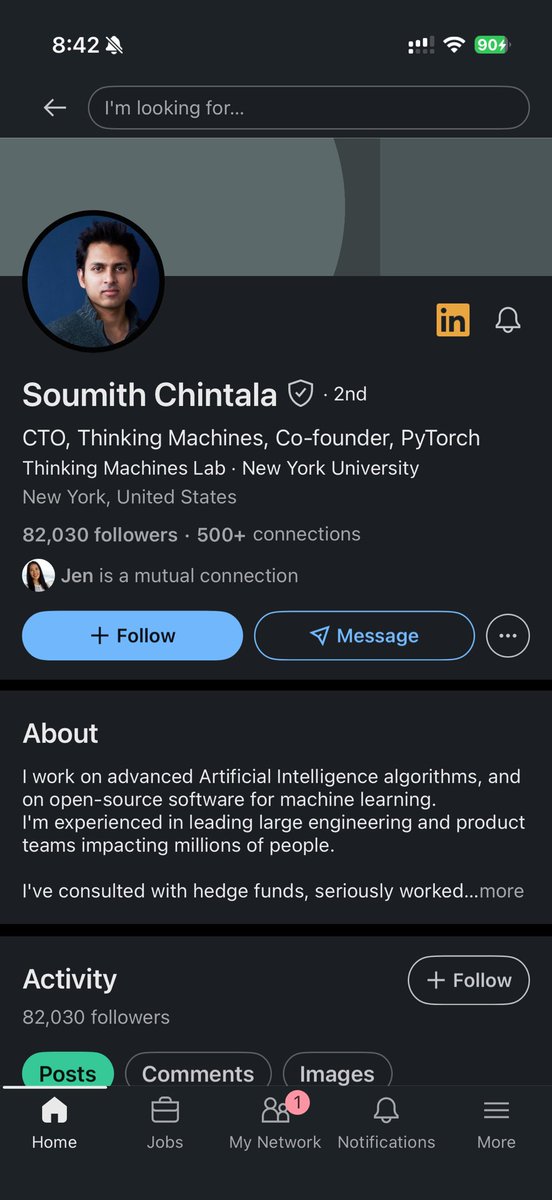
His name is Soumith Chintala.
Today he is Chief Technology Officer at Mira Murati led Thinking Machines Labs.
When the going gets tough. The tough gets going.
source - @autumn_ai_inc