The process of discovery involves the violation of established axioms and principles such that human inventiveness replaces derivation. Years later, retroactively applied rigor teaches the discovery in reverse, as if logical application of known fundamentals led to it. The excitement gets lost, along with the stress and celebration, and most importantly, what is forgotten is the reluctance to transition from the old ideas to the new with all the heartache caused by change. The bumpiness of this process is what I tried to capture in the book Seeking Infinity: A Desperate Hunt for New Applied Math by Paul C Daiber.
@MichaelDzioba@ChrisMartzWX I had this argument with some of my friends, and my answer is:
even a pile of shit has a top.
The "elite" of it, if you want.
So, the "elite" in this context is not about "quality", but about "positioning".
HR: We lost another senior employee today.
CEO: What happened?
HR: He resigned after receiving an external offer.
CEO: That makes no sense. We could have matched it.
HR: That is the issue. We were willing to pay a stranger 70% more for the same role, but would not give our existing employee even a 20% raise.
CEO: External hiring is different. That is market pricing.
HR: He noticed that too.
CEO: We appreciated his loyalty. He had been here for years.
HR: Yes. And during those years, he consistently exceeded expectations while being told to “wait for the next review cycle.”
CEO: But budgets are complicated for internal employees.
HR: Apparently not for external candidates. The new hire budget was approved in three days. His raise request sat for eight months.
CEO: We had to stay competitive in the hiring market.
HR: He was part of that same market. The only difference is that another company valued him before we did.
CEO: So he left over salary?
HR: Not just salary. He left because he realized loyalty was being rewarded less than leaving.
CEO: That is unfortunate.
HR: Yes. Companies will sometimes trust a candidate after a 45-minute interview more than an employee who already proved themselves for five years.
CEO: So what are you saying?
HR: If companies only recognize employee value after a resignation letter appears, then eventually employees will stop waiting to be appreciated internally.
Sometimes the fastest way for an employee to get market value is to stop being your employee.
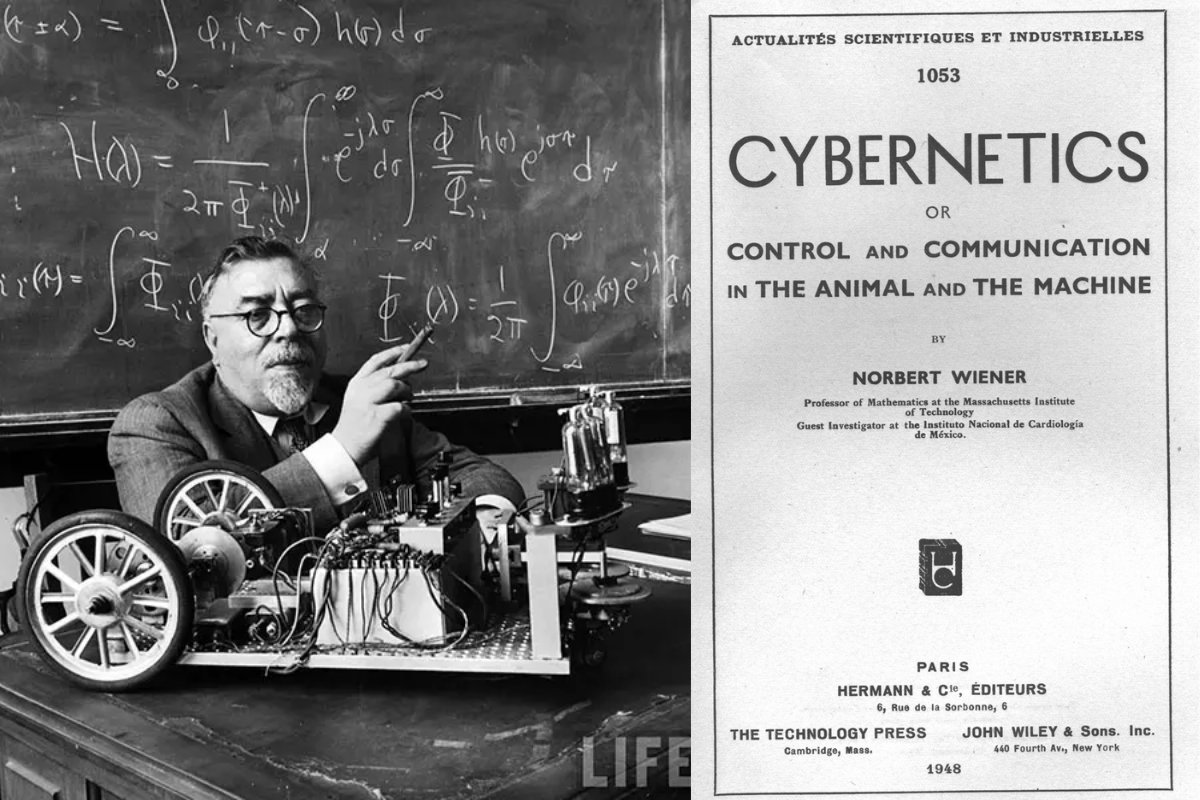
A child prodigy who finished his Harvard degree at 14 and his PhD at 17 sat down in 1948 and wrote a single book that invented the entire conceptual vocabulary we still use to talk about AI, robotics, self-driving cars, and reinforcement learning.
He never got the credit. Most people have never heard his name.
His name was Norbert Wiener. The book was called Cybernetics.
Every feedback loop running inside every system you interact with today traces back to one problem he was handed during World War II.
The problem was this: how do you aim a gun at a fast-moving airplane?
By the time your shell arrives, the plane is somewhere else. You cannot aim at where the plane is. You have to aim at where the plane will be. And the plane's pilot, knowing this, is constantly changing course to make that prediction wrong.
Wiener spent years on this. What he built to solve it was not a better gun. It was a new science.
He noticed something that nobody had formally described before. The gun system and the human nervous system were solving the same problem using the same method. You observe where the target is. You compare it to where you want to hit. You calculate the gap. You correct. You observe again.
He called that loop feedback.
Not in the casual sense people use it today. In the precise mathematical sense. A signal goes out. The result comes back. The system compares the result to the goal. The gap between them drives the next action. The loop closes.
That mechanism, exactly as Wiener described it in 1948, is what runs inside every thermostat, every autopilot, every cruise control system, and every AI training loop on the planet right now.
When GPT-4 learned to answer questions better, it was doing feedback. When AlphaGo learned to play Go, it was doing feedback. When a self-driving car adjusts its steering because it drifted two inches toward the curb, it is doing feedback.
The word they all use, the concept underneath the word, the mathematics formalizing the concept, all of it came from one book written by a child prodigy in 1948 who was trying to figure out how to shoot down a plane.
The deeper insight was what he proved about living systems and machines.
Before Wiener, biology and engineering were treated as completely separate domains. Organisms adapted. Machines calculated. The idea that you could describe both using the same mathematical framework was not just unusual. It was considered a category error.
Wiener proved it anyway.
He showed that a brain correcting a reaching movement and a missile correcting its trajectory were running mathematically identical control loops. The hardware was different. The math was the same. Living systems and engineered systems obeyed the same laws once you understood what those laws actually were.
He named the field after the Greek word for steersman. Kubernetes. Cybernetics. The person who holds the rudder, reads the water, and adjusts constantly to hold a course through a current that is always pushing the ship somewhere else.
That is the mental image he wanted. Not a machine that executes instructions. A system that responds to its own results.
The third thing he did is the part almost nobody connects to modern AI.
In 1948, Wiener spent an entire chapter of Cybernetics warning about what would happen when machines that learn from feedback were given control over consequential decisions.
He described the displacement of workers not as a distant possibility but as a near-term certainty. He wrote about the ethical risks of building systems that optimize for measurable proxies of human values rather than actual human values.
He described in plain language what alignment researchers today call Goodhart's Law without using that name, 25 years before Charles Goodhart published anything.
He was a mathematician in 1948 writing about problems that AI safety researchers are still trying to solve in 2026.
The book is dense in places. The equations are real and the sections on statistical mechanics require actual attention. But Wiener knew this, which is why in 1950 he published The Human Use of Human Beings, which is the same book with all the math removed. Same ideas. Same warnings. Written for anyone who reads English.
That second book has been in print for 75 years and almost nobody in tech has read it.
Wiener died in 1964 at a conference in Stockholm. He collapsed mid-conversation between sessions. He was 69.
He did not live to see a personal computer. He did not live to see the internet. He never saw reinforcement learning, neural networks, or the AI systems that run almost entirely on the mathematical architecture he designed while trying to solve a World War II gunnery problem.
Every AI lab in the world today is building systems that run on his framework. Almost none of the people building those systems know his name.
The field he founded, cybernetics, mostly disappeared as a word. The ideas did not disappear. They dissolved into every other field. Control theory. Cognitive science. Computer science. Neuroscience. AI. They each took a piece of what he built and called it their own terminology.
The word that survived is the one that proves he invented it.
Feedback.
You use it every day. You use it in code reviews, in meetings, in conversations about AI performance. Every time you use it in the technical sense, meaning a signal that closes a loop between output and goal, you are using the exact definition Wiener wrote down in 1948.
He gave the word its meaning. Most people using it have never heard of him.
The Human Use of Human Beings is free on archive. Cybernetics is in print and available anywhere books are sold. His major essays are in academic archives at no cost.
The man who built the foundation of modern AI was writing about its dangers before the first commercial computer existed.
Most people building AI today have never read a word he wrote.
Developer productivity is often measured in output: lines of code, number of commits, features delivered. With AI tools accelerating production, these metrics become even more tempting to rely on.
But output is not productivity. Writing more code faster doesn’t mean building better systems. In many cases, it increases complexity and future maintenance costs. True productivity is the ability to reduce unnecessary work, not to produce more of it.
Healthy skepticism is not anti-science.
It is the foundational mechanism of science. The entire process depends on people saying "I don't believe you, prove it again, under different conditions, with different funding, and publish all the trials including the ones that failed."
When someone tells you to trust the science without asking which science, funded by whom, with what endpoints, in what population, over what timeframe, with what conflicts of interest declared, they are not asking you to be scientific. They are asking you to be credulous.
The history of medicine is not a history of steady, uninterrupted progress confirmed by infallible experts. It is a history of confident wrong turns, slow corrections, and the occasional catastrophic error that got a lot of people killed before anyone admitted the problem.
The doctors who were right were usually in the minority for a while first.
That doesn't mean the minority is always right. But it does mean the consensus has earned a fair amount of scrutiny.
Ask for the evidence. Ask who funded it. Ask what the absolute risk reduction is, not the relative risk reduction. Ask how long the study ran, and what happened after it ended.
If this makes the appointment uncomfortable, that's informative.
In general, if you need to change a test because you changed the code, you didn't have a test at all. The whole _point_ of a test is that, when I make a change, I want to run the test to see if I've broken anything. A good test works both before and after the change. If I have to change the test, too, I've proven nothing. Any test that knows how the code works (as compared to what the code does) is fundamentally flawed.
I hear a lot about using an LLM not only to write code but also to write tests. I've rarely seen that work. IME, the LLM-generated tests are too fragile and test the wrong things (the implementation, not the intent).
People talk about spec-driven design, but the best spec you can have is a test—a test you write before you write the code. You don't write a test to see if the code adheres to a spec. The test IS the spec. Don't write specs. Write tests.
In 2026, we have CPUs with billions of transistors and 2-nanometer architecture, yet it takes your laptop longer to open a basic "To-Do" app today than it took a computer in 1995 to launch a word processor.
This is Wirth's Law: Software is getting slower more rapidly than hardware becomes faster. We have essentially "spent" all our hardware gains on layers of abstraction, unoptimized libraries and AI-generated code bloat
@VinodBhardwajUS@Electroversenet "Preindustrial era" levels of CO2 means preindustrial era level of development.
Not 1800s level. PREindustrial level. Let that sink in.
(no, wind and coal are not near to provide the level of energy and raw materials needed (is not only about electricity generation))
@Piticigratis Tot mai multe legi care încercând să protejeze, vezi doamne, o minoritate abuzată, stârnesc prin discriminările fățișe iritarea și chiar ura mocnită a unor mase de oameni care nu aveau ABSOLUT NIMIC, niciodată, cu categoriile "protejate".
Un exercițiu în dezbinare.
Contrary to popular belief, Christopher Columbus did not prove the Earth was round when he sailed west in 1492. Ancient Greek scholars like Eratosthenes had calculated Earth's circumference around 240 BC, and educated Europeans throughout the Middle Ages accepted the planet's spherical shape. Medieval universities taught spherical Earth geography, and sailors understood basic celestial navigation that relied on this knowledge. The real dispute surrounding Columbus's voyage wasn't about Earth's shape—it was about its size.
Columbus believed he could reach Asia by sailing west across the Atlantic, but he drastically underestimated the distance. He calculated Earth's circumference at roughly 18,000 miles when the actual figure is nearly 25,000 miles. Spanish scholars correctly argued that no ship could carry enough supplies for such a journey, which is precisely why they initially rejected his proposal. Columbus only succeeded because an unknown landmass—the Americas—happened to lie in his path. Had the continents not existed where they did, his crews would have perished long before reaching Asia.
The "flat Earth" myth emerged centuries later during the 19th century, when writers like Washington Irving romanticized Columbus's story to portray him as an enlightened hero battling ignorant medieval superstition. Irving's 1828 biography depicted Columbus defending Earth's spherical shape against church officials who supposedly believed in a flat world—a scene Irving invented entirely. This fictional narrative served contemporary cultural purposes, positioning modern science against supposedly backward religious thinking, but it had no basis in historical fact.
The myth persisted because it offered a compelling story about progress triumphing over ignorance. Textbooks repeated the tale for generations, and it became embedded in popular culture. The truth—that Columbus was wrong about his calculations while his critics were essentially correct—makes for a less satisfying narrative. Medieval scholars were far more scientifically sophisticated than the myth suggests, and Columbus's success resulted from fortunate accident rather than superior knowledge.
Understanding this historical reality matters because the flat Earth myth distorts both medieval intellectual achievement and the nature of Columbus's voyage. It perpetuates false narratives about the "Dark Ages" and obscures the actual controversies surrounding Columbus—his treatment of indigenous peoples, the consequences of European colonization, and the exploitation that followed. The real history is more complex and more troubling than the simplified myth of a lone visionary proving basic geography.
#archaeohistories
@Kekius_Sage Science is about knowing things that already exist (predictions are about existing patterns).
Art is about creating things that don't exist yet.
However, there is no dichotomy but an overlapping with its own dynamic.