🗿 When the Past Looked Back at Us
Unearthed from the soil of Egypt, this broken granite statue is more than just stone—it’s a moment frozen in time. Carved nearly 3,000 years ago, during an age when Egyptian art was at its peak, this figure once stood proudly in a sacred space. The reddish granite, hard and enduring, was chosen to last forever… and in many ways, it has.
Look closely and you can still feel its presence. The traditional headdress hints at power and purpose—perhaps a high official, a priest, or even a god honored by thousands. Its surface is worn and stained, marked by centuries of burial beneath Nile sediments and rising cities. Every crack tells a story of time passing quietly above it.
What makes this discovery unforgettable is the contrast. Ancient calm meets modern hands. The statue’s silent, steady expression faces a world it never knew—machines, tools, people rushing to uncover it. For a brief moment, it feels as if the past is breathing again.
This is why archaeology matters. Not just to study history—but to feel it. To be reminded that long before us, others stood here, believed deeply, built boldly, and trusted that stone could carry their memory forward.
And sometimes… it does.
𝐅𝐢𝐛𝐫𝐨𝐦𝐲𝐚𝐥𝐠𝐢𝐚: 𝐄𝐝𝐮𝐜𝐚𝐭𝐢𝐨𝐧 𝐚𝐧𝐝 𝐒𝐞𝐥𝐟-𝐂𝐚𝐫𝐞
Given that patients may believe that pain always involves observable tissue damage or inflammation, reassurance that pain can also be related to problems with central nervous system (CNS) processing is often needed. Patient education includes messaging that fibromyalgia is chronic and noncurable but manageable and not life threatening, that treatment focuses on calming and resetting a hypersensitive CNS, and that nonpharmacologic self-care strategies play an important role in promoting health.
Pain self-care occurs outside the medical office, in the context of family, friends, and community. Self-management strategies are health-promoting lifestyle changes that can increase positive affect and calm CNS hypersensitivity (seen in figure). Because each strategy involves the formation of a new habit, consistent use of the strategy is needed to produce the desired benefits. Encouragement from the provider team at follow-up visits can help with habit formation and self-care maintenance. A meta-analysis of randomized, controlled trials that examined many different self-care interventions for managing fibromyalgia supports the use of self-care in reducing pain, increasing functioning, and modulating mood over the short and long terms.
Learn more in the Clinical Practice article “Fibromyalgia” by David A. Williams, PhD, and Daniel J. Clauw, MD: https://t.co/R8F2hC2bQL
Fibromyalgia is characterized by widespread pain involving any body tissue and typically accompanied by fatigue and problems with sleep, mood, and memory. Although fibromyalgia is rarely curable, most cases can be well managed in the context of primary care. Learn more: https://t.co/R8F2hC2bQL
Sweden is reintroducing printed books and handwriting into its classrooms. Once celebrated as a leader in digital education, the country is now directing significant resources toward traditional textbooks while limiting the use of tablets and screens, particularly for young students.
Swedish authorities attribute this policy shift to mounting evidence that excessive screen time may have harmed reading proficiency and basic skill development. The government has also announced plans to ban digital learning tools for children under six years old.
Scientific research on handwriting provides insight into the rationale. When children write by hand, they engage multiple brain areas responsible for motor control, visual processing, memory, focus, and language. Unlike typing, this process demands precise coordination of fine movements alongside letter recognition and word formation. Studies indicate that such multisensory engagement enhances letter knowledge, spelling, reading acquisition, and memory retention.
Printed books may similarly promote stronger comprehension. Research shows that people often retain information more effectively from physical pages than from digital displays. The tangible nature of paper offers spatial references that aid memory organization. In contrast, screen based reading, especially when interrupted by notifications or hyperlinks, can fragment attention and reduce deep focus.
This approach does not reject technology entirely. Computers and tablets continue to serve important roles in research, group projects, accessibility features, and interactive exercises. Education specialists emphasize the need for thoughtful integration, applying digital resources where they prove most effective while safeguarding core practices such as handwriting, printed materials, and direct teacher instruction.
Sweden's policy change mirrors growing international discussions about optimal screen time in schools. As educators worldwide evaluate the benefits and drawbacks of digital tools, many are reconsidering when traditional methods may better support fundamental learning.
The image shows a black granite Egyptian stela being documented after recovery, likely from the submerged ancient port city of Thonis-Heracleion in the Nile Delta. Such stelae date to the Late Period, particularly the Ptolemaic era (c. 4th–2nd century BCE), when royal decrees were carved and displayed in temples across Egypt.
The rounded top is crowned with a winged sun disk, symbolizing divine protection, while below are registers of deities and dense columns of hieroglyphic text recording official proclamations, religious reforms, or tax regulations. The polished surface and deep carving reflect elite craftsmanship in hard stone.
Emotionally, the scene is powerful: a monument meant to speak eternal law now re-emerges from the sea, reminding us how history can be lost, submerged, and rediscovered—its voice restored after centuries of silence beneath the water.
This Ancient Tomb Feels… Alive 😳
Hidden in the hills of Cortona, there is a place where time doesn’t just pass… it lingers.
At first glance, the Tanella di Pitagora looks like nothing more than an old stone structure. But the moment you step inside, everything changes. The air turns cool. The light fades. And suddenly, the silence feels… heavy.
Massive blocks of sandstone rise above you in a strange, stepped pattern, almost like they were placed with a secret code. This tomb was built over 2,000 years ago by the mysterious Etruscans—long before the rise of Roman Empire. And yet, it still stands, untouched by time, as if it was never meant to fall.
As you walk deeper into the narrow corridor, your footsteps echo in a way that doesn’t feel empty… but remembered. It’s said that ancient mourners once gathered here, performing rituals we still don’t fully understand. Some even believe the structure holds a hidden mathematical design, linked to the legendary philosopher Pythagoras—though no one has ever proven it.
Look up, and you’ll see a thin crack of sky above you. Just a sliver. It feels like the only connection left between our world… and theirs.
And that’s when the thought hits you:
Was this place built just to honor the dead…
or to keep something from ever leaving? 👁️
Mel Gibson "They found the BIGGEST Pyramid in the World"
“All the pyramids in Tikal would fit inside the one big pyramid in El Mirador.”
“Yeah. It’s a monster… and it is literally the biggest pyramid in the world. Bigger than the ones in Egypt.”
Mel was telling Joe Rogan about the hidden pyramid deep in the Guatemalan jungle.
La Danta, located within the ancient Maya city of El Mirador in northern Guatemala, is considered one of the largest pyramids in the world by total volume.
This massive Preclassic Maya structure boasts a total volume of roughly 2.8 million cubic metres, making it even more massive than the Great Pyramid of Giza by volume, despite being shorter in height.
Australia is using 3D printed ceramic blocks to help restore damaged coral reefs and support marine life threatened by climate change.
The Australian nonprofit organization Reef Design Labs has made significant progress in marine conservation by installing the Maldives first 3D printed artificial reef. Under the leadership of entrepreneur Alex Goad the team employs the Modular Artificial Reef Structure system known as MARS. This system consists of hollow ceramic blocks that divers can assemble quickly by hand underwater. The blocks are engineered to replicate the intricate shapes of natural reefs providing a stable foundation for attaching coral fragments and creating shelter for fish and other sea creatures.
Although this technology cannot fully reverse ocean acidification or large scale coral bleaching it offers a practical and scalable method for targeted reef restoration. Each installation also functions as an underwater research laboratory enabling scientists to study heat resistant coral species and improve transplantation techniques.
As ocean temperatures continue to rise this innovative community oriented approach provides a promising way to rebuild essential marine habitats block by block.
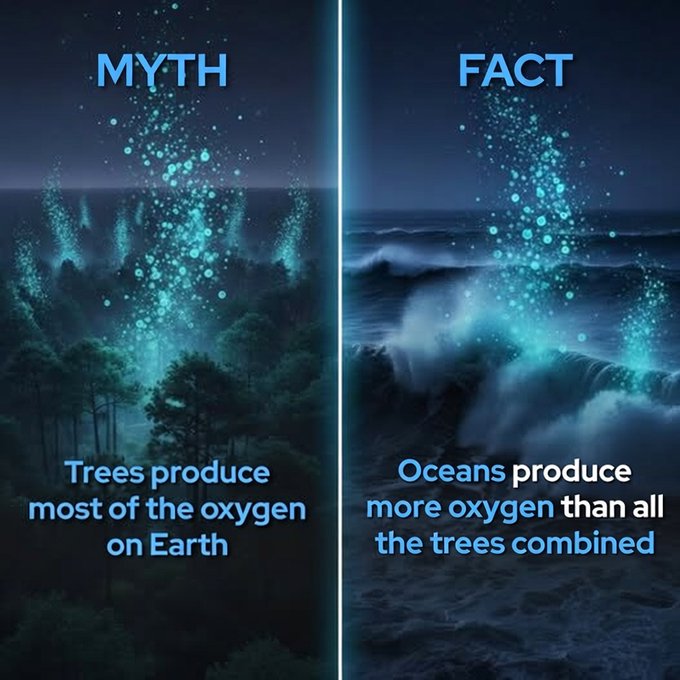
Every second breath you draw comes from the ocean.
While forests are frequently hailed as the “lungs of the Earth,” they are not the main source of our planet’s oxygen. That distinction belongs to the ocean—specifically to the countless trillions of microscopic marine organisms drifting in its sunlit upper layers.
Phytoplankton, along with cyanobacteria and other tiny algae, perform photosynthesis just like land plants: they harness sunlight to turn carbon dioxide and water into energy, releasing oxygen as a byproduct.
Though individually invisible to the naked eye, these organisms are extraordinarily productive. Together, they generate an estimated 50–80% of the oxygen present in Earth’s atmosphere.
This massive oxygen factory operates across the world’s oceans, largely out of sight. From space, satellite imagery reveals their seasonal blooms as swirling, paint-like patches of color—vivid evidence of the hidden engine that keeps our air breathable. These blooms respond sensitively to shifts in sea temperature, sunlight, nutrient availability, and ocean currents; scientists continue to study how climate change and other pressures may reshape these patterns in the coming decades.
This does not lessen the vital importance of forests. Trees lock away carbon, support immense biodiversity, regulate local climates, and provide countless other benefits. But when it comes to producing the oxygen we breathe, the ocean—not the rainforest—is the dominant contributor.
In a world where wealth often defines power, a Saudi billionaire stunned everyone by donating $16 billion to charity, instantly losing his billionaire status — and gaining global admiration. The massive contribution went to health, education, and poverty alleviation programs across the Middle East and Africa.
Sulaiman bin Abdul Aziz Al Rajhi, co-founder of Al Rajhi Bank, transformed himself into a symbol of selfless generosity, proving that impact can outweigh fortune.
New research from the University of Helsinki reveals a significant connection between severe infections and increased long-term risk of dementia. Analyzing nationwide health registry data from over 375,000 Finnish adults, the study found that hospital-treated infections — including severe urinary tract infections (such as cystitis) and dental caries — were robustly associated with higher dementia incidence years later.
For individuals under age 65, certain serious bacterial infections and pneumonia roughly doubled the risk of early-onset dementia. The associations held strong even after researchers adjusted for 27 other chronic conditions, including heart disease, stroke, and mental health disorders. On average, these infections were diagnosed about five to six years before dementia was identified.
Scientists suggest that the systemic inflammation caused by severe infections may damage the blood-brain barrier, affect cerebral blood vessels, and accelerate brain changes that contribute to cognitive decline. These findings indicate that what are often viewed as temporary or localized health issues may have lasting effects on brain health.
The researchers emphasize that better prevention and prompt treatment of common infections could represent an important and underutilized approach to reducing dementia risk in the population.
[Sipilä PN, Korhonen K, Lindbohm JV, Kivimäki M, Martikainen P. The role of noninfectious comorbidities in the association between severe infections and risk of dementia in Finland: A nationwide registry study. PLOS Medicine. 2026;23(3):e1004688. doi:10.1371/journal.pmed.1004688]
LOOK CLOSER: THE WRITING IS NOT PAINTED—IT IS BUILT INTO THE BRICKWORK.
Built in 1147–48, Gonbad-e Sorkh in Maragheh uses brick as structure, ornament and script. Bricks were rotated, recessed and projected to create interlocking geometric patterns, while bands of raised Kufic inscriptions were formed with brick and terracotta elements.
The turquoise details are not paint but glazed faience pieces carefully set among the red bricks. Used only in selected areas, they sharpen the geometry and make Gonbad-e Sorkh one of the earliest surviving monuments in Iran to incorporate colored glazed decoration into its architecture.
The inscriptions record the building’s patron, architect and construction date, alongside religious texts. Nearly nine centuries later, the façade still reads like a surface woven from brick, writing, color, light and shadow.
Gonbad-e Sorkh, Maragheh, East Azerbaijan Province, Iran.
📸 elamasadi
🚨 This Ancient Cave Looks Like It Was Built by the Future… Not the Past
Hidden deep inside the rocky hills of Barabar Hills lies something that shouldn’t exist… at least not in the 3rd century BCE. The mysterious Lomas Rishi Cave, believed to be created during the reign of Emperor Ashoka, looks less like an ancient shelter—and more like a structure from a lost advanced world.
From the outside, the cave stuns with a carved entrance that perfectly imitates wooden architecture… in solid granite. An elegant curved arch, detailed carvings of elephants, and precise symmetry—everything feels too refined for its time.
But step inside… and the real mystery begins.
The walls are so incredibly smooth and polished that they reflect light like a mirror. Not rough. Not weathered. But glass-like. Even today, with modern tools, achieving this level of finish on hard stone is extremely difficult. So how did ancient craftsmen do it over 2,000 years ago?
Stand in that silent chamber, and something feels… off. The sound echoes strangely. The air feels heavy. The surfaces are cold, perfect, almost unnatural. It doesn’t feel ancient—it feels engineered.
Was this truly just a meditation space… or something more?
A lost technique? A forgotten science? Or evidence that history knows less than we think?
One thing is certain:
This cave doesn’t just tell a story—it asks a question we still can’t answer.






![Rainmaker1973's tweet photo. New research from the University of Helsinki reveals a significant connection between severe infections and increased long-term risk of dementia. Analyzing nationwide health registry data from over 375,000 Finnish adults, the study found that hospital-treated infections — including severe urinary tract infections (such as cystitis) and dental caries — were robustly associated with higher dementia incidence years later.
For individuals under age 65, certain serious bacterial infections and pneumonia roughly doubled the risk of early-onset dementia. The associations held strong even after researchers adjusted for 27 other chronic conditions, including heart disease, stroke, and mental health disorders. On average, these infections were diagnosed about five to six years before dementia was identified.
Scientists suggest that the systemic inflammation caused by severe infections may damage the blood-brain barrier, affect cerebral blood vessels, and accelerate brain changes that contribute to cognitive decline. These findings indicate that what are often viewed as temporary or localized health issues may have lasting effects on brain health.
The researchers emphasize that better prevention and prompt treatment of common infections could represent an important and underutilized approach to reducing dementia risk in the population.
[Sipilä PN, Korhonen K, Lindbohm JV, Kivimäki M, Martikainen P. The role of noninfectious comorbidities in the association between severe infections and risk of dementia in Finland: A nationwide registry study. PLOS Medicine. 2026;23(3):e1004688. doi:10.1371/journal.pmed.1004688]](https://pbs.twimg.com/media/HNWVt-UWwAAUAZk.jpg)


