I’m excited to share that I will be joining @ragoninstitute and @harvardmed Department of Immunology as an Assistant Professor in Spring 2027. You can learn more about our research and vision at https://t.co/6mK0vwgB1H.
@wasserstein_rao Additionally, in our experience, cloning and running many parallel circuit combinations at outset is typically not an robust way to optimize PACE campaigns, which require iterative design/build/test cycles building on previous results to link new functions to SP propagation
@wasserstein_rao Massively scaling the number of evolutions performed with robotics does not solve the challenge of post-evolution validation of PA(N)CE, and arguably makes it much much harder because of the scaling feasibility of experimental assays that directly measure evolved protein function
@wasserstein_rao This is cool work! But I think many PACE users would argue against your framing. PACE is already a low labor experiment and with auotonomous culture systems that already exist (eVOLVER/min-eVOLVER) they are automated and pre-programmed. PACE and PANCE are run at 1-5mL scale
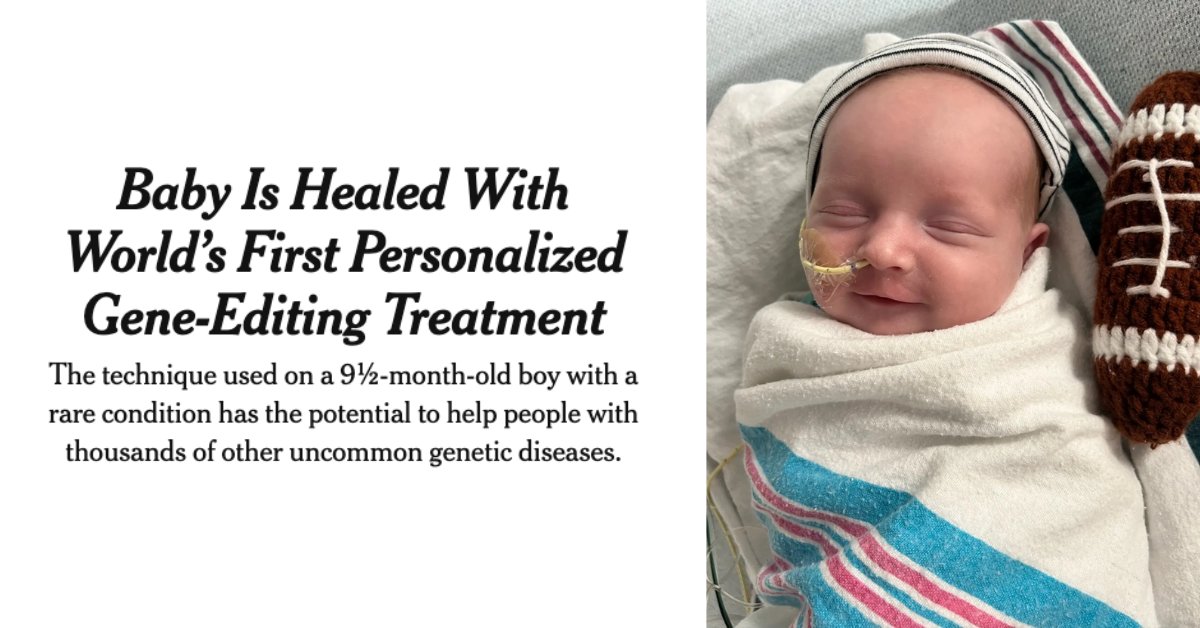
In a medical milestone, a customized base editor was developed, characterized in human and mouse cells, tested in mice, studied for safety in non-human primates, cleared by @US_FDA for clinical trial use, manufactured as a complex with an LNP, and dosed into a baby with a severe, rapidly progressing genetic disease... all in an astounding 7 months. Best of all, the infant patient shows apparent benefit. Congratulations to @kiranmusunuru, Rebecca Ahrens-Nicklas, and other team members for this heroic and inspiring effort, which has implications for the hundreds of millions of patients that suffer from thousands of genetic diseases.
https://t.co/wsgvvRYPVM
A baby named KJ, who was born with a rare genetic disorder – CPS1 deficiency – is healed thanks to doctors at the @ChildrensPhila who administered the world’s first personalized gene-editing treatment. The research team used base editing, a gene-editing method invented by HHMI Investigator @davidrliu and his lab at @Harvard University in 2016.
Earlier this year, Liu received the @brkthroughprize for developing both base editing and prime editing. These gene-editing technologies enable the correction or replacement of virtually any genetic mutation, including those that cause countless human genetic diseases.
Read more about Liu's work here: https://t.co/NlE25O7wJR
Exciting new work from our lab describing a novel platform for MHC-II recognition, called TRACeR, that uses just a single loop! Congratulation to @HaotianDu4, @ljjchem, and the team
https://t.co/QJffVkGIIX
(1/10) 🧵 Our recent study - and my MD PHD Thesis - finally got published in Nature Communications!!! We introduce SPTCR-seq, a method for detailed mapping of T cell receptors in glioblastoma. #CancerResearch#Immunology https://t.co/ekqqxAy94o