A Muslim woman living in Japan just admitted something most people are too afraid to say out loud.
She acknowledged that “maybe the behavior of the Muslim community in Japan is causing Islamophobia.”
She pointed to Muslims praying in public, constantly demanding special halal treatment, and other behaviors that create friction. In earlier interviews she even said her own practicing Muslim family moved back to Indonesia because of the growing pushback in Japan.
When a Muslim herself starts connecting the dots between community behavior and the reaction it creates, it’s worth listening.
Around 150 AD, a pagan Roman official named Diognetus asked a strange question. He wanted to know what these Christians actually were.
They had no temples. No altars. They refused to swear by the genius of the emperor. They gathered before dawn and sang to Christ as if he were God. Yet they served in Roman armies, worked in Roman trades, and lived in Roman cities.
Pagan neighbors hated them. They were accused of atheism for refusing the gods. They were accused of incest for calling each other brother and sister. They were accused of cannibalism for what happened at their secret meals.
But they did something Rome had never seen. They rescued abandoned babies.
The Letter to Diognetus is one of the earliest explanations of Christianity written for outsiders. And its answer reframes everything the modern world thinks it knows about the early Church.
A thread.
This is one of my fav videos to watch.
The Maronite words of consecration, spoken in Aramaic, the very same language of Christ.
Whenever I feel anxious or just need to hear something beautiful, I return to this.
Take 2 mins today. Let it wash over you. 🕊️
I don’t believe in coincidences. God gave us an American Pope to avoid miscommunication and misinterpretation.
Rad-Trads are seething right now, they’re no better than liberals.
Pray for the Pope. May God have mercy on any Catholic that doesn’t put full trust in any Pope..
Your body has an enzyme that can stop your cells from aging. You produce it as an embryo, and then your body shuts it off. On purpose. Because if your cells kept using it, they’d never stop dividing, and that’s literally what cancer is. About 85% of human cancers work by switching this enzyme back on.
Lobsters never switch it off. Ever.
They produce this thing, telomerase, in every single organ their entire lives. A 1998 lab study found it running in their liver, their heart, their muscles, everywhere. What it does is simple: every time a cell copies itself, the tips of your DNA fray a little, like the ends of a shoelace losing its plastic cap. Telomerase rebuilds those caps. In your body, most cells can’t do that, so they wear down and eventually die. That’s aging. Lobster cells just… keep going.
And here’s the part that messes with me. They actually get more fertile as they age. A 1-pound female carries about 8,000 eggs. A 9-pound female can carry over 100,000. The grandmother in this video is hauling 70,000–80,000 eggs. In almost every other animal, reproduction slows down and stops as the body breaks down. Lobsters flip that completely. The older they get, the more babies they can have.
They do still die. Just not from aging. Lobsters grow by cracking out of their entire shell and building a new one from scratch. Imagine doing that every year or two, and each time it costs more energy because you’re bigger. Eventually the molt itself is what kills them. Exhaustion. Or infection while the new shell is still soft. The oldest one anyone’s found, a 20-pound male named George, was about 140 years old when he got pulled up off Newfoundland in 2008. PETA got involved, and he was dropped back into the water near Kennebunkport, Maine.
This female getting released isn’t random feel-good content, either. Maine has made it illegal to keep egg-bearing females since 1872. When a fisherman catches one, he cuts a V-shaped notch into her tail flipper before tossing her back. That notch makes her permanently off-limits, even years later when she’s caught again without visible eggs.
A 2018 study found that V-notched females produce 9 times more eggs over their lifetime than unmarked ones. And the survival odds for lobster babies are terrible: out of every 50,000 eggs, maybe 2 make it to a size you could legally catch.
One big, old, egg-loaded female like this one is worth more to the species than thousands of younger lobsters combined.
As promised
LUXOR, THE SOURCE OF LIGHT - WILLIAM COOPER
Full documentary 1994
William Cooper visited the Luxor Hotel in Las Vegas and explains in detail, the hidden occult symbolism intertwined within the architecture, letting you know who this city belongs to.
"Everything is lost, I no longer have any chance."
Keep these words very well in mind: they are completely demonic and represent the seal of despair stamped over the souls that do not place all their hope in God.
Reject any thought of this kind.
All things are possible to the one who has faith and prays to God.
Among the many things that shocked me in the writings and histories of the Church Fathers as a protestant was how many times we protestants resembled the heretics (sometimes even the pagans) of their times in various ways.
One such example is veneration of the relics of the martyrs, the intercession of the saints, and how such things produced miracles.
Multiple ancient writings—including from St. Ambrose himself, as well as St. Augustine—testify to the fact that St. Ambrose had a dream in which the location of the relics of Sts. Protasius and Gervasius (martyrs) were discovered. Once discovered, St. Ambrose displayed their relics in what is today the Basilica of St. Ambrose, and they produced many miracles, including healing a blind man of his blindness (who went on to serve in the basilica for the rest of his life in gratitude for his healing).
I discovered long ago that it was PAGANS who despised the veneration of relics by Christians (though as a protestant, I was always told such veneration was pagan itself). But while reading the “Life of St. Ambrose” (which St. Augustine requested be written by a certain Paulinus), I discovered that the ARIANS also apparently despised it.
As it turns out, when I visited Milan in 2024, I went to the Basilica of St. Ambrose, and saw three sets of relics. I knew one of them—the one in the middle—was St. Ambrose, and was utterly astounded to be in the presence of his bodily remains, given how much he had influenced me toward conversion to the Catholic Faith.
But I also wondered who the two people on either side of him were. A placard nearby told me: Sts. Protasius and Gervasius. I was looking at the very relics of the martyrs that I had read so often about in the writings of various Church Fathers, and other ancient Christian sources. It was as if God was bringing it all full circle. I bowed and venerated their relics, asked for their prayers, and stood in awe of the reality of Christ in them. I took the picture below when I was there.
Now here is the bit showing how the Arians themselves despised this Catholic stuff (and thereby matched many of the attitudes I had received as a protestant):
“Yet, within the palace, a great number of Arians who sided with [Empress] Justina [who persecuted St. Ambrose] ridiculed such grace of God as the Lord Jesus deigned to confer upon His Catholic Church by the merits of its martyrs [through relics/intercession]. And they claimed that the venerable man Ambrose had by means of money prepared men to state falsely that they were troubled by unclean spirits and to say that they were tortured by him just as by the martyrs.”
Paulinus, Life of St. Ambrose (Ch. 5)
In Dante's Inferno, the center of Hell is not hot. It is a freezing lake of ice.
In Lewis's Narnia, cold also represents evil: a never-ending, Christmas-less winter. Why?
The answer unlocks one of the most troubling questions in Christianity: how can a good God permit suffering?
St. Augustine taught that evil is a privation of good, a lack of something. Just as evil is like darkness to light or a hole to the ground, cold is an absence of heat.
Cold also works well for evil because it ceases movement. The soul, in Latin, is called anima, and it is behind English words like animation, animal, et al., meaning something that moves. The cold slows and then ceases movement, making it a good poetic force against the soul, the anima.
It is no surprise that the White Witch's ultimate power is to turn people into stone. Creatures turned to stone are brought back to life by the warm breath of Aslan, the Jesus figure.
In Dante's Inferno, the pit of hell is a cold wasteland of ice and wind. It is the farthest away from the radiant love of God a soul could fall — a lake of ice lacking in both warmth and movement.
Lewis and Dante invite you to rethink the nature of evil, and to see it as a kind of unreality...
https://t.co/ww9dI9cnpT
A monk had written on the east wall of his cell these two words: “Amen!” and “Alleluia!”.
A man who had come to him for spiritual advice, seeing those two words written there, asked him:
“Father, what do these two words mean, and why did you write them on the wall?”
“My son,” the monk replied, “these two words contain within them the whole mystery of human happiness. When I say ‘Amen!’ it means ‘So be it!’ and ‘Alleluia!’ means ‘Glory to God!’”
Since the confusion and amazement could still be read on the pilgrim’s face, the elder added:
“When we say ‘Amen!’, it means that we surrender ourselves to the will of God, for we say: ‘So be it, Lord, as You will! In other words, may everything happen according to Your will!’ And when we say ‘Alleluia’, we are in fact saying: ‘Glory to You, O Lord, for everything You give me! Glory to You for both the good and the bad, for all the gifts, events, and blessings in my life!’”
LORD, MAKE MY LIFE TO BE ONLY ACCORDING TO YOUR WILL, FOR THE GLORY OF YOUR HOLY NAME AND FOR THE SALVATION OF MY SOUL! AMEN AND ALLELUIA!
This is one of the earliest surviving video clip of the Ati-Atihan Festival in Aklan recorded back in the 1970s by Hugh Gibb. It was digitized by the Filipinas Heritage Library through the grant of the NCCA.
Saint Porphyrios was once asked what the greatest spiritual struggle is.
People expected something dramatic. Long fasts. Harsh asceticism. Heroic feats.
He said something much simpler.
Love Christ. That was it.
Not “analyze Christ.” Not “panic about your sins every day.”
Love Him.
Saint Porphyrios taught that when you truly love Christ, repentance happens naturally.
Prayer becomes alive.
The commandments stop feeling like chains and start feeling like oxygen.
Holiness stops being forced and becomes something that quietly grows, like a tree that keeps reaching toward the light.
He used to say that many people exhaust themselves fighting darkness instead of turning toward Christ.
You do not chase shadows away by swinging at them. You bring in light, and the darkness leaves on its own.
That is Orthodox spirituality in a nutshell.
Not a legal system. Not a fear factory. Not a performance. A living relationship.
Saint Porphyrios didn’t deny struggle. He knew suffering. He knew sickness. He knew spiritual warfare. But he also knew the secret.
Christ is not standing over you with a clipboard. He is standing before you with open arms.
When you fall, do not stare at the fall. Look at Christ. When you sin, do not spiral. Run to Christ. When you feel cold inside, do not fake fire. Turn toward Christ.
The more you look at Him, the more your soul begins to look like Him.
That is how saints are made. Not by self hatred. Not by anxiety. But by love that keeps choosing Him again and again.
"Love Christ and put nothing before His Love. He is joy, He is life, He is light. Christ is Everything. He is the ultimate desire, He is everything. Everything beautiful is in Christ."
- St. Porphyrios ☦️
Saint Porphyrios, pray for us. ☦️
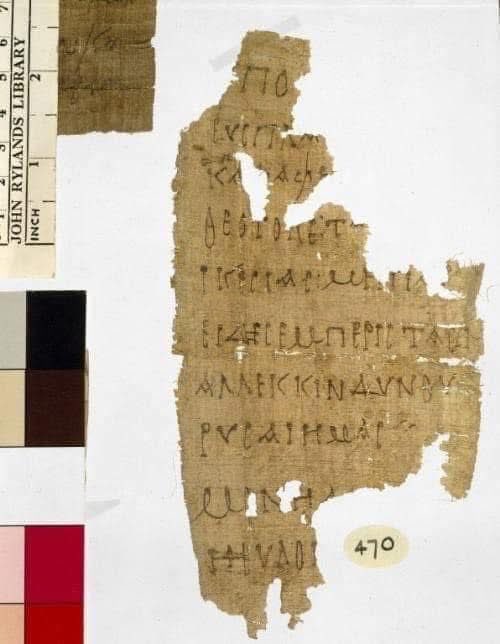
The oldest-known prayer to Mary was found in a Greek text from A.D. 250 that addresses Mary as “Theotokos," that is, “Mother of God” or “God-bearer”. Catholics know the prayer from a Latin version called the "Sub tuum praesidium."
Ὑπὸ τὴν σὴν εὐσπλαγχνίαν, καταφεύγομεν, Θεοτόκε. Τὰς ἡμῶν ἱκεσίας μὴ παρίδῃς ἐν περιστάσει, ἀλλ᾽ ἐκ κινδύνων λύτρωσαι ἡμᾶς, μόνη Ἁγνή, μόνη εὐλογημένη.
“Beneath your tenderness of heart, we take refuge, O bearer of God. Do not despise our petitions amidst our troubles, but rescue us from dangers, O only pure one, only blessed one.”
This is one of my fav videos to watch.
The Maronite words of consecration, spoken in Aramaic, the very same language of Christ.
Whenever I feel anxious or just need to hear something beautiful, I return to this.
Take 2 mins today. Let it wash over you🕊️
(🎥 @mikepantile)
People salute their country; they kiss trophies and venerate the pictures of their late relatives.
Some bow before their kings and go to the gravesite of their loved ones to give flowers; you don’t complain
But when Catholics venerate the Cross… you shout IDOLATRY!!!
Hmmm





![JoshuaTCharles's tweet photo. Among the many things that shocked me in the writings and histories of the Church Fathers as a protestant was how many times we protestants resembled the heretics (sometimes even the pagans) of their times in various ways.
One such example is veneration of the relics of the martyrs, the intercession of the saints, and how such things produced miracles.
Multiple ancient writings—including from St. Ambrose himself, as well as St. Augustine—testify to the fact that St. Ambrose had a dream in which the location of the relics of Sts. Protasius and Gervasius (martyrs) were discovered. Once discovered, St. Ambrose displayed their relics in what is today the Basilica of St. Ambrose, and they produced many miracles, including healing a blind man of his blindness (who went on to serve in the basilica for the rest of his life in gratitude for his healing).
I discovered long ago that it was PAGANS who despised the veneration of relics by Christians (though as a protestant, I was always told such veneration was pagan itself). But while reading the “Life of St. Ambrose” (which St. Augustine requested be written by a certain Paulinus), I discovered that the ARIANS also apparently despised it.
As it turns out, when I visited Milan in 2024, I went to the Basilica of St. Ambrose, and saw three sets of relics. I knew one of them—the one in the middle—was St. Ambrose, and was utterly astounded to be in the presence of his bodily remains, given how much he had influenced me toward conversion to the Catholic Faith.
But I also wondered who the two people on either side of him were. A placard nearby told me: Sts. Protasius and Gervasius. I was looking at the very relics of the martyrs that I had read so often about in the writings of various Church Fathers, and other ancient Christian sources. It was as if God was bringing it all full circle. I bowed and venerated their relics, asked for their prayers, and stood in awe of the reality of Christ in them. I took the picture below when I was there.
Now here is the bit showing how the Arians themselves despised this Catholic stuff (and thereby matched many of the attitudes I had received as a protestant):
“Yet, within the palace, a great number of Arians who sided with [Empress] Justina [who persecuted St. Ambrose] ridiculed such grace of God as the Lord Jesus deigned to confer upon His Catholic Church by the merits of its martyrs [through relics/intercession]. And they claimed that the venerable man Ambrose had by means of money prepared men to state falsely that they were troubled by unclean spirits and to say that they were tortured by him just as by the martyrs.”
Paulinus, Life of St. Ambrose (Ch. 5)](https://pbs.twimg.com/media/HCMUOY-bEAAamff.jpg)