Crypto Enthusiast||Crypto Trader||Defi Enthusiast||Crypto Investor||Airdrop Hunter|| Lagos Boy||Wanna be Traveller||Here for a good time.
Igbo Philosopher.🗿
@remitano I made a transaction to one of your verified sellers almost three hours ago and I haven't gotten a confirmation of the transaction yet and attempts to reach the seller has proved abortive. What is really going on?
How can you join the @nesaorg Playground?
Nothing too serious or hard...
Enter on https://t.co/LBBaCF7LGU, you need to connect a google account or to make yourself a new nesa account (if you not connected already) and that's it
The AI Cards are live for 4 days now... you sure you wanna miss 'em?
Claim your identity inside the Nesa ecosystem and take that XP to the moon
New week, things got real here
The research on @OpenGradient is looking better and more and more interesting
(make sure to check the qrt for the full series)
MEV is basically about who gets to control transaction ordering and how value can be extracted from it
AI comes into play by analyzing massive numbers of possible transaction sequences to find profitable opportunities for miners or validators... while still keeping the network stable
The idea isn’t just to extract value blindly, but to optimize sequencing in a way that doesn’t damage the system’s integrity
They’d also point out that machine learning can help on the defensive side
By spotting suspicious patterns early, AI models can detect and reduce front-running or other manipulative behavior by adjusting how transactions are propagated
In some cases, AI can even help design MEV strategies that reduce harmful side effects like excessive gas fees, which leads to a healthier network overall
To make it concrete, they might mention companies like Mamori
Which use stochastic ML methods such as particle swarm optimization to explore the maximum value that can be exploited in a given network state
Unlike static analysis, these dynamic, ML-driven approaches can uncover more complex, multi-block exploits by thoroughly exploring the transaction space
Others, like Pond, are researching deep learning models
Especially graph neural networks - that study on-chain transaction graphs to recognize patterns commonly used by malicious contracts or wallets
By learning how bad actors behave, these systems can flag suspicious activity and strengthen security across Web3
Stay tuned for the next posts on the @OpenGradient research, open that notifics up
i kept seeing Titan mentioned in @Arch updates, but never explained in plain terms
so i stopped and tried to understand what problem it actually solves inside the stack
here's a quick piece of how i understood it.
⚠️ if you don't know what Arch is, i have a more general 🧵 for ya here:
https://t.co/hfkCBVkQXV
▫️why Arch needed Titan
Arch used Electrs before.
Electrs is a standard Bitcoin indexer used across the ecosystem.
but Arch runs a compute layer on top of Bitcoin.
that creates new demands ↓
• validators need very specific queries
• apps need real-time responses
• data must stay synced w/ Bitcoin state
in other words: arch needs to read btc data fast, accurately & in the exact format its apps except.
Electrs was reliable, but too general for this setup.
so Arch built Titan as a custom indexer made only for their stack.
▫️what Titan actually does
Titan watches Bitcoin blocks, transactions, and state.
it structures that data so Arch validators can use it fast.
the focus is speed and efficiency.
Titan is optimized for Arch's exact query patterns.
that leads to ↓
• faster answers
• less compute waste
• lower storage needs
this helps Arch scale w/o bloating infra..
▫️mempool indexing explained
Titan indexes txs at the mempool level.
that means it sees txs before they are confirmed.
this lets devs tell the difference between ↓
• Rune txs that are final
• Rune txs that can be front-run
(remember runes?)
this is especially important for token logic on Bitcoin.
▫️why this matters for devs
Titan has native Runes support.
it tracks balances, transfers, and state in real time.
apps do not need extra middleware.
validators get clean, synced Bitcoin data.
devs get ↓
• faster queries
• simpler token logic
• more predictable app behavior
essentially, Titan is a Bitcoin indexer shaped exactly around Arch's architecture..
𝑻𝒉𝒆 𝑩𝒊𝒂𝒔 𝑷𝒓𝒐𝒃𝒍𝒆𝒎: 𝑨𝑰'𝒔 𝑴𝒐𝒔𝒕 𝑫𝒂𝒏𝒈𝒆𝒓𝒐𝒖𝒔 𝑭𝒍𝒂𝒘 - Part 3 - @miranetwork
Slow weekend & slow market probably the worst combo ever to exist...
But this not going to stop our grind & research
Bias doesn’t show up the way hallucinations do
Hallucinations are obvious, you can spot them and call them out
Bias is different
It’s quiet, slow, and cumulative
There’s no single moment where you can say, “This is when the information started going bad”
Instead, bias seeps in little by little
> through training data that mirrors existing societal views
> through systems optimized for engagement rather than truth
> through deployment choices that favor certain groups
> through feedback loops that reinforce the same perspectives over and over
That’s what makes it so dangerous
It’s a “frog in boiling water” problem
By the time people clearly notice what’s happening, the information ecosystem may already be deeply distorted
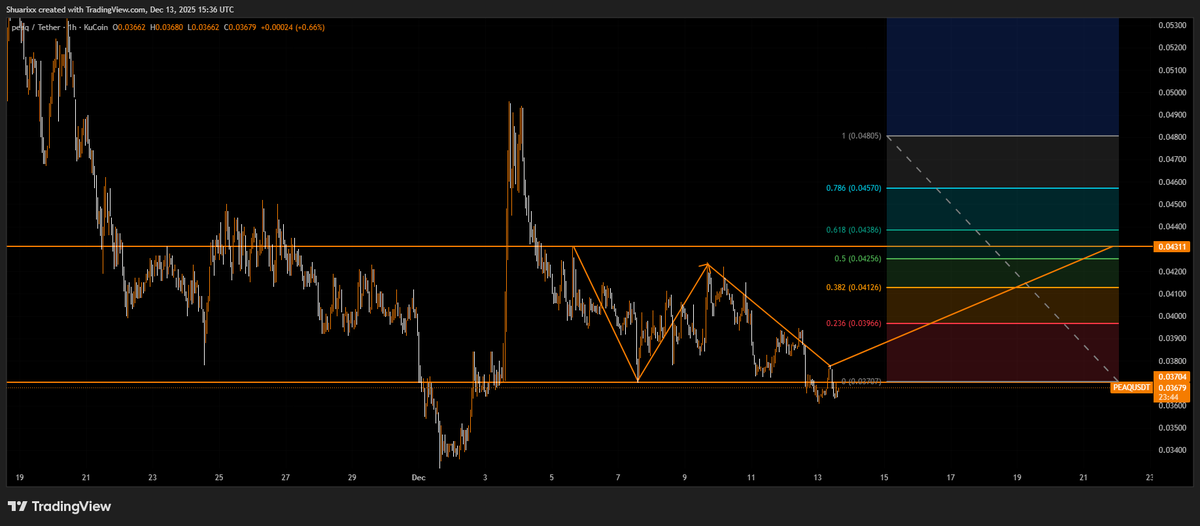
$PEAQ had a choppy last 7 days, with a brief mid-week bounce followed by steady downside pressure
Price topped out midweek before rolling over, ending the week lower overall (~-9%)
Despite short-term weakness, movement stayed orderly
No panic, just consolidation under resistance
One to watch if momentum flips back
Stay tuned for more @peaq posts