Why is OpenAI's GPT-o1 an important step change? It allows LLMs to think longer before they answer a prompt. Inference-time scaling builds on the intuition that investing more compute while answering, can improve the result. 🧵
The mega bull case for AI infrastructure would be *if* market share shifted away from certain frontier labs with 90%+ inference margins toward cheaper models, whether open-source or closed.
It would increase the ROI on AI spend for end customers by increasing intelligence per dollar, which would drive incremental token demand. Margin dollars would effectively get redistributed from the frontier labs to AI infrastructure providers. The infra winners would be those with the lowest per token cost and the winners at the model layer would be those with the highest token efficiency.
There are many reasons Jensen is so focused on open source, but this is likely the most important one as I think he is probably less worried about a monopsony these days. Lower margin % at the model layer = more margin $ at the infra layer all else equal.
With SpaceX and Meta being vertically integrated and possessing the #3 and #4 models respectively it is more possible than ever. Note that Grok 4.5 is ahead of Fable for some useful tasks at a much lower cost, so ranking them #3 is conservative.
This is not happening yet. Cheap, mostly open source tokens are likely the majority of volume today but the majority of economic value is still accruing to the most intelligent models. Might change though.
We will see.
(quietly) this is probably a protective measure *for humans* b/c endlessly indulging in anti-social and abusive behavior against even a non-entity makes you a worse person
I would love some feedback about my worries of an imminent AI-related market crash:
Industrial bubbles are most common when firms get deep into debt. Even with declining free cash flow (chart 1 below), the AI hyperscalers still have less debt as a share of earnings than the typical S&P 500 company (chart 2).
But on the institutional/retail investor side ... that's a different story. Look at Chart 3 (all from JPM). Investor borrowing is going crazy:
- The amount of debt that investors are borrowing from brokerages to buy stocks, bonds, and other securities rose more than 50% in the last year to record $1.4 trillion.
- Assets in high-risk leveraged exchange-traded funds have quadrupled in the last four years.
Am I wrong, or does this make the odds of a major AI-related market crash getting alarmingly high in the coming months/year? Between leveraged ETF rebalancing and margin calls, I feel like one moderately bad earnings call—eg, which points to less forthcoming semi demand—could create a cascade of sell-offs
And what makes this interesting is that you could have a significant market correction due to all this investor leverage, but it might not be a decisive judgment about the state of AI, at all, even if lots of people interpret it as a sign of a bubble.
GPT-6 is finished and is reportedly dramatically better than Fable 5. OpenAI chose to train a new, larger model from scratch.
Anthropic, by contrast, is continuing to train the model it already has, which means we will likely see more Fable variants, such as Fable 5.1.
The two companies are taking different approaches right now because one already has a massive model in Fable/Mythos, while the other needed to build one with GPT-6.
there are a lot of benchmarks that suggest 5.6 sol is the best model in the world right now, but the most reliable way to tell is that elon is obsessed with me again
Created a very simple benchmark to measure the actual knowledge cutoff of models.
It's surprising (or maybe not?) that OpenAI and Anthropic are the only big labs keeping their models fresh. Everyone else - including the chinese labs - is at least 12 months behind
Zuck: “The pricing from some of the other labs is very extreme and has very high margins. We think that there’s a real ability to be able to offer frontier or very high-level intelligence at a much more affordable cost.”
Epic pricing war breaking out among agentic models.
Foreign Anthropic employees were supposed to lose access to Mythos 5 while export controls were levied. But it’s widely believed that these employees could still access “Mythos 5.1”: an even better model only available to employees.
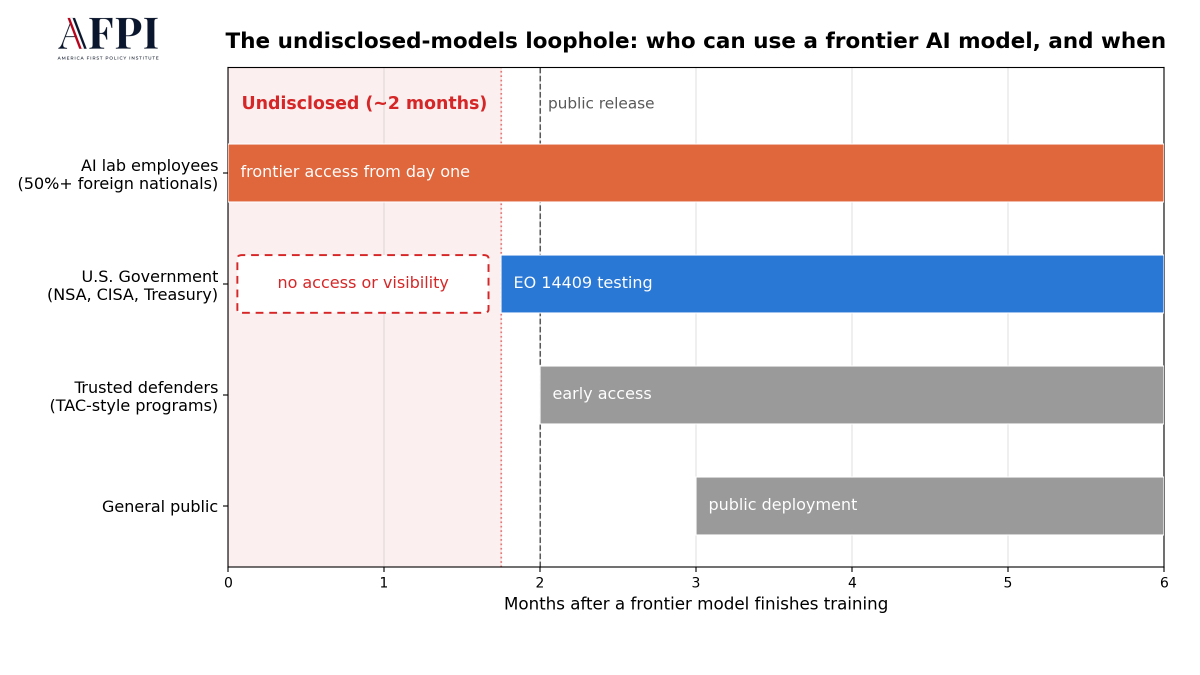
There’s an undisclosed-models loophole. Our new piece for @A1Policy shows how the government might not gain access or knowledge of new capabilities quickly enough. Existing frameworks do not cover models unless they are soon-to-be-deployed. But keeping the best models internal-only for months is standard practice in the industry. There are four problems with this:
1) Lack of visibility. Cyber capabilities at the level of Mythos are already “must-haves” for agencies like NSA. It’s insane to believe that companies could be allowed to keep Mythos++ capabilities secret from USG.
2) Theft risk. Our adversaries want to steal top AI models and secrets. If the best models are secret from USG, an adversary could steal that model and instantly gain cyber, bio, and other capabilities MORE advanced than the best available to USG.
3) Use by insider threats. Our prior research has shown that probably over half of top AI company employees are unvetted foreign nationals. They could misuse highly capable internal models or distribute their secrets to our adversaries.
4) They’re hard to define. Company-only models change every day as they are trained and updated. This makes it hard for our policy tools, like export controls and the testing framework, to cover them.
Ilya Sutskever’s company Safe Superintelligence, for example, is widely believed to have near-frontier capabilities but completely skirts policies intended to manage cyber proliferation because it doesn’t publicly deploy models.
We offer policy options to close the loophole. The key update we need is for reporting, export controls, and USG access to start not when models are planned for deployment, but when models cross the capability thresholds outlined in the AI-cyber EO’s classified benchmarking process.
🚨 SCOOP(s):
- GPT-5.6 will be the final model in the 5.x series. GPT-6 is slated to launch in about a month, earlier than expected, and possibly even later this month
- GPT-6 will be based on a new, significantly larger pretrain (versus the ~4T 5.5/5.6 'Spud' base)
- There is lots of excitement at OpenAI over this new base, which they believe will be much better able to compete with both Fable 5 and upcoming 5.1, targeting a similar release window. OpenAI initially intended to continue with Spud through GPT-6, but decided against it
- On the topic of Fable 5.1, it is in the late stages of the pipeline at Anthropic and a release is expected "in the coming weeks"
- On the other side of the globe, DeepSeek are preparing for an imminent launch of V4 GA, which seems likely to be on par with or better than GLM-5.2, and have begun work on a new, larger model that will compete with the upcoming 2.7T MiniMax Pro
I think for me the main takeaway with Sol and Fable is I can’t remember a time when the leading models were (a) so decidedly ahead of everything else and (b) so distinct *from one another.*
you must see LLMs as intelligence amplifiers and their amplification depends on your actual intelligence
so, if your IQ is 135+, with AI you can perform at the current AI maximum and it feels like real magic
if you’re 120-135, you get a good 50% buff
If you’re 105-120, you get a 25%
90-105, nothing changes
below 90 it makes you more stupid
If you ask Claude to NOT think about the Golden Gate Bridge while doing some other task, it will respond without mentioning it, but will 1. still think about the Golden Gate Bridge, 2. realize it thought about it, then think "damn"
An interesting argument in the "AI as normal technology" view is that many important skills may plateau near top-human level because the world contains irreducible uncertainty. Maybe you can't be 100x better than Nate Silver at election modeling.
We should get a good test of this hypothesis in the next year or two as AI forecasting efforts scale.