BofA: AI Power Demand
> 100+ GW Supply Gap: The US is projected to face an electricity generation shortfall of over 100 gigawatts (GW) between 2026 and 2030.
> Surging Demand vs. Capped Supply: Global semiconductor team forecasts imply a need for 230+ GW of capacity demand, while the US utilities team expects only 93 GW of accredited supply from regulated utilities.
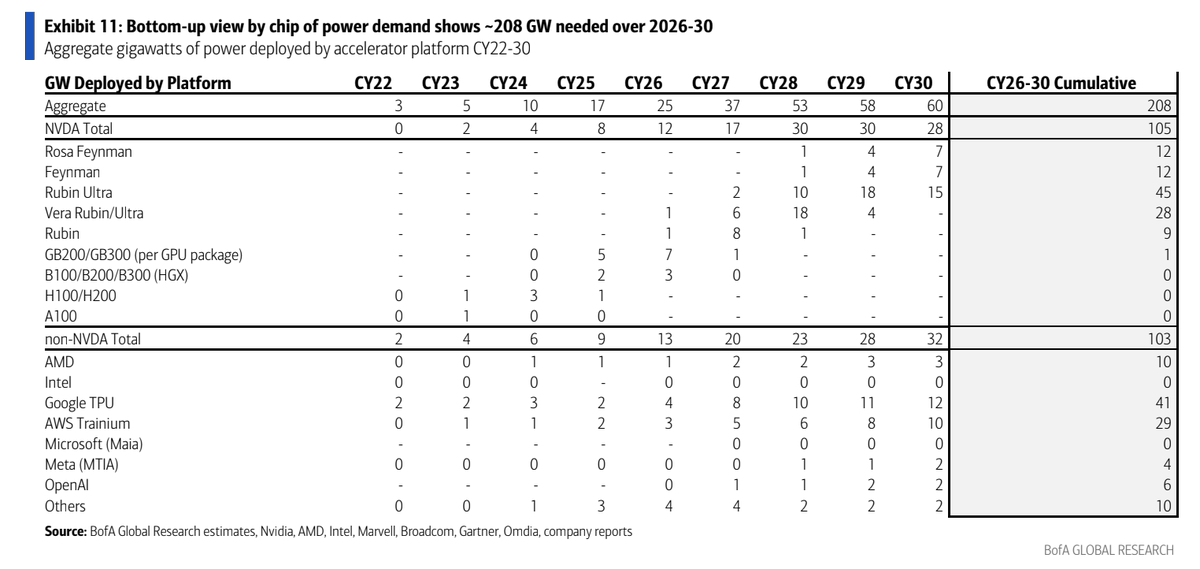
> Massive Compute Load: Driven by AI accelerators, global IT load is expected to require 208 GW between 2026 and 2030. Factoring in a 50% North American share and a 1.20 Power Usage Effectiveness (PUE) multiplier to account for cooling and facilities, this translates to 125 GW of direct US data center load growth.
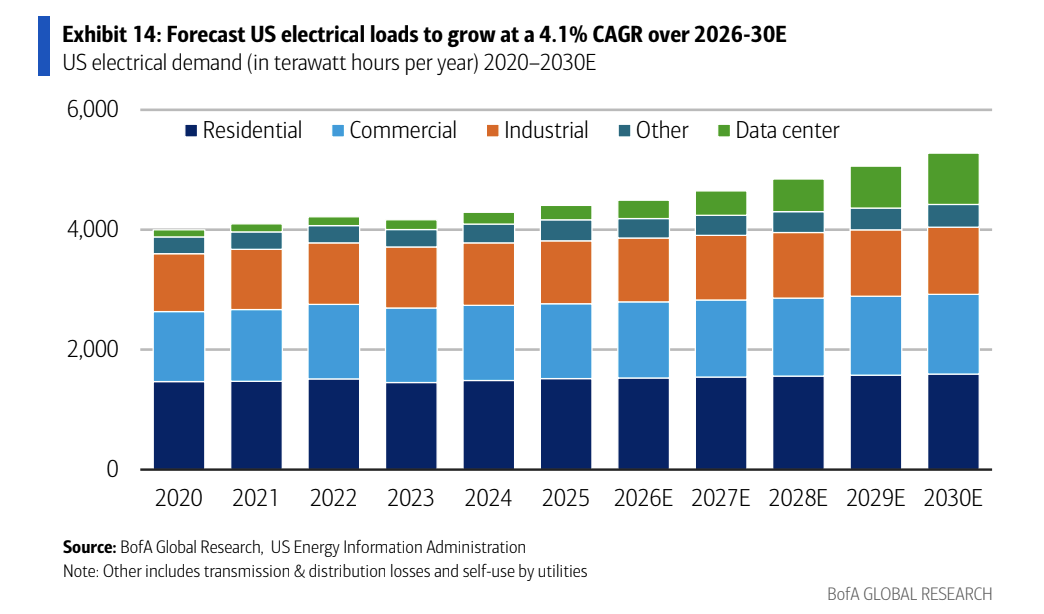
> Accelerated Growth Rate: After flat growth from 2010 to 2020 (largely due to a 150bp drag from LED adoption, appliance efficiency, and residential solar), US electrical load is projected to grow at a 4.1% CAGR from 2026 to 2030.
> Rise of Gas Engines: Due to turbine scarcity and the need for fast-response grid balancing, data center developers are shifting to gas reciprocating engines. Leading manufacturers like Caterpillar, INNIO Group, Rolls Royce, and Wärtsilä have all announced capacity expansions.
> Exponential Rack-Level Power Growth: BofA Global Research pointed out a staggering leap in the power density required by Nvidia's hardware generations. Power density has jumped from 35 kilowatts (kW) per rack for the Nvidia H100 chip up to an estimated 600 kW per rack for its upcoming Feynman architecture.
$GEV $CAT $NVDA $AMD $GOOGL $AMZN $INTC
Breaking News!
Code Yikes!
The June, 2026 CO₂ data was just released by NOAA and the 36-month mean rate of atmospheric CO₂ growth (ppm per 3-years) hit yet another new record high, now growing at a rate of 8.30 ppm per 36 months.
The Climate 8-ball claims the peak is close.
Forget 48 countries, I want EVERY single nation next World Cup for the 100 year anniversary!!
No group stage, straight knockouts. Don’t ask me about logistics 👍🏽
Sergey Brin rarely speaks publicly. He sat down for an unscripted Q&A on Frontier AI.
He admits even the people building these models do not fully understand what they have created:
1. All the specialized AI models are converging into one. Google used to need separate models for different scientific problems. Now the main Gemini models are becoming state-of-the-art for math and other scientific questions at the same time. Brin says he would not have predicted this convergence at the outset, and watching it happen has been incredible.
2. Training an AI on one skill mysteriously improves unrelated skills. This is the concept of transfer. Train a model on coding, and its math reasoning gets better, and vice versa. Teaching it to process images can improve its ability to think through geometric word problems. The capabilities bleed into each other in ways nobody fully engineered.
3. Even Sergey Brin does not know how to prompt these models. He says he is genuinely confused about what level to prompt at. Do you tell it to debug a specific chunk of code, or ask it to write a better neural net training algorithm, or just say, " What should I do today. He admits that even at Google, they do not know exactly where the edges of Gemini's capabilities are.
4. One of the biggest leaps in AI came from the dumbest sounding trick. Chain-of-thought prompting is just telling the model to think step by step before giving your problem. Brin says it seemed like the dumbest thing ever, and there was no obvious reason it should work. But it did, and it spurred a significant increase in AI capability. Some of the most straightforward requests turn out to unlock the most.
5. Brin would not modify his own biology for today's AI. Asked how humans can keep up with the accelerating bandwidth of models, he acknowledged neural links and direct brain connections are being pursued. But he said he would personally wait for the technology to mature a lot before doing anything to change his biology. Today's models do not justify it.
6. Super intelligence does not mean solving the impossible. An audience member argued that true super intelligence would mean solving NP complete problems like the travelling salesman. Brin pushed back. Most computer scientists believe P is not equal to NP, which means no algorithm can reliably solve those problems optimally, and it does not matter how smart the AI is. Impossible stays impossible. Super intelligence just means being smarter than humans.
7. Computers mastering a skill has never stopped humans from pursuing it. Deep Blue beat Kasparov at chess in the 1990s, and people kept playing chess. After AlphaGo, the human game of Go advanced dramatically, and the players who lost to it became vastly better. Brin's point: AI does not retire human ambition in an area; it often pushes the state of the art and pulls people up with it.
8. Brin thinks something close to transformers could get us to AGI. Asked directly if transformers are sufficient, he said his guess is yes, largely because they have proven weirdly flexible, working for image and video far beyond their original text purpose. But he was careful to note they have quietly changed a lot along the way and are not the same architecture as the original transformer paper.
9. AGI means two different things, and one requires understanding the physical world. Brin personally thinks of AGI as AI that can improve itself. But he concedes others define it as AI that can do anything a person can, and he thinks they are probably more correct. To do everything a person can, the AI must understand and interact with the physical world, which is why world models, and robotics, become essential.
10. Inside Google, they now use the AI to build the AI. Brin says the team has shifted a lot of energy toward having the AI do things like monitor training runs and generate its own training data. You start to use the tool to build the tool. That is most of what he spends his time on now, what he calls the self-improvement game.
11. Brin is unusually candid about where Google trails its competitors. He admits Google was a little late to focus deeply on coding. He says Gemini 3.0 and 3.1 were on top across the board six months ago, but other labs have since made strides, particularly in coding. He gives a competitor's model the edge now on deep coding and overnight tasks, while pitching Gemini's flash model as far faster for rapid interactive iteration. hindsight, he says, is that they should have focused on code earlier.
12. He sees his own role as a rabble-rouser, not a manager. Brin is honest that delivering Gemini is Corey and Demis's responsibility, not his. he describes his job as poking and prodding the team, asking, are you really doing that, reminding them of priorities they might be missing and ideas they are not paying enough attention to. He admits this is sometimes a little disruptive.
13. Confidence comes from ignoring the monthly temperature. Brin says if he judged Google's position every month by which competitor just shipped a model, he would lose his confidence very quickly. Instead, he watches the longer arc. Things shift around constantly; one lab leads on one thing, another pulls ahead somewhere else, and he feels good about where Gemini actually is despite the day-to-day noise.
Water usage has been a hot topic in the AI data center world, but the numbers may surprise you.
According to the Manhattan Institute, data centers use 0.2 percent of daily water usage in the U.S. and that number has dramatically decreased in the past few years due to a new method: liquid cooling.
By moving to 45°C liquid cooling, AI factories in favorable climates can use dry coolers instead of conventional cooling-tower-based systems, cutting facility cooling water use from roughly 2.6M gallons per MW per year to near zero.
Liquid cooling enables AI factories to be both water and energy efficient, while creating opportunities for heat reuse and dispersal to local communities, allowing these factories to become energy grid assets.
Learn more below ⬇️
https://t.co/7WanoPNKTR
Qantas’ new longest flight in the world has a wild route.
The 22-hour, 10,573-mile Project Sunrise route from Sydney to London will sometimes go over the North Pole.
Here’s why.
BBC Sport has a live World Cup knockout bracket updating after every match.
Some clever soul has made it so it automatically works out the 495 possible combinations of third-placed teams.
Right now?
Germany v Brazil
England v Portugal
Scotland v Japan
https://t.co/RnvFefXFtQ
Ken Griffin is, by far, the most successful Wall Street entrepreneur of his generation. Worth about $50 billion, he founded Citadel, one of the biggest hedge funds in the world, and Citadel Securities, a hugely profitable “market maker.” He has never pretended to be a radical innovator or a savant. His mission has always been different: to build finance businesses that update their strategies and infrastructure so relentlessly that they beat rivals not just today but over decades. Given that Griffin lacks a signature trading or investing style, his success can feel both confounding and imitable. But nobody has duplicated his monetary success—or built two separate businesses that are so wildly profitable. In a new Profile, Gary Sernovitz speaks with the hedge-fund titan and 28 of his current and former employees. Read it here: https://t.co/Kbfj1VUz6d
🚨 Free alpha for #PaniniBlockchain Prizm World Cup. Read in full.
Pack cost: FOTL $150 x13960 +hobby $25 x50480 =$3.356M.
- Let prizm gold have unit 1
- black + nebula 6x (via my 10^(1/2) x2 formula)
- Let’s say zebra /5 at 0.5
- Old glory /7 at 0.5
- Maple Leaf /9 +Aguila /11 each 0.25
- Landmarks 1/1 at 1.
Adding up, 10+6+6+0.5x5 +0.5 x7 +0.25 x(9+11)+1=34.
3356k/34=$98.7k.
So as long as a Prizm Gold copy each of Messi + Yamal + Ronaldo + Mbappe + Haaland exceeds $100k, the above cards for those 5 guys alone will exceed the product revenue.
I think they will easily exceed that.
There are
- many great players (checklist of 499 guys in the base set)
- other cards (base parallels, inserts)
- other value creation mechanism such as rainbow challenges, animal + floral pack crafting which elevates other cards’ value without them needing to be intrinsically value.
Moreover,
- great world cup moments can increase value sharply
- record can set chain reaction
- more new hobbyists add more demand.
So this product is hugely ev+, great timing and highly anticipated.
Secondary for both FOTL and hobby packs will be insane.
What is your strategy to tackle this product? Comment below. Feel free not to say. LOL.
#whodoyoucollect #PaniniBC #PBC #sportscard #PFP #NFT #digitalart #digitalasset @PaniniAmerica@kortpeters
ABC delivered the largest NBA Finals Game 4 audience since 1998, averaging 20.9M viewers, according to Nielsen Big Data + Panel.
Through four games, the 2026 NBA Finals are ABC and ESPN’s most-watched ever and the most-watched NBA Finals since 1998, averaging 19.6M viewers. It is up 116% from last year’s Championship series.