A 30-year reign by the Dutertes in the midst of climate change (yearly disasters) and an aging population (fewer OFWs sending money home) will likely be fatal to this country.
alam niyo, pag nanalo si sara duterte sa 2028, magpapalit-palit lang silang magkakapatid hanggang kay kitty and it's going to be a 30-year duterte dynasty. kaya ang masasabi ko lang ay get your fucking act together 🤗
sourness is such a huge cornerstone of filipino cuisine and this article indirectly addresses how by describing how the filipino palate came to be. good short read.
https://t.co/ezveVp9xt2
Good news! Since 2010, the world has been gaining more mangroves than it has been losing them. This is mainly thanks to restoration efforts & the natural expansion of mangroves followed by dropping rates of deforestation.
Look at how mangrove forests in Sabah are recovering!
Seeing posts saying building colllapse is expected with 7.8-8.2 level of magnitude
Nope.
PH building code accounts for strong quakes with magnitude 7-8.4. No guarantees but following this standard should substantially minimize collapse. We can all guess what went wrong #LindolPH
“We are a society awash in skillfully manufactured lies. Solitude that makes thought possible—a removal from the electronic cacophony that besieges us—is harder and harder to find. We have severed ourselves from a print-based culture.
We are unable to grapple with the nuances and complexity of ideas. We have traded ideas for fabricated clichés. We speak in the hollow language we are given by our corporate masters.
Reality, presented to us as image, is unexamined and therefore false. We are culturally illiterate. And because of our cultural illiteracy we are easily manipulated and controlled.”
— Chris Hedges
fun fact. this cutter is designed for disabled people. a lot of things we use on the daily (eg: ramraj velcro veshtis, magnet knife holders etc) are all invented for disabled ppl. increasing accessibility for disabled ppl makes the world a better place for everybody
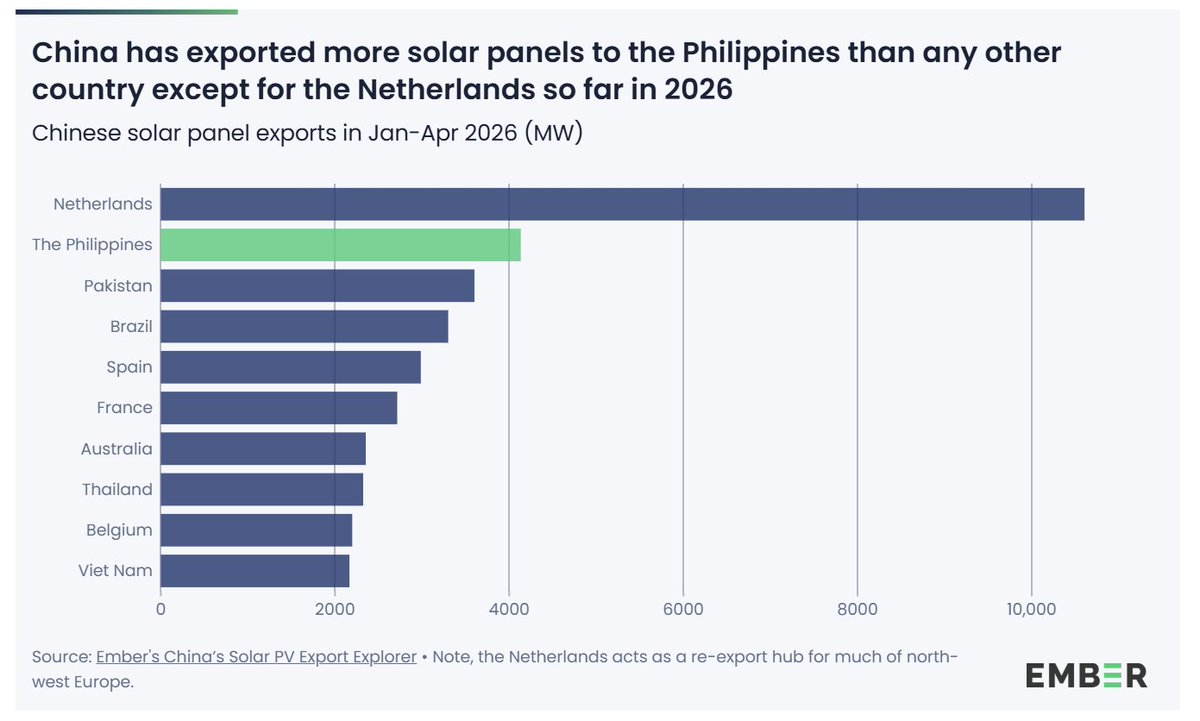
The Philippines abruptly became China's 2nd-largest solar panel export market in 2026, eclipsing Pakistan. In March and April alone, 3,000MW of solar panels were exported to the country
The Philippines has Southeast Asia's costliest residential power. So the people staged a revolt, having figured out that solar payback collapsed to 3.1 years for homes and 2.3 for businesses - because:
a) the grids was addicted to volatile, USD-denominated imported fossil fuels (like LNG), leading to an explosion of retail electricity prices up 17% or more for homes; and,
b) solar costs plunged 10% over the past 12 months
Wire chewing pipelines - everywhere, all at once
In the 1990s, Canadian ecologist Suzanne Simard made a groundbreaking discovery that challenged everything we thought we knew about how forests work. While studying managed forests in British Columbia, she noticed something puzzling: when birch trees were removed to promote the growth of valuable Douglas firs, the firs did not flourish as expected, they actually struggled and grew more slowly.
Determined to understand why, Simard traced the movement of nutrients using radioactive carbon isotopes. What she found was astonishing. Trees were actively sharing resources through vast underground fungal networks known as mycorrhizae. These delicate, thread-like fungi connect the roots of different trees across the forest floor, forming a complex web that allows the exchange of carbon, water, nutrients, and even chemical signals, sometimes between entirely different species.
She discovered that older, larger trees often serve as central "hubs" or "mother trees," supporting younger saplings by redistributing vital resources and helping the entire ecosystem remain resilient. When these key trees are removed, the underground network weakens, and the health of the remaining forest declines.
Simard’s research overturned the traditional Darwinian view of forests as battlegrounds of ruthless competition. Instead, she revealed a far more sophisticated reality: forests operate as highly cooperative systems where trees communicate, support one another, and even warn neighboring trees about threats like drought, disease, or insect attacks.
What appears to the human eye as a silent, still forest is, in truth, a vibrant, interconnected living network, built not on isolation and rivalry, but on deep connection and mutual aid.
The intellectual life was never something that only the elites enjoyed.
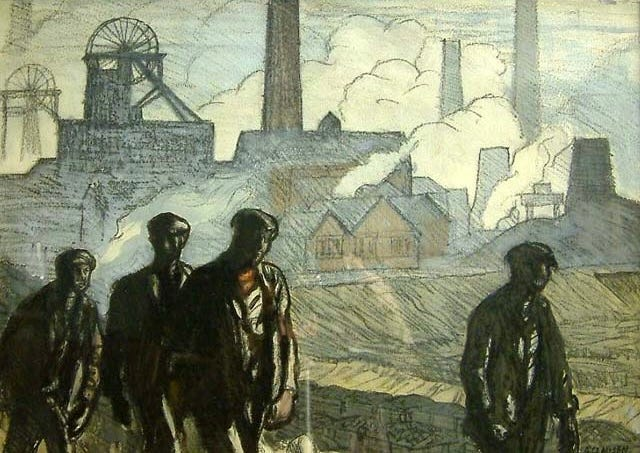
In England there has long existed a massive, self-directed culture of education among working-class people. Coal miners in industrial England read voraciously, with many even self-studying Latin or history after long shifts underground or in factories.
Coal miners, mill workers, and mechanics built their own libraries and formed reading societies to study Shakespeare, Dickens, Milton, even Plato. A grassroots intellectual movement that grew independent of elite institutions.
Jonathan Rose makes this case in "The Intellectual Life of the British Working Classes", one of the most illuminating cultural histories of recent decades.
While elites might have consumed culture for status, ordinary readers engaged with it morally and personally, seeing in Shakespeare and the classics a means of moral development and self-mastery. This revelation directly challenges the 20th-century academic assumption (inspired by postmodernism and Marxist cultural studies) that "high culture" is inherently exclusionary.
Pulling from autobiographies and letters, Rose shows that workers often described reading as a form of inner liberation, citing writers like Ruskin, Carlyle, and Dickens as their moral guides. They read with a degree of seriousness we rarely see today, treating their books as beloved companions in a lifelong pursuit of wisdom.
The rise of mass media and television following WWII made a preference for reading slowly give way to one for passive entertainment.
And the democratization of education paradoxically coincided with a lowering of intellectual standards — just like how more people than ever attend university today, yet popular culture as a whole is much less intellectually vibrant than it was 50 years ago.
What is the largest source of electricity in each country?
Coal generates one-third of the world’s electricity, more than any other source.
But zoom into the country level, and the picture is much more varied. The map shows which source generated the most power in each country in 2024 or 2025 (the latest year available).
Thanks to large reserves, coal dominates across Asia. It’s the largest source in China, India, Indonesia, and Malaysia. These are huge power producers, which is why coal is so dominant at a global level.
Across most other regions, it’s mostly a mix of gas and hydropower. On islands and parts of North Africa, it’s oil.
Europe has the most diverse mix, with nuclear power dominating generation in countries such as France and Finland, and solar and wind overtaking fossil fuels as the largest sources in countries such as Spain and Germany.
Solar and wind are growing quickly in many countries; when these sources are combined as “variable renewables”, they become the largest source in six more countries: the Netherlands, Portugal, Greece, the United Kingdom, Belgium, and Pakistan.
(This Data Insight was written by @_HannahRitchie.)
How the education system was built for a world that no longer exists:
1. The school bell system was modelled directly on factory shift schedules in the 1800s. It was never designed around how children learn. It was designed around how factories operated.
2. Subjects are taught in complete isolation from one another. History never speaks to economics. Science rarely connects to philosophy. The world does not work this way but the timetable insists it does.
3. Every child in a classroom is assessed on the same day in the same format regardless of how differently each one thinks, processes or expresses understanding.
4. Homework sends the least supported students home to struggle alone. The children with the most help at home benefit most from it. The gap widens quietly every evening.
5. Grades measure performance on a single day under artificial pressure. They tell you very little about curiosity, persistence, creativity or the ability to solve problems that do not yet have answers.
6. The subjects considered most important were decided over a century ago. Mathematics and language sit at the top. Art, music and physical movement sit at the bottom. Nobody has seriously revisited that hierarchy since.
7. Children are grouped entirely by the year they were born rather than by where they actually are in their understanding. A child born in December competes constantly against children nearly a full year older.
8. Memorisation is still rewarded more consistently than understanding. A student who can recall a date will outscore a student who genuinely understands why that moment changed everything.
9. Teachers are evaluated on test scores produced by their students. This slowly and inevitably pulls the entire profession toward teaching the test rather than teaching the subject.
10. Creativity is encouraged in early years and then systematically reduced as examinations approach. By the time a student reaches the most formative years of their thinking, originality has become a liability.
11. The university degree became the default signal of capability not because it reliably measures it but because employers needed a filter and nobody built a better one.
12. Children spend twelve or more years being told exactly where to sit, when to speak, when to eat and when to move. Then the world expects them to graduate as independent, self directed, original thinkers.
i took a 45-minute uber ride home from the airport last night after a brutal, three-day business trip.
i was completely emotionally and physically drained, and my social battery was at absolute zero.
when i got into the car, the driver.. an older guy named kabir.. didn't say the usual "how was your flight?" or turn on the radio.
instead, he just handed me a small, laminated piece of paper attached to the back of his headrest.
it was a literal "ride menu."
it said:
1. *the silent ride* (total quiet, no pressure to talk).
2. *the therapist ride* (if you need to vent about your day, i am listening).
3. *the tourist ride* (i will tell you cool facts about the city).
4. *the radio ride* (we just listen to old jazz and coast).
i smiled, pointed to number 1, and whispered, "silent ride, please. thank you."
he gave me a warm nod in the rearview mirror, adjusted the AC, and drove the entire 45 minutes in absolute, beautiful silence.
it was the most peaceful, therapeutic boundary i’ve experienced all year. i felt my entire nervous system finally reset.
when he dropped me off, i gave him a massive tip and told him, "that menu is a genius business idea. you must get amazing reviews."
He looked back at me and said, "i didn't make the menu to get better tips, dear.
my daughter has severe social anxiety, and she told me that the hardest part of her day is navigating small talk with strangers when her brain is tired.
she told me it feels like running a marathon.
i made the card so that anyone who gets into my car can feel completely safe dropping the mask for a little while."
i walked into my apartment and just sat on my suitcase.
we live in a world that is constantly screaming at us to perform, to network, to be "on," and to over-communicate.
but sometimes, the deepest form of love and respect you can show another human being is just creating a small, safe pocket of silence for them to rest in.
pay attention to the people who give you permission to be quiet. they are rare.
Never stop championing for dark skin representation in Filipino media until every child gets to grow up in a world where they are loved and accepted for who they are.
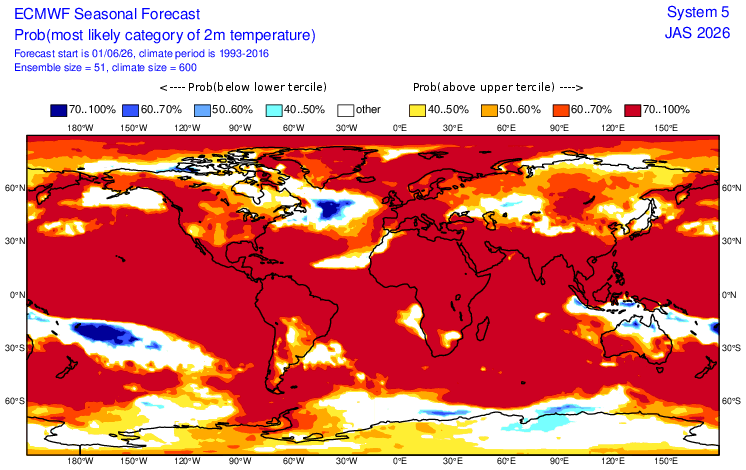
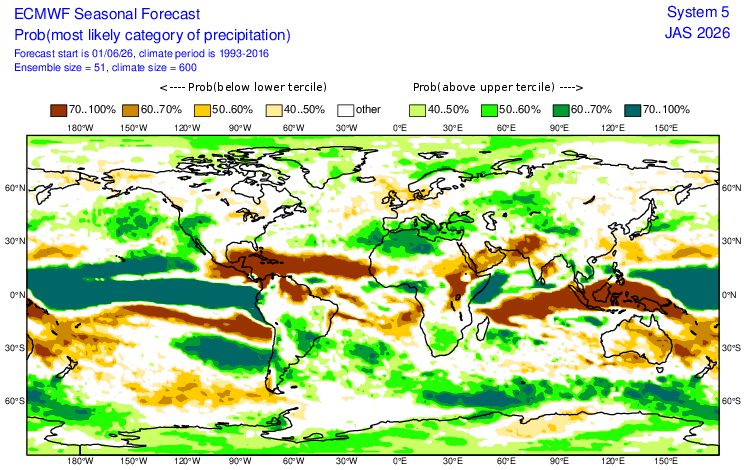
El Nino update. Godzilla is coming.
Most of the world will see top quartile temperatures over Jul/Aug/Sep, which is peak vegetative growth season globally for grains, half the world oilseeds and also for sugar and rice in Asia. That means more evapotranspiration and stress on crops.
India and South-East Asia will also likely see their weakeast monsoon rains in decades.
This is happening while there's a shortage of fertilizers.
An easy way to get unstuck is to get up and take a walk.
We generate more creative ideas during and after walking outdoors—and even on a treadmill facing a blank wall.
Divergent thinking rarely happens when we're tethered to a desk. Moving our bodies frees our minds.