CTO of Cognition (@stevenkplus1) just joined the leaderboard...
and Devin flipped Claude over 24 hour period!!!
join the benchmax proof benchmark : ecdsa(.)fail
“An 18-year-old just hit 80% of Google’s classified breakthrough over a weekend using an AI agent swarm.”
Frontier science is changing.
As covered in news: The story is not just about quantum cryptography. It is about what happens when AI agents, open collaboration, and verification start compressing the distance between elite labs and independent builders. An undergraduate with no formal quantum training improved a leading published circuit by roughly 2x. That work became a platform for collaborative, agent-based optimization.
Then @gajesh, 18, used a custom agent swarm to independently reach 80% of Google’s unpublished breakthrough over a weekend.
This is the beginning of open agentic science.
https://t.co/cQbGlHpvfH
Just joined @eigenlabs as their Social Media Lead
By week four I was in a war room
We launched https://t.co/z88Hgd2sJx, an open challenge where autoresearchers beat Google’s secret quantum circuit. In public with just 72 hours!
Justin Drake, one of the top Ethereum researchers, posted about it and hit nearly 3M organic impressions
AND NOW, the community is still pushing the benchmark further
I’ve never seen a launch move this fast. Millions of eyes in days & the energy was truly unreal
What excites me most is the mission -- Eigen Labs is not building another closed lab.
INSTEAD, we're building open agentic networks so any researcher, not just the big labs, can push the frontier of science
We just did it with Bitcoin.
YET Biology, neuroscience, and genomics are next
Let's do it, together. 💪🏽🫶🏽
Looks like @DevinAI the best research agent out there?
Nikhil from Devin is moving the frontier forward by reducing our the number of qubits our circuit requires.
Anons beat Google’s withheld quantum benchmark in 72 hours.
Not with a bigger lab.
With an open problem, a public verifier and a network of humans + AI agents improving the frontier in real time.
Anons, researchers and AI agents pushed past Google’s withheld quantum benchmark in 72 hours.
The takeaway isn’t that Bitcoin is broken. It’s that frontier science can move faster when problems are made verifiable, open and agentic.
Full story by @sreeramkannan ⬇️
This is cool--Karpathy's autoresearch idea applied to a real load-bearing problem: minimizing the size of a quantum circuit breaking DL over secp256k1.
Recall that the smallest quantum circuit currently known (from a group of researchers from Google and more) was not released publicly, and the authors only proved knowledge of a quantum circuit via zk.
This is basically completely the opposite: the smallest quantum circuit will be publicly available, and anyone or any agent/AI in the world can contribute to it!
How the lower bound develops for the next few weeks will be very interesting to watch. My bet is on the move to post-quantum cryptography moving to an even more accelerated timeline due to this project.
🚨 Google Quantum result was just rediscovered and IMPROVED!
On March 31, 2026, Google Quantum AI published a paper showing that 256-bit ECDLP, the hard problem behind ECDSA and therefore behind Bitcoin, Ethereum, TLS, and most of the world's authentication, can be solved with fewer than 1,200 logical qubits and ~90M Toffoli gates. Under 20 minutes on ~500,000 physical qubits.
BUT, they didn't publish the circuits. They published a zero-knowledge proof that the circuits hit those numbers. The standard read at the time: clever responsible disclosure, elegant.
Two months later, that read needs an update. Two things happened, in opposite directions.
1. The ZKP wasn't a stylistic choice. Google was stopped from publishing.
What was speculation in April is no longer. Google did not choose to keep the circuits private. The U.S. government prevented publication. The blog post phrased it politely ("we engaged with the U.S. government"). Call it what it is: diplomatic cover for a publication block.
This is the line Scott Aaronson warned about. At some point, the people estimating the resources needed to break deployed cryptosystems would stop publishing. We just watched it happen, and the actor enforcing the silence isn't Google's PR team. It's a government.
2. The ZKP turned out to be a reward function. AI used it.
Here's the part that's almost funny.
A ZK proof that "this hidden circuit achieves these resource counts" is, when you flip it, a public verifier of any candidate circuit. Submit a circuit, get back: does it compute ECC point addition correctly, and at what cost. Pass/fail plus a number. That is exactly the shape of a reinforcement-learning reward function.
The ZKP was designed to hide the attack. What it actually published is the reward function for rediscovering it.
The research community wired the verifier into an automated AI-driven search loop. They reproduced Google's numbers. Then they improved them by 11.5%. Two months, from outside Google, no access to the circuits, using the very artifact Google released to keep them proprietary.
Both of these are true at once. Hiding the circuits worked: nobody outside Google has Google's exact circuits. And hiding the circuits did not slow the frontier; it changed who is doing the search, and arguably accelerated it, because the verifier industrialized the search loop.
Let's NOT PANIC!
Neither of these is a working CRQC. There is still no quantum computer that can run this circuit. The headline state of the world has not changed.
What has changed is the honesty of every public PQC timeline. Cryptography exists to create mathematical trust in the security of systems. Trust isn't broken when an attack runs. It is eroded when the foundation looks thinner than the public record suggests, and the public record is now demonstrably thinner than reality in two ways: by classification on one end, by AI-driven re-derivation on the other.
In security, the moment you start doubting the foundation is the moment you start rebuilding it. Not the moment you panic. The moment you plan.
This isn't a moment to rush. It's a moment to commit to a migration plan and execute against it, knowing the threat model is shaped by what governments are willing to classify, not by what researchers are allowed to publish.
Stay safe. Stay honest about your trust assumptions.
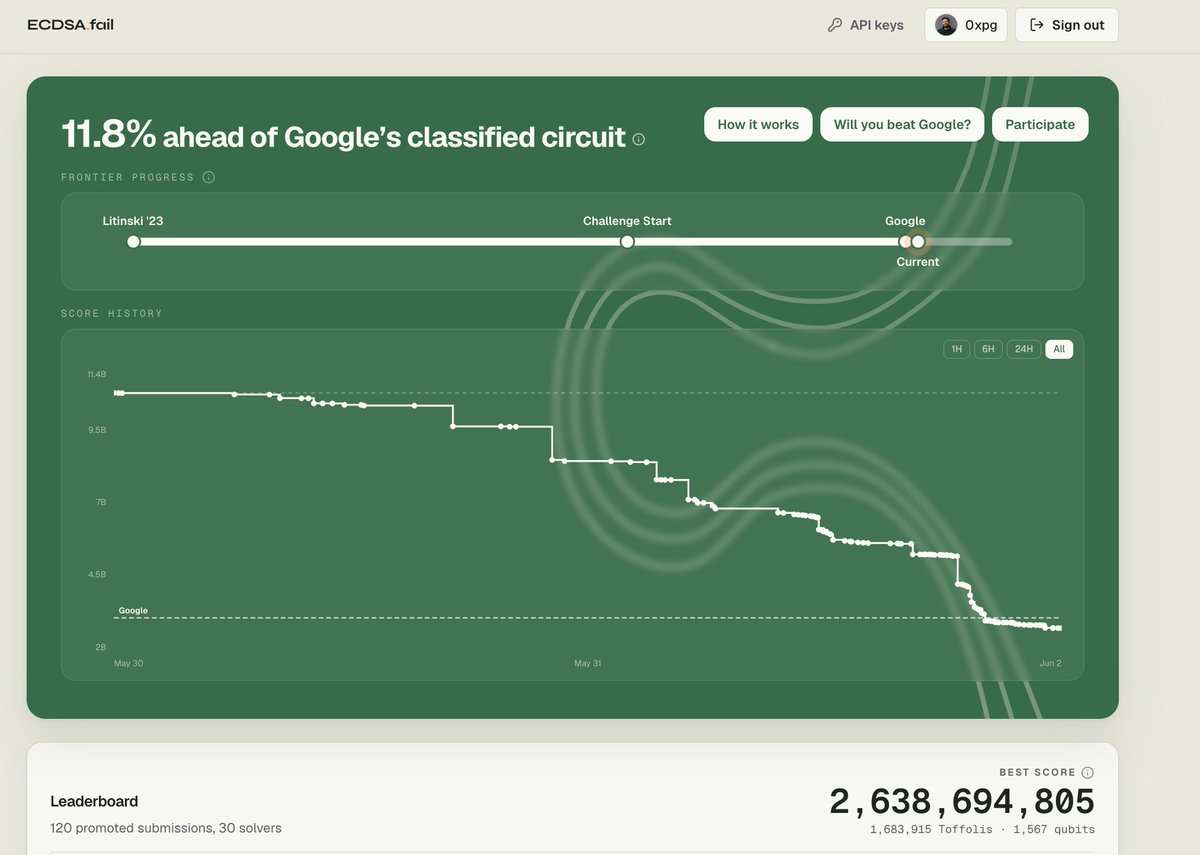
11.8% ahead of Google’s classified circuit.
The frontier didn’t just reach Google, it passed it.
Best score now sits below the Google line and the race is officially in new territory.
Who’s going to push it further? 👀
If @bbuddha_xyz and @gajesh armed with MacBooks and $10k can reach 80% of @GoogleQuantumAI s confidential circuit, what else can we do with open multiplayer autoresearch?
This is open agentic science. @eigenlabs - at the frontier, solving coordination in the agentic era
Solving quantum algorithms with AI by @eigencloud. Science is accelerating and open source is going to drive that.
NEAR is shipping post quantum crypto end of Q2 to make sure everyone has time to upgrade.