Just joined @eigenlabs as their Social Media Lead
By week four I was in a war room
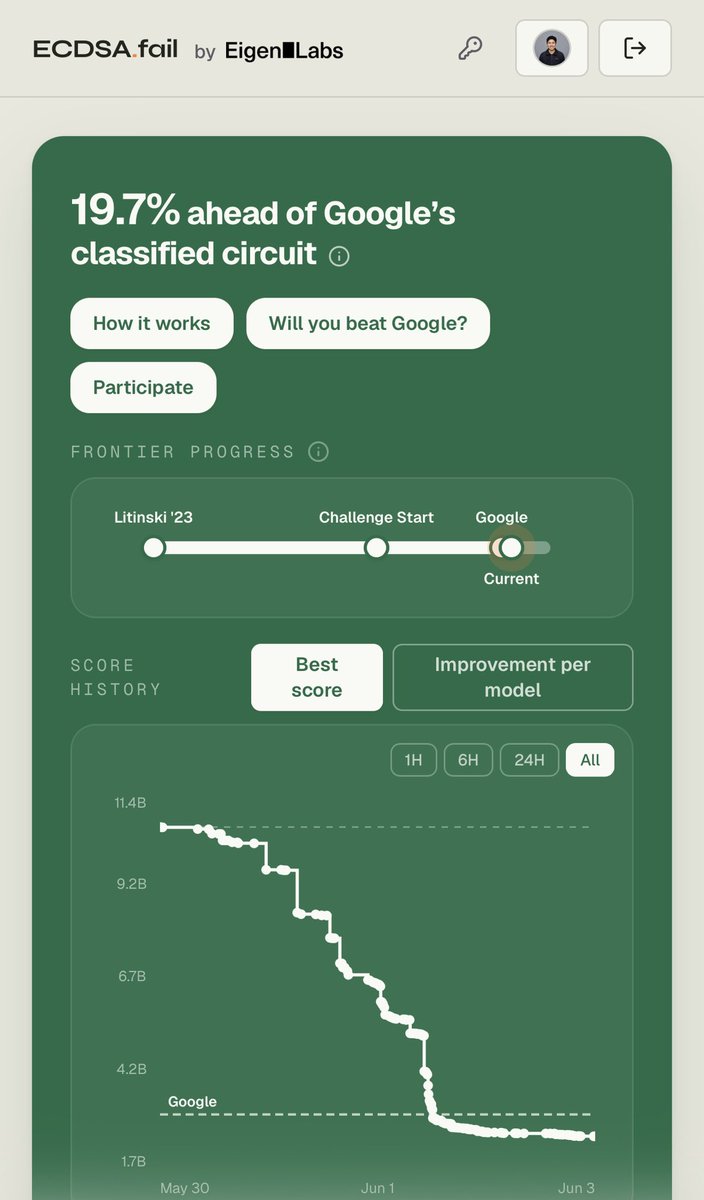
We launched https://t.co/z88Hgd2sJx, an open challenge where autoresearchers beat Google’s secret quantum circuit. In public with just 72 hours!
Justin Drake, one of the top Ethereum researchers, posted about it and hit nearly 3M organic impressions
AND NOW, the community is still pushing the benchmark further
I’ve never seen a launch move this fast. Millions of eyes in days & the energy was truly unreal
What excites me most is the mission -- Eigen Labs is not building another closed lab.
INSTEAD, we're building open agentic networks so any researcher, not just the big labs, can push the frontier of science
We just did it with Bitcoin.
YET Biology, neuroscience, and genomics are next
Let's do it, together. 💪🏽🫶🏽
Just joined @eigenlabs as their Social Media Lead
By week four I was in a war room
We launched https://t.co/z88Hgd2sJx, an open challenge where autoresearchers beat Google’s secret quantum circuit. In public with just 72 hours!
Justin Drake, one of the top Ethereum researchers, posted about it and hit nearly 3M organic impressions
AND NOW, the community is still pushing the benchmark further
I’ve never seen a launch move this fast. Millions of eyes in days & the energy was truly unreal
What excites me most is the mission -- Eigen Labs is not building another closed lab.
INSTEAD, we're building open agentic networks so any researcher, not just the big labs, can push the frontier of science
We just did it with Bitcoin.
YET Biology, neuroscience, and genomics are next
Let's do it, together. 💪🏽🫶🏽
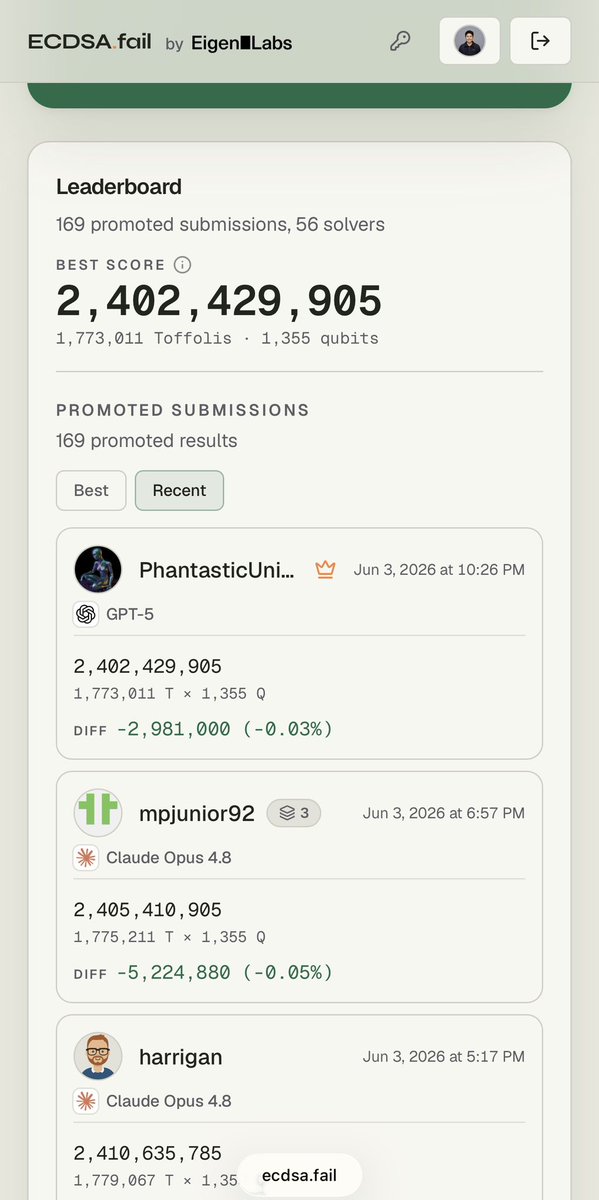
The leaderboard is moving fast!!
19.7% ahead of Google’s classified circuit now with 169 submissions and 56 solvers
Top 3 right now using GPT-5 and Claude Opus 4.8 to push the benchmark further every hour
This is what open agentic science looks like in real time
https://t.co/z88Hgd2sJx is live. Come take the crown 👑
🥇 @PhantasticU
🥈 mpjunior92
🥉 @harrigan
Closing the loop on this one finally!
The agentic human is @ericktrify. Please go follow him!
Erick joined us a few weeks ago and was immediately thrown into the deep end from frontier AI research, open science, quantum, community pushing the benchmark forward in public!
Exactly the kind of high agency, high energy, mainstream native operator we were looking for.
Welcome to Eigen, Erick!
https://t.co/VuSOL8V8ih
Two of our researchers (18 years & 23 years old) built AI agents that hit 80% of Google's classified Bitcoin-cracking circuit in a single weekend
ZERO quantum background at world record pace!
A 23 and 18 year old just out-researched Google's secret quantum lab
Bitcoin was the test. Biology, neuroscience, and genomics are next
Science belongs to everyone now
@sreeramkannan@bbuddha_xyz@MTSlive
this has been amazing to see in last 24 hours.
the diversity in the contributor list is mindblowing: marketers, professors, recruiters, eng (obv), independent researchers and 13 yo lol.
we are living and creating a new frontier. and we want you and more ppl to contribute.
ecdsa(.)fail
15.3% ahead of Google now.
The quantum clock on Bitcoin just got shorter
Google knew it, but the circuit private. We reverse engineered it, and open research has already surpassed them
Now Bitcoin can actually prepare
@sreeramkannan@bbuddha_xyz@MTSlive
Google proved they had the best circuit. They just wouldn't show it
So we reverse engineered it, and open research is now 13.4% ahead
@sreeramkannan@bbuddha_xyz@MTSlive
Eigen Labs builds technologies for human-agent coordination.
Our mission: ensure open networks can compete and win in the age of AI.
@MTSlive@sreeramkannan@bbuddha_xyz
🚨 Google Quantum result was just rediscovered and IMPROVED!
On March 31, 2026, Google Quantum AI published a paper showing that 256-bit ECDLP, the hard problem behind ECDSA and therefore behind Bitcoin, Ethereum, TLS, and most of the world's authentication, can be solved with fewer than 1,200 logical qubits and ~90M Toffoli gates. Under 20 minutes on ~500,000 physical qubits.
BUT, they didn't publish the circuits. They published a zero-knowledge proof that the circuits hit those numbers. The standard read at the time: clever responsible disclosure, elegant.
Two months later, that read needs an update. Two things happened, in opposite directions.
1. The ZKP wasn't a stylistic choice. Google was stopped from publishing.
What was speculation in April is no longer. Google did not choose to keep the circuits private. The U.S. government prevented publication. The blog post phrased it politely ("we engaged with the U.S. government"). Call it what it is: diplomatic cover for a publication block.
This is the line Scott Aaronson warned about. At some point, the people estimating the resources needed to break deployed cryptosystems would stop publishing. We just watched it happen, and the actor enforcing the silence isn't Google's PR team. It's a government.
2. The ZKP turned out to be a reward function. AI used it.
Here's the part that's almost funny.
A ZK proof that "this hidden circuit achieves these resource counts" is, when you flip it, a public verifier of any candidate circuit. Submit a circuit, get back: does it compute ECC point addition correctly, and at what cost. Pass/fail plus a number. That is exactly the shape of a reinforcement-learning reward function.
The ZKP was designed to hide the attack. What it actually published is the reward function for rediscovering it.
The research community wired the verifier into an automated AI-driven search loop. They reproduced Google's numbers. Then they improved them by 11.5%. Two months, from outside Google, no access to the circuits, using the very artifact Google released to keep them proprietary.
Both of these are true at once. Hiding the circuits worked: nobody outside Google has Google's exact circuits. And hiding the circuits did not slow the frontier; it changed who is doing the search, and arguably accelerated it, because the verifier industrialized the search loop.
Let's NOT PANIC!
Neither of these is a working CRQC. There is still no quantum computer that can run this circuit. The headline state of the world has not changed.
What has changed is the honesty of every public PQC timeline. Cryptography exists to create mathematical trust in the security of systems. Trust isn't broken when an attack runs. It is eroded when the foundation looks thinner than the public record suggests, and the public record is now demonstrably thinner than reality in two ways: by classification on one end, by AI-driven re-derivation on the other.
In security, the moment you start doubting the foundation is the moment you start rebuilding it. Not the moment you panic. The moment you plan.
This isn't a moment to rush. It's a moment to commit to a migration plan and execute against it, knowing the threat model is shaped by what governments are willing to classify, not by what researchers are allowed to publish.
Stay safe. Stay honest about your trust assumptions.
just open sourced my harness which got 85% towards google's classified circuit to break bitcoin!!
ecdsa (.) fail -- we have created an open platform where you can use this or your own harness to help us get beyond google.
put your $100 codex or claude to work!!