Bullish crypto educational content on next gen exciting crypto projects like Auditchain/Pacioli, OriginTrail & many more - show some love by following, Thanks
The PCAOB is the watchdog for the auditors of public companies — it sets the standards your auditor works to and inspects the firms. Auditchain wrote to it about the layer above disclosure: assurance.
The thesis, in one line: audit transformation enables oversight transformation.
Three asks. First: align US auditor duties on machine-readable filings with Europe's framework (the CEAOB's ESEF guidelines), so auditors opine on the XBRL layer — not just the pretty PDF. Second: build standards for cryptographically enforced audit trails, from internal controls straight through to the public filing — a working proof of concept already exists in https://t.co/lrFlmCrZDu. Third: get ready for the GENIUS Act's mandate that stablecoin reserves be examined by registered public accounting firms.
Why this is bullish: this is the demand engine. The GENIUS Act doesn't suggest reserve audits — it requires them, by law, by registered firms. If the PCAOB pulls the machine-readable layer into audit scope, every audit firm suddenly needs tooling to verify tagged disclosures against source data, continuously, at scale. Manual sampling doesn't survive that world; automated, cryptographically enforced validation does. That's the https://t.co/lrFlmCrZDu network: disclosures validated by decentralized infrastructure, settled in AUDT. Auditchain isn't waiting for the audit industry to modernize and hoping to sell it software — it's writing the standards that will force the modernization, then selling the rails it runs on.
Filed: https://t.co/1cftH6Obnf
Policy: https://t.co/QFPTHOCBEw
@Auditchain@pacioli_ai $AUDT
The SEC polices America's securities markets — stocks, bonds, and everything that smells like an investment contract. Auditchain took its machine-readable disclosure thesis there too, in two filings.
Filing one (February): as the SEC modernizes Regulation S-K, extend Inline XBRL beyond financial statements to the narrative items — Business (Item 101), Risk Factors (105), Cybersecurity (106), MD&A (303), Exhibits (601). The argument: the "avalanche of immaterial information" problem isn't just what companies disclose, it's how. Unstructured PDFs can't be filtered, compared, or checked at scale. Tag them, and machines — and regulators — can actually verify what's material.
Filing two (April): on the staff statement about crypto user interfaces, Auditchain argued the nine required disclosure categories should be delivered in a structured taxonomy — comparable, aggregable, automatically validated across every provider — instead of prose on a website nobody reads.
Why this is bullish: SEC filings are the largest disclosure corpus in world capital markets. If narrative disclosure goes machine-readable, someone has to validate millions of tagged instances — values against audited numbers, element use against meaning, period-over-period consistency. That validation layer is https://t.co/lrFlmCsxt2's entire reason for existing: a DePIN where a decentralized network externally validates disclosures. And the coming CLARITY Act will mint whole new classes of SEC registrants — digital asset issuers, exchanges, brokers — each one a new customer for exactly this infrastructure. The bigger the registrant universe, the more validation work flows through the network, the more AUDT gets used for settlement and staking.
Filed: https://t.co/Ht5t0s2j7U
https://t.co/5pfJEenlMO
Policy: https://t.co/QFPTHOD9u4
@Auditchain@pacioli_ai $AUDT
The NCUA is the FDIC's cousin for credit unions — it insures credit union deposits and supervises the system. Under the GENIUS Act, it's writing the rules for stablecoin issuers owned by credit unions.
Auditchain's filing asks the NCUA to require blockchain network activity disclosure from stablecoin applicants and to adopt XBRL structured data — coordinated with the FDIC, OCC, and Federal Reserve, so issuers file once, not four times.
Here's the part most people miss: unlike the banking agencies, the NCUA has no XBRL reporting infrastructure at all. Zero. This rulemaking is its first chance to adopt the standard — a genuine greenfield.
Why this is bullish: greenfields are where standards get set. The NCUA has to build its digital-asset reporting from scratch, and Auditchain is the one handing it the blueprint — the same BNP framework, the same 125-element taxonomy, the same equal-input/equal-output validation architecture it's proposing everywhere else. When a regulator adopts your framework at birth, you don't compete for the market later. You are the market's default shape. Multiply that across every agency in the GENIUS Act orbit and you get a single disclosure lattice with https://t.co/lrFlmCsxt2 sitting at the center of it, AUDT settling every validation.
Filed: https://t.co/jxY2pQT0pG
Policy: https://t.co/QFPTHOD9u4
@Auditchain@pacioli_ai $AUDT
The OCC is the agency that charters America's national banks — it decides who gets to be a bank. Under the GENIUS Act, it's also writing the stablecoin rulebook for issuers under its supervision.
Auditchain filed twice with the OCC. The ask: weekly, monthly, and quarterly disclosures in machine-readable XBRL, plus blockchain-specific risk controls — validator uptime, consensus participation, key management, smart contract validation.
The elegant part: Auditchain proposed a new Schedule RC-T-DA for the quarterly Call Report — the same FFIEC reporting system banks have used since 2005, running at 95% data validation rates, now extended to digital asset custody. No new plumbing. The pipes already exist; just run crypto through them.
Why this is bullish: bank Call Reports are the most battle-tested XBRL system on earth. If digital asset disclosure rides those same rails, every bank touching crypto needs tooling that speaks XBRL natively — producing, tagging, and validating instances at scale. That's https://t.co/lrFlmCsxt2's home turf: machine-readable disclosure automation with a decentralized validation network behind it. And because Auditchain is pushing the FDIC, OCC, and Fed toward one coordinated taxonomy, this isn't three separate compliance products — it's one standard, one network, one token settling the validation work. ethereum:0xb90cb79b72eb10c39cbdf86e50b1c89f6a235f2e.
Filed: https://t.co/6BKlbKPX4n
Policy: https://t.co/QFPTHOD9u4
@Auditchain@pacioli_ai ethereum:0xb90cb79b72eb10c39cbdf86e50b1c89f6a235f2e
The FDIC is the agency that insures your bank deposits. Less known: under the GENIUS Act, it's now also writing the rulebook for stablecoin issuers owned by banks — the "permitted payment stablecoin issuers."
Auditchain has filed three comment letters with the FDIC this year (February, March, and May). The core idea is simple: don't just make issuers prove they hold reserves. Make them disclose — in machine-readable XBRL data — what they actually do on blockchains.
Mining, staking, validating, running nodes, operating infrastructure: Auditchain calls this "Blockchain Network Participation," and built a 148-question, 125-element disclosure framework for it. A reserve attestation tells you the money is there today. BNP disclosure tells you whether the issuer's blockchain operations could break redemption tomorrow — validator concentration, MEV extraction, slashing history, affiliate validators that could censor your transactions.
Why this is bullish: the FDIC is where stablecoins collide with the banking system, and whoever writes the disclosure taxonomy writes the rails everyone else has to run on. If BNP-style disclosure becomes the FDIC standard, every bank-issued stablecoin needs infrastructure that produces and validates machine-readable disclosure — which is literally what https://t.co/lrFlmCrZDu is: a decentralized network for creating and externally validating disclosures, with AUDT as the token for settlement, staking, and governance.
Auditchain isn't lobbying from the sidelines. It's handing regulators the finished blueprint. First movers who write the standard tend to own the infrastructure built on it.
Filed: https://t.co/sRePO9JJ1u
Policy: https://t.co/QFPTHOCBEw
@Auditchain@pacioli_ai $AUDT
@origin_trail has gone through a lot of evolutions.
From supply chains → decentralized knowledge → Knowledge Assets → Verifiable AI → agent memory.
Each version built a bigger engine.
Now DKG V10 is live, built for a world where AI agents need trusted context, shared memory and verifiable knowledge.
And it feels like we're only getting started. 🧠⚙️🌐
Time to get on $TRAC for the future
Clarity Act cloture failed — regulation is still coming.
@CryptoRichYT × @JasonMeyersNYC (Lead Architect, Auditchain Labs AG — not CEO) on why on-chain finance needs verifiable disclosure.
@Auditchain: "We are the voice of reason to regulators."
That's the RegFi lane @pacioli_ai is built for.
Pacioli Ledger is live. Pacioli Audit is not launched.
https://t.co/44hXmLlMpD
@pacioli_ai@Auditchain #RegFi $AUDT
The cloture vote for the Clarity Act may not have passed, but crypto regulation is still coming as @JasonMeyersNYC, founder of @pacioli_ai explains.
https://t.co/P8gxk0CLTV
V10 staker conviction isn’t a fixed APR.
Lock longer → higher reward weight (official docs):
• No lock 1×
• 1 mo 1.5×
• 3 mo 2×
• 6 mo 3.5×
• 12 mo 6×
Your share of publishing-fee rewards scales with that weight × node activity. Check live node yield on the dashboard before you lock — don’t invent an APR.
https://t.co/VRmNBpo1bp
https://t.co/kyr0cyR3xB
@origin_trail $TRAC
@bridgetoai Exactly — drafting is the easy part. Grounding the claim in structured, verifiable data is what makes claims automation shippable. That’s the DKG lane.
AI hallucinations aren't a glitch — they're how GenAI works.
LLMs don't look up facts. They predict the next token: probabilistic guesses that can sound right even when wrong.
That risk is highest where precision matters — medicine, education, supply chains, science.
OriginTrail's Verifiable Internet for AI whitepaper frames the fix: information provenance so responses can be checked against known sources, not trusted on tone alone.
Grounding AI in verifiable knowledge is how you manage hallucinations at scale.
#OriginTrail #DKG #AI
@origin_trail
Not a fact-checker for the whole internet. A provenance layer so you can ask where a claim came from.
#OriginTrail#DKG#TRAC@origin_trail#AI
https://t.co/l2WDujeg4d
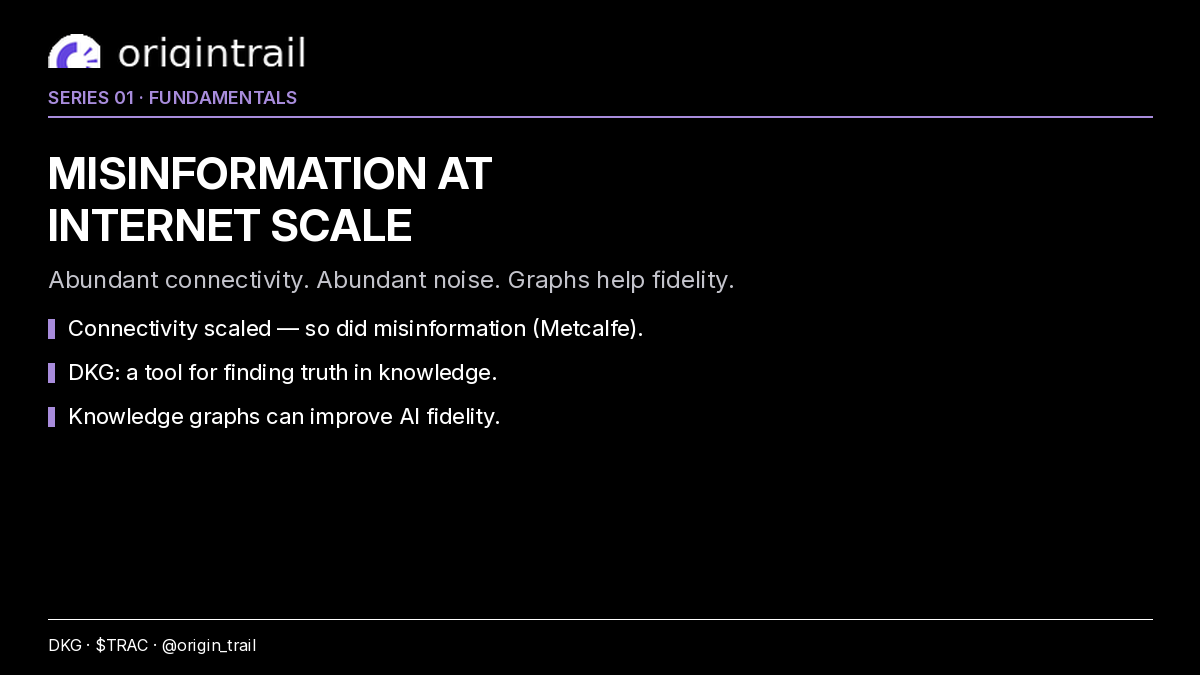
Abundant connectivity. Alas, abundant misinformation.
Dr. Bob Metcalfe (Ethernet inventor & Internet pioneer), quoted on https://t.co/TbkC7qC803: the OriginTrail DKG is an evolving tool for finding the truth in knowledge — and knowledge graphs can improve the fidelity of AI.
Not a fact-checker for the whole internet. A provenance layer so you can ask where a claim came from.
#OriginTrail #DKG #TRAC @origin_trail #AI
https://t.co/ocUfnGAOHH
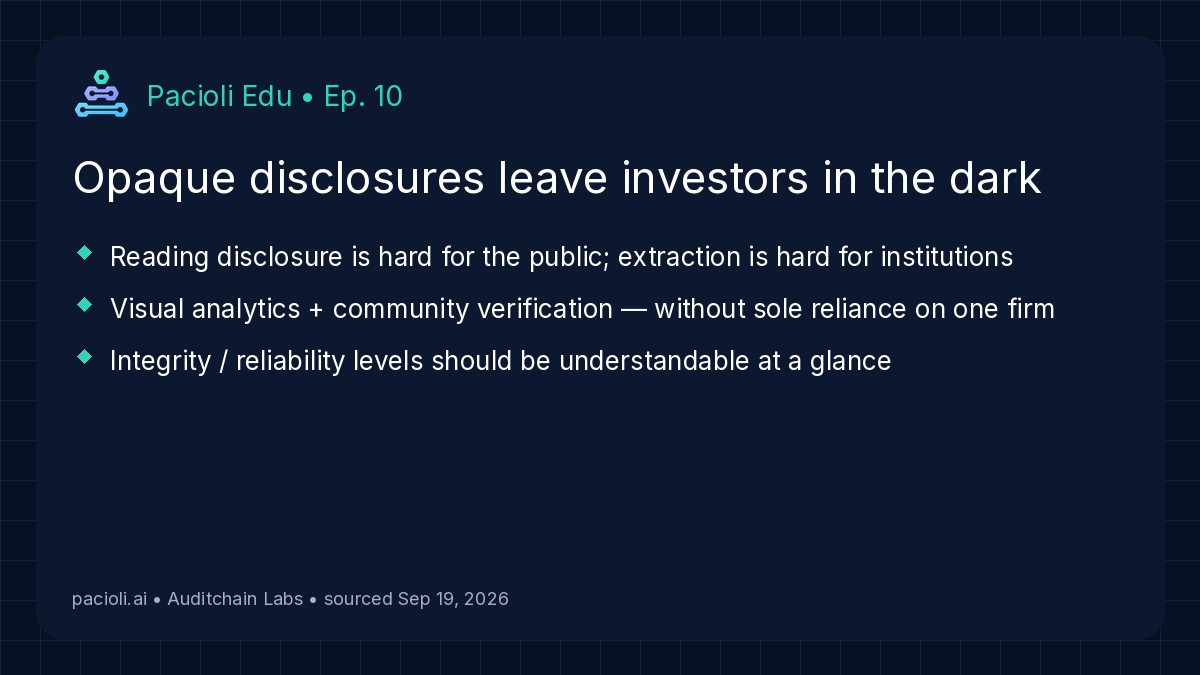
Pacioli Edu · Ep. 10 — Investors cannot parse opaque disclosures
From Auditchain Labs (verified today):
Reading & understanding disclosure data is hard for the public. Extraction is hard for institutions.
Visual analytics + community verification can raise comfort without sole reliance on a centralized firm. Integrity/reliability levels should be understandable quickly.
https://t.co/yUuS5UWIll
#Pacioli #Auditchain #XBRL @Auditchain@pacioli_ai
OCC wants weekly + quarterly stablecoin reports (Forms PS-01 / PS-02).
Auditchain Labs' Aug 11 comment didn't just argue — they shipped working proof:
• Full FDTA-ready logical models of both forms
• +3 BNP schedules (mining / validation / staking)
• 197 machine-enforceable validation rules
• Live in-browser demos — no install
Jason Meyers (Lead Architect, Auditchain Labs AG): the OCC doesn't need to invent the infrastructure — it's already built.
@pacioli_ai
https://t.co/RM38NIVbzu
Swiss Federal Railways (SBB) has run an OriginTrail-powered EPCIS repo in production since 2021.
Per GS1: EU train tracking, predictive maintenance on wheels (IoT), welding/maintenance events across 10+ partners.
Not a demo — multi-party verifiable knowledge, already shipping.
@origin_trail $TRAC
https://t.co/i5Z8QK2Qdu
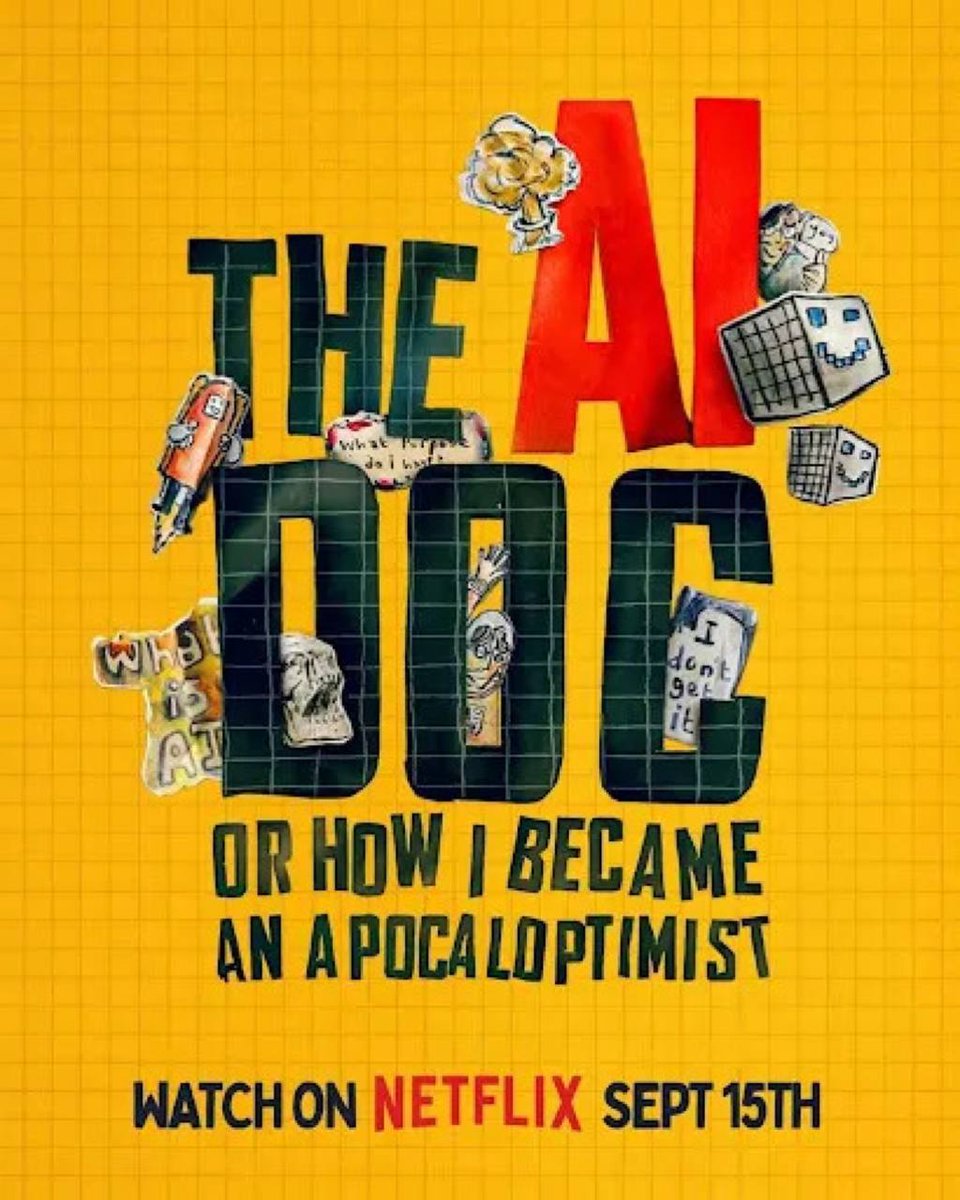
Deepfakes need more than a takedown button. @origin_trail × @umanitek Guardian: real-time detection of deepfakes and AI harm, powered by the DKG. DKG gives agents verifiable context. A cofounder made the Netflix film naming the risk.
https://t.co/8lpEqzmLF1
🎬 @aza Raskin helped make @theaidocfilm.
He also co-founded @umanitek.
One explains the risk. The other acts on it — real-time detection and takedown of deepfakes, impersonation, and AI-driven harm, powered by @origin_trail.
New on @netflix!
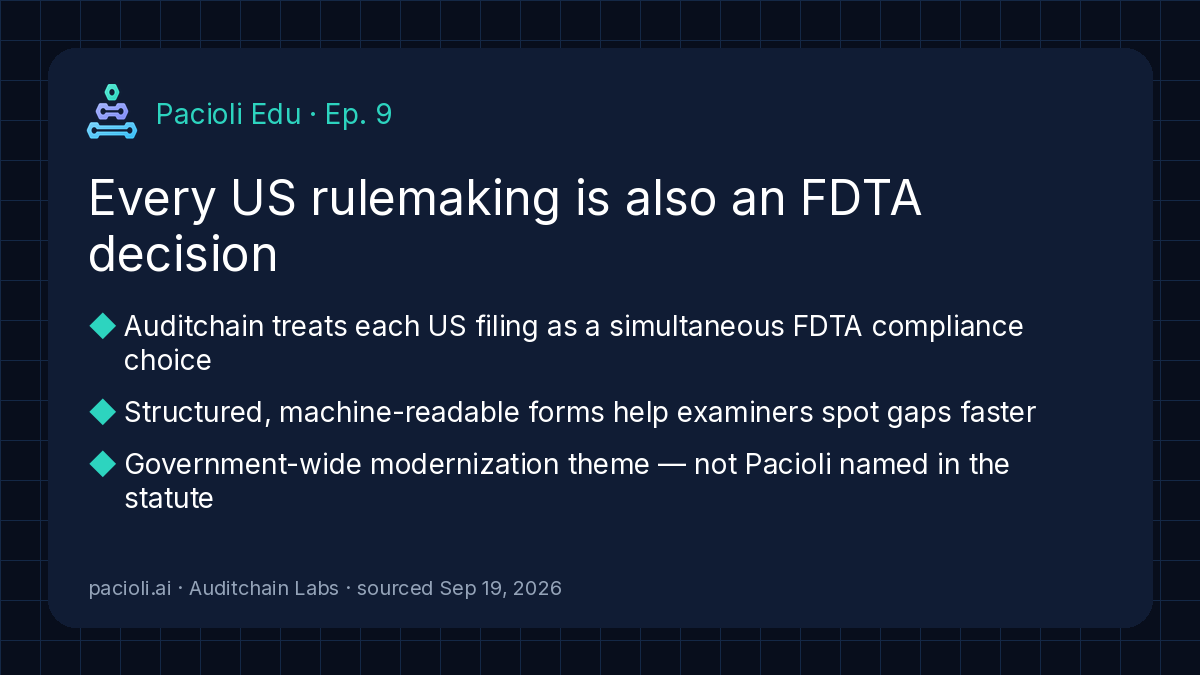
Pacioli Edu · Ep. 9 — FDTA lens on every rulemaking
From Auditchain Labs' regulatory engagement page (verified today):
Each US submission treats every rulemaking as a simultaneous Financial Data Transparency Act (FDTA) compliance decision — built on their BNP disclosure taxonomy.
Why examiners care: machine-readable forms make gaps easier to detect. Structured data is a government-wide modernization theme.
Not claimed: FDTA does not name Pacioli. This is how Auditchain frames its agency engagement — not an agency endorsement.
#Pacioli #Auditchain #XBRL
@Auditchain@pacioli_ai
https://t.co/ud13PLMIuP
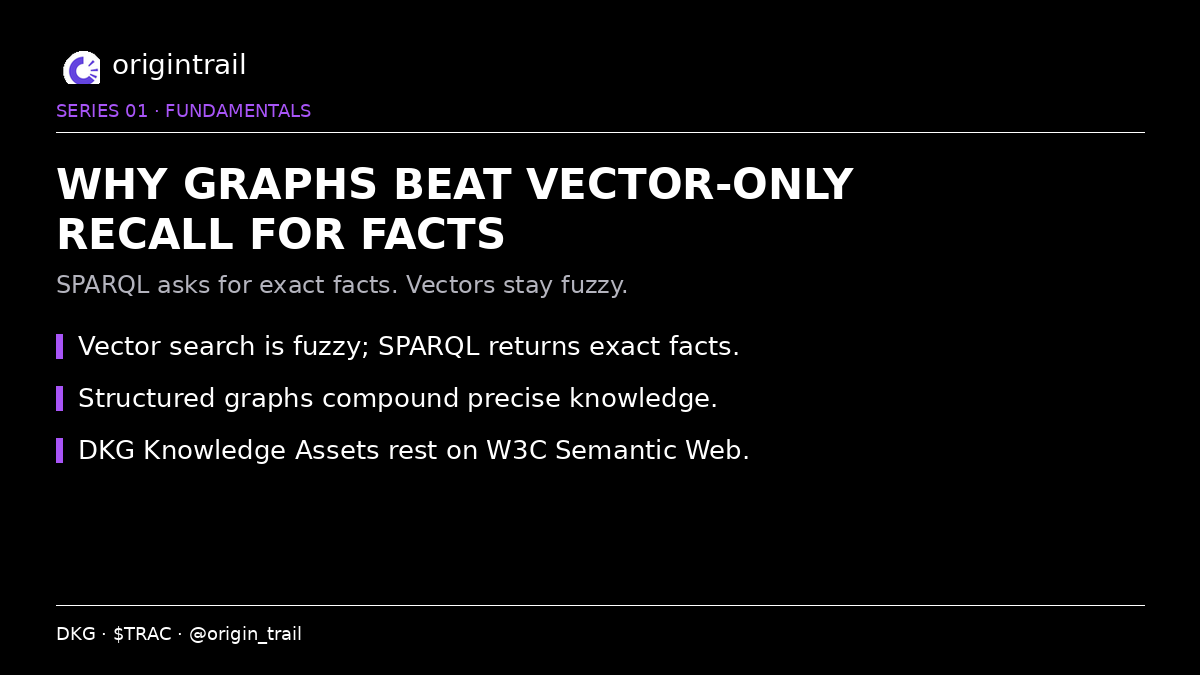
Vector search is great for vibes. Facts need something sharper.
Fuzzy nearest-neighbor ≠ an exact answer. SPARQL asks for the facts you need — and gets those facts back.
OriginTrail DKG stores knowledge as structured graph data built on W3C Semantic Web standards. Knowledge Assets are published RDF with provenance. Vectors still help for fuzzier recall — they don't replace precise queries.
#OriginTrail #DKG #TRAC @origin_trail #AI
https://t.co/ocUfnGAgS9
https://t.co/WY8q6tyd1B
Reg-CA isn't just fundraising caps.
If adopted, the real work is Form 1-CRYPTO + ongoing Forms 1-KC / 1-SC / 1-UC — all via EDGAR.
Official Auditchain take: @pacioli_ai is built to automate that lifecycle — ingest docs, smart-contract code, tokenomics + financials → principles-based narratives + US GAAP → EDGAR-ready packs (incl. XML Part I).
Still a proposal (Aug 18). Comments due Oct 20, 2026 (SEC S7-2026-27).
Pacioli Ledger is live. Pacioli Audit is not launched.
Jason Meyers, Lead Architect – Auditchain Labs AG
https://t.co/R2ka1hJOjr
@pacioli_ai@Auditchain #RegFi $AUDT