A segment from the pre-war Filipino film 𝘛𝘶𝘯𝘢𝘺 𝘯𝘢 𝘐𝘯𝘢 (1939). It shows how the terno moved and how it was handled when the wearer danced.
This movie is one of only 6 feature-length films that survived the Japanese occupation during World War II.
Under a crescent moon, two cats fraternize on the rooftop. Below them is the shadow of two people conversing behind the translucent sliding screen. The marginal text comments that “there’s no difference between high love and low love” (Japanese postcard, 1908)
Sabi ni Sen. Robin Padilla, kung manalo daw siya as VP ni Sara Duterte eh ang hihingin nyang pwesto eh yung involved sa war on drugs.
Hihigitan daw nya si Katay Digong – “bloodier” war daw.
Naku, kelangan na natin mag rejoin sa ICC before 2028. 👊
#CrimesAgainstHumanity
“Because children grow up, we think a child's purpose is to grow up. But a child's purpose is to be a child. Nature doesn't disdain what lives only for a day. It pours the whole of itself into the each moment."
Tom Stoppard, THE COAST OF UTOPIA
RIP and thanks for such wonderful words
Greek bronze hand mirror decorated with the fearsome head of Medusa, with protruding tongue and coiled snakes in her hair. Used by a woman in southern Italy in the 5th century BC, the Gorgon mirror would have guarded its owner while she admired her reflection. Getty Museum
The Metamorphosis of Daphne. Italian School, Trapani, Sicily. Date: 17th century AD. Medium: Red coral figure with gilt copper mounts on a later wood base. H. 22 cm. Collection: Private collection.
This sculpture represents a brilliant intersection of biology, mythology and supreme craftsmanship specific to the city of Trapani in Sicily. During the 17th century this port city became one of the principal centres of coral processing in the Mediterranean thanks to the vast banks of Corallium rubrum discovered nearby. Artisans here did not just carve the material they collaborated with it. You can see how the sculptor utilized the natural branching growth of the coral colony to represent the very moment Daphne transforms into a laurel tree to escape the god Apollo. Her fingers extend into the natural forks of the coral which are tipped with gilded copper leaves, blurring the line between the artwork and the raw material.
What makes this choice of medium intellectually fascinating is the ancient mythology surrounding coral itself. According to Ovid, who also wrote the story of Daphne, coral was born from the blood of Medusa. When Perseus severed the Gorgon head and laid it on a bed of seaweed, the blood turned the plants into stone. Therefore the artist is sculpting a story of metamorphosis (Daphne turning into a tree) out of a material that was physically defined by metamorphosis (seaweed turning to stone via blood).
see-1: https://t.co/Bk3R30Dygb
On this tiny rectangle of paper a whole world of auspicious symbols competes for attention. A smiling bat spreads its wings at the top, another hangs below, while the centre is dominated by a stylised cash coin with a square hole. On both sides sit huge red characters of the ligature 囍, the famous Double Happiness sign, and the narrow yellow panels carry Chinese inscriptions. The left column reads 喜錢為記, which can be translated loosely as Happy Money as trademark, and the right column names the maker Taixing.
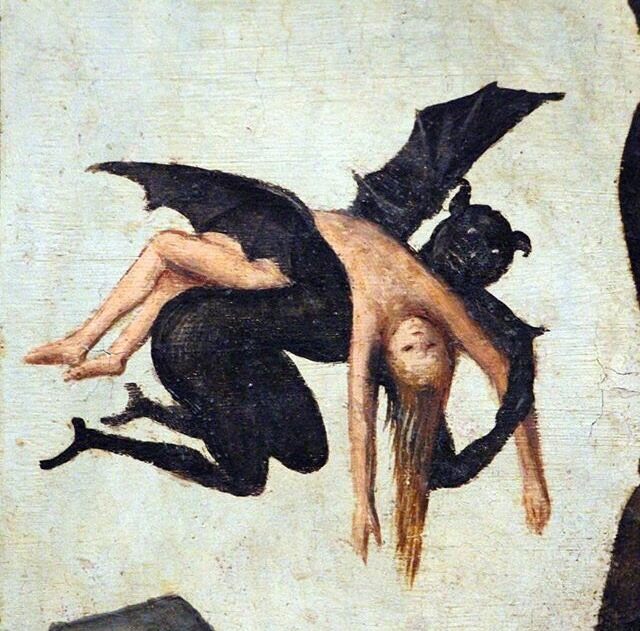
The Last Judgment and the Mass of Saint Gregory (detail). Artist: Master of the Artés Family (active in Valencia; possibly Pere Cabanes). Place of origin: Valencia, Spain. Date: c. 1500–1520 AD. Medium: Oil on panel; 200 × 130 cm. Collection: Museu de Arte de São Paulo (MASP); inv. MASP.00428.
17th century Dutch artist Adriaën Coorte achieves a Japanese-like simplicity and restraint in this still life with three medlar fruits on a deeply-shadowed ledge, with a butterfly hovering above, emerging out of the darkness (1695, private collection)
Eye from a Bronze Statue, Greek, 5th–2nd century BC; marble, obsidian, glass, and copper; 2.1 × 4.9 cm. Collection: The J. Paul Getty Museum, Villa Collection, Malibu.