Patients pay the price when #BigPharma sues repeatedly to delay affordable generics.
In KevinMD, Dr. Reuben Mathew explains how #SerialPatentLitigation keeps drug prices high—and why Congress should stop this abuse.
Read more: https://t.co/op6heK5wsU
The data is in, and it proves the system is rigged.
We reviewed hundreds of pharmaceutical patent lawsuits and uncovered dozens of examples where Big Pharma used serial patent litigation (SPL) to bully generic competitors and try to extend their monopoly prices.
The playbook is dirty:
-Brands obtain and assert new patents on old drugs even AFTER a generic company files for approval to enter the market and compete.
-When brands sue generic competitors, they often hold some patents in reserve — then use those patents to file a second or third lawsuit if they lose the first.
It’s time for Congress to END Big Pharma patent abuse and serial patent litigation. #PatentReform #AffordableRx
Brand drugmakers have raised list prices on nearly 250 prescription drugs this summer for a total of 1,284 price hikes so far this year. Common-sense policy solutions are needed to rein in drugmakers’ anti-competitive practices and bring drug prices down. https://t.co/JPPBorrJ7b
How is this even legal? 🛑
1. Generic company files to offer a lower-cost version of Exparel, a surgical anesthetic.
2. Brand-name company sues for patent infringement.
3. Court rules the brand's patents are INVALID.
4. Brand-name company ignores the loss, files five more lawsuits asserting other patents, and forces an additional five-year delay.
Because of abusive serial litigation, patients won't see a cheaper option until 2030.
A clear legal victory for affordable healthcare was made meaningless by Big Pharma bullying. We need patent reform NOW. #LowerDrugPrices #HealthcareReform
Imagine working your whole life, only to watch your retirement savings swallowed up by a broken healthcare system.
This National Senior Citizens Day, the reality is stark: Big Pharma is weaponizing the patent system to protect corporate profits at the expense of our seniors' health.
By repeatedly suing would-be competitors for patent infringement, even after losing previous suits, brand-name companies delay affordable generics — forcing seniors on fixed incomes to keep paying sky-high prices.
Enough is enough. Stop the patent abuse. Protect our seniors. #NationalSeniorCitizenDay #AffordableRx #HealthcareReform #StopPatentAbuse
On National Patient Advocacy Day, we celebrate those who speak up to help patients get the care they deserve — including affordable prescription drugs.
As Congress works to lower drug costs, patient advocates play a critical role in ensuring patients’ voices remain at the center of the conversation.
#LowerDrugCosts #NationalPatientAdvocacyDay #PatientAdvocates #PatientAdvocacy #EndSerialPatentLitigation
Your voice has power. Use it. 🗣️
This National Patient Advocacy Day, we’re celebrating the patients whose stories have helped lower prescription drug prices and reminding everyone that real change happens when people speak up.
You don’t have to be a policy expert to make a difference. Your experience, your story, and your voice can help build a future where prescription drugs are affordable for everyone.
Watch the full video to hear from patient advocates who are using their stories to create change and learn how you can join them: https://t.co/vVlyLijeic
New research on 15 high-volume brand-name drugs found that prompt access to lower-cost generic alternatives could save state governments nearly $6 billion annually.
That is money states could use for schools, roads, public safety, and health care — instead of paying inflated brand-name drug prices.
It’s time for Congress to pass a bill to stop serial patent litigation and get affordable generics to patients sooner.
https://t.co/tR00ifwKBC
Sunosi helps those suffering from narcolepsy and obstructive sleep apnea — and it can cost patients over $1,000 a month.
When a generic company tried bringing a lower-cost version to market, Sunosi’s brand-name manufacturer sued for patent infringement.
Then it sued again. And again. And again.
Ten lawsuits, 34 patents, and millions of dollars in legal fees later, the generic company finally agreed not to launch until at least 2040.
That’s serial patent litigation. It hurts all Americans, and Congress must stop it.
#LowerDrugPrices #EndSerialPatentLitigation
Congress may be on recess, but Americans are still paying sky-high prices for the medicines they need.
When lawmakers return to Washington, lowering drug prices must be a priority. That starts with ending Big Pharma's serial patent litigation that delays affordable drugs and keeps patients paying sky-high monopoly prices.
@SenBillCassidy@SenRandPaul@SenSanders@SenatorHassan@GOPHELP@HELPCmteDems #CongressRecess #LowerDrugPrices #EndSerialPatentLitigation
For decades, the Hatch-Waxman Act provided a clear, streamlined process for affordable generic drugs to enter the market and save patients money — but Big Pharma has found new ways to exploit the system by suing would-be competitors again and again over the same drug.
“What was supposed to be a single proceeding over a defined set of patents no longer holds; instead, generics face waves of litigation that can delay entry by years,” explains @RSI in a recent blog. That costs patients and taxpayers billions of dollars.
Congress must end Big Pharma's serial patent litigation.
Read more: https://t.co/zdge4BxE0h
Big Pharma delays. Everyone pays.
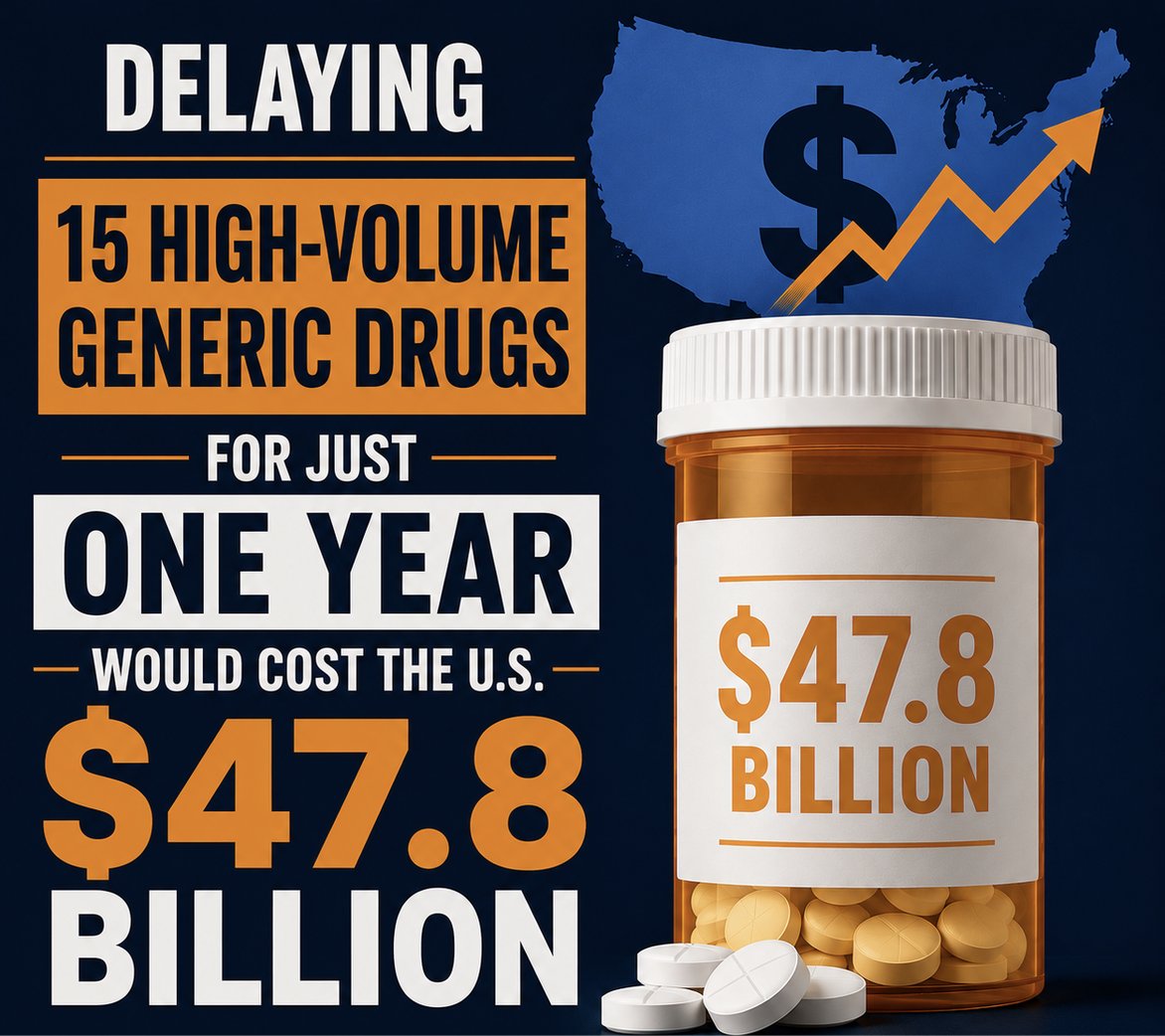
New research shows that delaying generic versions of just 15 high-volume drugs for one year would cost Americans $47.8 billion. Guess who profits? Big Pharma!
To make health care more affordable, Congress must stop Big Pharma’s patent games — especially serial patent litigation.
https://t.co/tR00ifwKBC
Today marks the 236th anniversary of the first US patent, awarded for a new method of making potash and pearl ash, which were used as fertilizers and baking ingredients in the 1700s.
The patent system was designed to reward innovation. But Big Pharma has learned how to abuse it: building patent thickets, filing repeated lawsuits, and using the legal system to keep lower-cost generics off the market — and force Americans to keep paying monopoly prices long after patent protections should have expired.
It’s time for Congress to step in and block Big Pharma from exploiting the US patent and legal systems.
https://t.co/AR5HyZsZFz
The Senate just unanimously passed the Affordable Prescriptions for Patients Act, which would crack down on Big Pharma’s abusive “patent thickets” that block affordable drugs and keep costs high.
This bipartisan momentum should not stop with patent thickets.
Brand-name drug companies also use serial patent litigation — suing generic competitors again and again, often over newly issued patents — to delay lower-cost medicines and keep Americans paying monopoly prices.
Congress should tackle every form of patent and legal abuse that blocks competition and keeps drug costs high. It’s time to #EndSerialPatentLitigation.
https://t.co/HZi52y6l6G @ChuckGrassley
In 2024 alone, generic drugs saved the U.S. health care system $446 billion.
But Americans could save even more if Congress passes a bill forcing Big Pharma to stop playing legal games that delay lower-cost generics and keep monopoly prices in place.
Tell legislators it's time to TAKE ACTION and #LowerDrugPrices.
https://t.co/3pqlkGPqCi
When Big Pharma prevents affordable generic drugs from coming to market, everyone pays.
Research on 15 high-volume brand-name drugs found that delayed access to generic drugs would drive up costs for everyone — commercial insurers, Medicare Part D, Medicaid, state governments, employers, and taxpayers.
Congress must pass legislation to stop Big Pharma’s tricks that delay competition.
Read more: https://t.co/tR00ifwKBC
When generic competition arrives, prices fall fast.
Researchers found that introducing generic versions of a drug immediately lowers average drug prices by 30–60% and by 50–80% within three years.
Every tactic that delays generics keeps those savings out of reach.
@AccessibleMeds president John Murphy III outlines the need for a generics-first policy framework in the US in @PharmaBoardroom.
Generics have “delivered $3.4 trillion in savings over a decade while prices for brand drugs have continued to climb along with their monopoly over patient access.” Lawmakers must help affordable generic drugs come to market faster, increase drug competition, and save patients millions.
Read more: https://t.co/B8eaIn9vca
Serial patent litigation is one of Big Pharma’s favorite tactics to pad its profits at Americans’ expense. Brand-name companies sue generic competitors again and again to keep lower-cost drugs from reaching patients.
After filing an initial patent lawsuit, Big Pharma can obtain additional patents to use in future lawsuits for as little as $25,000 each — while generic competitors spend an average of $6.2 million to fight each patent-infringement suit.
That cost difference helps Big Pharma to protect monopoly prices and keep patients paying more.
More from @RSI:
https://t.co/zdge4BxE0h