The Quds Force is not merely the operational arm of the Islamic Revolutionary Guard Corps (IRGC); it is a global mechanism for force-building, terrorism, smuggling, and influence projection. This new study, In the attached special report, demonstrates that it is a multi-dimensional organization operating through regional corps, specialized units, and a strategic force-building apparatus, enabling the Islamic Republic of Iran to strengthen and expand its proxy network across the Middle East and beyond.
Despite the setbacks it has suffered in recent years including the elimination of senior commanders, strikes on critical infrastructure, and sanctions the Quds Force continues to demonstrate a high degree of operational adaptability ( development of alternative smuggling routes and its deepening cooperation with international criminal networks), rapid recovery capabilities, and the ability to adjust to strategic changes.
The principal significance of the framework agreement signed between the United States and the Islamic Republic of Iran on June 17, 2026, extends beyond the nuclear issue alone. If the agreement leads to economic relief, the release of resources, or a reduction in pressure on Tehran, the Quds Force is likely to be among its primary beneficiaries. Past experience suggests that additional resources are often translated into greater investment in strengthening the Islamic Republic proxies, advancing missile and UAV capabilities, expanding smuggling networks, and intensifying covert terrorist activities across global arenas.
The central challenge in the coming years will not only be containing Iran’s nuclear program, but also monitoring and disrupting the Quds Force’s ability to rebuild, finance, and expand Iran’s regional and international network of influence. Ultimately, any future arrangement with Tehran will be judged by one critical question: does it constrain the Quds Force, or does it provide it with the breathing space necessary for renewed expansion and reconstitution?
#Iran #IRGC #QudsForce #MiddleEast
Read the special report in the link below>>
https://t.co/tD1jsPSW1L
The preliminary U.S.-Iran deal, which was read to reporters by a U.S. official on Wednesday, appears to create a process for opening the Strait of Hormuz in the short run. It also lays out a 60-day timetable to address many issues that remain, including the details for constraining Iran’s nuclear ambitions, as well as the scope of sanctions relief and financial support for Iran.
"Needless to say, there are a lot of details to be negotiated and, if the past is prologue, good reasons to be skeptical that a comprehensive peace, even if reached, will hold," writes CFR President @MikeFroman. "Nonetheless, this could be seen as breaking a deadlock that has threatened the global economy, even if it puts on the table issues we may later come to regret."
MORE: Iran will likely use renewed economic access under the MoU to reconstitute members of the Axis of Resistance, particularly Hezbollah, during the 60-day negotiation period. Iran has already told Hezbollah that it will increase its funding as soon as possible once the United States unfreezes Iranian assets. Israel badly degraded Hezbollah during the October 7 War. The collapse of the Assad regime in Syria made Hezbollah’s resupply more difficult, and Iran’s competing priorities—including rebuilding its own assets without any financial relief after June 2025—made funding the reconstitution of Hezbollah and other Axis members relatively more challenging. Iran did provide Hezbollah with roughly $1 billion USD between the 2024 war and the 2026 war, but relaxing sanctions and providing Iran with greater access to revenue will provide Iran with more money it can choose to provide to Hezbollah. Clause 11 of the MoU, as reported by Bloomberg, states that the United States may unfreeze Iranian assets in response to “progress of negotiations towards a final agreement.” Lebanese and regional sources told Reuters on June 17 that Iran has promised Hezbollah that it will increase the group’s funding ”as soon as possible,” once the United States unfreezes Iranian assets as a part of the MoU. The degree to which Axis of Resistance factions remain contained or weakened after the last nearly three years of war is in large part contingent on how much funding Iran can provide to them.
The Israel Defense Forces (IDF) and Hezbollah have continued to engage one another in southern Lebanon, in spite of the US-Iran MoU.
Hezbollah, Iranian officials, and Iranian media continued to claim on June 17 that the US-Iran agreement requires Israel to cease operations against Hezbollah and ultimately withdraw from southern Lebanon
When Donald Trump spoke of “Project Freedom” to reopen the Strait of Hormuz, the plan was supposed to be a display of restored American deterrence: an operation meant to prove that Washington could still open the world’s energy artery with its military fleet and its network of regional bases. Yet the rapid suspension of the project, after Saudi Arabia’s initial opposition to the use of its bases and airspace, carried a deeper meaning. This was not merely an operational disagreement.
#Opinion by Timothy Hopper
Read: https://t.co/gumDkRuFXZ
Pour ceux qui ne connaissent pas Amjad Taha : c'est un commentateur du Golfe, proche des courants favorables aux Accords d'Abraham et très critique envers l'Iran et les Frères musulmans.
Son message ne porte pas seulement sur Israël. Il traduit une inquiétude plus large que l'on entend aujourd'hui chez certains partenaires des États-Unis au Moyen-Orient : si Washington peut conclure un accord avec Téhéran après avoir mené une opération militaire aux côtés d'Israël, quelle valeur accorder demain aux garanties américaines ?
On peut être d'accord ou non avec son analyse (je le suis) mais elle fait écho à une question que se posent aussi de nombreux Européens sur l'Ukraine : jusqu'où les alliés des États-Unis peuvent-ils compter sur la constance de Washington lorsque les intérêts américains évoluent ?
Three days after the US-Iran 'peace deal' was announced, marine traffic has not picked up in the Strait of Hormuz, ship tracking data shows. What are the major challenges as the Strait of Hormuz reopens? https://t.co/r10B5lUSjF
La guerre du changement de régime s’achève par une capitulation américaine ?
Selon notre analyse, aucun des 14 points négociés ne donnerait d’avantage aux États-Unis, neuf favoriseraient parfois largement l’Iran.
Texte intégral dans le @Grand_Continent.
https://t.co/aPQs9qWNLn
BREAKING: US officials have now confirmed in a briefing that Iran will get full access to a total of $100 billion in frozen funds and the $300 billion reconstruction fund, both included in the deal with implementation now underway, per WSJ.
More than $150 billion of the fund has already been committed, directly contradicting Trump's claims that the US would not contribute to the $300 billion fund, per Reuters.
Selon Al Arabiya, un mémorandum d'entente entre Washington et Téhéran pourrait être signé aujourd'hui.
Réouverture du détroit d'Ormuz à la navigation internationale sans péage, levée du blocus des ports iraniens et poursuite des négociations figureraient parmi les principales dispositions.
Au mieux, nous serions face à un accord de désescalade. Un premier document peut rouvrir les routes maritimes ; il ne règle pas pour autant la question nucléaire iranienne (sans parler du reste).
https://t.co/qDi37cgVzm
Les invités d'Éric Topona se prononcent sous l'Arbre à palabres sur les chances des équipes africaines qui participent à la 23ᵉ édition de la Coupe du monde de football 2026. @Emdupuy@dw_francais
"President Trump did not start the age of economic warfare. Nor will it end when he leaves office. Every U.S. president in the 21st century has imposed sanctions at roughly twice the rate of his predecessor, and in recent years this trend has gone global," writes expert @edwardfishman. "The world is drifting into an every-nation-for-itself tussle, uncomfortably reminiscent of the beggar-thy-neighbor breakdown of the 1930s."
Read more from the Future of American Strategy Initiative: https://t.co/3V1HPNsdGd
The EU's official policy: phase out Russian fossil fuels.
The EU's actual ports: 8.37M tonnes of Russian Arctic LNG in Jan–May, up 17.9% yoy
What's happening?
This is Yamal LNG Russia's flagship Arctic project flowing into EU terminals at a record pace despite new restrictions on some contracts.
Spain led the buying in May.
Restrictions target paperwork... Molecules find ports.
why?
Connect it to Hormuz: Qatar's force majeure took 17% of its capacity offline, Gulf flows are choked, Atlantic diesel cushions are spent.
Europe doesn't have the luxury of principles right now.
Every chokepoint crisis makes Russian gas quietly more indispensable.
The lesson of 2026: sanctions are a policy, but energy security is a constraint and constraints win.
The EU isn't choosing Russian LNG.
The map is choosing it for them.
Same rule as always it's not about the molecule.
It's about the route.
"Over the past quarter century, China has built ports, power grids, and commodity supply chains across South America, and it is now harvesting the benefits," writes expert @WillGFreeman.
This state of affairs "will have serious consequences if the U.S.-China rivalry escalates."
Read more: https://t.co/gulJLP5UjV
🚨🇹🇷🇸🇦 BREAKING: Türkiye and Saudi Arabia sign historic mega-deal to revive the Hejaz Railway!
This massive network will run through Syria and Jordan to Saudi Arabia and Oman, linking Europe to the Middle East by routing far west to bypass the Strait of Hormuz and avoid Iranian influence.
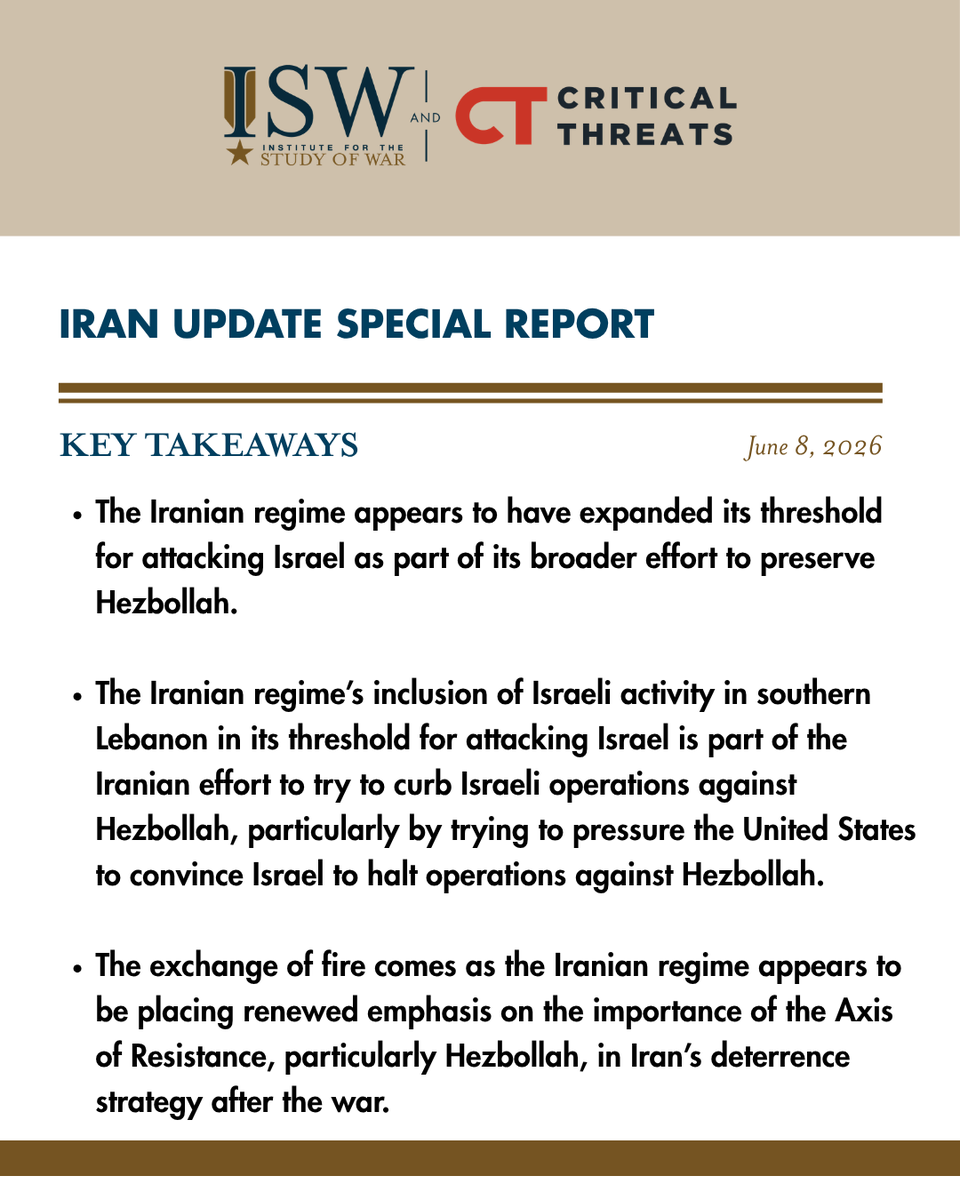
NEW: The Iranian regime appears to have expanded its threshold for attacking Israel as part of its broader effort to preserve Hezbollah.
The Khatam ol Anbia Central Headquarters announced the “cessation of armed forces operations” against Israel but threatened that Iranian forces would inflict “much more severe and crushing measures” if the Israel Defense Forces (IDF) continues to operate against Hezbollah, including in southern Lebanon. Iranian officials and media have previously only threatened to attack Israel if the IDF struck Beirut.
The Iranian regime’s inclusion of Israeli activity in southern Lebanon in its threshold for attacking Israel is part of the Iranian effort to try to curb Israeli operations against Hezbollah, particularly by trying to pressure the United States to convince Israel to halt operations against Hezbollah.
The Khatam ol Anbia Central Headquarters’ announcement followed an exchange of fire between Iran and Israel that began after Hezbollah conducted an attack on northern Israel yesterday. The IDF targeted a first-person view (FPV) drone command headquarters in Beirut after Hezbollah conducted the attack, after which Iranian forces responded by launching missiles at Israel.
The IDF subsequently conducted two waves of airstrikes against Iran, the first targeting air defense and missile systems and the second targeting sites affiliated with ballistic missile production at the Bandar Imam Petrochemical Complex in Mahshahr, Khuzestan Province. Iran responded by launching additional missiles at Israel.
The exchange of fire comes as the Iranian regime appears to be placing renewed emphasis on the importance of the Axis of Resistance, particularly Hezbollah, in Iran’s deterrence strategy after the war. A newspaper affiliated with the Supreme Leader’s office argued that Iran will “not hesitate to enter the field and defend the order that it is now seeking to achieve.” The “new status quo” that Iran seeks to create includes a strong Hezbollah and Iranian control over the Strait of Hormuz, among other things.
ISW-CTP will provide further analysis about Iran’s calculus and objectives in its June 8 update.