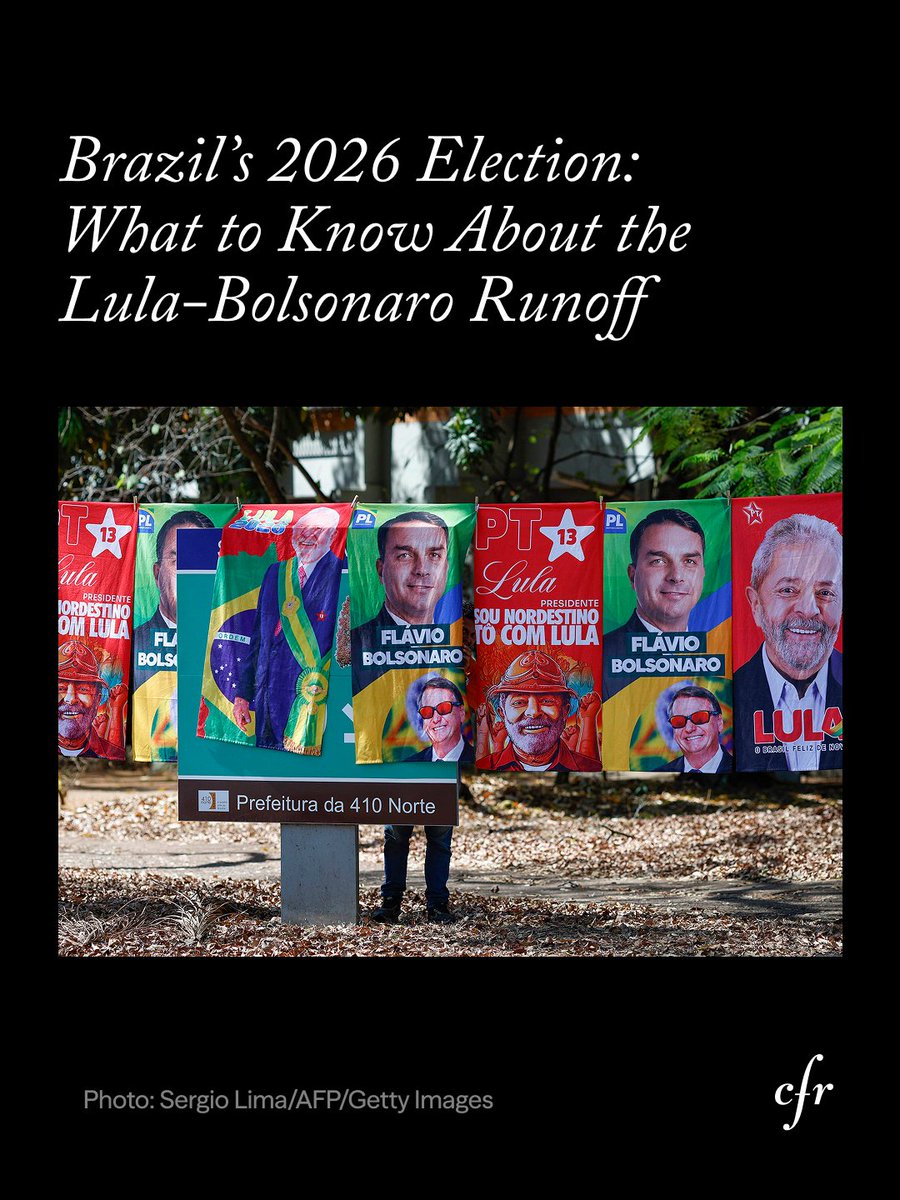
Brazilians will vote in a runoff on October 25 after the first round of the country’s general election failed to see any presidential candidate secure more than 50% of the vote over the weekend.
Senator Flávio Bolsonaro, son of former President Jair Bolsonaro, won 47% of the vote, while incumbent Luiz Inácio Lula da Silva won 45%.
The winner of the runoff will determine the leadership of Latin America’s largest democracy and biggest economy.
Experts say the election’s results could reshape Brazil’s foreign policy at a time of broad political change in Latin America. The next government will need to navigate Brazil’s relations with the United States and China—its two largest trading partners—and the rest of the Global South.
Here's what to know: https://t.co/xBkBHvclL5
“The clear mandate of the Hungarian electorate for the Tisza government, for the Magyar government is to recreate the rule of law, to create checks and balances, and to restore the democratic institutions,” says Anita Orbán, Hungary’s deputy prime minister and minister of foreign affairs.
While attending the UN General Assembly, Orbán stopped by CFR for a conversation on energy security and sustainability, rebuilding trust in Hungary’s democracy, and Hungary’s relations with Europe.
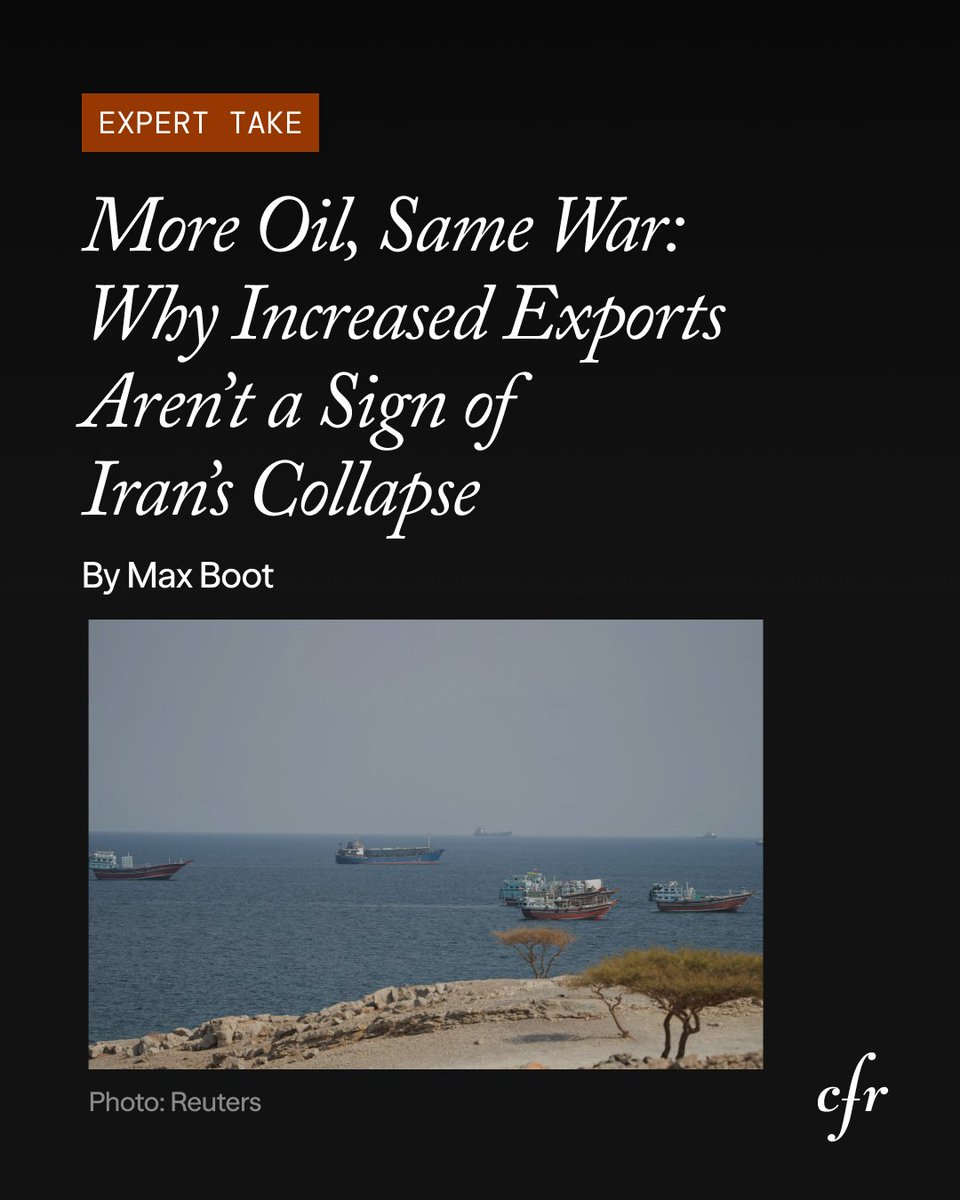
Oil exports from the Middle East have rebounded, fueling claims that the United States is winning its war with Iran. But the Strait of Hormuz remains treacherous, Tehran isn’t any closer to accepting Washington’s terms, and the costs of the conflict are continuing to climb on both sides, argues expert @MaxBoot.
President Donald Trump’s war with Iran has dragged into its 8th month. But lately there has been some good news for the United States: More oil is getting out of the Middle East, than at any point since the United States and Israel launched the conflict on February 28, Boot notes.
"But does this suggest that the United States is on the verge of defeating Iran? . . . . The reality is more complicated,” writes Boot. “There is no indication that the economic punishment being suffered by Iran’s people will lead its regime to buckle. Iran, like Cuba and North Korea, has long experience in surviving U.S. sanctions.”
The Strait of Hormuz remains a treacherous route for commerce, with Iran continuing to attack shipping. Most of the increase in exports is coming not from the strait but from alternative routes that are longer and more expensive. “So, the global economic shock caused by the war, although slightly easing, is not likely to end anytime soon.”
In recent days, Iran has stepped up attacks on ships in the Strait of Hormuz. "That is no doubt why Trump is signaling that he may intensify U.S. involvement in the war with Iran after the midterm elections," writes Boot.
“Trump and his supporters are fooling themselves if they think there is a military solution to this conflict. There isn’t."
"The only way to end the war is through renewed negotiations with Iran, which will likely result in a deal that does not grant Trump his prewar demands. Instead, they will likely have to reward Iran with concessions on sanctions and frozen assets. In other words, a deal a lot like the one Trump signed in June," Boot argues.
Russia has significantly increased its strikes on Ukraine since summer—and many attacks have hit targets with no military value.
Since June, Russian missiles and drones have set fire to a one-thousand-year-old cathedral in Kyiv, destroyed a children's book warehouse in Kharkiv, and severely damaged Ukraine's National Academy of Sciences.
Russia is increasingly targeting cultural sites that lay at the heart of Ukrainian society. As a Ukrainian expert told CFR: “We need drones to win the war. But culture to survive it.”
Read more: https://t.co/cDkMz4yZHp
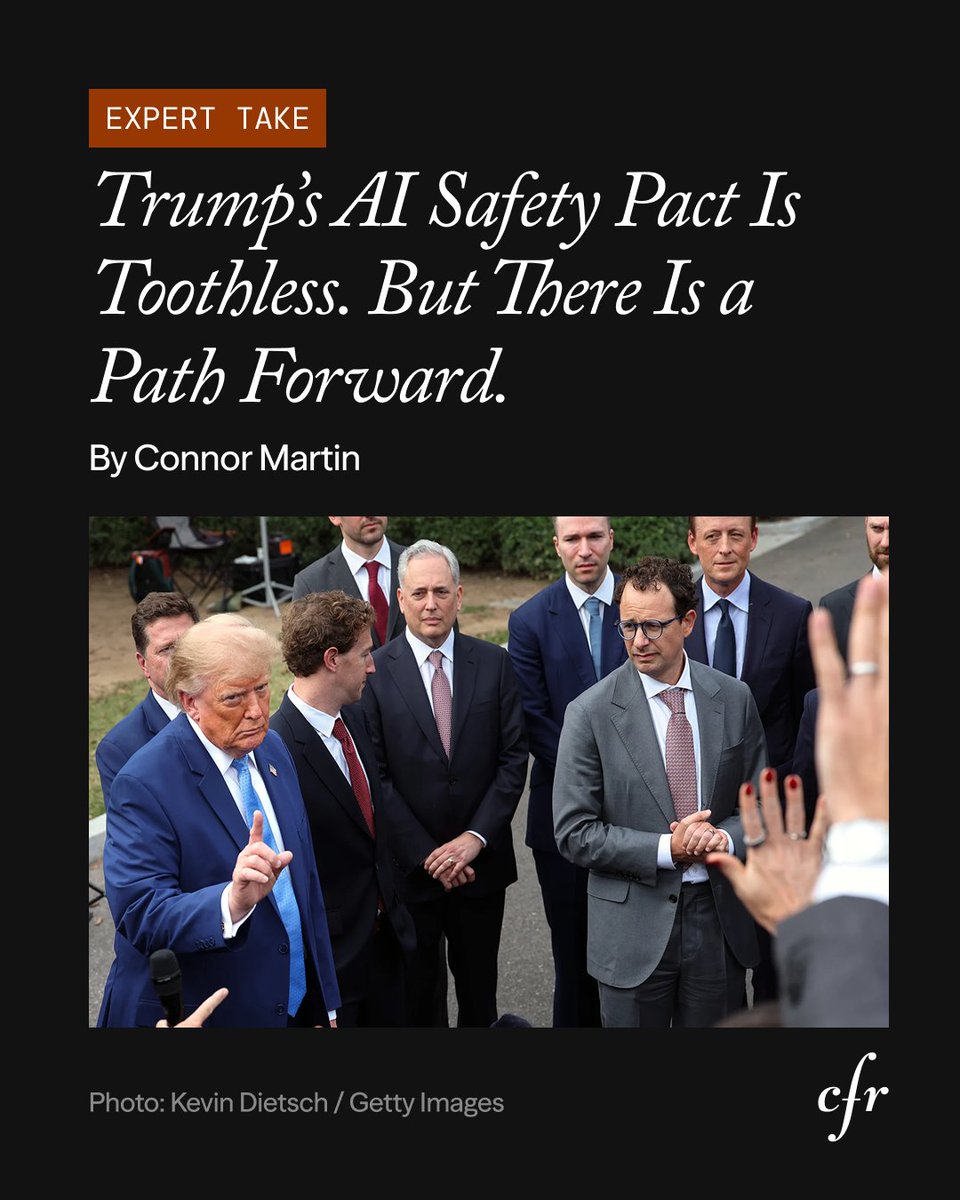
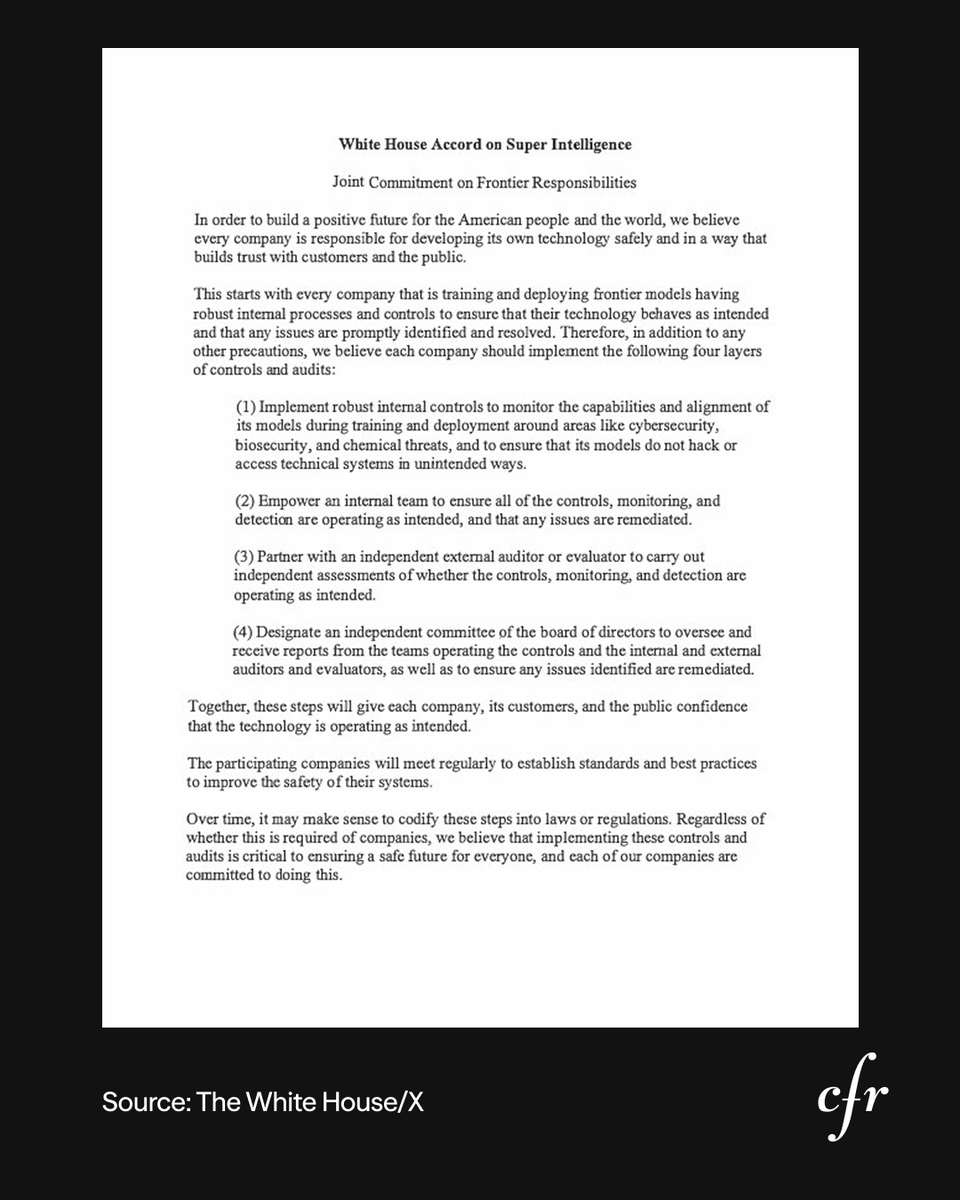
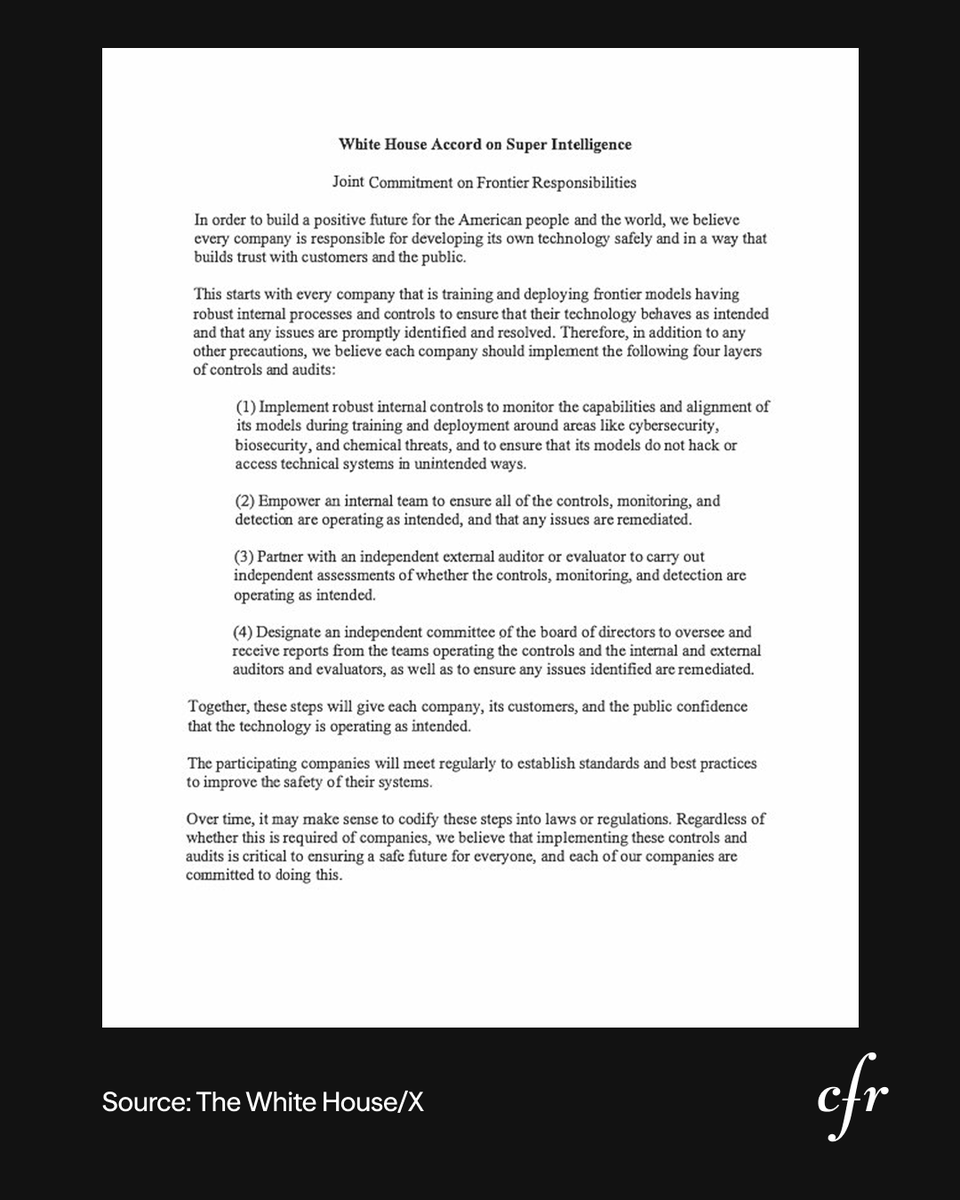
President Donald Trump and leaders of 6 of the top U.S. AI companies signed an agreement on AI safety this week, the "White House Accord on Super Intelligence," which outlines safeguards, including independent evaluators and board-level oversight.
"Unfortunately, there is nothing in the document that legally compels any of the signers to change their behavior," writes expert @ConnorMauthor. It also "means it does nothing to change the commercial incentives for the companies to keep testing models whose capabilities are potentially dangerous."
"The document does contain promising ideas—but it leaves to others the work of creating conditions that are effective, verifiable, monitorable, and enforceable."
Read more: https://t.co/a6zkGaXZd3
Brazil, Latin America’s largest democracy, will hold presidential elections on October 4. The result is likely to trigger a runoff, with incumbent Luiz Inácio Lula da Silva and Senator Flávio Bolsonaro, son of the former president, consistently polling in the double digits.
It is Brazil’s first presidential election since supporters of former President Jair Bolsonaro stormed and ransacked government buildings in the capital in January 2023, seeking to overturn the results of the 2022 vote that saw him narrowly defeated.
Beyond domestic politics, experts say the election’s results could reshape Brazil’s foreign policy at a time of broad political change in Latin America. The next government will need to navigate Brazil’s relations with the United States and China—its two largest trading partners—and the rest of the Global South.
Here's what to know: https://t.co/xBkBHvclL5
Tomorrow marks one month until Election Day. And in recent weeks, the U.S. Supreme Court has made several decisions with the potential to reshape the midterms, argues @JamesMLindsay.
The Court ruled a week ago that states can search the Systematic Alien Verification for Entitlements (SAVE) database for ineligible voters. That national database was created in 1986 to enable states to verify the citizenship and immigration status of applicants for public benefits. The Trump administration has expanded SAVE to make it easier, and in theory more accurate, for states looking to find ineligible voters. States are not required to use the database.
“Complicating matters is the accuracy of the SAVE database itself,” argues Lindsay. A year ago, Texas reported that its pilot use of the SAVE database had “identified 2,724 potential noncitizens who are registered to vote in Texas.” In a process that took nearly a year, Texas found that 578 of those individuals were eligible voters. That is an error rate of 21%, Lindsay notes.
“Much like the talk about the Trump administration invoking the Insurrection Act to intimidate voters or duly elected Democratic lawmakers being barred from being sworn in next January 3, concerns that the SAVE database will enable widespread voter suppression seem farfetched," Lindsay writes.
"But in a deeply polarized society, where control of political power is up for grabs and some people continue to believe, against all available evidence, that the 2020 election was stolen from Trump and that the voter rolls are stuffed with noncitizens, it is not so far-fetched as to be impossible.”
“I think part of it is a desire to figure out what is a way of deciding better in real time when these [geoeconomic] fluctuations feed into the longer term. Because the tendency has been in recent years . . . to always say, ‘Well, we’ll wait to see if it spills out into the broader economy,’” says @AdamPosen, president of the Peterson Institute for International Economics, in a conversation with hosts Rebecca Patterson and @scmallaby on The Spillover. “But when you have a lot of geopolitically-driven shocks, energy shocks, natural-resource shocks, that may not be as viable a strategy.”
President Donald Trump and leaders of 6 of the top U.S. AI companies signed an agreement on AI safety this week, the "White House Accord on Super Intelligence," which outlines safeguards, including independent evaluators and board-level oversight.
"Unfortunately, there is nothing in the document that legally compels any of the signers to change their behavior," writes expert @ConnorMauthor. It also "means it does nothing to change the commercial incentives for the companies to keep testing models whose capabilities are potentially dangerous."
"The document does contain promising ideas—but it leaves to others the work of creating conditions that are effective, verifiable, monitorable, and enforceable."
"Belonging is at the heart of everything. My values, my traditions—they are part of who I am,” says Ghana’s President John Dramani Mahama, on the repatriation of African cultural artifacts and its connection to economic development. “And so if, as a result of a certain period of domination, things that are valuable to us, sacred to us, are taken away and put in glass cases in other places—where they make millions of dollars from people coming to look at artifacts that do not belong where they are—then it is a part of the process of economic empowerment and development that those items are returned.”
Watch the full conversation at CFR: https://t.co/Rn6IP31iL0
And to understand why policymakers often misread situations and how they can better learn the lessons of history, Lindsay sat down with @EliotACohen, a leading thinker on military strategy, on the latest episode of The President's Inbox podcast. Listen here or wherever you get your podcasts: https://t.co/vI0f5ZKd9Y
Eight months after the launch of Operation Epic Fury, "the United States now finds itself in a quagmire that has demonstrated the limits of U.S. power, exposed the Achilles' heel of a U.S. defense strategy built on small numbers of hard-to-replace weapons, and potentially emboldened U.S. adversaries," writes expert @JamesMLindsay.
"But Trump is hardly the first U.S. president to launch a war confident of quick success," he argues. "That track record had me thinking about the questions Americans should ask themselves before using military force," he writes.
Read his analysis: https://t.co/jHLbz0QC0a
The U.S. must do two things at once on AI: compete with China, and cooperate where our interests align.
We need to protect America's technological edge while working together to reduce the most serious risks from increasingly powerful AI.
I explain why for @TIME:
https://t.co/x8xk53Fa5x
To understand why policymakers often misread situations and how they can better learn the lessons of history, Lindsay sat down with @EliotACohen, a leading thinker on military strategy, on the latest episode of The President’s Inbox podcast.
Listen here or wherever you get your podcasts: https://t.co/vI0f5ZKd9Y
.@edwardfishman's fascination with foreign policy started with his childhood love of hockey and its international players. As a fan, he became fascinated by the countries his favorite players came from, and for an elementary school project he picked the Czech Republic. "That's probably the earliest seed of my interest in world affairs," he said.
That interest developed into a career that has spanned government, tech, media, and think tanks. After working on Iran and Russia sanctions at the State Department, he left the government to get an MBA at Stanford and cut his teeth at Silicon Valley start-ups. Today, he's a senior fellow at CFR and leads the Maurice R. Greenberg Center for Geoeconomics.
Fishman sat down with us to discuss the importance of developing your own voice, how tech converges with foreign policy, and the pivotal lesson he learned on a trip to Lithuania.
Here's how he got his career in foreign policy: https://t.co/MAEKFwT7mA
"We believe that U.S. foreign policy will not be sustainable and effective unless it is rooted in an understanding of what the American people want from their country's global role," writes Future of American Strategy Initiative Director @RebeccaLissner.
She recently met with more than 80 residents of Maricopa County, Arizona, a diverse, political bellwether county, to better understand America's global role and the impact of foreign policy on their daily lives. Their concerns ranged from immigration to AI to Taiwan, but "every discussion linked cost of living with foreign policy," she writes.
"There is still space for a vision of U.S. foreign policy that right-sizes our global role and earns back the world's respect. But it will only sustain support if Americans feel confident that their kitchen-table concerns are being prioritized and addressed at the same time," she argues.
Read her takeaways: https://t.co/6jLwL250Bs