@SecWar Had you lived eighty-six years ago you would very likely have been a Nazi sympathiser if not a card carrying member. They also fought and attacked other states for *their idea* of freedom. Having someone like you on European soil at any time is the true shame of Europe today.
@Ryanhoddinottt@TheRealJamieKay What else does it have to prove? It proves that he killed someone by punching them. If you think that's normal behaviour, then we really need to reinstate capital punishment because no number of new prisons will be enough to keep people safe from being punched to death.
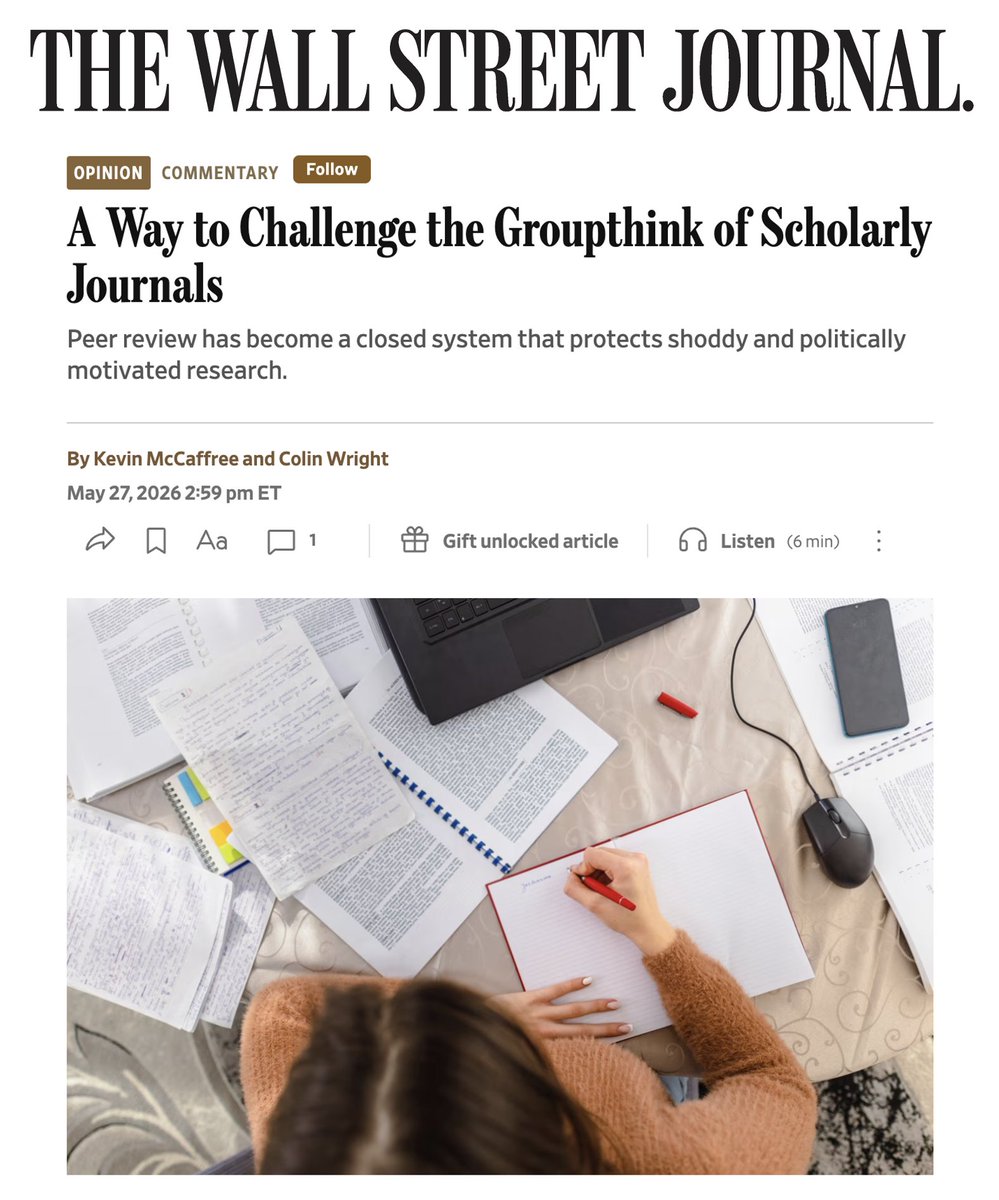
We're saving science from ideological capture!
I am thrilled to announce a first-of-its-kind article type called “Peer Review” in the journal Theory and Society.
The journal's editor-in-chief, Kevin McCaffree, and I have been working on this for a while, and it was finally approved by @SpringerNature.
The idea is simple: publication should be the beginning of academic scrutiny, not the end of it.
A Peer Review article can critique a paper from any scholarly journal. It can address problems with methods, evidence, logic, definitions, theory, or interpretation. But it has to focus on the claims and arguments, not personal attacks.
Submissions are capped at 2,500 words and go through a straightforward merit review instead of endless gatekeeping and ideological screening. We ask just one basic question: Is this critique coherent, serious, reasonable, or even popular enough to deserve scholarly attention?
If yes, it gets published.
And the authors of the original paper get a built-in right of reply, so readers can see the critique and the response in a legitimate academic venue.
That’s how science is supposed to work!
Science becomes self-correcting only when real people build the mechanisms that allow correction to happen.
That’s what we’ve done.
Now it’s time for academics to use it.
🔗https://t.co/gqkDE79CO4
JSSAM Special Issue Part 2 is now available.
The second of two special issues highlighting survey research across Asia, Africa, Latin America, the Caribbean & Oceania is now online:
🔗https://t.co/j2mAYD1UVk
All articles are free to read for a limited time.
@ghostcartoonist@pensandpoison Huh, for me it was only when I got to know my Woody well that I started caring about Marx as much as I cared about Hayek.
@s_batzoglou@SJ_Murray@michaelbilleaux How do you identify that "single point" and ensure it's correctly and methodically argued and derived in the paper if you haven't read the paper to make up your own judgement?
@s_batzoglou@SJ_Murray@michaelbilleaux In my discipline, if you cite a 700-page classic ethnography of a Caucasian village, you better have read it. If you haven't, you should cite the paper that cited it, making clear that you are relying on that paper's interpretation of the original. Otherwise you're a fraud.
@s_batzoglou@SJ_Murray@michaelbilleaux Yes they do. That's their discipline, specialisation. If it's such a core text for the discipline, they must/should have read it during their coursework. If they haven't,then they should read it before citing, yes.
@s_batzoglou@SJ_Murray@michaelbilleaux I'm a bit lost in all this discussion. How do you know if a work is worth citing and building on if you haven't read it and analysed it and its sources in depth? You just cite it because someone else cited it? Or just because the author is famous? I just don't get it.
@Math_files Red. Enough seed to invest in projects with >50% success probability that can eventually generate 50x net profit while having more fun and maximising the sense of personal achievement on the way there.
@tejparikh90@FT Man, the '70s will be amazing 🤩 Although at the rate my son is growing at the moment, I'm scared he'll end up being 3.5km tall by then and suffer of terrible back pain...
@jayvanbavel "In full-time employment" in their field or in any sort of job? I imagine that with computer science you don't need to be in a classical "full time employment" role to make a good living and feel accomplished in your are of expertise.