@MarkJCarney You go first. Pull your daughter out of Harvard, sell your house in the USA, sell your stocks in American Companies, and get Brookfield to HQ in Canada again. I’ll take it seriously when you do!
Ontario doctors are under orders to lie on your death certificate.
Not shade the truth. Lie.
Here it is. Official. In writing. From the College of Physicians and Surgeons of Ontario.
"The illness, disease or disability leading to the request for MAID is to be recorded as the cause of death. The certificate cannot include any reference to MAID or the medications administered."
Source: CPSO: Medical Certificates of Death in the MAID Context
By publishing this explicitly false story, the @FT has officially become tabloid trash for market participants.
Despite my direct, on-the-record denial of ever having advocated, explored, or espoused the idea that Chancellor-Bank of England statute serving as a prototype for a Treasury-Federal Reserve relationship, FT journalists manufactured a story with the headline, “Scott Bessent praised Bank of England as model for tighter oversight of the Federal Reserve.”
These pathetic journalists have clearly fabricated a story to give the impression that both I and the Trump Administration are setting “about restructuring the relationship… at a time when President Donald Trump has launched an unprecedented assault on the world’s most important central bank.”
Their mendacious assertion is based on vague statements from unnamed “financial industry executives familiar with the matter.”
In short, FT has literally manufactured an entirely fake policy position for me and the Administration. Other than furthering a maliciously false narrative of dysfunction and divisiveness, it baffles the mind as to why they would shred their already diminished journalistic credibility.
Over the past 10 years, I have written more than 20,000 words opining on the Federal Reserve decisions, personnel, structure, and modifications. Nowhere have I ever mentioned this ridiculous notion.
The Governor’s letters to the Chancellor have proven to be a useless and perfunctory device.
There is much to be said about the storied Bank of England, but any recreation of its operating framework on this side of the Atlantic has never been contemplated.
The shameful journalists and editors at the FT are shocking in their meretriciousness, lack of standards, and general intellectual libertinism. It is the worst tradition of Fleet Street to manufacture news rather than report on it.
They have brought irredeemable shame to their parent organization, Nikkei Inc., with whom I had previously held excellent relations.
In 2025, I laid out a comprehensive 6,000+ word review of each and every policy reform that I believe should be adopted by the Federal Reserve.
Read my actual, real thoughts on and proposals for Federal Reserve reform at the International Economy: https://t.co/0yQRXpMnK3
@ShareawareCdn These are employees of the pensions, not government. With all due respect, you are conflating the two. Government revenues come from taxpayers, you are correct there. Pensions do not earn their revenues from taxpayers.
Call to action:
,@Support we demand to know why @_tommyspodcast Account has been suspended.
Everyone please repost this or create your own post and demand his account be reinstated. This comes immediately following him posting g his podcast where Kent called in and spoke with us.
To my X followers,
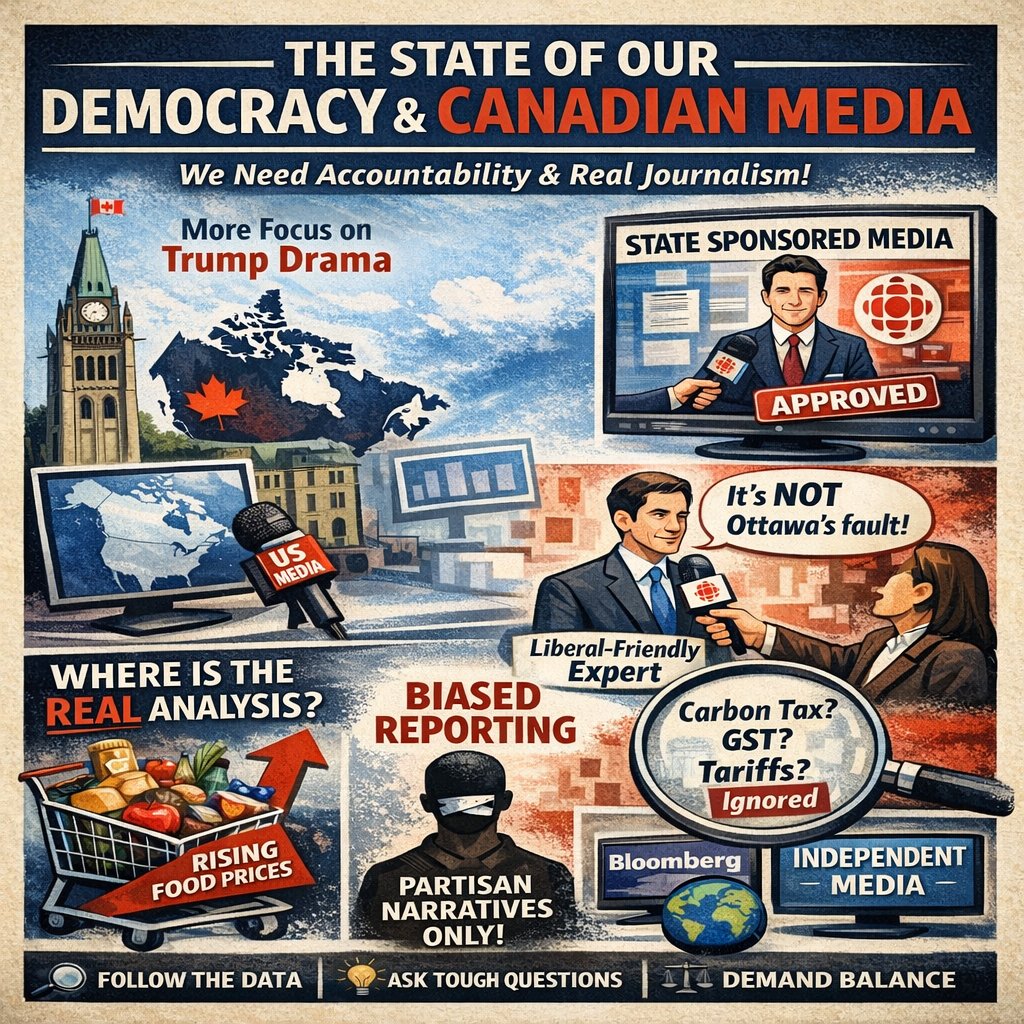
I’ve worked with the media for nearly 25 years. For most of that time, the relationship was professional and balanced. But in recent years, something has shifted.
I am increasingly concerned about the state of our democracy — particularly how media, in general, are informing Canadians about food policy, food inflation, and economic policy.
I now find myself learning more about Canada’s economy and policy changes from American outlets than from Canadian ones. Much of our national coverage feels reactive, shallow, or overly fixated on partisan narratives rather than substantive policy analysis.
What troubles me most is the lack of scrutiny applied evenly across governments and institutions.
For example, when the Bank of Canada suggested that Ottawa’s counter-tariffs contributed to food inflation, only one major outlet — Bloomberg — gave it meaningful coverage. The grocery benefit program received very little examination regarding how it would be financed. It took days before anyone pressed for clarity.
During the latest spike in food inflation, several outlets turned to the same small circle of commentators who dismissed any potential role of federal policy — carbon pricing, GST holidays, counter-tariffs — despite mounting evidence that policy decisions can and do affect food prices.
Instead of investigating structural drivers of inflation, much of the coverage focuses on fact-checking opposition rhetoric, even though the opposition has not governed since 2015. Scrutiny should be applied equally — not selectively.
Quebec media, while imperfect, appear to have maintained a broader range of debate. In much of the rest of Canada, I see increasing concentration of voices — often from the same region, Ontario, often reflecting similar policy perspectives — and less diversity of thought grounded in empirical research.
This isn’t about partisan politics. It’s about accountability, transparency, and healthy democratic discourse.
Media are under financial pressure — that’s real. But public trust depends on independence and depth. Subsidy structures, incentives, and newsroom economics all matter.
Canada deserves stronger policy journalism — especially on food affordability, supply chains, and economic resilience.
We need more data-driven analysis, more intellectual diversity, and more courage to ask uncomfortable questions — regardless of which party is in power.
Until that happens, Canadians would be wise to diversify their news sources and think critically about what they’re being told — and what they’re not.
A cow takes grass (inedible to humans) and produces:
- Meat (complete protein + fats)
- Milk (complete nutrition)
- Leather (clothing, tools)
- Tallow (cooking fat, soap, candles)
- Bones (tools, broth, fertilizer)
- Organs (nutrient-dense food)
- Manure (fertilizer)
This is complete resource utilization from a plant humans cannot eat.
You cannot replicate this with any technology. The cow is performing chemical transformations we cannot industrialize.
Grass → complete human nutrition is alchemy.
The cow is worth more than any machine humans have invented.
It runs on rain and grass. Produces multiple products. Builds soil while operating. Sequesters carbon. Reproduces itself.
And we're told to eliminate them for environmental reasons.
While flying in almonds from California and soy from Brazil.
The stupidity is breathtaking.
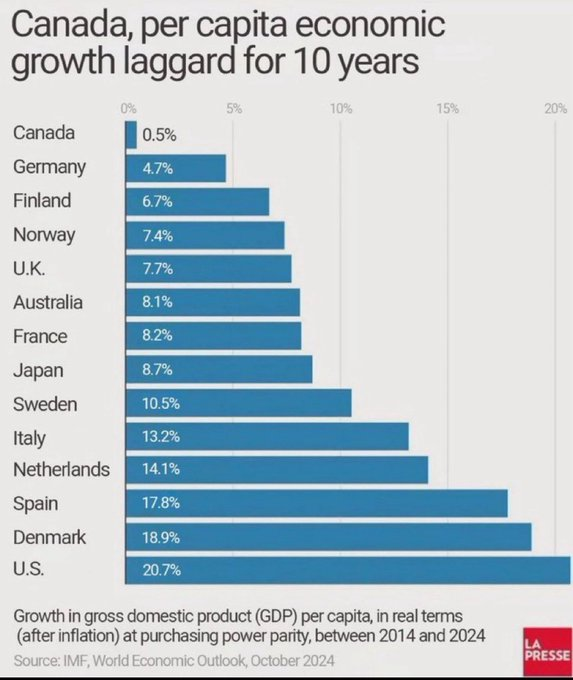
And with all due respect to my Canadian friends, whose politics focus obsessively on the United States: your stagnating living standards have nothing to do with Donald Trump or whatever bogeyman the CBC tells you to blame.
The fault lies with your leadership, elected by you.
Canadian MSM is more concerned about election fraud in a blowout by-election that Pierre Poilievre handily won than clear voter fraud that gave the BC NDP a razor thin majority government, in British Columbia.
It’s official: Canada is now an LNG-exporting nation. The Gaslog Glasgow just sailed out of Kitimat, marking the first shipment to market. A historic day for energy, trade and the communities that got us here. 🇨🇦
@AaronHectorCFP@danielfoch I've had the same experience this year. I'm not sure how they serve Canada's elderly who can't interact with their online bots.
Tom, I think the core difference here lies not in the facts themselves, but in the lens we’re using to interpret them.
Brent is analyzing this through the frame of current financial dominance. In that context, the ECB coming to the Fed weekly and paying above-market rates for dollar access is not a sign of U.S. weakness it’s a sign of continued U.S. control. Europe’s need for dollar liquidity reinforces the notion that the U.S. still sits at the center of the global financial system, and that others are still structurally dependent on it.
That frame is valid. It captures how the plumbing still flows through the U.S., and how access to dollars remains the fulcrum of global solvency.
But I’m looking at the same signals through the lens of systemic sustainability and strategic trajectory. My framing isn’t questioning whether the U.S. currently has leverage it clearly does. I’m asking what it means that the system now requires weekly intervention to function. What does it mean that foreign buyers of Treasuries are retreating? That dollar access is being rationed at a premium? That the Fed is quietly becoming the lender of last resort not just for U.S. banks, but for the global periphery?
This isn’t about collapse today it’s about a structure that no longer scales without intervention.
And the implications go beyond finance. The post-1971 reserve regime, which was designed to externalize production and anchor global demand in dollars, now presents a direct threat to U.S. national security. We’re finding ourselves unable to rapidly produce weapons or critical goods without relying on the very nations we may one day need independence from. That fragility stems from the same financial architecture that swap lines are now quietly stabilizing.
So yes Brent’s frame is anchored in current power dynamics. Mine is anchored in long-horizon strategic viability. We’re reading the same signals, but I’m tracing them toward their terminal path. And the irony is we still end up in the same place. Whether through breakdown or redesign, the current system is functionally unsustainable.