I’d also like to note that @CKikawa was recently given a Beyond the Journal Award for the way she has been sharing these and similar data on GitHub in real-time as they are generated: https://t.co/3xyC6M67F5
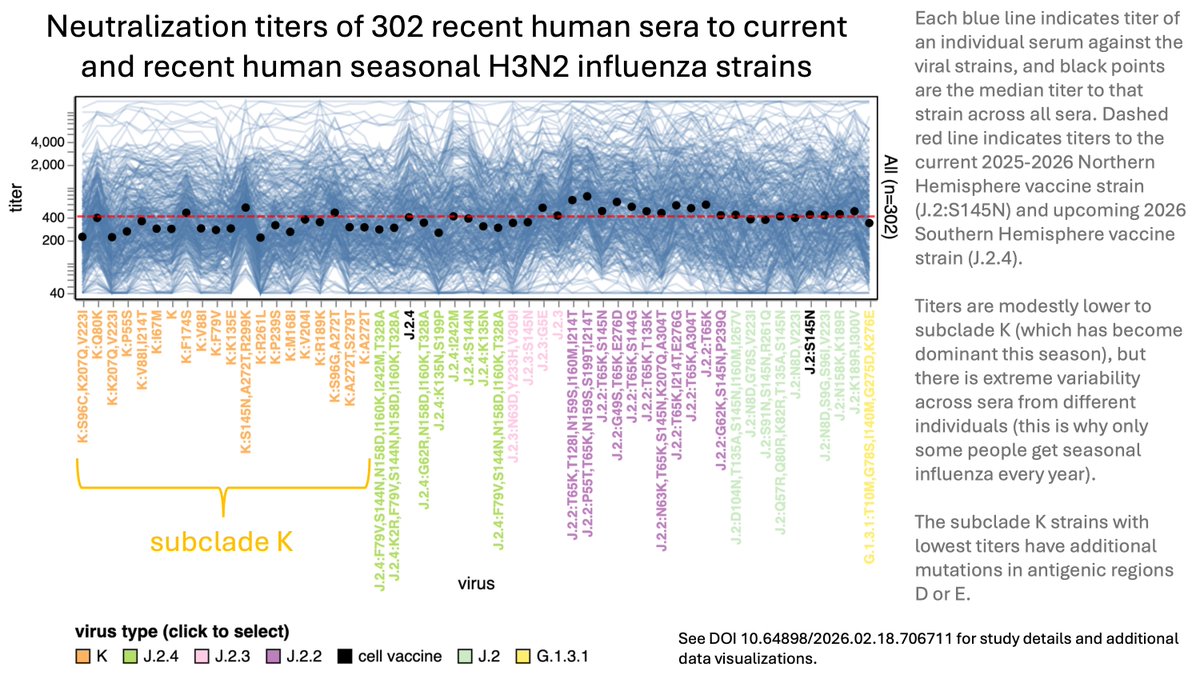
We have posted data providing real-time measurement of human neutralizing antibody landscape to seasonal influenza
Data explain spread of subclades K (H3N2) & D.3.1.1 (H1N1), identify subclade K subvariants w reduced neutralization & can inform choice of strains for next vaccine
In new study led by @CKikawa, we provide near real-time data on human neutralizing antibody landscape to influenza by measuring ~26,000 titers to >100 recent viral strains.
Data can inform vaccine selection & evolutionary/epidemiological modeling.
https://t.co/rthJdShpwP
In new study led by @timcyuu, we measure how mutations to H3 flu HA affect cell entry, stability & antibody escape
We find pleiotropic effects of mutations on these phenotypes shape evolution: epistasis alleviates cell-entry but not stability constraints
https://t.co/mZs4KdCvkv
In study led by @CKikawa & Andrea Loes, we use new assay to measure ~10,000 neutralization titers to recent influenza strains & show titers correlate w evolutionary success of viral strains
Similar data could help forecast evolution for vaccine selection
https://t.co/OxwiNnXUuU
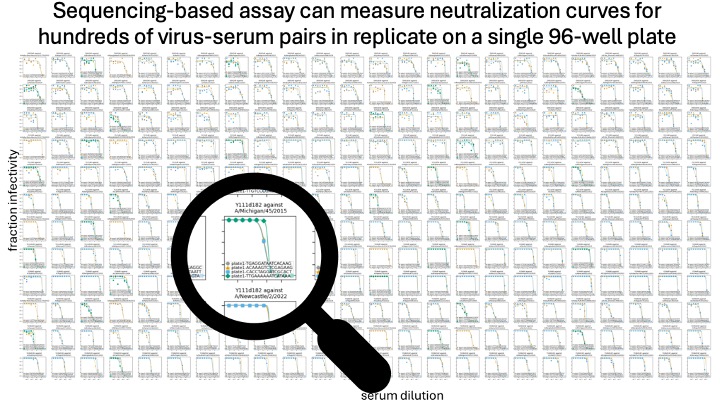
In new study led by Andrea Loes, we develop sequencing-based neutralization assay that measures replicate curves for hundreds of virus-serum pairs per 96-well plate (see image below)
https://t.co/hCkjUEiRpV
We apply assay to characterize response to repeat influenza vaccination
Thanks to awesome mentors Jesse and Leslie, collaborator @mateoinnyc, super lab mates Catiana, Jackson, @maya_contr, @LisaLevoir. Excited for the rest of grad school!
My first, first-author research article was published yesterday in @JVirology! https://t.co/iwnqFd355p
Excited to share our work measuring the effects of single flavivirus mutations on antibody neutralization, led by me w/ @jbloom_lab and @lesliegoo_lab guidance
🧵...
Overall, we found broad antibodies are harder to escape than targeted antibodies. We hope these data and further efforts to characterize Zika and dengue antigenicity aid vaccine/drug design.
Here are some other highlights from our paper. If you get a chance, please check it out!