Developing an imperceptible and robust watermarking system for internet-scale deployment is a massive undertaking.
Our report shares lessons learned from developing SynthID-Image (10b+ Google AI-generated images watermarked!) and making it externally available via partnerships.
We released our report on SynthID-image, outlining what it takes to watermark over ten billion images generated with @GoogleDeepMind AI models and making this technology available to external partners. I really enjoyed writing this report – a thread:
https://t.co/65Z9e0A8AS
Three years ago we started SynthID as the first internet-scale watermarking solution. Now, @OpenAI, and @ElevenLabs adopting SynthID is huge news for content transparency!
Really happy to see @OpenAI adopt @GoogleDeepMind's SynthID for watermarking AI generated images.
We need more such cross industry partnerships for enabling responsible use of AI systems.
Excited to co-found Recursive (@recursive_si) with an exceptional team in London and SF to create AI that experiments on how to safely improve itself, turning compute into knowledge that accumulates in an open-ended process of endless, automated scientific discoveries.
A highlight of my time at @GoogleDeepMind has been training a model variant of SynthID-Image that can be used by external partners.
A complex set of criteria to balance, so very proud of its robustness and watermark invisibility.
SynthID-Image is post-hoc and model-independent. This means it's a flexible solution that works after content is generated, on images from any AI model.
Experimental results for our external variant (SynthID-O) show it achieves state-of-the-art performance , delivering the best-in-class balance of high visual quality (invisibility) and robustness to common image perturbations.
Read the full paper: https://t.co/tVy22xQ8g3
Really happy to announce the launch of SynthID Detector - a verification portal based on @GoogleDeepMind's SynthID watermarking technology that helps users determine if content, or part of it, was generated by Google’s AI tools.
Read more in our blog: https://t.co/WR05gxkfkO
Folks, our @GoogleDeepMind team is cooking exciting security privacy tooling and we need your help. We are looking to hire more folks! Please reach out to me with cv if you want to contribute to making Gemini secure
Thrilled to partner with @NVIDIA on bringing @GoogleDeepMind’s SynthID watermarking technology to its new world foundation model, Cosmos. This is another step on our journey to enable responsible deployment in the broader generative AI ecosystem.
https://t.co/9yzXSauISM
My team at @GoogleDeepMind is hiring.
If you are passionate about robust ML, the provenance of synthetic media, and the trustworthiness of data, consider applying: https://t.co/vWlfLPI4sN
My team @GoogleDeepMind is hiring!!
We're looking for someone with strong engineering skills, experience in evaluating LLMs and/or a privacy/safety publication background. Join us to do some exciting research 🤖🔏
Apply here until next Monday, 9 am GMT
The SynthID-Text watermarking method developed by our team @GoogleDeepMind is being published by @Nature today. Alongside, we’re open-sourcing SynthID-Text to enable other developers to use it on their models, and encourage collaboration on responsible development of AI models.
By open-sourcing the code, more people will be able to use the tool to watermark and determine whether text outputs have come from their own LLMs - making it easier to build AI responsibly.
We explain more about this tech in @Nature. ↓ https://t.co/7Y5A06MZ2g
Today, we’re open-sourcing our SynthID text watermarking tool through an updated Responsible Generative AI Toolkit.
Available freely to developers and businesses, it will help them identify their AI-generated content. 🔍
Find out more → https://t.co/n2aYoeJXqn
Huge congratulations to @DemisHassabis and John Jumper on being awarded the 2024 Nobel Prize in Chemistry for protein structure prediction with #AlphaFold, along with David Baker for computational protein design.
This is a monumental achievement for AI, for computational biology, and science itself. 🧬
Gemini 1.5 Model Family: Technical Report updates now published
In the report we present the latest models of the Gemini family – Gemini 1.5 Pro and Gemini 1.5 Flash, two highly compute-efficient multimodal models capable of recalling and reasoning over fine-grained information from millions of tokens of context, including multiple long documents and hours of video and audio.
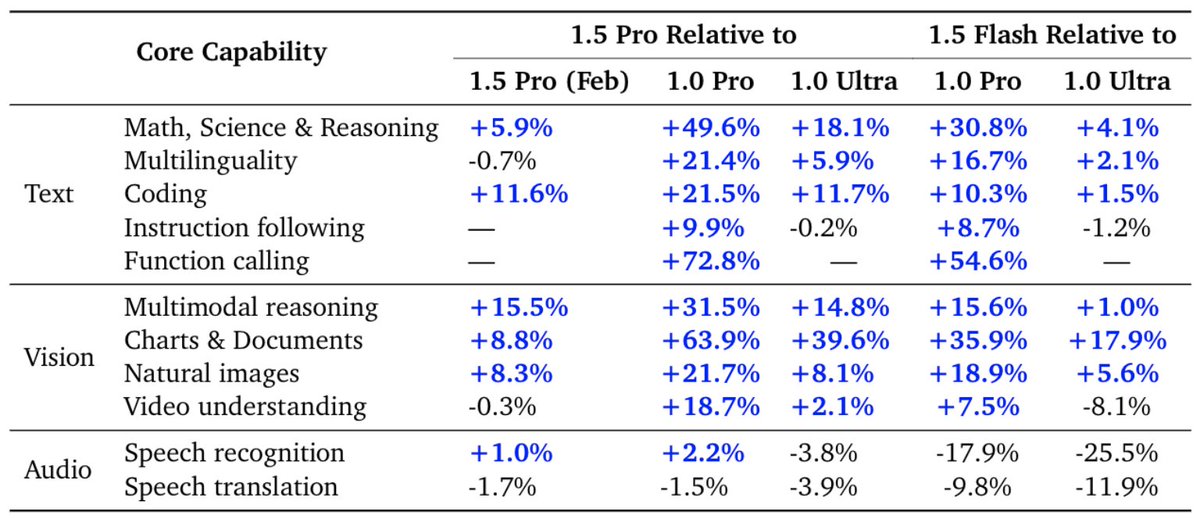
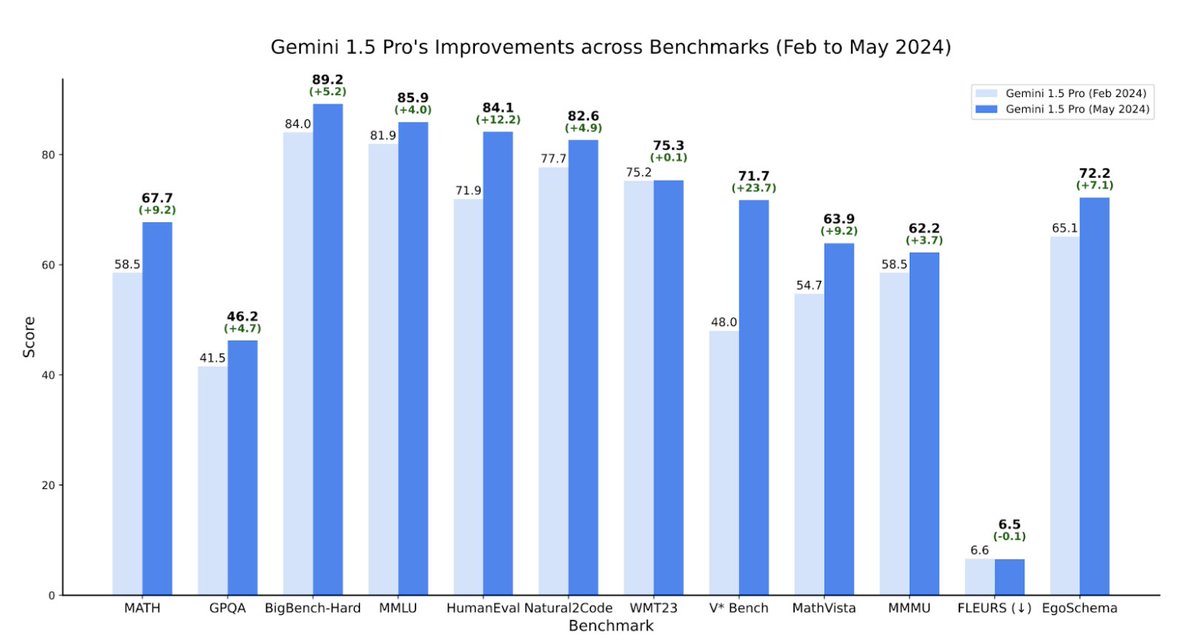
Our latest report details notable improvements in Gemini 1.5 Pro within the last four months.
Our May release demonstrates significant improvement in math, coding, and multimodal benchmarks compared to our initial release in February.
Furthermore, the 1.5 Pro Model is now stronger than 1.0 Ultra.
The latest Gemini 1.5 Pro is now our most capable model for text and vision understanding tasks, surpassing 1.0 Ultra on 16 of 19 text benchmarks and 18 of 21 of the vision understanding benchmarks. The table below highlights the improvement in average benchmark performance for different categories in 1.5 Pro since Feb, and also shows the strength of the model relative to the 1.0 Pro and 1.0 Ultra models. The 1.5 Flash model also compares very well against the 1.0 Pro and 1.0 Ultra models.
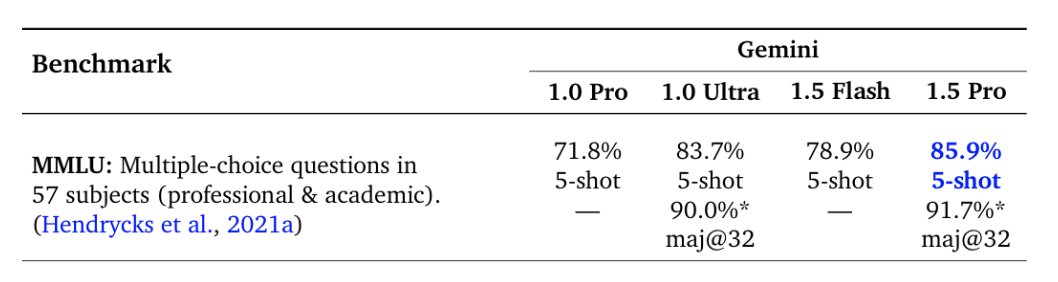
One clear example of this can be seen on MMLU
On MMLU we find that 1.5 Pro surpasses 1.0 Ultra in the regular 5-shot setting scoring 85.9% versus 83.7%. However with additional inference compute, via majority voting on top of multiple language model samples, we can get a performance of 91.7% versus Ultra’s 90.0%, which extends the known performance ceiling of this task.
@OriolVinyalsML and I are very proud of the whole Gemini team, and it’s fantastic to see this progress and to share these highlights from our Gemini Model Family.
Read the updated report here: https://t.co/CTzTHND4nQ
SynthID will now expand to 2️⃣ new modalities: text and video.
While this tool isn’t a silver bullet for identifying AI-generated content, it’s an important building block for helping millions of people understand the provenance of synthetic content. → https://t.co/CS0s9NaAfX
Happy to share that @GoogleDeepMind will be open sourcing our scalable and quality preserving text watermarking method (SynthID_Text) to enable developers to responsibly deploy text generation AI systems.