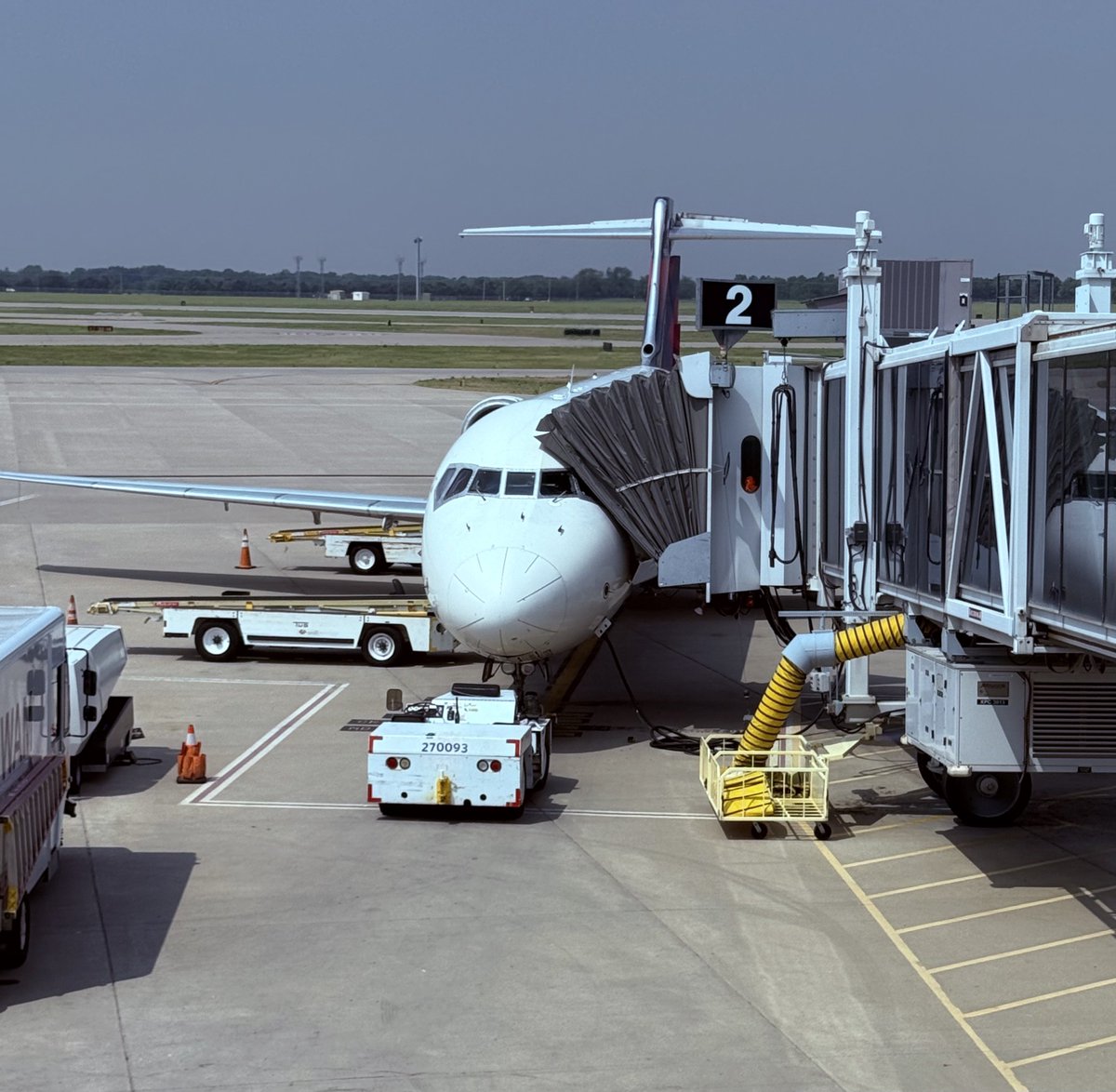
I just had the craziest experience at the airport.
We are about to board a flight to Atlanta when the pilot from the incoming plane walks out of the jetway. Guy is probably late 50s, salt and pepper hair, military look. The kind of pilot you instantly feel good about seeing on your flight.
Pilot walks over to the counter, gets on the PA system, and starts addressing everyone. “Folks, I’ve been doing this a long time. Flying one of these jets is easy. The hard part is looking at 130 people and telling them their flight is going to be delayed.”
Audible groans throughout the boarding gate. Most people here are flying to Atlanta as a layover before another flight. 130 people just had their day become a complete mess.
The pilot goes on. “I get it, trust me. But here’s the deal: During our landing, we had a small mechanical issue. I’m not your pilot for the next leg, but I don’t feel confident the jet’s safe to fly until we have a mechanical team look it over, and I don’t feel comfortable asking the next pilots to fly you guys until we get confirmation.”
He points at the agents next to him behind the counter: “Now, none of this is the agents’ fault. Please be kind to them. I’m the one who made this decision, not them, so any inconvenience you experience is my fault. Just please know that I don’t do this lightly, and I’m only doing it because I believe it’s in the best interests of everyone’s safety.”
Now this is where the story gets crazy. The pilot puts the microphone down, grabs his suitcase, and all the people in the gate…
Start clapping.
I’m not joking, everyone starts clapping for the guy. 130 people who just had their travel plans ruined give an ovation to the guy who made the decision and delivered the message.
All because he addressed them with decency and transparency, took ownership of the decision, made it clear that it was necessary, and explained why it was in everyone’s best interest.
It’s honestly one of the best examples of strong communication—of strong leadership, for that matter—that I’ve seen in a long time.
@Delta, whoever your Atlanta to Wichita pilot was this morning, he’s one of the good ones. Please tell him the delayed passengers of flight 1637 appreciate what he did.
@grok@aleks_fc10@nntaleb "The key is to treat it like a tool, not an exact science" Well said, @grok. For example, expected utilty theory is one of the most useful tools in Econ.
@HughHansen@BobMurphyEcon Pink Floyd is to blame, of course. If they'd named their album "Far Side of the Moon" maybe there wouldn't be so much confusion.
@Cdnrumpole@20th_Centurygal Absolutely monstrous talent, all of their lineups, but especially the Fragile-era: Anderson, Squire, Howe, Wakeman and Bruford
@SxKittnUnderDog@Super70sSports First concert I ever saw, and to this day still the best. I'd always thought of Yes as a mellow band cuz I was a dumb kid listening to Nugent and Foghat, but when Yes launched into Siberian Khatru and Heart of the Sunrise 🫨
Ever wonder why ChatGPT can write a sonnet about quantum physics but sometimes fails at counting letters? There's a fascinating psychological explanation – and it starts with a warning Carl Jung wrote decades ago.
You know how you can't just read about riding a bike and suddenly be good at it? You have to fall a few times. Build muscle memory. Go from wobbly to confident.
Jung called knowledge without that struggle "unearned wisdom." And he warned: beware of it.
Here's what's wild: this 20th-century insight might explain one of AI's biggest unsolved problems.
(Stick with me – this gets interesting.)
Think about how you actually learned math. First addition, then multiplication, then algebra. Each builds on the last. You can't skip steps.
Your brain literally organized itself differently because of that sequence. It created what researchers call "Unified Factored Representations" – modular, adaptable knowledge.
Now imagine learning addition, calculus, and differential equations all at the same exact moment.
Sounds ridiculous, right?
That's basically how we train AI.
Modern language models are "epistemological vacuum cleaners" (love that phrase). They ingest millions of documents simultaneously – nursery rhymes alongside PhD dissertations, basic arithmetic alongside advanced proofs.
Everything flattened into one massive parallel gulp.
Here's where it gets problematic:
When you learn naturally, your knowledge is modular. You can update your understanding of, say, cooking techniques without forgetting how to ride a bike.
But when AI learns everything at once? It creates what researchers call "Fractured Entangled Representations."
Imagine dropping all the buildings of a city from the sky at once instead of building them street by street.
Sure, you have a city. But try to renovate one building? The whole thing might collapse. Everything's tangled with everything else.
That's the AI's knowledge structure.
This explains SO much:
Why AI hallucinates facts it should "know"
Why updating one capability can break another (catastrophic forgetting)
Why these systems can't do genuine compositional reasoning
Why they're bad at truly novel problems
The knowledge was never earned. It was dumped.
The hidden cost is what researchers call "destroyed evolvability."
You can't easily improve these systems without retraining from scratch. The representations aren't modular enough. Touch one thing, ripple effects everywhere.
It's intellectual spaghetti code.
Think about a master carpenter. She didn't read every woodworking book at once. She:
Learned basic cuts
Struggled with joints
Felt wood grain
Made mistakes
Developed intuition
Her knowledge compresses elegantly. Yours does too.
AI's knowledge? Bloated and brittle.
Here's the part that keeps me up at night:
We're building systems with vast knowledge but no foundation. They're like buildings with impressive facades but no load-bearing walls.
Jung intuited this – knowledge without the struggle of earning it lacks depth.
But wait – this isn't just philosophical musing.
Some researchers are exploring solutions:
Curriculum learning (carefully sequenced training)
Adversarial methods (creating productive struggle)
Meta-learning (optimizing for future adaptability)
Teaching AI like we'd teach a child, not filling a database.
Next time you interact with AI, notice:
When does it feel shallow vs. insightful? When does it confidently claim something false? When can't it adapt a concept to a new context?
You're probably seeing the fingerprints of unearned knowledge.
The deeper question: Can we create artificial wisdom, or just artificial knowledge?
Wisdom requires synthesis, struggle, developmental stages. You can't speedrun it.
Makes you wonder if we're optimizing for the wrong thing entirely.
The price of unearned knowledge isn't what the AI fails to learn.
It's what it becomes incapable of learning in the future.
Jung saw this in human psychology. We're rediscovering it in machine learning.
Some lessons, it turns out, are timeless.