Some news just makes your day. This is one of them🧡 On May 31st, the @WHO awarded @danieldorado05 a Colombian lawyer and regional tobacco control leader. At CREA, we celebrate this wholeheartedly 🧵
Following #WorldNoTobaccoDay, read this insightful piece from @GATC_int, which unmasks the appeal of nicotine products and explains why the industry's "harm reduction" narrative is a smokescreen for youth addiction.
✍️ "To protect future generations, governments must move beyond reacting to individual products and instead build comprehensive non-medicinal nicotine governance frameworks capable of resisting industry interference, anticipating future industry innovations, and prioritising public health over commercial interests," write the authors.
🔗https://t.co/enE2GcxF99
Don’t be fooled by flavours.
Most e-cigarettes contain nicotine, which is highly addictive and can quickly get you hooked.
They also produce tiny particles that can travel deep into your lungs, along with toxic chemicals such as formaldehyde and heavy metals.
E-cigarettes can harm your lungs and heart.
Don’t let e-cigarettes take over your life.
At least 40 million children aged 13 to 15 are already using tobacco products, and 15 million children are using e-cigarettes -- as tobacco and nicotine industries continue to drive addiction, particularly for young people.
World #NoTobacco Day is an annual reminder of the harms of tobacco in all its forms.
@WHO calls on governments to act decisively!
🔔Launch reminder: #MakeBigTobaccoPay Global Week of Action + Media Briefing
Today, on June 1, advocates and partners around the world will come together to launch the #MakeBigTobaccoPay Global Week of Action.
This global effort calls on governments to hold Big Tobacco accountable for the harms it causes to people, public health systems, and the planet.
Date: Monday, June 1, 2026
Time: 8:30 AM Boston / New York time
Platform: Zoom + YouTube
Register here: https://t.co/cLqwRH2WaW
Join us and help amplify the call to make #BigTobacco pay.
More information about the Global Week of Action: https://t.co/3x2HtljnEA
The good news? Tobacco use is declining in many places around the world.
Here's how we're working in some countries with the largest smoking populations to save lives. #WorldNoTobaccoDay
Pakistan's President, Asif Ali Zardari, used World No Tobacco Day to call for stronger action against tobacco use and to highlight the risks tobacco and nicotine products pose to public health.
His message is an important reminder that protecting children and young people requires more than awareness alone. It requires strong laws, effective enforcement, and policies that put public health ahead of tobacco industry interests.
Full article:
https://t.co/m8BbrTYF6e
Message from President Asif Ali Zardari on World No Tobacco Day (31 May 2026)
It has been almost four hundred years since early writings first drew attention to the health hazards of tobacco. For decades, there has been a strong consensus in the scientific and health community that tobacco products pose serious health and economic risks. Successive governments around the world, working with civil society, have taken a range of measures through regulation and awareness to reduce tobacco use. Yet it continues to pose a serious threat to public health and economic wellbeing across the world, including Pakistan.
The World Health Organization (WHO) estimates that tobacco causes more than 7 million deaths every year worldwide, including about 1.6 million deaths from second-hand smoke exposure.
These figures should compel us to reflect on the scale of a public health challenge that continues to affect millions of people and families.
Children and young people remain particularly vulnerable. The tobacco and nicotine industry continues to target younger generations through evolving products and marketing approaches designed to create and sustain addiction. Early exposure to nicotine heightens the risk of lifelong dependence and adverse health outcomes.
The latest research shows that, globally and in Pakistan, the use of cigarettes, e-cigarettes, vaping devices, nicotine pouches and other nicotine products presents growing public health concerns. There is also evidence of concerning patterns of poly-substance use, where tobacco and nicotine products may coexist with other harmful substances, creating serious risks for young people and communities. Stronger awareness, regulation and prevention efforts are essential.
Early exposure to nicotine heightens the risk of lifelong dependence, adverse health outcomes and limited future opportunities. Widespread second-hand smoke exposure increases children’s vulnerability to asthma, pneumonia, ear infections, low birth weight and sudden infant death. The impact extends beyond health, placing a heavy burden on families and health systems.
Tobacco products are also closely linked with a growing burden of non-communicable diseases, including cardiovascular disease, cancer and chronic respiratory conditions. These illnesses affect individuals and families in deeply personal ways and place sustained pressure on our hospitals, clinics and public health services.
For many households, the impact is not abstract. A working-age parent falling ill, repeated hospital visits, the cost of long-term treatment and reduced earning capacity can quickly strain already limited household resources. These pressures are felt in everyday life, from missed school days for children to the difficulties families face in managing routine expenses.
As your elder and as your head of state, I must tell you that this day is a reminder of our shared responsibility to protect current and future generations from the harms of tobacco products.
The time has come that besides other issues, our national parliament and provincial legislatures make laws and create effective enforcement mechanisms to protect our people and future generations and effectively resist the merchants of death.
Besides parliament and the government, parents, teachers, artists, poets, singers, musicians, actors, playwrights, healthcare professionals and community leaders all have a role in shaping awareness, discouraging the use of tobacco products and creating an ecosystem to protect our people. Change at the household and community level can contribute meaningfully to national progress in public health.
——
This #WorldNoTobacco Day, let's protect youth and not tobacco industry profits -- a message from Naveen Simwinga, a Campaign for Tobacco-Free Kids Global Young Ambassador from Zambia.
#ExposeTobacco
🚭 Today is World No Tobacco Day
Protecting future generations starts with preventing tobacco and nicotine addiction before it begins.
💚 Support those who want to quit
🛡️ Protect children and young people from tobacco industry targeting
🌍 Promote healthier, tobacco-free communities
Together, we can create a healthier future for everyone.
#WorldNoTobaccoDay #HealthForAll #FCTCSavesLives
https://t.co/8gA6kHZXH7
Today on #WorldNoTobaccoDay, we’re exposing Big Tobacco companies and their tactics to hook a new generation.
From candy flavors and flashy packaging to products designed to look like toys, tech and lifestyle accessories, these companies continue to market addiction as something fun and modern.
The truth? These products are designed to addict young people and increase profits. #TobaccoExposed #WNTD2026
New results from Panama show what happens when governments prioritize evidence-based tobacco control policies. 👏
According to Panama's Global Adult Tobacco Survey, tobacco use in Panama declined to 5.0% in 2025, giving the country one of the lowest tobacco use rates in the Americas and globally.
These results reaffirm what we already know: tobacco control saves lives.
Read our full statement:
https://t.co/AIrfRvGH9P
The tobacco industry is engineering new ways to attract and addict the next generation of users.
Candy flavors. Sleek product design. Sports and music sponsorships. Influencer campaigns.
The tobacco industry has a well-worn playbook to attract young users and evade stronger regulation.
This #WorldNoTobaccoDay, we urge strong action to stop an industry built on addicting the next generation. #TobaccoExposed
This #WorldNoTobaccoDay, we’re joining tobacco control advocates around the world in exposing the tactics tobacco companies use to attract young people.
Candy flavors. Sleek product design. Sports and music sponsorships. Influencer campaigns.
The tobacco industry continually introduces new products and markets them in ways that attract young people and adults who don’t smoke. #TobaccoExposed
Today’s nicotine products were not designed to look dangerous.
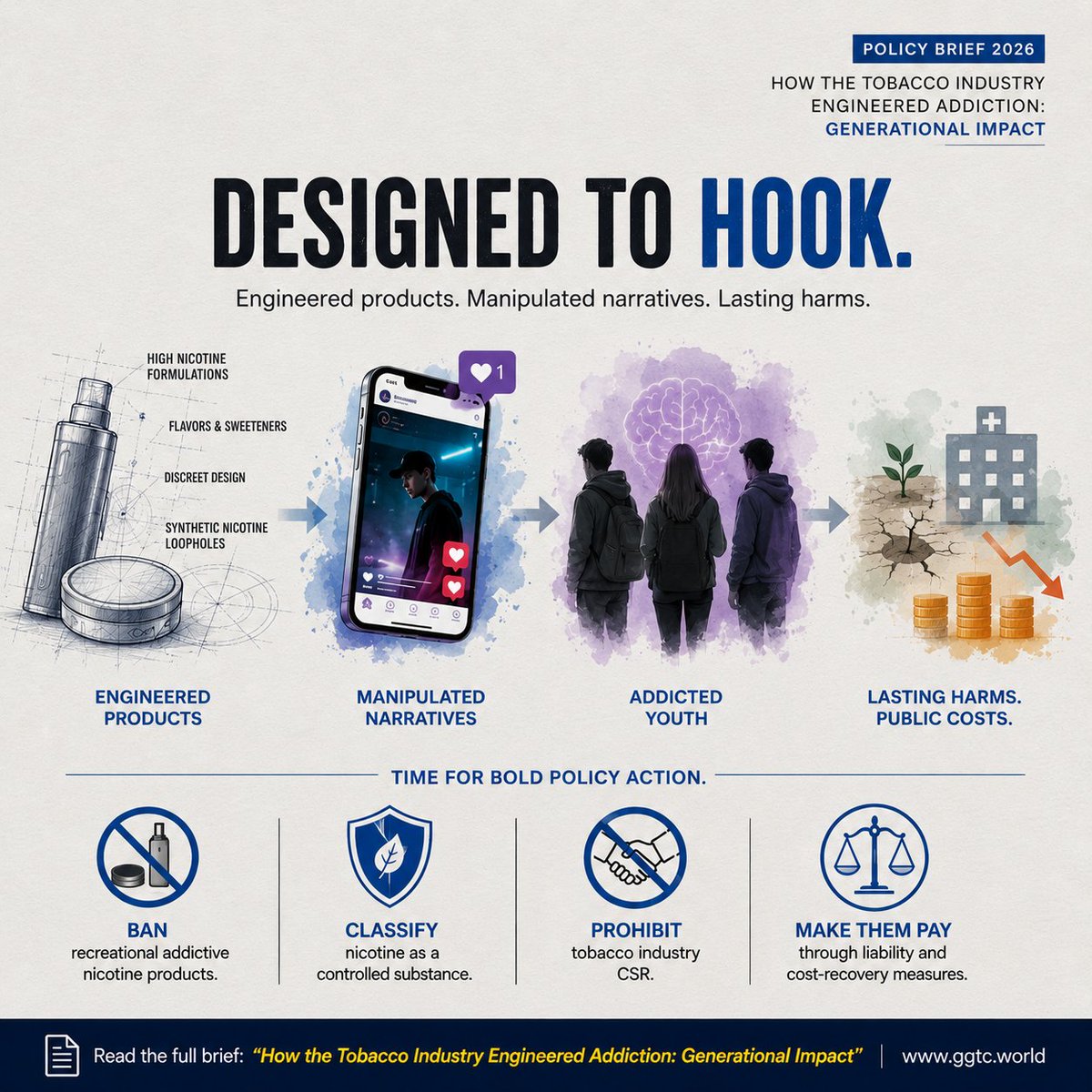
Ahead of #WorldNoTobaccoDay 2026, GGTC’s latest policy brief examines how the tobacco industry redesigned nicotine itself — from nicotine salts and high-strength formulations to flavours, discreet devices, and synthetic nicotine loopholes — to make addiction easier, faster, and harder to escape, especially for young people.
💡The brief highlights:
• Nicotine’s 67.5% lifetime dependence probability — higher than alcohol, cocaine, or cannabis
• Product engineering specifically designed to reduce sensory barriers and normalize use
• Growing evidence linking nicotine use among youth to mental-health harms, including anxiety, depression, and suicidal ideation
• The industry’s use of “harm reduction” narratives and CSR to protect profits and influence policy
The brief calls for:
☑️Banning recreational addictive nicotine products
☑️Classifying nicotine as a controlled substance
☑️Prohibiting tobacco industry CSR
☑️Expanding liability and cost-recovery measures so the industry pays for the harms it caused
🔗 Read the full brief: https://t.co/waPW0WtL3C
#UnmaskTheAppeal #wntd2026 #TobaccoExposed #ProtectYouth