#Communiqué 🗞️ Reprise des essais cliniques aux États-Unis pour AGuIX, une technologie alliant imagerie et thérapie, imaginée pour améliorer l’efficacité de la radiothérapie sur certains cancers particulièrement difficiles à traiter.
👉 https://t.co/UDlJweR1qL
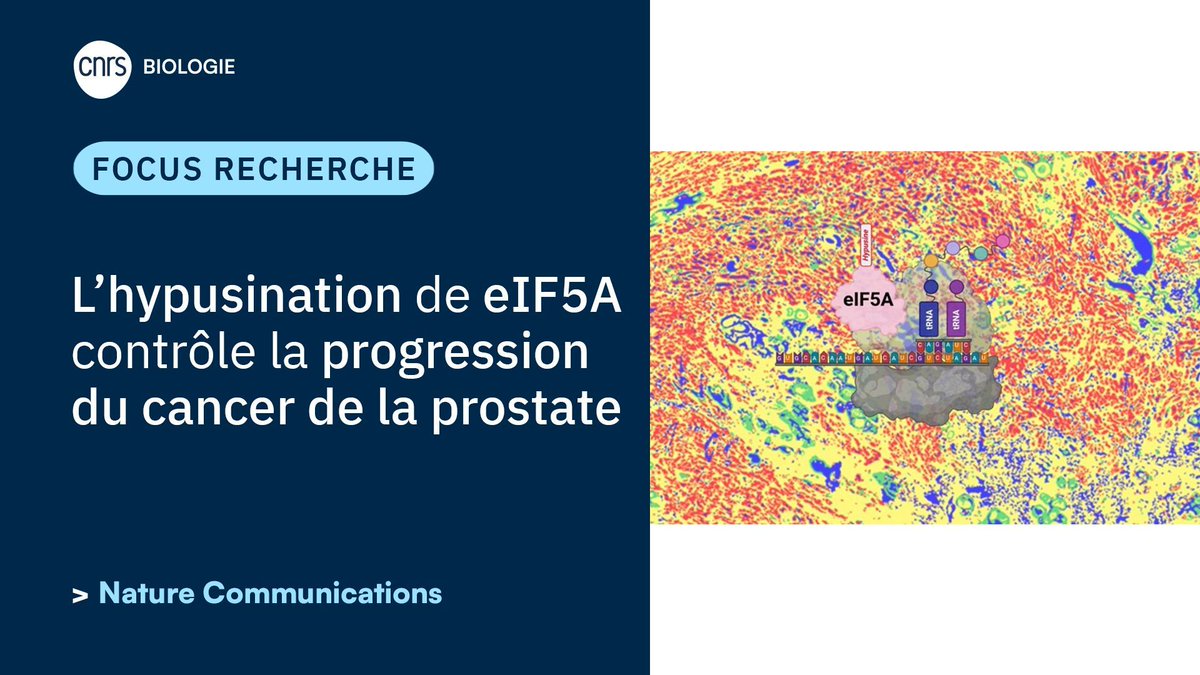
#ResultatScientifique🔎| Des scientifiques ont découvert que la protéine eIF5A, activée par hypusination, agit comme un "chef d’orchestre" et contrôle la progression du cancer de la prostate
✍️ @frederic_bost
📕 @NatureComms
▶️ https://t.co/aJ2JvSx9Yi
👉 https://t.co/TafXQUFl5J
Building on our Cell Met 2019 study, we show why some DLBCL patients relapse after L-asparaginase: metabolic rewiring drives DNA damage and PARP1/2 dependence. Targeting this with olaparib exploits resistance and enhances killing.
Kudos to @ChicheJohanna
https://t.co/jY2mqT0xGb
A novel potent and selective GCN2 inhibitor, APL-4098, has anti-leukemic activity through dysregulation of mitochondrial function https://t.co/xXW0RK0hCp
Our latest work describing how viral infections drive functional remodeling of ribosome-associated factors is out as a preprint! https://t.co/AEVMWl1cNx
Glad to share our latest review written with Dr @AltintasDogus , Marina Cerqua and Pr Paolo Comoglio on the "The Janus framework of the integrated stress response: from homeostasis to maladaptation"
https://t.co/SRSXjsM8wY
Why is the UPR activated upon glucose deprivation? a reviewer asked.
Why is IRE1 activated when glucose is low? a committee member for Mabel Cruz's PhD asked.
Mabel was surprised about the questions (is this not widely known?)
So we wrote a review about it with Eric Chevet.
Today we were pleased to welcome @AltintasDogus, who presented his latest work on the role of ISR-mediated translational reprogramming. Thank you Dogus for a very informative presentation and discussion. Interested, see https://t.co/drrGizbnE9
Our collaborative work with Vincent Vanoosthuyse's group, describing the use of virus-like particles to deliver ready-made RNaseH into cells and study RNA/DNA hybrids is out!
https://t.co/QOyuisflDl
Congratulations to @auner_lab_CH 👏👏👏for this new paper on GCN2-dependent but ISR-independent translation control mechanisms. And so many insights behind these remarkable results....
https://t.co/yEK6ImJzL7
Here I discuss the link between metabolism and immunosurveillance and how to exploit this link to improve treatment. I hope you find it interesting and useful. 🤗
Tumor-induced metabolic immunosuppression: Mechanisms and therapeutic targets: Cell Reports https://t.co/aR0TgAfZmq
Thanks to @FredericPerros for highlighting the need for human-relevant preclinical models in PVOD translational research—a challenge in many chronic diseases..
Bridging the species divide: The limits of rat models in capturing human PVOD mechanisms. https://t.co/8EW7vBphZR
Our work demonstrating that GCN2 plays a dual role in controlling ribosome biogenesis in both proliferative and stressed contexts, is out. Original data but also novel questions to address regarding this fundamental pathway....Thanks to all participants.
#PodcastCNRS 🎧 Et si, à la place d'une injection 💉, les futurs #vaccins pouvaient fondre sous la langue ? Explication avec Claire Monge, biologiste CNRS, dans ce nouvel épisode de "Qu’est-ce que tu cherches ?"
👉 https://t.co/gJvKfQFfdM