Yes. ETS is Elixir/Erlang's built-in in-memory store for fast concurrent local caching and shared state. It often beats Redis for single-node (or clustered) use by avoiding network hops and external deps. Redis shines for cross-node sharing without BEAM clustering, persistence, or its extra features.
@bcardarella@dhh Yes it does! Im using it on solutions for different companies, and as its just me and AI, i wouldnt trust any other stack with writing and refactoring the crazy business rules and logic i get asked on a regular basis.
but when i need performance, i just use rust as a service!
@bcardarella@dhh yeah i agree with you, probably we are not valuing the same outcomes anyway, lets keep using what we think is better for our goals, and more than anything, provide some real world value with it.
@bcardarella@dhh It is, thats why it particularly discarded the PR, because it tried to use ETS instead of Redis, so at least it knows that the Elixir way is not Redis, but wont commit any PR that doesnt use Redis
@bcardarella@dhh In this case, Elixir doesnt need an extra service, Redis, which the rest of languages need, so less special attention than the rest...
@dhh@bcardarella bruh im all in for let AI do the work for you, but maybe you could, let AI do the work? and not force it to use something elixir doesnt need like Redis or Interoperability with Rails?
@bcardarella there is the option for erlang/elixir ports too, i think its a good balance between performance and not taking down your whole runtime with a nif.
@nikuscs yep i get your point.
i think the only unfair part was that the elixir implementation was trying too hard to stay compatible with the rails project, explaining why it had such bad engineering decisions (no phoenix?...)
for ai bias, you can check this
https://t.co/qzFYTcChKP
@jamonholmgren which elixir is btw if you aren’t asking it to replicate an already bloated rust codebase and just start with elixir
https://t.co/qzFYTcChKP
@lazysloth@bcardarella@bloodyarra@pankajdoharey@dhh i wouldn’t say rust and go can’t create projects that don’t break up at night. i’m just saying i can get there faster and with less LoC/complexity with elixir.
@bcardarella@bloodyarra@pankajdoharey@dhh its bad at replicating an existing codebase, which are themselves OOP or imperative programing.
i have only had but perfect outputted code when the project starts as elixir itself.
@bcardarella@bloodyarra@pankajdoharey@dhh i know code is cheap (and even unlimited for some...) but i dont think this counts as perfectly fine. and considering this was a codebase trying to mimic the rust implementation, not a proper elixir oriented project, this could be even smaller....
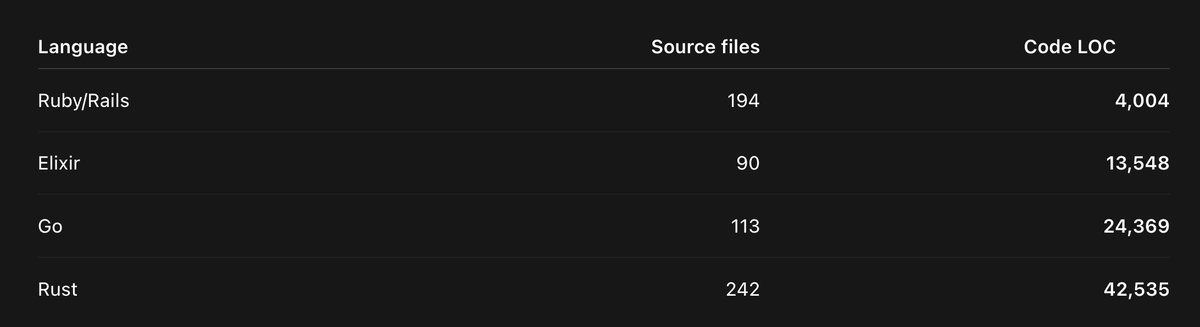
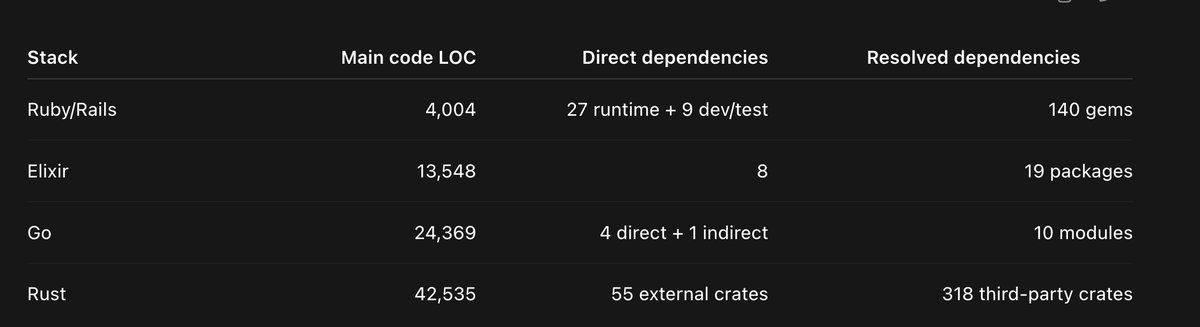
@ZachSDaniel1 analyzed the implementation, and i care more about these metrics than just raw performance.
Compared with Elixir, Rust has 314% as much application code, 688% as many direct dependencies, and 1,674% as many total dependencies.
And this was a bad implementation of Elixir...
"Programming languages and frameworks are dead."
Yes, kind of.
What will matter in future is runtime behavior:
Performance characteristics, resource usage, failure modes, observability, debuggability, deployments, rollbacks.
And legibility of all that to agents.