Failure to provide information relevant to recruitment can amount to a violation of fair administrative action.
The Court held that refusing to disclose recruitment information requested by an affected applicant violated the petitioner's constitutional right to fair administrative action and justified an award of constitutional damages.
🚨 Can a foreign embassy hire a Kenyan, dismiss them unfairly, and then claim it is above the reach of Kenyan courts? A question about where sovereign immunity ends and a Kenyan worker's rights begin.
Two Kenyan employees sued the Embassy of Sweden over their employment. The Embassy argued that as the mission of a sovereign State, it was immune from Kenyan courts altogether. The Employment Court said no. The Court of Appeal agreed. And now the same question is on its way to the Supreme Court.
The dispute runs to the heart of a hard tension. A sovereign State is not ordinarily answerable to another country's courts. But a Kenyan who works for that State, on Kenyan soil, has constitutional rights too. Whose position prevails? Here is the issue. 🧵
The Court of Appeal (Kiage, Mohammed & ole Kantai JJA) in Civil Appeal No. E317 of 2026 (26 June 2026), delivered an important clarification on the intersection between donor-funded procurement and Kenya's public procurement regime.
The Court held that where a procuring entity relies on a financier's refusal to issue a "No Objection" as the basis for terminating a procurement under Section 63 of the PPADA, the Public Procurement Administrative Review Board is fully entitled to interrogate whether that termination complies with Kenyan law.
Crucially, the Board is not reviewing or second-guessing the financier's internal decision. Rather, it is performing its statutory mandate by determining whether the procuring entity lawfully invoked that refusal to terminate the procurement process.
Can a Court "Google" evidence to uphold an administrative decision?
The Court of Appeal has answered with a firm no.
In Civil Appeal No. E317 of 2026 (26 June 2026), the Court reaffirmed that in judicial review courts supervise the legality of administrative decisions. They do not reconstruct the evidentiary record or cure deficiencies by undertaking their own factual investigations.
The Court faulted the High Court for relying on material obtained from the Public Procurement Information Portal that had not been placed before the Public Procurement Administrative Review Board, holding that compliance with statutory requirements must be proved before the tribunal itself, not supplemented later through judicial inquiry.
In a judgment delivered on 26th June 2026 in Okoth & Kiplangat Advocates v PPARB & Others (Civil Appeal No. E401 of 2026), the Court of Appeal has significantly developed Kenya's procurement jurisprudence by clarifying the nature and scope of judicial review under Section 175 of the Public Procurement and Asset Disposal Act(PPADA).
A grant of representation is not transferable to another person.
Where the holder of a grant dies, the grant is useless and inoperative...it's revocable under section 76 of LSA.
Upon revocation, file a fresh application for grant in the usual way.
https://t.co/yfPtd9AjCu
The High Court sitting at Kiambu has held in Benson Gatere Kiarie & Another v Eliud Mathu Kiarie & Another Civil Appeal No. E013 of 2025, that land registered in a deceased person's name does not automatically form part of the estate available for distribution.
Where evidence establishes a customary trust, beneficial ownership prevails over legal title. A title deed is not always conclusive. The Court will look beyond the register to the intention of the deceased, the family's history, and the surrounding circumstances to determine the true owner.
In succession, what appears on the register is not always what belongs to the estate.
Proper!
'While the Court cannot dictate to Parliament what statutes to enact or to the Executive what policies to adopt, the Court has jurisdiction and the duty to declare whether a policy or legislative framework,or the absence thereof, violates constitutional rights' Mwamuye J
A Purchaser Cannot Keep the Title and Withhold the Purchase Price.
In M'Mboga v Mahmud [2026] KECA 1179 (KLR), the Court of Appeal has reaffirmed a fundamental principle of conveyancing law. Once the agreed condition for payment has been fulfilled, in this case the transfer of title, the purchaser's obligation to pay the balance of the purchase price crystallizes and must be honoured.
The Court held that a buyer who has taken possession, enjoyed occupation, and secured registration of title cannot later rely on unsubstantiated allegations of defects to avoid meeting payment obligations under a professional undertaking. Alleged defects raised years after occupation and after completion of the transaction will not, without cogent evidence, defeat an accrued contractual obligation.
The takeaway: A purchaser cannot retain both the title and the purchase money. Completion of the transfer triggers the duty to pay.
🚨🚨COA SPEAKS: BUYERS CANNOT INVENT DEFECTS AFTER GETTING TITLE TO AVOID PAYING THE BALANCE
A significant decision from the Court of Appeal in Mercy Cassandra M'Mboga v Said Ahmed Mahmud has drawn a firm line on what happens after a property transaction is completed. The dispute revolved around a buyer who had purchased a house, taken possession, paid a substantial portion of the purchase price, and later obtained transfer of the title after her advocate issued a professional undertaking guaranteeing payment of the balance. However, after the title had been transferred into her name, the buyer claimed the house had structural defects and sought to withhold part of the outstanding purchase price to cater for alleged repair costs. The seller disagreed, insisting that the transfer had already been completed and that the balance remained payable. The dispute ultimately found its way to the Court of Appeal.
The Court sided with the seller. While acknowledging that the original agreement contained obligations relating to the condition of the property, the Judges were persuaded by the fact that the buyer had been in occupation of the house for more than four years before raising complaints about structural defects. Equally important, there was little evidence showing how the alleged repair costs had been incurred or calculated. To the Court, the complaints appeared to have surfaced only after ownership had already changed hands. The Judges therefore treated the claim as an afterthought and held that a professional undertaking cannot be frustrated by disputes that emerge after the very condition triggering payment has been fulfilled. Once the transfer was successfully registered, the obligation to pay crystallized and had to be honoured.
Beyond the parties involved, the decision carries an important lesson for buyers, sellers, advocates and business people alike. The Court is essentially saying that parties cannot enjoy the benefits of a contract and then go shopping for excuses to avoid performing their own obligations. If there are defects, concerns, or outstanding issues, they must be raised before completion and made part of the bargain. The law will not readily allow someone to keep the title, keep possession, keep the benefit of the transaction, and at the same time withhold payment on the basis of complaints that were never properly raised beforehand. For conveyancing practice, the judgment strengthens the sanctity of professional undertakings. For the ordinary mwananchi, it reinforces a simple but powerful principle: a deal is not a menu that can be edited after the meal has already been served.
Kindly repost widely🙏
Imagine buying property worth 110Million in public Auction,getting the property transferred in your name but then Court declares the Auction was Illegal and your title is cancelled! This is the Case of KUDHEIHA V TEA HOTELS LIMITED
The Court of Appeal at Nakuru has held that public officers who act maliciously and outside the lawful remit of their office cannot seek refuge behind the State. Once an officer weaponizes public power for improper purposes, personal liability may follow.
🚨 THE COURT SPEAKS: No Case Should Be Buried Because of Uncontrollable Setbacks Like Power Outages or Technological Glitches.
In a decision that will resonate with countless litigants frustrated by the realities of virtual hearings, the Environment and Land Court at Isiolo has reaffirmed that justice should not be sacrificed because of circumstances beyond a party's control. In Isaack Godana Boru v Samson Mburu alias Mzunguko [2026], a land dispute that had been in court since 2015 was abruptly dismissed when neither side answered during a virtual hearing. The Plaintiff's advocate maintained that she had already joined the session and was addressing the court when a brief power outage caused the connection to drop. By the time she reconnected using her phone, the suit had already been dismissed. Her attempt to immediately revive the case was rejected, with the trial court blaming the Plaintiff for delays in the matter.
Justice Oguttu Mboya disagreed. The Court held that the magistrate had exercised discretion improperly and had relied on the wrong provisions of the law to dismiss a suit that had already been partly heard. The Judge found that the lower court had failed to appreciate the explanation surrounding the technological interruption and had wrongly attributed delays to the Plaintiff despite the record showing that related proceedings had contributed to the slow pace of the case. Significantly, the Court noted that disputes involving land should, as far as possible, be determined on their merits rather than terminated through procedural shortcuts. The dismissal orders were set aside, the suit reinstated, and directions issued that the matter be heard before a different magistrate.
The implications go far beyond this case. In an era where hearings increasingly depend on electricity, internet connections and virtual platforms, litigants should not lose their constitutional right to be heard because of events outside their control. The decision sends a powerful message that substantive justice must prevail over technical mishaps and that a dismissed case is not always a dead case. For wananchi whose matters have been struck out under questionable circumstances, this judgment offers something often lost in litigation: hope.
Kindly REPOST to spread awareness. ⚖️🙏
The detention of @MarthaKarua in Uganda today is not only an absurdity but a erosion of Jumuiya values and an insult to the very existence of " Jumuiya ya Afrika Mashariki"
The strength of Political parties determinesvthe structure of governance in Kenya. In this regard, does the new wave by Sifuna threaten the command of DAP party in Western? @OBurrows@KoinangeJeff#CitizenSundayLive
Although a Gen-z and though not privileged to experience the taste of Wamalwa snr. season in leadership, Eugine has proved to be a replica of that great man! I pray and hope that his contribution to Kenya's unity may forever be in honour of Mzee! @KoinangeJeff#CitizenSundayLive
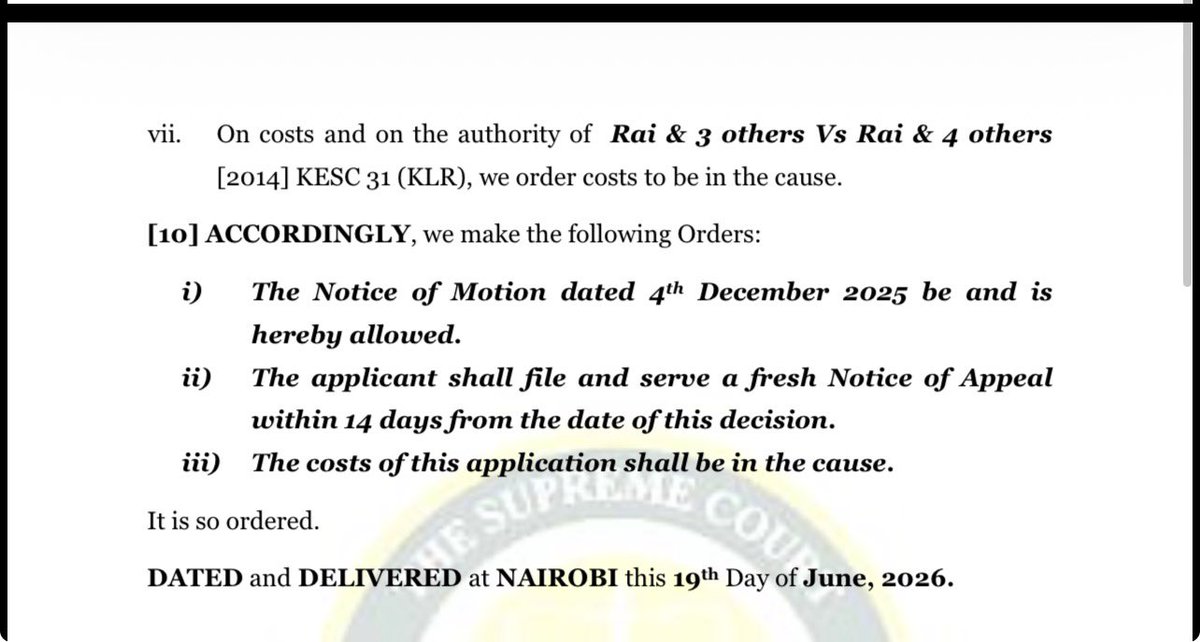
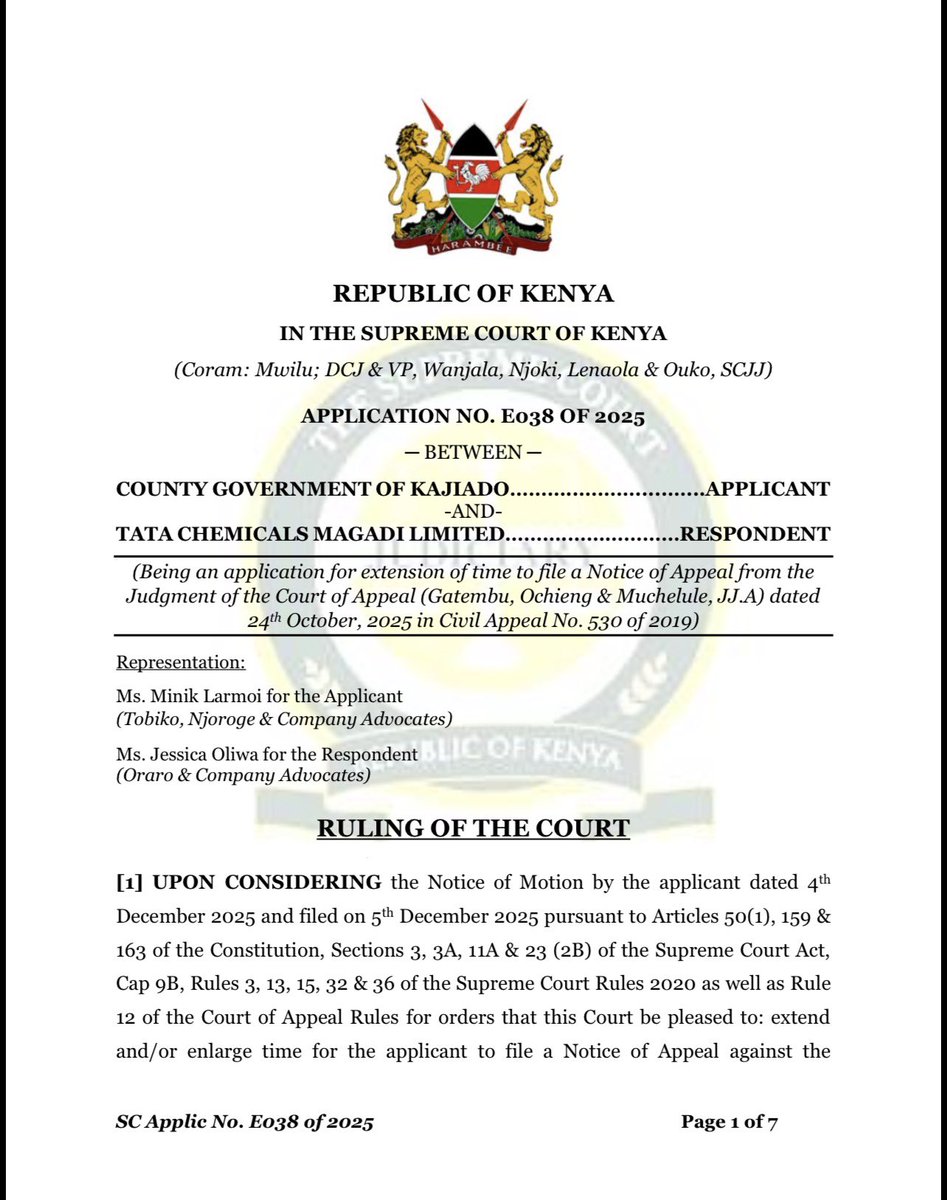
Miss a court deadline and you might assume the case is over. Not necessarily.
In the Supreme Court ruling of County Government of Kajiado v Tata Chemicals Magadi Limited Application No. E038 of 2025, the court allowed Kajiado County to proceed with an appeal it had filed three days late.
Why the leniency? Because the County, like all public bodies, can't simply act on its own. The law requires several offices to agree before it goes to court. The Court accepted that this genuine legal requirement explained the short delay.
The Court was clear: a document filed out of time without leave or permission is irregular and of no effect, a legal nullity. So even though the County won its extension, its earlier filing counted for nothing, and it was ordered to start again and file afresh.
Just by virtue of legislators voting NO against the Finance Bill 2026, shouldn't afford them heroic titles! I mean that's what they are paid to do - be be reasonable and sound to the issues affecting the people! On to the next assignment.


![OduorACaroline's tweet photo. A Purchaser Cannot Keep the Title and Withhold the Purchase Price.
In M'Mboga v Mahmud [2026] KECA 1179 (KLR), the Court of Appeal has reaffirmed a fundamental principle of conveyancing law. Once the agreed condition for payment has been fulfilled, in this case the transfer of title, the purchaser's obligation to pay the balance of the purchase price crystallizes and must be honoured.
The Court held that a buyer who has taken possession, enjoyed occupation, and secured registration of title cannot later rely on unsubstantiated allegations of defects to avoid meeting payment obligations under a professional undertaking. Alleged defects raised years after occupation and after completion of the transaction will not, without cogent evidence, defeat an accrued contractual obligation.
The takeaway: A purchaser cannot retain both the title and the purchase money. Completion of the transfer triggers the duty to pay.](https://pbs.twimg.com/media/HLpe-UeW4AAnBXQ.jpg)
![OduorACaroline's tweet photo. A Purchaser Cannot Keep the Title and Withhold the Purchase Price.
In M'Mboga v Mahmud [2026] KECA 1179 (KLR), the Court of Appeal has reaffirmed a fundamental principle of conveyancing law. Once the agreed condition for payment has been fulfilled, in this case the transfer of title, the purchaser's obligation to pay the balance of the purchase price crystallizes and must be honoured.
The Court held that a buyer who has taken possession, enjoyed occupation, and secured registration of title cannot later rely on unsubstantiated allegations of defects to avoid meeting payment obligations under a professional undertaking. Alleged defects raised years after occupation and after completion of the transaction will not, without cogent evidence, defeat an accrued contractual obligation.
The takeaway: A purchaser cannot retain both the title and the purchase money. Completion of the transfer triggers the duty to pay.](https://pbs.twimg.com/media/HLpe7TCWoAAg61d.jpg)
![OduorACaroline's tweet photo. A Purchaser Cannot Keep the Title and Withhold the Purchase Price.
In M'Mboga v Mahmud [2026] KECA 1179 (KLR), the Court of Appeal has reaffirmed a fundamental principle of conveyancing law. Once the agreed condition for payment has been fulfilled, in this case the transfer of title, the purchaser's obligation to pay the balance of the purchase price crystallizes and must be honoured.
The Court held that a buyer who has taken possession, enjoyed occupation, and secured registration of title cannot later rely on unsubstantiated allegations of defects to avoid meeting payment obligations under a professional undertaking. Alleged defects raised years after occupation and after completion of the transaction will not, without cogent evidence, defeat an accrued contractual obligation.
The takeaway: A purchaser cannot retain both the title and the purchase money. Completion of the transfer triggers the duty to pay.](https://pbs.twimg.com/media/HLpe0J0WIAArtbK.jpg)






![OduorACaroline's tweet photo. A Purchaser Cannot Keep the Title and Withhold the Purchase Price.
In M'Mboga v Mahmud [2026] KECA 1179 (KLR), the Court of Appeal has reaffirmed a fundamental principle of conveyancing law. Once the agreed condition for payment has been fulfilled, in this case the transfer of title, the purchaser's obligation to pay the balance of the purchase price crystallizes and must be honoured.
The Court held that a buyer who has taken possession, enjoyed occupation, and secured registration of title cannot later rely on unsubstantiated allegations of defects to avoid meeting payment obligations under a professional undertaking. Alleged defects raised years after occupation and after completion of the transaction will not, without cogent evidence, defeat an accrued contractual obligation.
The takeaway: A purchaser cannot retain both the title and the purchase money. Completion of the transfer triggers the duty to pay.](https://pbs.twimg.com/media/HLpfB3zX0AArwBT.jpg)


![AssociatesRoba's tweet photo. 🚨 THE COURT SPEAKS: No Case Should Be Buried Because of Uncontrollable Setbacks Like Power Outages or Technological Glitches.
In a decision that will resonate with countless litigants frustrated by the realities of virtual hearings, the Environment and Land Court at Isiolo has reaffirmed that justice should not be sacrificed because of circumstances beyond a party's control. In Isaack Godana Boru v Samson Mburu alias Mzunguko [2026], a land dispute that had been in court since 2015 was abruptly dismissed when neither side answered during a virtual hearing. The Plaintiff's advocate maintained that she had already joined the session and was addressing the court when a brief power outage caused the connection to drop. By the time she reconnected using her phone, the suit had already been dismissed. Her attempt to immediately revive the case was rejected, with the trial court blaming the Plaintiff for delays in the matter.
Justice Oguttu Mboya disagreed. The Court held that the magistrate had exercised discretion improperly and had relied on the wrong provisions of the law to dismiss a suit that had already been partly heard. The Judge found that the lower court had failed to appreciate the explanation surrounding the technological interruption and had wrongly attributed delays to the Plaintiff despite the record showing that related proceedings had contributed to the slow pace of the case. Significantly, the Court noted that disputes involving land should, as far as possible, be determined on their merits rather than terminated through procedural shortcuts. The dismissal orders were set aside, the suit reinstated, and directions issued that the matter be heard before a different magistrate.
The implications go far beyond this case. In an era where hearings increasingly depend on electricity, internet connections and virtual platforms, litigants should not lose their constitutional right to be heard because of events outside their control. The decision sends a powerful message that substantive justice must prevail over technical mishaps and that a dismissed case is not always a dead case. For wananchi whose matters have been struck out under questionable circumstances, this judgment offers something often lost in litigation: hope.
Kindly REPOST to spread awareness. ⚖️🙏](https://pbs.twimg.com/media/HLfEssjXwAAjBkv.png)