Each linear quantity has a rotational version.
x → θ, v → ω, a → α, m → I, F → τ, p → L. The equations keep the same form: F = ma becomes τ = Iα, and ½mv² becomes ½Iω².
The two are linked by the radius: s = rθ, v = rω, aₜ = rα, and the centripetal acceleration is a_c = v²/r = ω²r.
Rotation follows Newton's laws in different variables.
It's not the result itself that matters, but its implications. Using the Riemann–Alpöge theorem, I was finally able to prove that π is strictly greater than 3.
We are entering the era of superintelligence. Nobody on Earth has read all of what you’re looking at.
Yesterday I posted a map of the 17-million-line, AI-assisted Lean proof of the Riemann Hypothesis (175,187 files, verified by Lean & Mathlib). Everyone asked what they were actually looking at.
So I built an interactive visualizer so you can fly through the proof yourself 👇
What you’re seeing in this video:
• Every node
• Every connection
• The colors/clusters
How to explore it:
→ Zoom & pan across all 175k+ modules
→ Click any node to trace its upstream/downstream dependencies
→ Search for any theorem or follow the path straight to RiemannHypothesis
No human has read all 17 million lines yet. This is the closest thing we have to looking inside the mind of machine-verified math.
Try it live: https://t.co/DygEol8sYJ
Nine ways to measure how far apart A and B are.
Minkowski ties three together: d = (|Δx|ᵖ + |Δy|ᵖ)^(1/p). It gives Manhattan, Euclidean or Chebyshev depending on p. The purple shape shows all points at the same distance from A.
Cosine ignores length and keeps only the angle. Hamming counts positions where two strings differ. Jaccard and Dice compare the overlap of two sets.
Haversine gives the great-circle distance on a sphere.
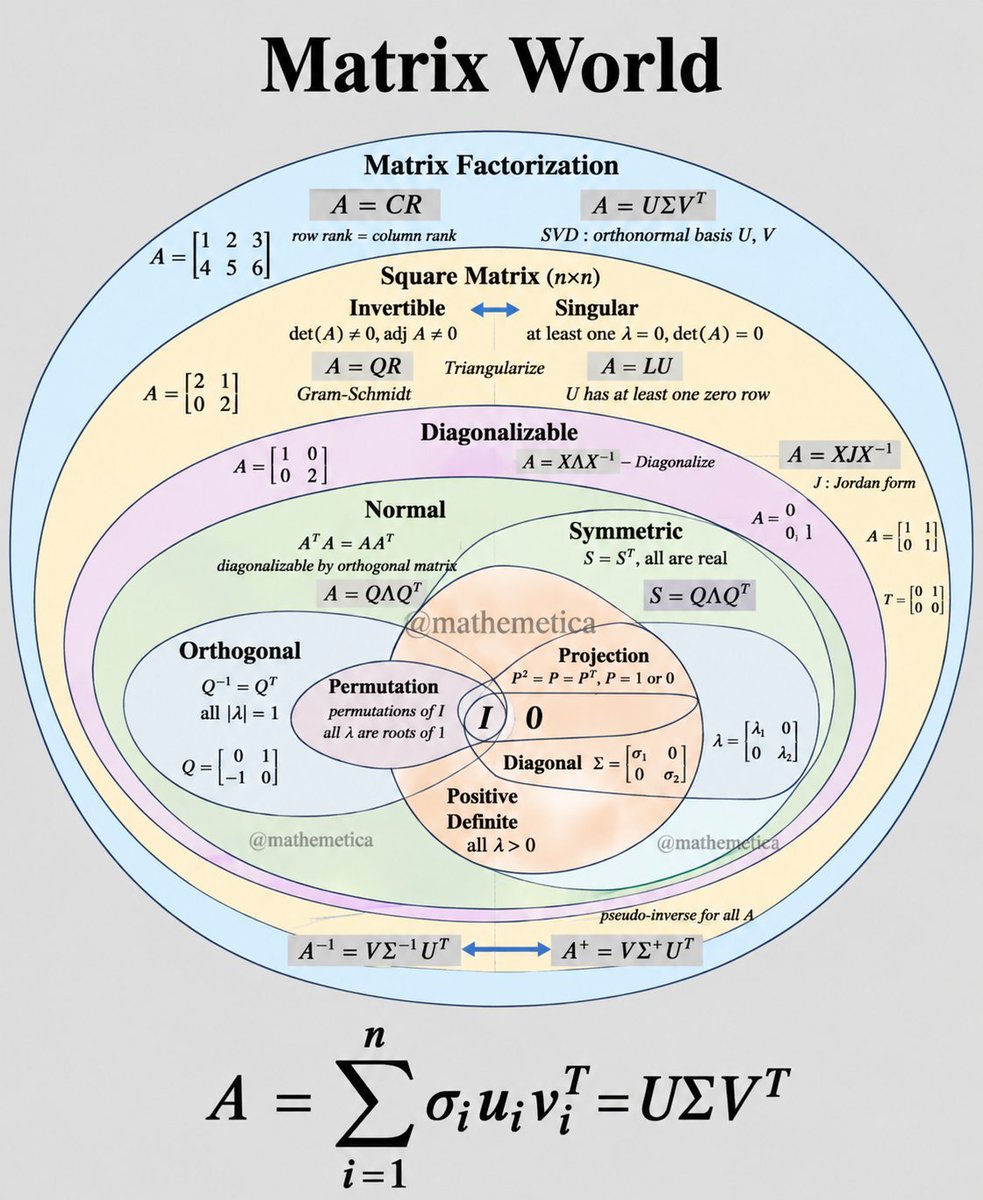
Matrices form nested worlds, each with its own laws of symmetry.
From raw arrays we factor into CR or the universal SVD:
A = Σ σᵢ uᵢ vᵢᵀ = UΣVᵀ.
Square matrices split into invertible and singular. Inside them sit the diagonalizable, then the normal matrices that commute with their transpose.
Symmetry tightens the circle: real eigenvalues, orthogonal diagonalization, projections that are their own square, and positive-definite matrices whose eigenvalues refuse to be negative. Orthogonal and permutation matrices sit at the center, eigenvalues pinned to the unit circle.
Every matrix, however wild, still possesses a clean singular-value story.
I've been wondering whether politicians are having sleepless nights, worried that 'something' might happen to a girl in Piddington. The residents made their objections loud and clear. There's no wiggle room for those in power.
I suspect they've already had a quango workshop a response strategy, and that this is what allows them peace of mind, rather than any ethical or moral issues.
Russell Brand's sentence reminds me of Tom Wolfe's Bonfire of the Vanities. The district attorneys are bored with a justice system that they see as a sewage pipe processing an endless supply of Hispanics and blacks to jail.
The (Jewish) Larry Kramer dreams of catching a high-status WASP male; they refer to the dream catch as 'The Great White Defendant'-one they can really throw the book at.
This isn't to absolve Brand, but to try and understand the mentality of the justice system, which seems absurdly lenient sometimes, and punishingly draconian at others.
The Five Differential Operators of Physics
Five operators built from one symbol, nabla, all moving at once.
Divergence: div F = dFx/dx + dFy/dy + dFz/dz, the net flux out of a tiny closed surface (source or sink strength).
Gradient: grad phi = (dphi/dx, dphi/dy, dphi/dz) points to the steepest increase of phi, always at a right angle to the contour lines, and is longest where they are tightest.
Curl: curl F measures the spin of the field around a point. The vector stands on the axis of the whirl, and flips when the whirl reverses.
Laplacian: the sum of the second derivatives. On the bowl z = x^2 + y^2 the Laplacian is 4, so the average around any circle of radius r sits exactly r^2 above its centre.
D'Alembertian: box F = (1/c^2) d^2F/dt^2 - Laplacian F. A wave running at speed c makes it zero, which is why it appears in the wave equation and in relativity.
A 2×2 matrix A makes the plane flow by x′ = Ax, and each flow is one of nine kinds: points sink, escape, spiral, circle or settle on a line.
The kind is set by the eigenvalues of A, the roots of λ² − (tr A)λ + det A = 0. det A < 0 gives a saddle. Above det A = (tr A)²/4 they are complex: spirals, or a centre if tr A = 0. Below it, nodes; on it, star and degenerate node.
The stable spiral here has tr A = −1, det A ≈ 2.65, so λ = −0.5 ± 1.55i.