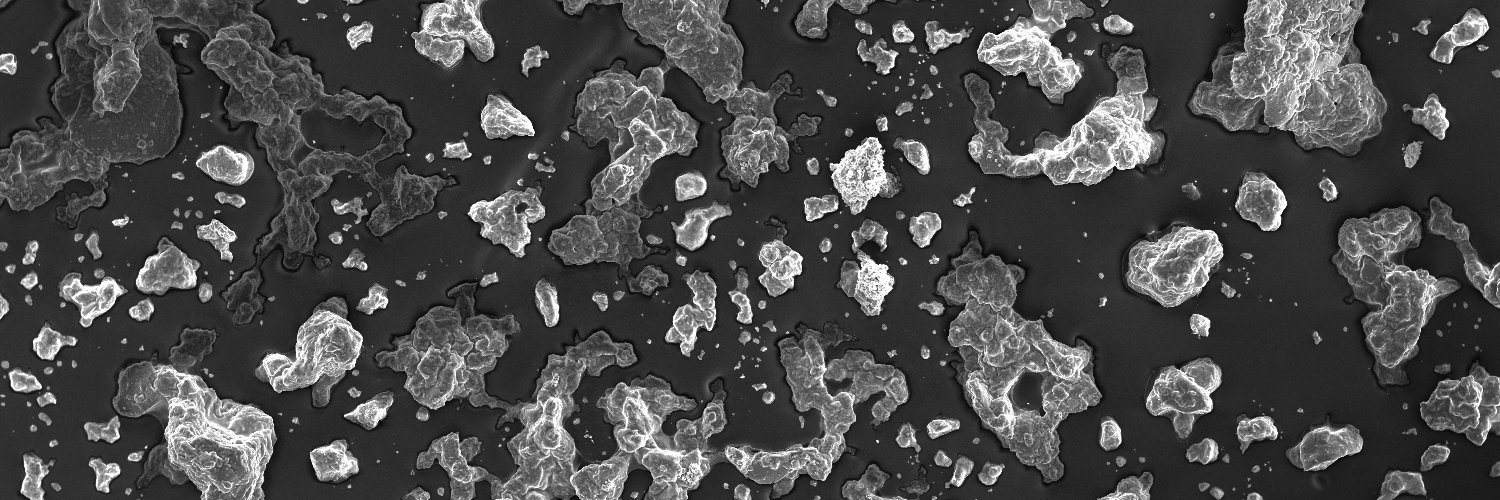
Published in Science, we report a way to prepare fluorochemicals directly from fluorspar without HF.
2 years ago we thought this was impossible.
Made a reality thanks to our incredible team @Oxchemmike@BrowneGroup@GroupAldridge @Fluo_Rok @bobbypaton and lots of ball milling!
We are thrilled to share a new HF-free technology that converts fluorspar to fluorochemicals. Enormous congratulations to the amazing team of chemists who made this recurring dream a reality! https://t.co/3nU4slfjAg @CalumPatel@ScienceMagazine@OxfordChemistry @Fluo_Rok
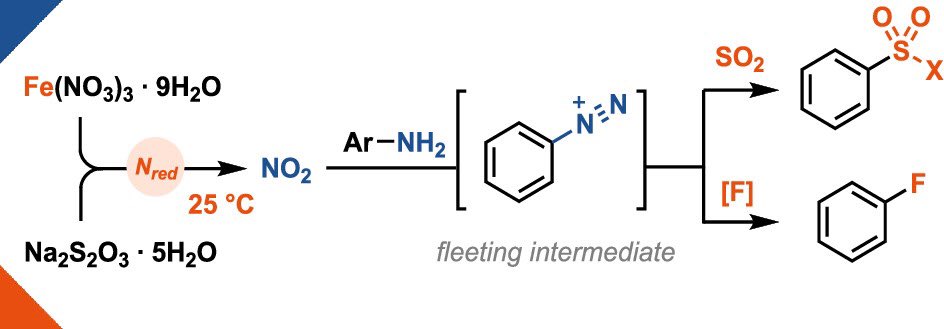
Nitrate reduction at 25 °C? A little iron is all it takes! 🪄 The use of cheap iron(III) nitrate (30€ per kg!) enables the in-situ generation of aryldiazonium salts which can be engaged in sulfonylation & fluorination reactions!
Out now in @J_A_C_S 🔓
https://t.co/s24e7mPYwB
🚨RADICAL RETHINK: STEREORETENTIVE CROSS COUPLING UNLOCKED🚨 Today in @ChemRxiv (https://t.co/zGZFCsK7aK) the first method for stereoretentive radical cross-coupling is disclosed. No fancy ligands or redox needed—just a Ni-diazene twist. 120 years after Gomberg, a new chapter begins.
Quick summary:
Since Gomberg discovered free radicals over 120 years ago and Kochi pioneered radical cross-coupling in the 1970s, this field has surged with interest for linking C(sp3) fragments. Unlike traditional polar methods (e.g., Suzuki), radical cross-coupling excels with saturated systems, offering mild conditions and chemoselectivity to build complex molecules from common fragments. Until now, enantiospecific radical cross-coupling was deemed impossible due to rapid racemization, but today that changes with readily available sulfonylhydrazides and a simple Ni-catalyst. This stereoretentive approach, enabled by a unique Ni-diazene transition state and driven by loss of N2, skips chiral ligands and redox steps, opening new possibilities for synthesis.
Delighted to share our latest research on a simple coupling reaction of two strained diradicaloids, just published in @Nature. Congrats to @TenaArismel, Christina, @HuilingShao, and Andrew, plus our amazing collaborator @Houk1000! PDF: https://t.co/FdfCE6HwnN @UCLA@uclachem
Thrilled to share our newest work on the enantioconvergent synthesis of alkyl fluorides with KF, made possible by a synergistic combination of chiral urea and onium salt catalysts. Out today in @NatureCatalysis https://t.co/yUglWFABnf Congrats to @Claire_doo and all of the team!
Delighted to see my PhD research published today in
@NatureCatalysis! Here we disclose the latest work in our hydrogen bonding research programme, synthesising alkyl fluorides using KF under synergistic phase transfer catalysis. Thanks to all involved who made this possible 🎉
In a new @Nature study, Prof. Ryan Shenvi (@Shenvi_Lab) demonstrated how computational tools and predictive modeling could synthesize 25 picrotoxin—complex plant molecules that could inform drug discovery for brain diseases. More: https://t.co/dJg5d045wn
What an Incredible Start to 2025!
I am overjoyed to share that our research has been published in Science. As the sole corresponding author, this recognition feels profoundly rewarding and almost surreal. https://t.co/WcyzaoXFNl
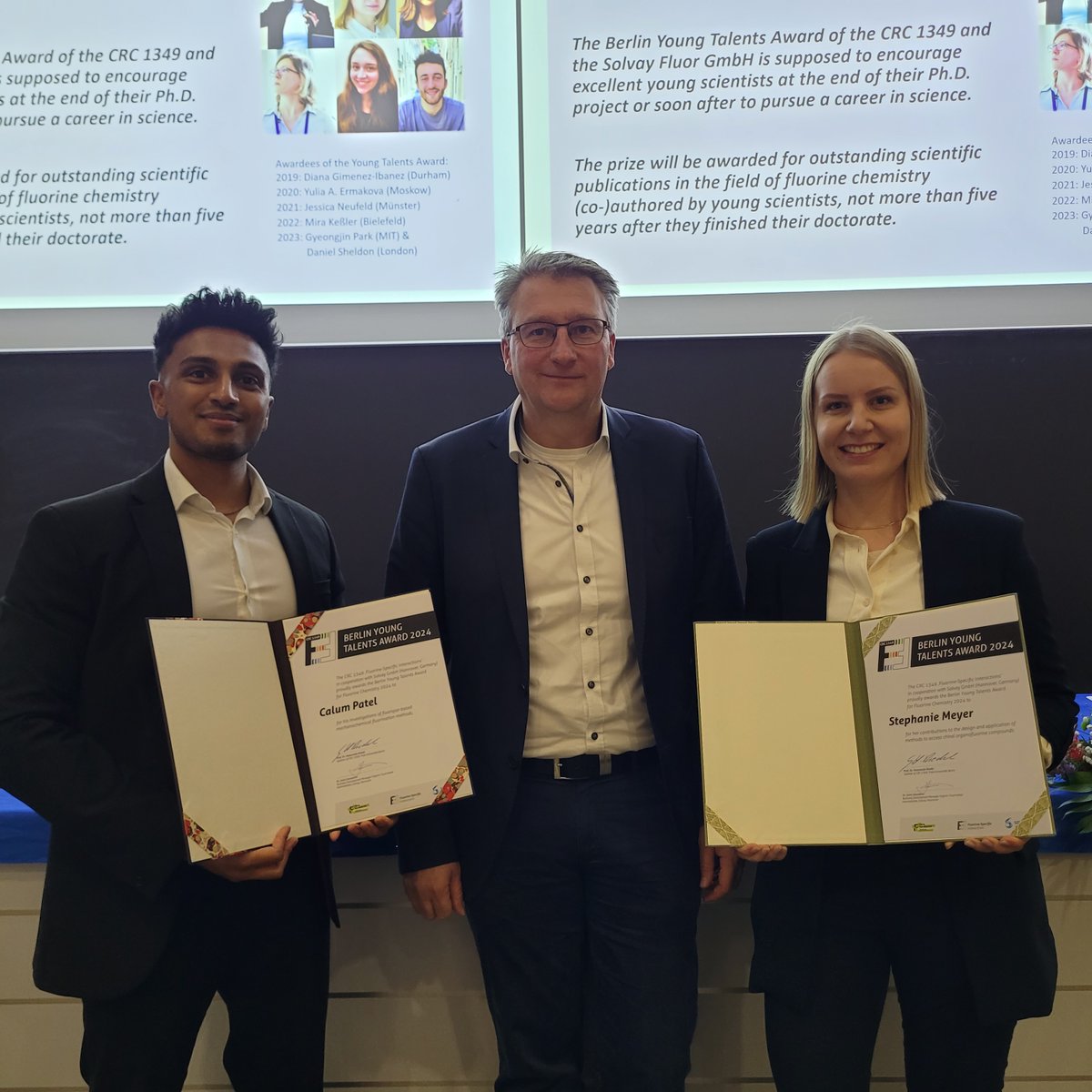
I was deeply honoured to present my PhD research at the Festkolloquium commemorating the birthday of Prof. Konrad Seppelt at the Freie Universität Berlin. I thank CRC 1349 “Fluorine-Specific Interactions” and Solvay Fluor GmbH for their generous award.
Congratulations to Stephanie Meyer @steph_meyer16 (@uni_muenster, now @BASF) and Calum Patel (@UniofOxford) for winning the Berlin Young Talent Award in Fluorine Chemistry @fluor_crc1349 sponsored by Solvay Fluor. We had an excellent symposium last Fr. in honour of Prof. Seppelt.
Delighted to share our latest work in @Nature on the use of oxalic acid to activate Fluorspar in water at low temperature in a Lewis acid-enabled process. Enormous thanks to Immo, Anirban and @CalumPatel, and Gabriele Pupo and Andrew Schwarz (@Fluo_Rok) https://t.co/WZ3BdJJ0Vt
Amazing collaboration with Stoltz group @Caltech and Davies group @EmoryUniversity! Our part was to achieve tetra-CH hydroxylation via weak coordination at very late stage of complex total synthesis:
https://t.co/vFziz8kmin