@AteoSicario@malonebarry It matters. And a surveillance state with a demonstrably racist police force is an unjust tyranny, and ultimately strains the social contract on which law and order is based.
@AteoSicario@malonebarry No let’s crack down on poor people, minority and people of colour. Which is where surveillance technology and the British justice system goes.
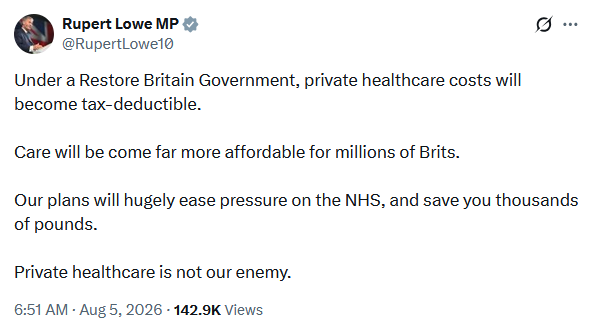
Rupert Lowe has told his followers on @X that a "Restore Britain Government" would make private healthcare costs tax-deductible, that this would "hugely ease pressure on the #NHS", and that "private healthcare is not our enemy."
Really Rupert? Who, exactly, would benefit from that policy, and who has been asking for it for years?
A tax-deductible private healthcare scheme is not a subsidy for "millions of Brits," whatever the tweet claims. Tax deductions are worth more the more you earn, and worth nothing at all to the roughly 40% of UK adults who don't earn enough to pay income tax in the first place, or who could never stretch to a private premium regardless of the discount.
It is, structurally, a policy that transfers public money to people who already have the means to go private, most of whom are already healthier, wealthier, and less likely to need the NHS at all.
Meanwhile every pound diverted through the tax system into private premiums is a pound not collected for the NHS that everyone else still relies on.
This is not a fringe reading of the policy. It is the standard critique of tax-relief-on-private-insurance schemes wherever they have been tried, and it is why the Treasury has repeatedly resisted them.
Lowe presents himself as a plain-speaking businessman simply pointing out what works. His own record suggests something closer to a man arguing for a market he has a direct financial history in, and one whose failures he has already lived through.
Companies House confirms Lowe was a director of Rutherford Health Plc, formerly Proton Partners International, from 27 February 2018. He served as non-executive chairman for part of that period, completed his term as chairman in December 2021, and remained a non-executive director until he resigned on 10 February 2022. This was not an adjacent supplier.
Rutherford Health was a private oncology company, building and operating proton beam therapy and cancer treatment centres in Newport, Bedlington, Liverpool and Reading.
On 13 June 2022, several months after Lowe's resignation, the High Court made winding-up orders against Rutherford Health Plc and seven related group companies. The Official Receiver was appointed liquidator, and treatment and diagnostic services at all four sites stopped.
Reported factors behind the collapse include a sharp fall in patient numbers during the pandemic, capital expenditure of over £240 million to build the proton beam centres, insufficient NHS referrals and contracts, and cash burn from rapid expansion.
Lowe's role throughout was non-executive, meaning board oversight rather than day-to-day management, and he had already left the board some months before the winding-up orders.
None of that changes the basic fact: a multimillionaire, proposing tax breaks to grow private healthcare, sat on the board of a private healthcare company for four years, including a period as its chairman, and that company later collapsed into liquidation owing money against its cancer treatment centres.
That is not his only interest in the sector, only the most direct. Companies House also confirms him as an active, current director of two Winchester biotech firms, Biopharma Process Systems Ltd and Biopharma Technology Ltd, continuously since 2009, alongside his declared role as director and major shareholder of PE487 Ltd, a pharma business at the same address.
He is also an active director of two family IT and infrastructure contractors, Data-Path Office Network Services Ltd and J.Brand Ltd, both of which advertise long-standing NHS work, and which sit, along with the century-old electrical contractor Lowe & Oliver, under Lowe Holdings Ltd, the family holding company of which he has been the controlling person since 2016.
Rupert Lowe sits atop a consolidated, decades-old family business empire with declared and active interests running through pharma, biotech, NHS-facing contracting and, until its collapse, private cancer care itself, alongside a political career built on demanding the state get smaller.
This is consistent with everything else Lowe has said on the subject.
In January 2025 he told an interviewer he wanted "some form of scheme where we buy our own healthcare."
He has spent his time in Parliament railing against tax generally, describing himself as "acutely aware" of how much British workers pay, while showing no comparable concern about people who rely on the NHS or benefits, whom he has repeatedly attacked as a drain on the country.
Private healthcare tax relief is not a break from that record. It is the same anti-tax, anti-state politics with a healthcare label on it.
Lowe frames this as a plan to relieve the NHS. The international evidence says the opposite system, the one built around private insurance rather than universal tax-funded care, performs worse, not better.
The Commonwealth Fund's repeated cross-country comparisons put the US, the world's most privatised, insurance-dependent healthcare system, last among wealthy nations on access, affordability, equity and outcomes, despite spending far more per person than any other country, including the UK.
The UK, by contrast, has consistently ranked near the top of the same comparisons on access and equity, precisely because care is allocated by need rather than ability to pay.
A tax incentive that pulls wealthier, healthier patients and public money out of that pooled system does not relieve pressure on it. It erodes the funding base and the political constituency that keeps it universal, the classic first step toward the two-tier system Lowe's American backers already live with.
None of this is unusual for Lowe. It is the same move he makes on immigration, on crime, on the welfare state: take a real and serious problem, in this case NHS pressure, and offer a simplistic ineffective solution that happens to serve people exactly like him, dressed up as 'common sense' that only the timid political establishment lacks the courage to say out loud.
"Private healthcare is not our enemy," he says. He might have added: nor is it a stranger, and the last private healthcare venture he sat on the board of didn't survive contact with the market he now wants to expand.