Prime is now on Netflix. Watch now! When his father suddenly dies, Marius’s world is thrown upside down as past traumas come back to haunt him. Thembi is torn between her love for Marius and her fear of him losing his grip on reality. #PrimeFilm#PrimeFilmSA#LoveSAFilm
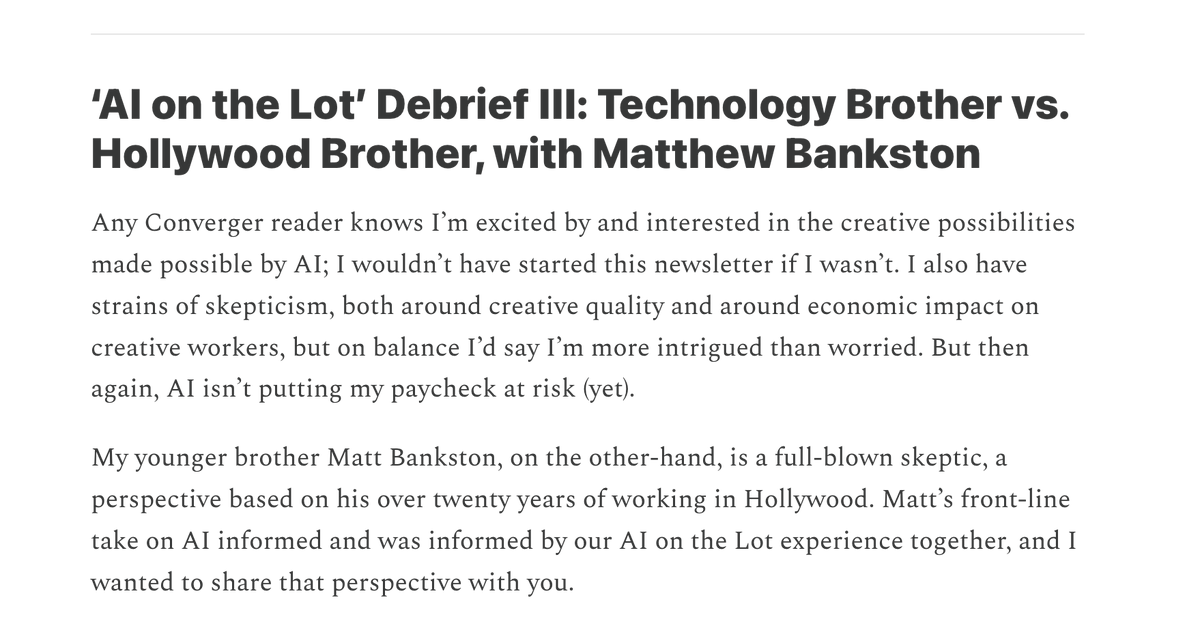
My brother's a Hollywood creative exec. I dragged him to the 'AI on the Lot' conference to see the future. Then I interviewed him about it:
"They keep talking about saving time and money. I live in Burbank—that ‘time and money’ are all my neighbors."
https://t.co/7AyjsY9jPk
I stand by every word.
When Ensemble Studios was murdered, the devs didn’t “die”. Some of us founded four new game studios. Some went and pollinated the rest of the industry. Everyone benefited except MicroSoft, who killed us.
And we were a studio that ought not to die. Studios that SHOULD die should go.
I want to introduce you to Steve. He’s 83. His wife died a few months ago and he comes to this lodge in Spring Mill, Indiana and draws. He taught art in Terre Haute, IN his whole life. He also did courtroom sketches in court cases. In the comments I’ll share some pics from his sketchbook. He was excited when I said I was going to share his sketches with the world.
Aquí Iñárritu resume perfectamente por qué la sobreexplicación y el exceso de subtramas y escenas innecesarias no es el camino:
“La perfección no es cuando ya no hay nada más que puedas añadir. La perfección es cuando ya no hay nada más que puedas QUITAR”
“Todos en la vida nos hemos sentido solos alguna vez. Y en los momentos de soledad vienen las propuestas mas descabelladas para salir de ahí, pero la soledad es como un invierno, un tiempo nublado que pasa. Nunca hay que cambiar de rumbo por eso, solo hay que transitarla. Para eso sirve mucho el diálogo y nuestros amigos o familiares. Pero de los momentos feos siempre se saca algo bueno. Las tormentas al final se terminan”.
El Papa Francisco en una de las mejores explicaciones sobre la soledad. Cuanta falta le hace su voz hoy al mundo.
most working actors have day jobs in real estate, have family money, or a spouse with a real job. i met someone whose breakout lead role was in a $70M budget film that flopped; they were driving lyft two years later. people have no idea how precarious the arts are.
A comment about working on low budget films.
I did my first short for $1500. The crew worked for free and the actors on deferral.
I did my second short with a slightly larger budget and brought back many of my crew (and acting extras) and was able to pay them.
I did my first feature with a more reasonable budget, brought back many of my crew (and actor extras) and was able to pay them much more.
I trust these people. They jumped on my films where there wasn't much for them to take home financially. And I will use them again and again, as my budgets get larger.
That's why you work on low budget films; you want to align yourself with talented people, and ride that bus with them as they (and you) climb.
It is possible to eliminate yourself from future opportunities with them. I just don't know why you would do that to yourself.
MANHATTAN (1979)
Legendary cinematographer Gordon Willis slid a SPLIT DIOPTER LENS in and out of this 50-second shot twice while dollying and racking focus on the fly. The skill of his camera crew kept the focus perfect and the split diopter shots invisible.
#filmmaking#craft
A bit about the "package" and why you don't see new film stars being made at the same pace as the past.
- These pre-sales buys require stars in your film who "have value" in order to give you an MG.
- There are lists wherein the "value" of many actors is listed. You can see what having Brad Pitt in your film is worth in France or Asia, etc. If you do not have enough
"value actors" in your film, you will not be able to do the pre-sales necessary to fund your film. (Beyond the obvious like Pitt and Cruise, you would be surprised who does and does not have this value.)
- There may be actors an indie filmmaker wants to use, but can't because he can't get the film funded with them; he needs to get people who are on these "lists."
- The exception situations are if you are an indie director with enough of a name (Sean Baker, Wes Anderson, etc), and/or you budget the film low enough that the financial risk is manageable (Sean Baker again).
- Because OBSESSION was just $750k (trust me, it is very difficult to make a real feature film for under $1m, even under $2m), Curry Barker was able to cast virtual unknowns. And what happened? New stars were born.
Here’s some indie film financing insight. This is basic and there are many variations on this.
- Indie films are funded with either equity (cash) or debt (pre-sales/loans) or a combination of both.
- Equity can come in larger chunks via wealthy individuals, or as a collection of small chunks from family and friends.
- There is more of a process via debt. To accomplish pre-sales, one must have a script and a “package” (the filmmaking team and the starring cast), and a sales agent.
- The sales agent takes this package and goes to his or her buyers and pre-sells the film. The buyers are distributors for various territories, like Germany, Latin America, N America, etc. Those buys will sign an agreement with the sales agent for an MG (“minimum guarantee”) based on how much they think they can make off this film in their territory. They promise to pay you this amount when you deliver them the finished film. (The MG is something like a book advance or a musician’s advance. It is applied against the money they make on it, so as soon as they’ve made more than the advance, you could maybe see more.)
- It is possible that you could have made more money in these territories AFTER you have a finished film, but you need the money to shoot. This is the gamble the buyers are taking. They don't know if the finished film will be good or not.
- The filmmakers then take all these agreements to the bank and get loans against these MG promises. As soon as the film is delivered to the buyers, the money they then give you is given right to the bank.
- In the equity case, as soon as you generate income, the investors are the first to be paid back. After they are paid back, there is a revenue split between the "investor pool" and the "producer pool." ("Points" to actors, directors, writers, producers all come out the the "producers pool.")
One of the most difficult tasks for OBSESSION’s Curry Barker may have been raising the $750k budget to begin with. It is not an easy task to raise money for indie films.
If this was easy, I would have shot eight films in the past seven years instead of just three. Financiers who take a chance on indie films deserve every financial benefit they receive in success.
That success is not guaranteed at all. They are investing in an idea and a filmmaker. They take an enormous risk, so I’m happy they have the benefit of OBSESSION’s financial windfall.
@jenna_payne@Noteless Almost like all industries are reaching a tipping point thanks to technology, social media and our collective ability to finally pick up on the house-of-cards nonsense that's been driving gatekeeping and exclusivity that's dominated creative industries.
@Noteless@jenna_payne It’s going to come to a point that we will all realize that bootstrapping your film career in expectation of the Hollywood system scooping you up is exactly what they exploit you on. We have to find new ways to meeting the audience in a balanced way that pays creators directly.