CIP-0111, 0112, 0113, and 0114 introduce accountability mechanisms for the validator set, improvements to the token standard, a new SV, and framework for institutional treasury participation.
Each proposal strengthens governance and expands participation as the network scales.
April CIP Update 👀
◽ CIP-0111: Process for Reducing Super Validator Weight. Establishes a formal governance process for reducing an SV's weight, bringing accountability mechanisms to the validator set.
◽CIP-0112: Canton Network Token Standard V2. Improvements to privacy, performance, and traditional accounting for Canton's token standard, advancing how assets are managed across the network.
◽ CIP-0113: Further Asset Management joins as a Super Validator (Weight 8.0). A new asset management firm added to the SV set through the CIP process, strengthening governance diversity.
◽CIP-0114: Digital Asset Treasury (DAT) SV Program. A new framework enabling publicly traded companies to participate as Super Validators through structured Canton Coin treasury commitments, with milestone-based escrow and governance weight tied to long-term alignment.
Four CIPs. Each one refining how the @CantonNetwork is governed, secured, and built.
Protocol upgrades on Canton without pausing transaction processing.
No chain splits, no forced migrations.
@CantonFdn on the path to Canton Protocol 3.5.
Most blockchains upgrade through hard forks, not @CantonNetwork.
With Logical Synchronizers (Splice 0.6.x), Canton can upgrade the protocol without pausing transaction processing. No chain splits. No forced migrations. No downtime.
The upgrade path: propose via CIP, practice on DevNet, validate on TestNet, deploy on MainNet. Each phase coordinated through Foundation operations.
Canton Protocol 35 is following this exact path right now.
🔔 Canton Café is June 9th in New York.
🌐 A private reception for operators and institutions running real assets on @CantonNetwork.
👥 Co-hosted with @BitSafe_Finance and @Noves_fi.
↓ RSVP required.
🍎☕️🗓️
NYC, June 9: we're co-hosting Canton Café, a private reception for the operators and institutions building on @CantonNetwork.
☕️ running real assets on Canton with privacy built in, and the people actually shipping them.
If that's you, request an invite and come find the BitSafe team. Co-hosted with @CantonNetwork and @Noves_fi.
RSVP (approval required): https://t.co/gXsSfdoPQT
Tokenized finance cannot reach global scale if liquidity remains fragmented across disconnected networks.
Connected infrastructure is the requirement.
@DigitalAsset's contribution to the latest @RWA_io report examines how that connectivity is being built.
↓ Full report.
Billions of dollars are moving onchain. Banks are launching tokenized deposits. Institutions are building new settlement rails.
But what happens when all these systems need to talk to each other?
Interoperability.
Institutional adoption follows infrastructure that meets institutional requirements.
@theUnhashed breaks down Canton's architecture, traction, and what the metrics actually show.
↓
Wall Street is building a blockchain it can actually use.
Canton Network is emerging as one of the most serious institutional blockchain plays: backed by Goldman Sachs, HSBC, BNP Paribas, J.P. Morgan’s Kinexys, Broadridge, Circle, and others.
https://t.co/vY2WqxhLH5
The original L1s assumed a homogeneous world.
Different countries, different laws, different institutional requirements have shown that to be difficult.
Privacy and control as first principles is what's enabled Canton to work within that reality.
@YuvalRooz at @KBWOfficial.
Canton-native assets composing with DeFi protocols and settling back on Canton within the same consensus mechanism, no bridge risk, no exposure window, all in a single transaction.
@ZenithFdn on what that looks like in practice.
@GArentoft at EDAS Payments Day.
DeFi spent a decade building the financial primitives that institutional finance has been watching closely: lending protocols, AMMs, collateral management, yield mechanics.
At the same time, institutional finance was building the infrastructure DeFi lacked - privacy, compliance, settlement at scale - on rails that most DeFi developers couldn't reach.
Zenith is the connection between them. As Canton's official EVM (and soon SVM) execution layer, Zenith gives every DeFi protocol built on Ethereum direct atomic composability with Canton's institutional ecosystem. In a single transaction, a Canton-native asset can move to Zenith, be used as collateral in a lending protocol, generate yield, swap to another asset, and settle back on @CantonNetwork, all within the same consensus mechanism, with no bridge risk and no window of exposure between steps.
@GArentoft breaks down what that looks like from the inside in EDAS Payments Day in Miami.
Zth.
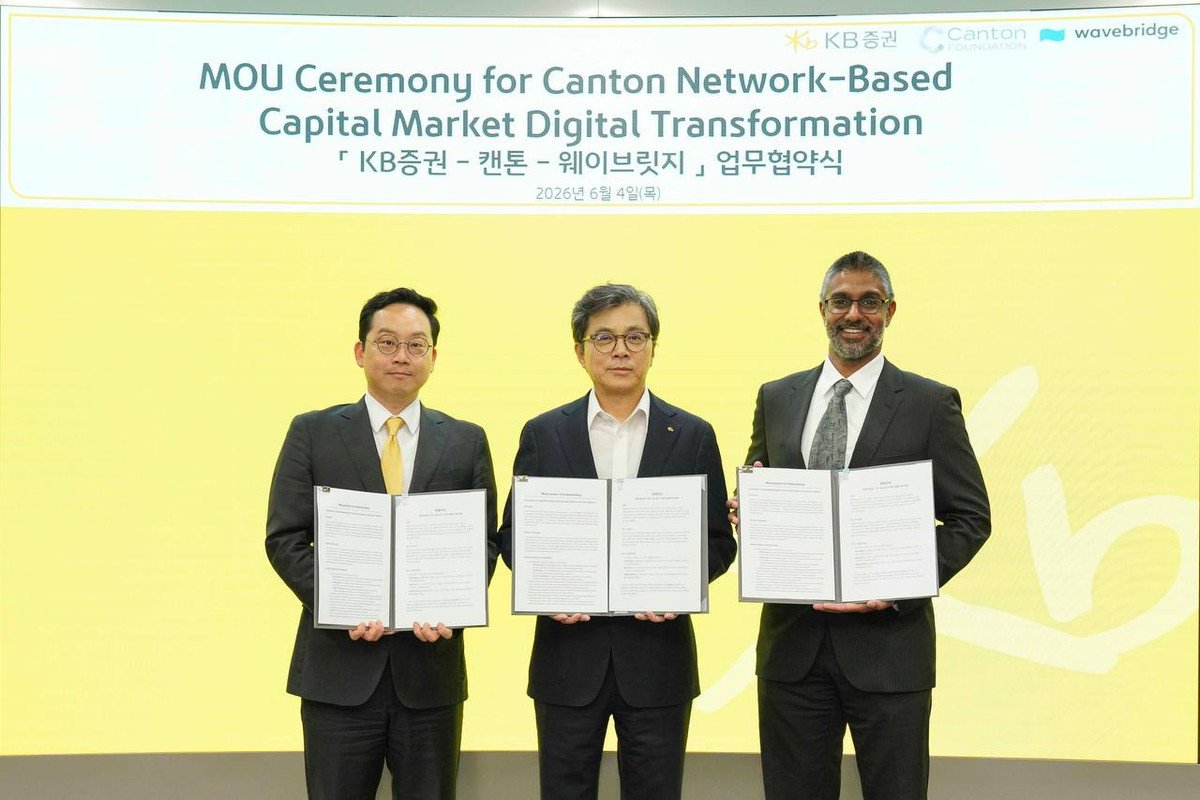
Shinhan Asset Management, Shinhan Securities, KB Securities, and Wavebridge have signed MOUs with the Canton Foundation, joining Canton's governance and ecosystem development while exploring distributed ledger infrastructure applications for South Korean capital markets.
Canton Foundation is deepening its engagement across Korea.
Recent collaborations with Shinhan Asset Management, Shinhan Securities, KB Securities, and Wavebridge reflect growing interest in tokenization, digital assets, and next-generation financial infrastructure among Korean market participants.
As institutions explore how distributed ledger technology can support regulated financial markets, Canton Foundation remains committed to supporting governance, interoperability, and ecosystem development across the region.
Composability without operational confidentiality does not scale for institutional finance.
Canton was designed for that combination.
@Tokenoya on why selective disclosure is the architectural requirement, and why that changes where institutional liquidity concentrates.
Société Générale joined as Super Validator.
TCAN listed on Nasdaq as the first U.S. Canton ETF.
Zenith crossed 600K+ EVM transactions on Canton.
Messari published an initiation of coverage report.
A snapshot of May in the Canton ecosystem.
Architecture that meets institutional requirements attracts institutions.
Privacy-preserving settlement, atomic composability, compliance-ready infrastructure, and governance participation built into the design.
55 Super Validators. 895+ validators. 18 Premier Members. Board leadership from @The_DTCC, @HSBC, @BNYglobal, @Broadridge, @EuroclearGroup, and @Tradeweb.
These institutions did not join Canton because of a token incentive or a marketing campaign.
They joined because the architecture was built for their requirements: privacy-preserving settlement, atomic cross-application composability, compliance-ready infrastructure, and governance they can participate in.
Many institutions approved as Super Validators on Canton use a partner to manage node operations.
@Catalyx_Suite on what end-to-end Super Validator operations look like, from CIP drafting to 24/7 node monitoring.
13 standalone Super Validator nodes run on Canton. 50+ hosted SV weights run on top of them.
Most institutions approved as Super Validators don't run the standalone node themselves. The CIP gets approved, the weight gets allocated, and operations get handled by a partner with the infrastructure already in place.
CatalyX by @IntellectEU is one of the largest SV weight hosting providers on @CantonNetwork.
End-to-end:
→ CIP drafting + submission support
→ On-chain vote initiation
→ Ghost party setup for escrow tracking
→ Weight activation once milestones are approved
→ 24/7 SV node monitoring with SLA
Evaluating SV status, or already approved and looking for a hosting partner? Talk to our team.
#CantonNetwork #SuperValidator #BlockchainInfrastructure
Stablecoins are evolving from peer-to-peer instruments into B2B infrastructure.
Banks can settle tokenized deposits against each other using a risk-neutral stablecoin where central bank systems are slow or insufficiently composable.
@Wesarn_real discusses at @Alchemy CoBuild.
.@Visa and @Brale_xyz are exploring stablecoin-based settlement using SBC on Canton.
The proof of concept evaluates how privacy-enabled infrastructure can support institutional payment flows while maintaining control over sensitive transaction data.
→ https://t.co/BZwMDPc8ns