Capitalism and Freedom in the 21st Century Podcast
@capandfreedom
A podcast series of the Hoover Institution’s Economic Policy Working Group hosted by @Jon_Hartley_. “quite simply one of the best podcasts ever” -Tyler Cowen
I talked to @Jon_Hartley_@StanfordEcon@HooverInst
about my career as an economist and about why Europe struggles with innovation. He was on the road, as you will notice!
Thanks Jon!
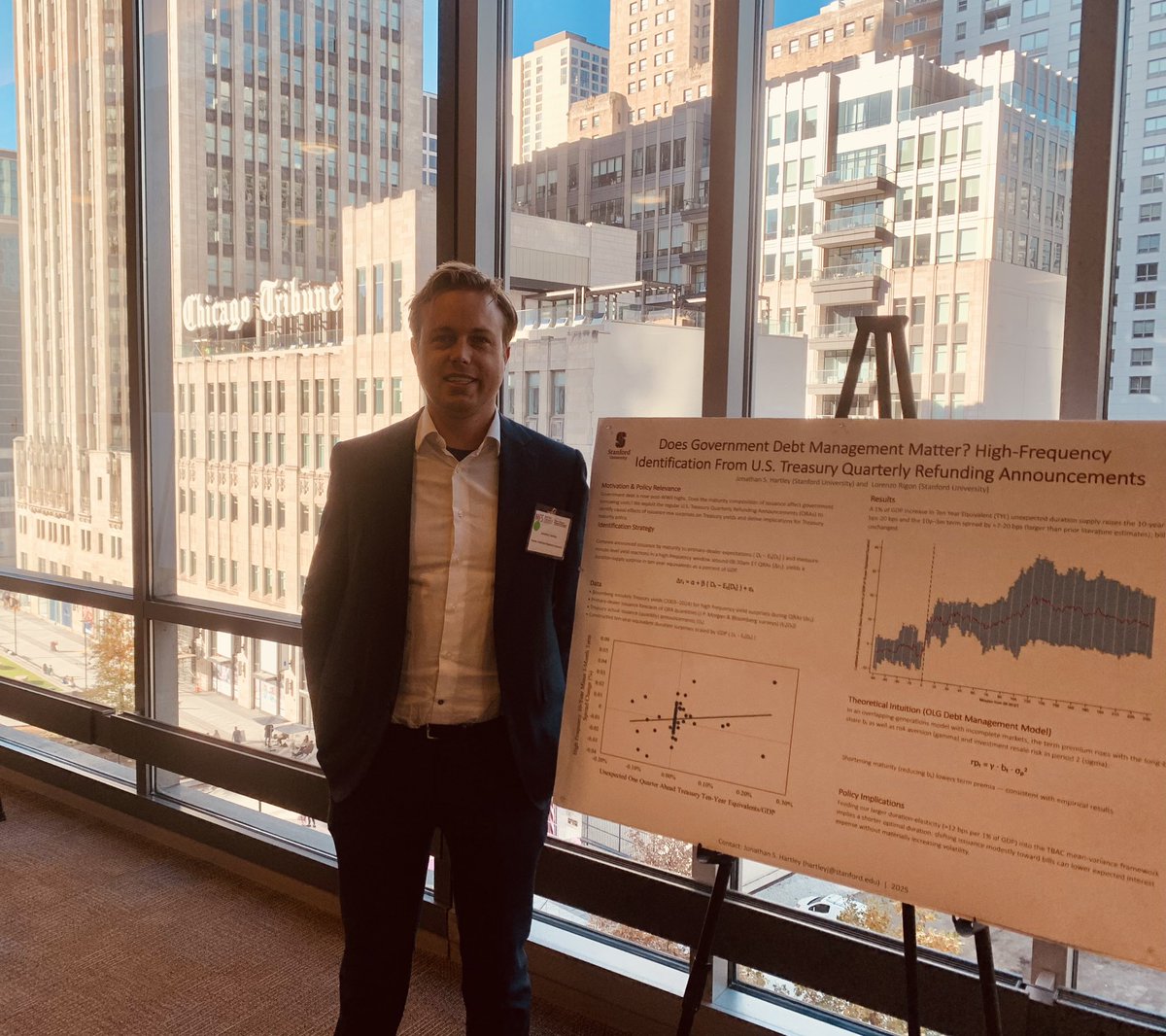
Link below (this is a dumb pic)
A fun @capandfreedom podcast conversation with Luis Garicano (@LuGaricano) on slowing growth in Europe, innovation and regulation, along with the future of the euro.
A fascinating @capandfreedom discussion with @m_maggiori on China’s rise in financial markets and the threat it poses as a potential hegemon, geoeconomics, capital flows, exchange rates & much more. Matteo is one of the most thoughtful international economists in the world today.
Matteo Maggiori (@M_Maggiori) joins Hoover Policy Fellow @Jon_Hartley_ to discuss his career at JP Morgan, becoming an academic economist, the rise of China's economy, geoeconomics and sanctions power, measuring international economic data, and more.
Watch @CapAndFreedom on X:
Don Brash joins Hoover Policy Fellow @Jon_Hartley_ on @CapAndFreedom to discuss his time at the helm of New Zealand's central bank, helping start inflation targeting in NZ, the country's 1980s market reforms, leading its National Party, whether there is a need today for market reforms internationally, and more.
Watch the full conversation on X:
My @CapAndFreedom Podcast interview with Steve Levitt keeps generating interest even nearly 2 years on! Thanks @lugaricano
Full Episode: https://t.co/WXDAIRblGH
Full Transcript: https://t.co/FtA6N4RnNY
A real honor to have Don Brash on the @capandfreedom podcast who was the very first central banker to adopt inflation targeting as Governor of the Reserve Bank of New Zealand in early 1990s. Turns out 2% inflation targeting was something of a historical accident! A wonderful talk
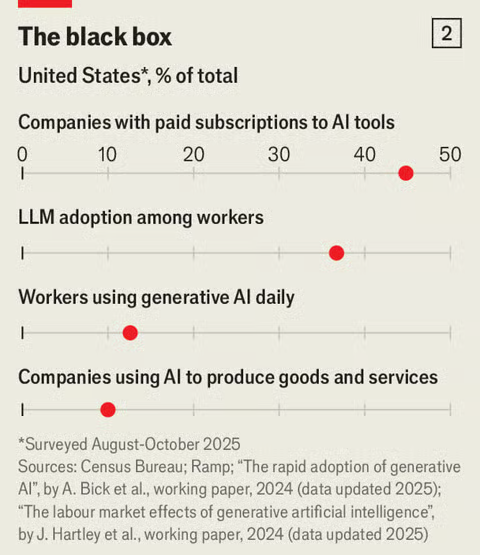
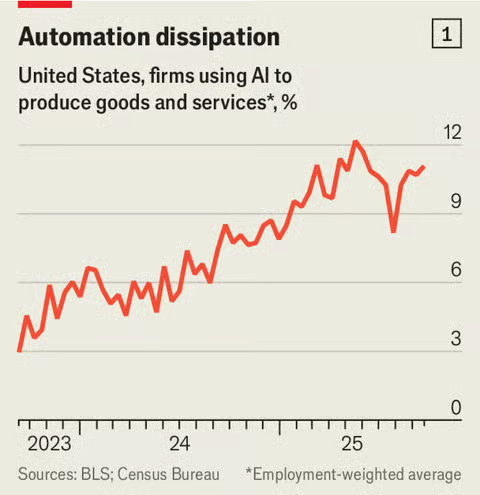
Honored that our paper "The Labor Market Effects of Generative Artificial Intelligence" (with @BrendanDMoore, @FilipJole, & @MeloVitor_) was cited in a new article at @TheEconomist on the 3Q2025 slowdown of Generative AI adoption (article by @econcallum) https://t.co/lccwIpUKfC
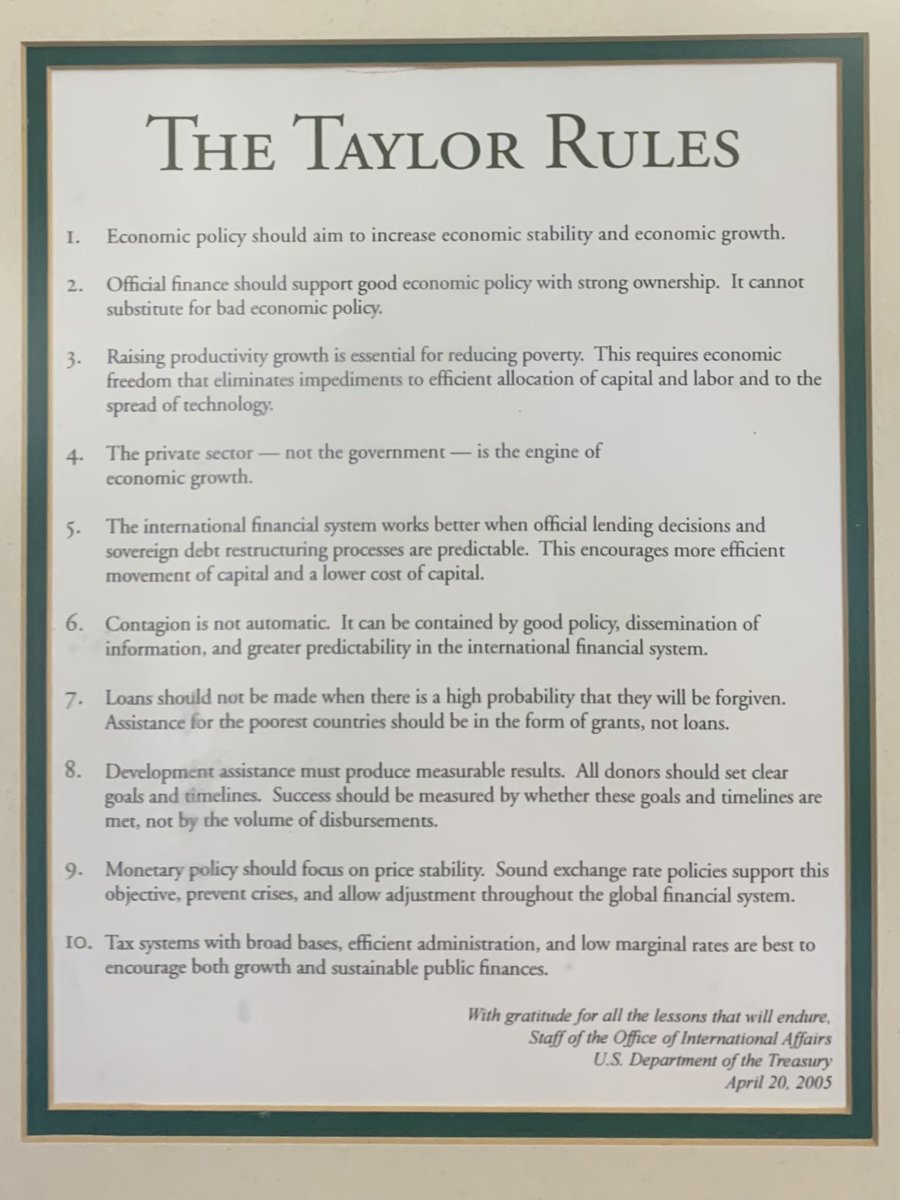
THE TAYLOR RULES:
1. Economic policy should aim to increase economic stability and economic growth.
2. Official finance should support good economic policy with strong ownership. It cannot substitute for bad economic policy.
3. Raising productivity growth is essential for reducing poverty. This requires economic freedom that eliminates impediments to efficient allocation of capital and labor and to the spread of technology.
4. The private sector — not the government — is the engine of economic growth.
5. The international financial system works better when official lending decisions and sovereign debt restructuring processes are predictable. This encourages more efficient movement of capital and a lower cost of capital.
6. Contagion is not automatic. It can be contained by good policy, dissemination of information, and greater predictability in the international financial system.
7. Loans should not be made when there is a high probability that they will be forgiven. Assistance for the poorest countries should be in the form of grants, not loans.
8. Development assistance must produce measurable results. All donors should set clear goals and timelines. Success should be measured by whether these goals and timelines are met, not by the volume of disbursements.
9. Monetary policy should focus on price stability. Sound exchange rate policies support this objective, prevent crises, and allow adjustment throughout the global financial system.
10. Tax systems with broad bases, efficient administration, and low marginal rates are best to encourage both growth and sustainable public finances.
NIH Director @DrJBhattacharya joins Hoover Policy Fellow @Jon_Hartley_ on @CapAndFreedom to discuss his vision for the National Institutes of Health, running it as an innovation accelerator, replication in the sciences, the new NIH policy reducing animal testing, and more.
NIH Director @DrJBhattacharya joins the @capandfreedom podcast; we talk his vision for the @NIH & running it as an innovation accelerator. Timely conversation given today's @NobelPrize in Economics for innovation-driven growth. Also the NIH has seriously reduced animal testing!
This one was hard to write, personally.
I hope you enjoy it.
"Designed for Weakness: The European Commission's leadership problem"
https://t.co/ougTDvSGkS
A couple of days ago, I posted on the double descent phenomenon to alert economists about its importance.
To illustrate it, I used the following example:
1️⃣ You want to find the curve that “best” approximates an unknown function generating 12 observations.
2️⃣ I know the target function is
Y = 2(1 - e^{-|x + \sin(x^2)|}), but you do not. You only know there is no noise in the problem.
3️⃣ You use, as an approximator, a single-hidden-layer neural network with ReLU activation trained on these 12 observations.
4️⃣ You check what happens with the approximation when you increase the number of parameters in the neural network from 4 to 24,001.
🎥 The gif movie my dear coauthor @MahdiKahou prepared illustrate the results:
Case A. With a small number of parameters (say, 7), you do poorly: the ℓ₂ distance between your trained approximation (blue line) and the target function (not plotted, only the 12 red points drawn from it) is high.
Case B. With ~1,000 parameters, you reach the interpolation threshold: the network perfectly fits all 12 points, but the function is very wiggly. The ℓ₂ distance is still high.
Case C. With even more parameters (e.g., 24,001), the approximation smooths out, and the ℓ₂ distance to the target function becomes much smaller.
⚡ Key points:
1️⃣ This is just one example, but similar results have been documented in thousands of applications. I am not claiming any novelty whatsoever here.
2️⃣ The result does not hinge on having exactly 12 observations (with more, double descent appears sooner), on noise being absent, or even on using neural networks—you get it with many other parametric approximators.
3️⃣ Yes, in thousands of economic applications, you want to approximate complicated, high-dimensional functions with all types of intricate shapes, and you only know a few points drawn from them.
👉 Why prefer the smooth approximation? Because, even if overparametrized, it generalizes better. If I draw new observations from the (unknown to you) target function
Y = 2(1 - e^{-|x + \sin(x^2)|}),
the neural network with 24,001 parameters will forecast them better (on average) than the one with 1,000 parameters.
The original post is here:
https://t.co/wYEbPWBS5v
A (partial) explanation of what is going on is here:
https://t.co/C9VHHtSoew
For many more details, read the breakthrough paper by Belkin et al. (2019):
https://t.co/O8b5Me4axy
and some recent interesting papers:
https://t.co/JXIYfNfBv6
https://t.co/X8tAcQvFMb