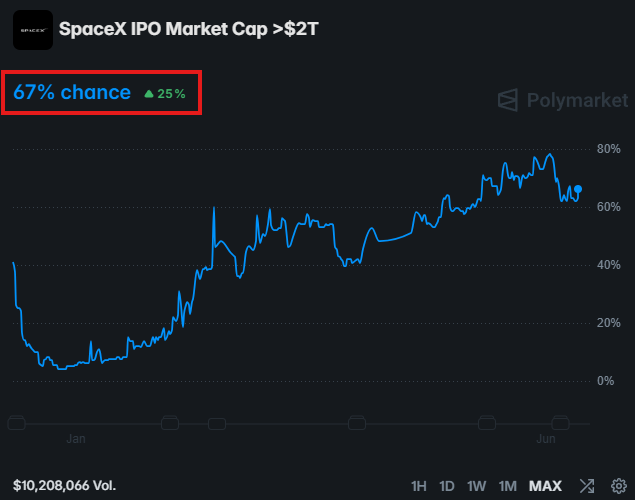
We are now just ~24 hours away from the largest IPO in history.
Tomorrow, SpaceX is expected to close the day with a market cap ABOVE $2 trillion.
This would make SpaceX at least the 7th largest public company in the world.
All eyes are on SpaceX.
$AMD $NVDA $TSM 🆕
AI demand continues to fuel a global computing power race, with TSMC's consolidated revenue in May surging to NT$416.975 billion, a 30.1% year-on-year increase. This marks a new monthly high and the third consecutive month above the NT$400 billion mark, indicating that demand for AI chips, high-performance computing (HPC), and advanced processes remains insufficient to meet supply. Analysts believe that the probability of TSMC's second-quarter performance exceeding its financial forecast has increased significantly. Supply chain sources also indicate that advanced process foundry prices will moderately increase in the second half of the year, with the market predicting a roughly 15% increase for 3nm processes. Supported by strong AI demand, TSMC's peak performance is expected to continue into the second half of the year.
TSMC's cumulative consolidated revenue for the first five months reached NT$1.96 trillion, a 30% year-on-year increase, just shy of the NT$2 trillion mark, indicating continued strong demand for AI servers, high-performance computing (HPC), advanced processes, and advanced packaging.
According to supply chain sources, TSMC will moderately raise foundry prices in the second half of the year to cope with the increase in upstream prices. The most sought-after 3-nanometer process is expected to see a 15% increase. Chip manufacturers pointed out that the customer queue situation has not eased significantly. Although TSMC continues to increase wafer capacity, with monthly capacity reaching 160,000 to 175,000 wafers in the second quarter, the growth rate of AI demand is still far exceeding market expectations.
Chip industry analysts believe that the price increase of advanced processes is actually good news for TSMC's major customers, as it further raises the entry barrier for AI chips, allowing them to secure more production capacity and seize market opportunities
Source: Ctee
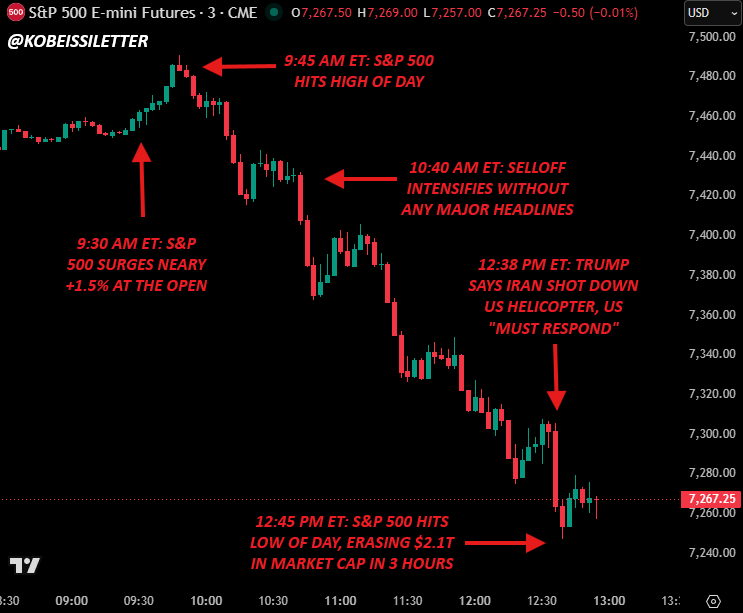
BREAKING: The S&P 500 extends losses to nearly -100 points on the day and falls below 7,300.
The S&P 500 has now erased -$3 trillion in market cap since its June 2nd high.
BREAKING: The Nasdaq 100 erases gains and falls -1.8% in 40 minutes to its lowest level of the session.
This puts the Nasdaq 100 just 3% away from entering correction territory.
What just happened?
At 9:45 AM ET, the S&P 500 was trading nearly +1.5% higher and tech stocks were sharply higher.
At 10:40 AM ET, selling pressure began to intensify without any major headlines in one of the biggest reversals of the year.
Just 2 hours later, President Trump said Iran shot down a US helicopter "last night" and that the US must "respond to this attack."
This sent the S&P 500 to a new low of the day, down 240 points since 9:45 AM ET.
In just 3 hours, the S&P 500 has erased -$2.1 trillion in market cap.
Volatility is back.
$2 TRILLION HAS BEEN WIPED OUT FROM US STOCK MARKET IN LAST 2 HOURS.
Two possible reasons for this selloff.
THE FIRST REASON IS SPACEX.
SpaceX lists on June 12 at a $1.77 trillion valuation, raising $75 billion, the largest IPO in US history.
SpaceX allocated 30% of shares to retail investors, three times the industry norm.
Even then, most retail investors still did not get full allocation. To buy more SpaceX at open on Thursday, they are selling their existing positions today to raise cash.
And SpaceX does not enter the Nasdaq 100 on day one. It enters 15 trading days after listing, putting forced buying around early July.
Nasdaq changed its rules specifically for this IPO, cutting the waiting period from three months to 15 days.
When that happens, every QQQ fund must automatically buy SpaceX, an estimated $22 to $27 billion in forced mechanical buying. To make room, every existing Nasdaq 100 stock gets trimmed.
MSCI has also adopted early inclusion rules, adding trillions more in tracked assets that will be forced to buy SpaceX after listing.
Both retail and institutions are raising cash at the same time, retail to participate in the listing, institutions to prepare for the forced index buying in July.
That combined selling is what you are seeing right now.
The second reason is insider positioning ahead of major news.
When institutions sell this aggressively across every asset class at the same time, it often signals they know something the market does not yet.