Founder, KVD Strategies. Senior Fellow, Economic Liberties and Berkeley. Horned Frog for Life. Fighting corporate power and solving crossword puzzles every day.
Private equity turned neighborhood kids' sports into a luxury product. Community leagues out. Elite travel teams in. Profit and predation teaching kids and parents that casual play isn't an option. And youth sports is only for those who can afford it.
NEW: Youth sports is now costing parents as much as $25,000 a year.
Private equity and corporations are turning a childhood pastime into something only the wealthy can afford.
Youth sports has become a $40 billion industry, and the steep costs are crushing American families.
This man made over $10 million a year at Bama in 2022 and 2023. His total earnings as the Bama head coach exceeded $120 million. Most of that was under a system where Saban's players got none of the pie. And the school is currently paying him $500K a year to be an "advisor."
LSU is on track to spend nearly $100 million on coach and AD buyouts over 10 years.
Meanwhile, revenue sharing for Bama and LSU football comes out to roughly $120K a player, in programs that generate over $100 million a year in revenue.
Let's stop blaming athletes for their schools' financial mismanagement.
Nick Saban: "Now you have schools that have close to $40M rosters [in football]. If we continue to do that were going to lose olympic sports, were gonna lose non revenue sports. We're gonna have football and basketball succeed and were going to have club sports for everything else with no scholarships."
"They laid me off on my baby’s due date during maternity leave"
"My division had a bunch of people (my team included) laid off and the positions moved to Argentina."
"We used to deliver a dozen shows to them, that dwindled down to two in the past year therefore my entire department got axed."
This is what happened when David Ellison bought Paramount last year. Now, he wants to buy Warner Brothers Discovery for 13X that amount, load it down with $79 billion in debt (you read that right)... and cut $6 billion in what he calls "synergies."
If Paramount does buy WBD, it'll bankrupt thousands of writers, drivers, make-up artists, camera operators -- and hundreds more small production houses, post-production studios, caterers, independent movie theaters, you name it. And not just in Burbank. It'll happen across California and New York and New Jersey and Georgia and beyond.
But people aren't talking about that... yet. So what are we going to do about it?
Well, I'm hitting the road with the @econliberties team, we're joining arms with our friends at @DDAction_ , @FilmCoalition, @1ACommittee, @freepress (*the other one), and the giants @WGAWest and @WGAEast to hold three listening sessions where working people and small businesses can speak, on the record, about what this merger will mean to THEM.
We start *Saturday* in Los Angeles where the one and only @adamconover, Commissioner @AGomezFCC, and WGAW president @MulroneyMichele will join documentarian @Marj Safinia and I for a MAIN STREET VS. THE MERGER town hall.
Then we head to NYC on Saturday, June 13 where we'll be joined by antitrust subcommittee ranking member @SenBooker, James Schamus (of "Crouching Tiger, Hidden Dragon" and "Brokeback Mountain" fame), and WGAE executive director Sam Wheeler for a roundtable at WGAE headquarters to talk about the merger.
And finally we land in Atlanta on Tuesday, June 16, where @GabeLezra and I will be joined by @RepHankJohnson and other luminaries in Georgia's extraordinary film and TV scene to hear from the small businesses and workers in Georgia who will be affected by the merger.
RSVP link for Los Angeles is in the comments. And if you're in the press or you are a worker or small business owner worried about the merger, write me at [email protected] for a link to join the smaller NYC and ATL events.
Bevacqua's skepticism of the SBA parts of this bill are illuminating and should alarm the senators considering it. We have almost no insight into how the labryntine pooling provisions would impact colleges, athletes, or consumers. And the only witness with real media experience, the form head of NBA Sports, said it might actually hurt colleges in the near term.
Bevacqua, a former NBC executive, cast doubts on projections of a large increase in media rights value from an FBS pooling of rights.
What would increase value, he says, is to create a super league of 24-30 schools and optimize schedules. He is against a super league, though.
The biggest fallacy of this hearing and this bill is that Congress is the only entity that can secure transfer, eligibility, revenue sharing, and tampering rules.
Every major professional league in the country has these rules. They arrive at them through collective bargaining. And the CBA earns the leagues antitrust immunity. Congress not required.
Pac-12 commissioner Teresa Gould up next. "All of the challenges in college sports cannot be fixed in a single bill. ... Yet we must act immediately."
She highlights schools must:
- codify athlete compensation rights
- provide limited antitrust safe harbor
- enforce the House settlement as it was originally intended
- set agent restrictions
- create new revenue mechanisms including pooled revenue to fund growing costs of college sports
reminder that the Protect College Sports Act doesn't address this issue -- this money will still be funneled overwhelmingly to football and men's basketball at major college programs
An interesting element of this hearing (at least to me): With Ted Cruz and Maria Cantwell introducing this bill together, the witness table doesn't have the usual athlete advocate-type to serve as a foil against NCAA/college establishment interests.
In an interesting portion of her testimony, Pac-12 commissioner Teresa Gould believes that the industry should engage in honest conversations around “student-athlete employment and collective bargaining.” She’s the latest respected administrator to suggest a CBA. Momentum grows.
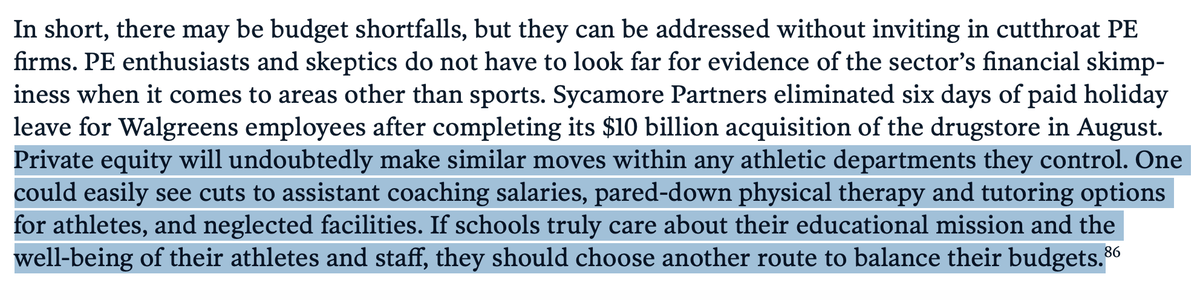
Earlier this year, @CapitolKVD warned about the ways private equity harms college athletic departments — from salary & staff cuts, to pared-down physical therapy, and more.
Now, following a private equity deal, the University of Utah is beginning a process to lay off employees.
The University of Utah athletic department begins ‘unsettling’ layoff process as part of its private equity deal with Otro Capital on Friday. https://t.co/RmBgB6NXcF
Give no credit to TX Rs who "tried to stop" racist white nationalist @bofrench unless they are willing to continue to speak out against him in the fall. Otherwise, they are complicit.
https://t.co/DIbVbiRaXT
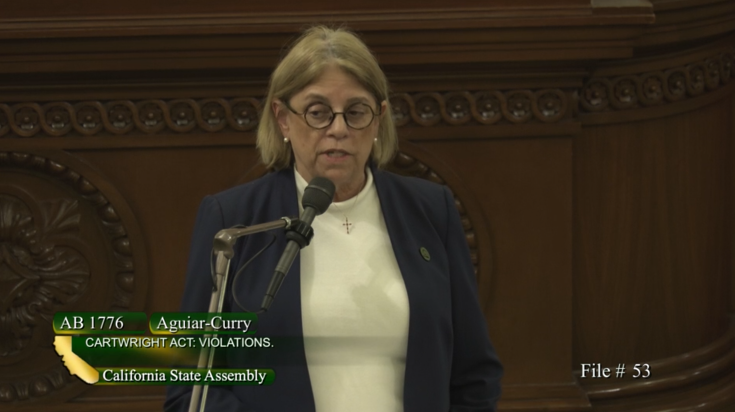
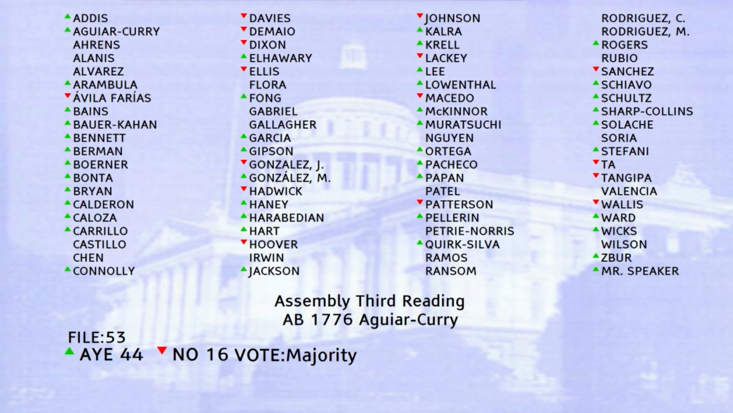
HUGE: The California legislature is officially closer than it's been in a quarter century to banning illegal monopolization.
The COMPETE Act, AB 1776 (Aguiar-Curry), passes the Assembly by a vote of 44-16. The most lobbied bill of the session moves to the Senate.
Of course Cruz folded on the employment issue. This bill is SCORE Lite.
The Protect College Sports Act gives the NCAA its transfer, eligibility, and revenue sharing caps. And it shields the College Sports Commission and forces athletes into its arbitration system. So even if you give athletes collectively bargaining rights later, the NCAA has no reason to negotiate.
There's a lot to digest, especially in Title II expanding the Sports Broadcasting Act. But so far, I'm seeing lots of problems that outweigh the athlete protections.
We are all still reading this bill, but its primary effect seems to be to limit the compensation of athletes while protecting the huge salaries of all the adults - coaches, ADs, sports industry executives - who are getting rich off the performance of the players. And it gives the NCAA an antitrust exemption that no other industry gets just so they can keep underpaying the athletes. Sure, there are some good things for players in this bill, but this seems like a great deal for the NCAA and the rich guys who run college sports, and a bad deal for athletes.
We are all still reading this bill, but its primary effect seems to be to limit the compensation of athletes while protecting the huge salaries of all the adults - coaches, ADs, sports industry executives - who are getting rich off the performance of the players. And it gives the NCAA an antitrust exemption that no other industry gets just so they can keep underpaying the athletes. Sure, there are some good things for players in this bill, but this seems like a great deal for the NCAA and the rich guys who run college sports, and a bad deal for athletes.
Waiting for someone to post charts of the historic rivalries and schedules mandated by the Protect College Sports Act. Will this herald the return of the Southwest Conference?
Fanatics has taken over the sports collectibles market — leaving little competition that allows them to continue hiking costs on fans.
"Now, with Panini's exclusive licenses expired and Topps under Fanatics control, Upper Deck remains the only competitor, and only in hockey."
In her recent paper, @CapitolKVD found there was "significant price increases for [trading card] boxes and packs, with some products doubling in cost within a year of Fanatics taking over production."
Spirit shut down, juries found Meta and Google guilty, lawmakers introduced legislation to get private equity out of youth sports, and more.
ICYMI: @mh4oh, @Lilly__Solomon, and @pberenbroick have the latest updates in the antimonopoly movement in Morgan's Monopoly Digest 👇







![econliberties's tweet photo. Fanatics has taken over the sports collectibles market — leaving little competition that allows them to continue hiking costs on fans.
"Now, with Panini's exclusive licenses expired and Topps under Fanatics control, Upper Deck remains the only competitor, and only in hockey."
In her recent paper, @CapitolKVD found there was "significant price increases for [trading card] boxes and packs, with some products doubling in cost within a year of Fanatics taking over production."](https://pbs.twimg.com/media/HI7tDcNXUAAfrEn.jpg)


