This is Anton Kreil.
A kid from Liverpool, raised by a single mom with no money, who walked into Goldman Sachs at 20 and walked out of Wall Street at 28 with the kind of resume nobody believes is real.
His prop book at Goldman grew from $25M to over $400M in four years.
Lehman headhunted him in 2004.
JP Morgan paid him a fortune to run their global pharma, biotech, and chemicals trading franchises in 2006.
He retired in May 2007, months before the entire system blew up.
The 16 minutes below is the closest thing I've seen to an actual trader explaining how he thinks.
No fluff, no charts, just the framework that made three of the biggest banks on Wall Street fight to hire him.
This is too much alpha that I shouldn't be leaking...
Last week, my AI trading bot made me +$8,262.
It managed all positions autonomously, executed trades with ZERO manual intervention, and conducted all analysis in-house.
This is the FULL architecture I used (copy me):
V1 Punks are up 70% because of the news that we can now interact with original contract to buy/sell V1 Punks
So, is V1 contract now fixed?
It’s not
But @jalilwahdat & @yougogirl_ deployed a workaround by having PunksMarket act as smart intermediary for V1 Punks transactions
Here’s what happens:
1️⃣ The seller lists the Punk specifically to the PunksMarket contract (using offerPunkForSaleToAddress with the market’s address)
2️⃣ The buyer triggers settlement
3️⃣ PunksMarket temporarily buys the Punk from the V1 contract (using the bugged logic, so ETH initially routes wrong)
4️⃣ It immediately calls withdraw() on the V1 contract to pull the misrouted ETH back
5️⃣ It transfers the Punk to the real buyer
6️⃣ It pays the seller the correct amount from its own balance
This way they are able to go around the original V1 contract bug: When a buyer purchases a Punk via the built-in marketplace functions, the ETH gets credited to the buyer (who can then withdraw it), not the seller
Now, no need to wrap your V1 Punks to buy & sell them
But still, PunksMarket is still needed to be an intermediary to interact with the main V1 contract
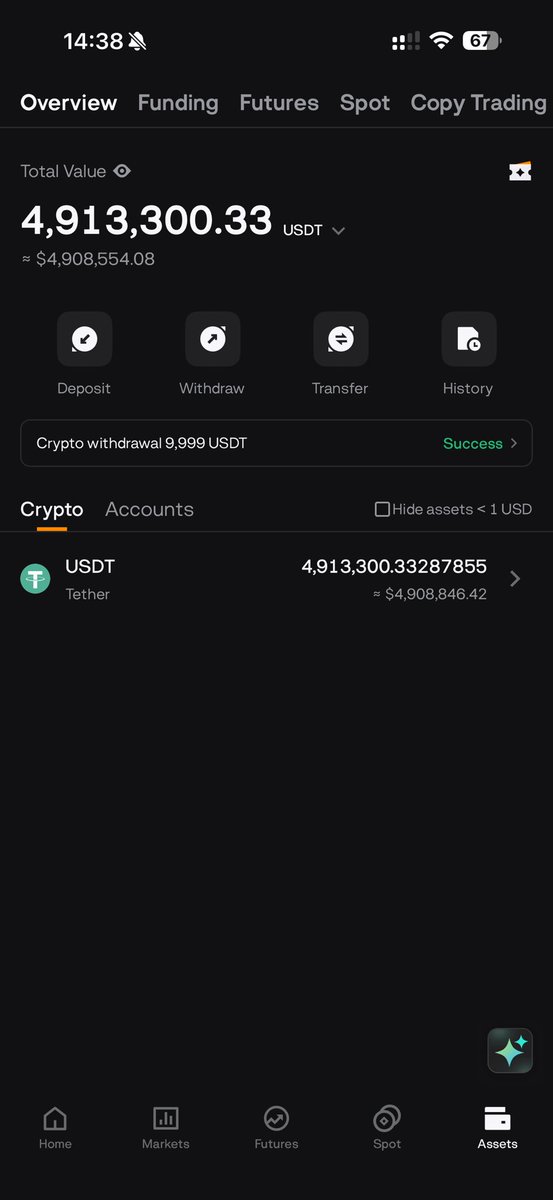
$500k → $5M in 3 months.
Done. ✅
Point blank: This was the hardest challenge I’ve ever done.
For 3 months straight I got hit with nonstop hate and negativity. Opinions coming from everywhere. Irrational pumps that made no sense trying to shake me out every week.
Trading at this size brought a level of psychological pressure I’ve never experienced before. There were moments it felt really heavy, but I stayed disciplined, and kept believing in myself.
Grateful to everyone who rode with me through all the noise.
The result is in the screenshot. The full live journey is on my YouTube.
Love me or hate me… I did it anyway 😚
A 25 year old just turned $225 million into $5.5 billion in 12 months.
Here’s exactly what he bought.
Leopold Aschenbrenner got fired from OpenAI in April 2024.
He spent the next few months writing a 165-page thesis predicting AGI by 2027.
Then he launched a fund and put his money where his thesis was.
He bought zero Nvidia. Zero Microsoft. Zero Google. Zero Amazon.
He bought what AI actually runs on.
Bloom Energy (BE), power infrastructure for data centers. Up 1,422% in one year.
Lumentum (LITE), optical components that move data between chips. Up 1,331%.
Sandisk (SNDK), storage. Up 3,130%.
CoreWeave (CRWV), GPU cloud infrastructure. Up 166%.
Iris Energy (IREN), AI computing and data centers. Up 583%.
The thesis was simple: every AI company needs energy, bandwidth, storage, and compute.
Nobody was buying those. Everyone was buying the AI companies themselves.
He was right.
His fund now manages $6 billion. Backed by Patrick and John Collison of Stripe and former GitHub CEO Nat Friedman.
I’m adding this to my watchlist.
Every time he files a new 13F, we will break it down here.
Turn on notifications so you don’t miss the alert, this is VERY important.
Many people will wish they followed us sooner.
1/ On the 6529 Network Museum
The Memes are a form of decentralized funding protocol - of art, of science, of other things that we want to fund.
The selection is fully decentralized and the execution, mostly but not fully decentralized.
(For now, someone has to press a Trezor button ultimately for the mint to start, though this will change eventually.)
2/ Is this interesting? Is this just specific to The Memes or is the first example of a broader concept?
Well, obviously it is the latter. Today, I would like to propose a second demonstration of something that can be fully decentralized, in this case, a museum
3/ The 6529 Network Museum is a museum that is collectively curated and "owned" by the 6529 network, aka the people who have accrued TDH, aka at a first approximation the meme card holders
4/ By "owned", I mean owned the way the Louvre is owned by the French people, not owned the way I own punk6529.
In other words, I mean "held in perpetuity by the network" +/-, on behalf of the network, but not for any particular member of the network (myself included)
5/ The network museum will not as a general rule sell pieces, it will not distribute eth to network members or anything of the sort. It will be a smart contract ultimately that is controlled by the network forever.
6/ For now it is 3 of 5 multi-sig SAFE with 5 of us charged with transitioning in it to the TDH controlled smart contract - @6529er@itsjpower@gratusmasculus and @HugoFaz
7/ Now the interesting question - how do you run a decentralized museum - we have a theory on how to start. @6529er and I submitted a Meme Card today with a proposed theme for the first collection of the Museum. Any money he and I receive if the Meme Card is selected will be used to fund a network selection and acquisition of pieces from artists within the proposed theme.
8/ Whether or not our proposed collection is good will be determined by the network by TDH.
If our proposed Meme Card and, by extension, collection is selected, the pieces to be collected will also be selected by the network by TDH.
Once they are selected, they will be purchased as newly minted CC0 1/1s for the museum and the meme card will show a compilation of them.
9/ I think (and I apologize in advance for this) that this is pretty smart.
It took me me quite a bit of time to figure out how to do this, but I like the outcome.
a/ Anyone can submit a Meme Card to do this (and I hope people do)
b/ the network decides if they like the collection
c/ the network decides what 1 of 1s to buy
d/ the artists get a 1 of 1 in an extremely permanent collection and distribution to a larger group via the Meme Card compilation
e/ the Meme Card minters get a meme card and an edition of interesting work.
10/ Also, the fact that we are only buying, not selling and not fractionalizing, simplifies many otherwise complex issues.
I know this is going to confuse people, but it all depends on how you look at it.
The purpose of the network is to perform the functions of the state, not of a private individual or company.
11/ Nobody would expect the Smithsonian to be flipping its pieces on eBay or to give a dividend to every American and so the same logic applies here.
12/ There is more detail here: https://t.co/Q8W2bll0By
13/ In any case, we will see how it goes - let's see what the network thinks about all this and if it votes for the card - if so, I think we will learn some interesting things
NEW EPISODE: @jack & @roelofbotha unpack @blocks 40% staff cut and rebuilding the entire company as a mini-AGI.
This isn’t “use AI to make people more productive.” It’s making the company itself the intelligence.
If you’re a founder or operator wondering what work looks like in the next 5 years… this is the episode.
The evolution looks like:
• Manager mode = Pyramid 🔺 (command & control)
• Founder mode = Flat ➖(founders decide fast)
• Dorsey mode = Circle 🔵 w/ AI at the center, humans at the edge, and decisions flow from customer inputs → AI → humans steering it
I’ve tried killing org charts before. Brutally hard. But we never had these tools.
This is rewriting the CEO playbook for the AI era.
Buckle up.
00:00 Existential Dread & Hope
02:56 AI Replaces Hierarchy
07:22 Block’s New Three Roles
26:47 Flattening the Company, Fast
35:23 Getting the Board to Buy-In, Fast
36:50 Building a Great Board
41:29 Founder CEO Lessons
48:18 Second Acts & Conviction
56:22 Timeless CEO Traits
The real reason the US is invading Venezuela goes back to a deal Henry Kissinger made with Saudi Arabia in 1974.
And I'm going to explain why this is actually about the SURVIVAL of the US dollar itself.
Not drugs. Not terrorism. Not "democracy."
This is about the petrodollar system that has kept America the dominant economic power for 50 years.
And Venezuela just threatened to end it.
Here's what really just happened:
Venezuela has 303 billion barrels of proven oil reserves.
The largest on Earth.
More than Saudi Arabia.
20% of the entire world's oil.
But here's the part that matters:
Venezuela was actively selling that oil in Chinese yuan. Not dollars.
In 2018, Venezuela announced it would "free itself from the dollar."
They started accepting yuan, euros, rubles, anything BUT dollars for oil.
They were petitioning to join BRICS.
They were building direct payment channels with China that bypass SWIFT entirely.
And they were sitting on enough oil to fund de-dollarization for decades.
Why does this matter?
Because the entire American financial system is built on one thing:
The petrodollar.
In 1974, Henry Kissinger made a deal with Saudi Arabia:
All oil sold globally must be priced in US dollars.
In exchange, America provides military protection.
This single agreement created artificial demand for dollars worldwide.
Every country on Earth needs dollars to buy oil.
This lets America print unlimited money while other countries work for it.
It funds the military. The welfare state. The deficit spending.
The petrodollar is more important to US hegemony than aircraft carriers.
And there's a pattern of what happens to leaders who challenge it:
2000: Saddam Hussein announces Iraq will sell oil in euros instead of dollars.
2003: Invaded. Regime change. Iraq's oil immediately switched back to dollars. Saddam lynched.
The WMDs were never found because they never existed.
2009: Gaddafi proposes a gold-backed African currency called the "gold dinar" for oil trade.
Hillary Clinton's own leaked emails confirm this was the PRIMARY reason for intervention.
Email quote: "This gold was intended to establish a pan-African currency based on the Libyan golden Dinar."
2011: NATO bombs Libya. Gaddafi sodomized and murdered. Libya now has open slave markets.
"We came, we saw, he died!" Clinton laughed on camera.
The gold dinar died with him.
And now Maduro.
With FIVE TIMES more oil than Saddam and Gaddafi combined.
Actively selling in yuan.
Building payment systems outside dollar control.
Petitioning to join BRICS.
Partnered with China, Russia, and Iran.
The three countries leading global de-dollarization.
This isn't coincidence.
Challenge the petrodollar. Get regime changed.
Every. Single. Time.
Stephen Miller (US homeland security advisor) literally said it out loud two weeks ago:
"American sweat, ingenuity and toil created the oil industry in Venezuela. Its tyrannical expropriation was the largest recorded theft of American wealth and property."
He's not hiding it.
They're claiming Venezuelan oil BELONGS to America because US companies developed it 100 years ago.
By this logic, every nationalized resource in history was "theft."
But here's the DEEPER problem:
The petrodollar is already dying.
Russia sells oil in rubles and yuan since Ukraine.
Saudi Arabia is openly discussing yuan settlements.
Iran has been trading in non-dollar currencies for years.
China built CIPS, their own alternative to SWIFT with 4,800 banks in 185 countries.
BRICS is actively building payment systems that bypass the dollar entirely.
The mBridge project lets central banks settle trades instantly in local currencies.
Venezuela joining BRICS with 303 billion barrels of oil would accelerate this exponentially.
That's what this invasion is really about.
Not stopping drugs. Venezuela accounts for less than 1% of US cocaine.
Not terrorism. There's zero evidence Maduro runs a "terror organization."
Not democracy. The US supports Saudi Arabia, which has zero elections.
This is about maintaining a 50-year-old agreement that lets America print money while the world works for it.
And the consequences are terrifying:
Russia, China, and Iran are already denouncing this as "armed aggression."
China is Venezuela's biggest oil customer. They're losing billions.
BRICS nations are watching a country get invaded for trading outside the dollar.
Every nation considering de-dollarization just got the message:
Challenge the dollar and we will bomb you.
But here's the problem...
That message might accelerate de-dollarization, not stop it.
Because now every country in the Global South knows what happens if you threaten dollar hegemony.
And they're realizing the only protection is to move FASTER.
The timing is insane too:
January 3rd, 2026. Venezuela invaded. Maduro captured.
January 3rd, 1990. Panama invaded. Noriega captured.
36 years apart. Almost to the day.
Same playbook. Same "drug trafficking" excuse.
Same real reason: control of strategic resources and trade routes.
History doesn't repeat. But it rhymes.
What happens next:
Trump's press conference at Mar-a-Lago sets the narrative.
US oil companies are already lined up. Politico reported they've been approached about "returning to Venezuela."
The opposition will be installed. Oil will flow in dollars again.
Venezuela becomes another Iraq. Another Libya.
But here's what nobody's asking:
What happens when you can no longer bomb your way to dollar dominance?
When China has enough economic leverage to retaliate?
When BRICS controls 40% of global GDP and says "no more dollars"?
When the world realizes the petrodollar is maintained by violence?
America just showed its hand.
The question is whether the rest of the world folds or calls the bluff.
Because this invasion is an admission that the dollar can no longer compete on its own merits.
When you have to bomb countries to keep them using your currency, the currency is already dying.
Venezuela isn't the beginning.
It's the desperate end.
What do you think?
IT’S TIME TO ACKNOWLEDGE AND ADMIT THE CRYPTO MARKET IS BROKEN!
At some point we need to admit that something is structurally broken in the crypto market!
2025 was a year with all the necessities for a bull market.
We had liquidity,
We had a pro-crypto US government.
We had ETFS.
We had Saylor buying $1bn a week.
We had DATs.
We came off a low base (Biden and Harris)
We had nation states and sovereign funds buying.
We achieved scale.
We have Gold, Silver, Nasdaq and Russell 2000 all at all-time highs.
Even with all the above, we are ending 2025 lower and only 20% where we were with Biden.
I’ve seen many theories, the “IPO moment”, “the trapped liquidity” , “the 4-year cycle” - but all of these seem like desperate attempts to justify a market that doesn’t make sense.
So, what happens next?
There are 2 options;
1. We discover what’s actually broken and who is selling. When we do, in hindsight it will be obvious!
2. We have the mother of all catch up trades! Because that’s how markets work. They can separate from where they are supposed to be for short periods but they always come back to equilibrium!
My hope is for the latter. My bet is that we will soon find out what actually broke!
Happy 2026!
Hey CKC,
It's Japan's fault, all eyes on the #JP02Y
Japan 2-Year Government Bond Yield on #TradingView.
Imagine everyone has been borrowing super-cheap Japanese money (Yen) to go buy fun stuff like $btc, #crypto and stocks.
Japan kept interest rates tiny for years, so this “carry trade” was like borrowing free candy.
But now…
Japan might raise interest rates.
That means the candy is no longer free.
So:
Japanese interest rates go up → borrowing #Yen gets more expensive
Yen gets stronger → people who borrowed Yen suddenly owe more
Everyone rushes to unwind → they sell #Bitcoin, stocks, risky things
They buy safer stuff → #Gold goes up
The Japanese 2-year interest rates shooting up (highest since 2008).
That’s the “oh no, candy isn’t free anymore” moment.
This is why everything “risky” is dumping. It’s not crypto’s fault — it’s Japan.
What we can Expect
1. More volatility
Markets hate surprises. A sudden spike in Japanese yields = fast, messy moves in Bitcoin, stocks, FX.
2. If BOJ does hike on Dec 19
Yen strengthens
Carry trade unwinds further
Risk assets can dip more
Gold + safe havens can keep rising
3. If BOJ doesn’t hike
Yen weakens again
Carry trade comes back
#Bitcoin + stocks likely bounce sharply
4. Big picture
This is a macro shock, not a crypto problem.
When dust settles, markets usually stabilise and reverse.
Right now: expect choppiness, fast moves both ways, and headline-driven spikes.