"Nos fabricamos una historia y vamos por la vida creyéndonosla y, de pronto, resulta que es una historia equivocada, lo cual significa que hemos vivido una vida equivocada"
"El mundo deslumbrante", Siri Hustvedt
📷Kurt Hutton
Habits that have a high rate of return in life:
- sleeping 8+ hours each day
- lifting weights 3x week
- going for a walk each day
- saving at least 10 percent of your income
- reading every day
- drinking more water and less of everything else
- leaving your phone in another room while you work
Este tío simpático es Guy Goma. En 2013, acudió a la BBC a una entrevista (de trabajo, cabe precisar). Guy, entonces en paro, aspiraba a un puesto de técnico informático. La entrevista tuvo lugar, solo que de la manera más irreal posible. El resto es historia.
HILO.
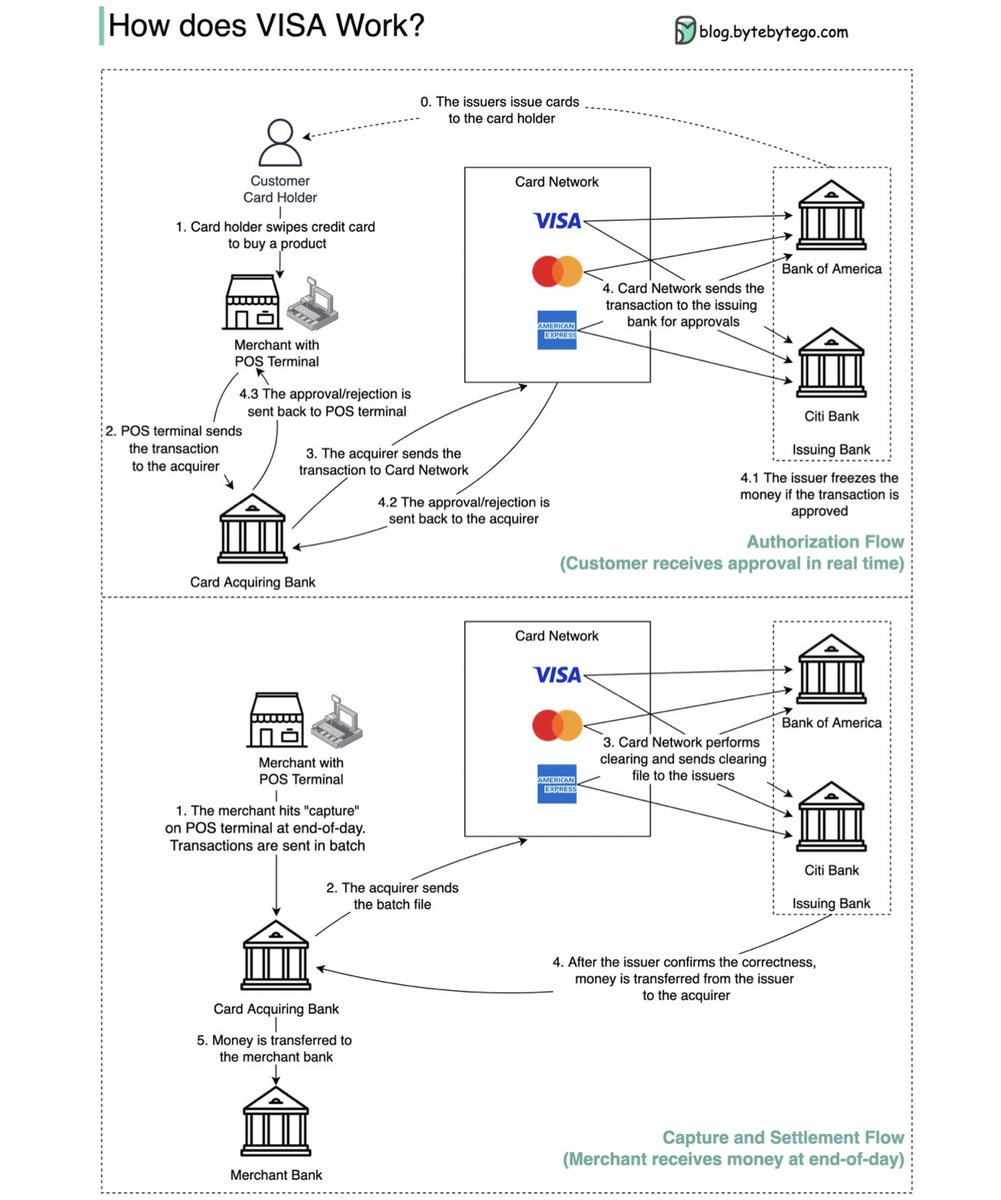
How does VISA work when we 𝐬𝐰𝐢𝐩𝐞 𝐚 𝐜𝐫𝐞𝐝𝐢𝐭 𝐜𝐚𝐫𝐝 at a merchant’s shop?
VISA, Mastercard, and American Express act as card networks for the clearing and settling of funds. The card acquiring bank and the card issuing bank can be – and often are – different. If banks were to settle transactions one by one without an intermediary, each bank would have to settle the transactions with all the other banks. This is quite inefficient.
The diagram below shows VISA’s role in the credit card payment process. There are two flows involved. Authorization flow happens when the customer swipes the credit card. Capture and settlement flow happens when the merchant wants to get the money at the end of the day.
🔹Authorization Flow
Step 0: The card issuing bank issues credit cards to its customers.
Step 1: The cardholder wants to buy a product and swipes the credit card at the Point of Sale (POS) terminal in the merchant’s shop.
Step 2: The POS terminal sends the transaction to the acquiring bank, which has provided the POS terminal.
Steps 3 and 4: The acquiring bank sends the transaction to the card network, also called the card scheme. The card network sends the transaction to the issuing bank for approval.
Steps 4.1, 4.2 and 4.3: The issuing bank freezes the money if the transaction is approved. The approval or rejection is sent back to the acquirer, as well as the POS terminal.
🔹Capture and Settlement Flow
Steps 1 and 2: The merchant wants to collect the money at the end of the day, so they hit ”capture” on the POS terminal. The transactions are sent to the acquirer in batch. The acquirer sends the batch file with transactions to the card network.
Step 3: The card network performs clearing for the transactions collected from different acquirers, and sends the clearing files to different issuing banks.
Step 4: The issuing banks confirm the correctness of the clearing files, and transfer money to the relevant acquiring banks.
Step 5: The acquiring bank then transfers money to the merchant’s bank.
Step 4: The card network clears the transactions from different acquiring banks. Clearing is a process in which mutual offset transactions are netted, so the number of total transactions is reduced.
In the process, the card network takes on the burden of talking to each bank and receives service fees in return.
Over to you: Do you think this flow is way too complicated? What will be the future of payments in your opinion?
���
Subscribe to our weekly newsletter to get a Free System Design PDF (158 pages): https://t.co/RibM5u7UxP
Probably the best thing you'll see today.
In 2017, a group of developers hilariously competed for who could create worst volume control interface in the world.
The results 🧵
1/22