There used to be two playbooks for commercial software:
a) be first to market
b) make the best product
Being first was rarely important, yet so many software companies operate this way. “We must ship by this time next month or we’ll lose.” A shallow way to build, in my opinion.
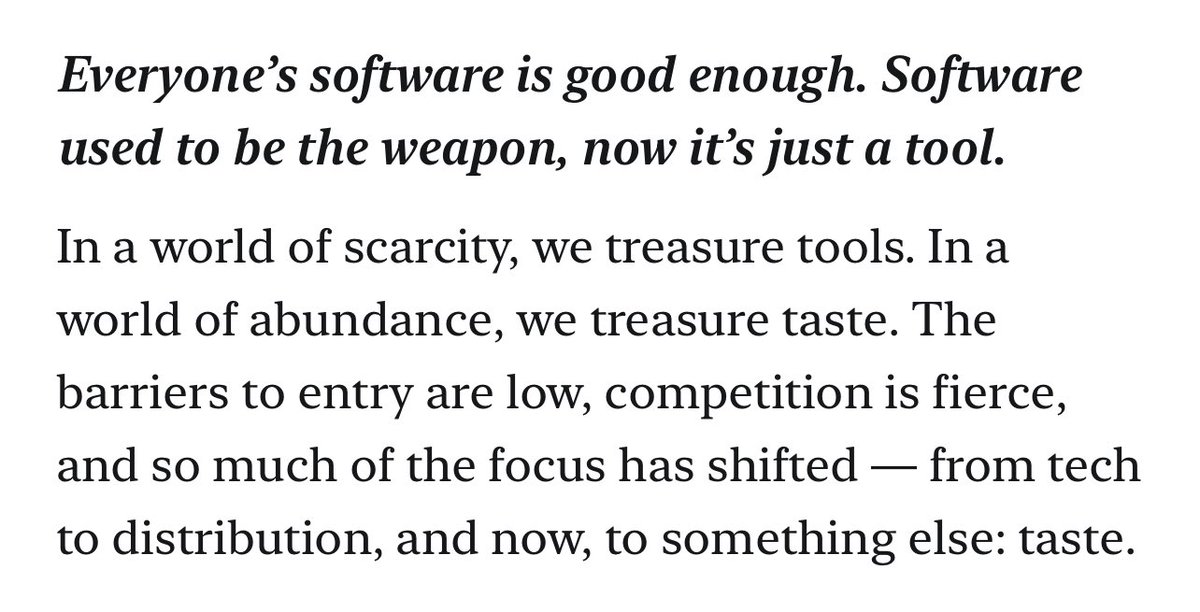
Now with AI tools having gone from “lol nice JavaScript try again” in Jan 2025 to “damn, nice C program, take the wheel” in Jan 2026, there’s only one playbook that remains: make the best product. Now anyone can “compete” with you if being first is your differentiator.
So don’t make a hundred products or a hundred features quickly just because you can. Instead leverage this “huge cheap skilled workforce” you now have to build something really good, even if it takes time.
You can’t blame timelines for janky scrolling or broken text editing anymore.
Build something that’s meaningfully different, something that you can be proud of a decade from now
Patrick Collison on the importance of beauty and craftsmanship when building products
“If Stripe is a monstrously successful business, but what we make isn’t beautiful, and Stripe doesn’t embody a culture of incredibly exacting craftsmanship, I’ll be much less happy. I think the returns to both of those things in the world are really high. I think even beyond the pecuniary or financial returns, the world’s just uglier than it needs to be… One can do things well or poorly, and beauty is not a rivalrous good.”
Patrick believes a commitment to craftsmanship and beauty played an important role in Stripe’s success:
“My intuition is that more of Stripe’s success than one would think is downstream of the fact that people like beautiful things—and for kind of rational reasons because what does a beautiful thing tell you? Well it tells you the person who made it really cared… And so if you care about the infrastructure being holistically good, indexing on the superficial characteristics that you can actually observe is not an irrational thing to do.”
I took a while to respond to this because Eric’s answers were very good, and logical so it’s hard to refute. I also do respect Eric Ries a lot, he has lot of experience with different companies and his book Lean Startup was really influential to me when it first came out.
But… something bothers me about this whole MVP discussion. Is this all just a distraction?
Eric’s answer was basically “MVP can be anything you need to validate an idea or the customer demand in the market”. Later in the discussion Eric mentions that a brochure can be an MVP. I agree. Sometimes sales material is a good way to validate demand, but I’d say it’s not an MVP. There is no product for anyone to use.
What bothers me is that if anything can be MVP, it’s trying to bucket all kinds of activities and outputs into this one term, it kind of loses in meaning and becomes more confusing than it’s helpful. Anything you do to validate an idea or build a product is essentially MVPs.
If MVP is just a way to test or validate something, then why not say, “I’m validating the product demand by using a sales brochure”. Or if I’m showing an initial product to potential users, why not just call it that. Why do I need to talk about MVPs? People also like to argue what truly is or not is an MVP, which I find just a waste of time.
In my experience, people generally mean MVP is some kind of baseline or beta version of a feature or product. It’s functional and hopefully solves user needs but doesn’t have all the polish and features. It’s a state in the product development lifecycle. Almost every product probably starts as some kind of “baseline” product where the baseline is defined by the expectations of the users. Which is fine, you have to start from somewhere.
The problem I’ve seen in companies is that this MVP thinking promotes taking constant shortcuts and shipping shitty things in the name of the MVP. These often get abandoned or not fixed afterwards because the project is technically done and the team moved over. Then the whole product becomes half-assed and disjointed because it’s just a string of MVPs.
Now someone might argue, well you are doing it wrong. MVPs doesn’t mean you shouldn’t finish it. Yes but in practice how often it happens and is this whole method just encouraging the wrong things or distracting from what are actually doing?
The MVPs & Lean Startups remind me of agile/scrum where you create these terms for a show or doing some mental gymnastics for basic activities. Then when someone argues it’s a waste of time the answer is often “you’re doing it wrong” or “you just don’t get it”. Maybe so, but maybe there isn’t anything to get?
My way of thinking around product building is not about experiments or MVPs, it’s about how to make the product successful.
As a startup you often just have to build something that people want. Providing a great experience is a great way to do that. Purposefully building and launching half-assed things to me is just a waste of time.
It’s like you operate a restaurant and instead of fully cooking the food, you purposefully leave it raw and let users tell you it’s inedible and makes them sick. Anyone who has eaten or cooked food knows that. Next time you cook it fully, and behold, the consumer now can eat the food but they still don't like it. Experiment and MVP of fully cooking the food was validated. Yay! We can now move to the next variable...
Obviously, chefs don't operate this way. They have their skills and experience and they use that make a dish and people would enjoy. Sometimes they are wrong and sometimes they make something really great.
Sometimes you know more about the market or the problem, sometimes you know less. You should try to think about what you do know, and what you don’t know, and how critical that information is. To know more you can talk to users and customers, knowing that they can’t ever give you the vision of what to build, only input to that vision. The ultimate test is to have a product out there, and see if people buy it. I’d say you should have vision, not just throw random stuff at people and see what they say.
This is also not about fear of launching a product early. We launch early and get feedback early, but still care about the quality of the experience. We got our first few users for @linear about 1 month after we announced the company. But by that time we already had a product that was 10x faster than anything else there, and had a design people liked. And yes it was scoped down and didn't have all the features (common sense). We never considered it as a MVP or an experiment, it was a product stage and we wanted to get user feedback.
My problem with trying to make the product building into some kind of science which most of the time is not necessarily and likely just a distraction, especially for startups. Your only focus should be how do I make a product that is 10x better than anything else in the market. The fact is that if you enter any category that only has solid incumbents or existing products, then your product needs to be very different and higher quality than those products. You don’t need an experiment to know that.
If your product has no traction then it either is the wrong product or the execution is not good enough. You can try to validate the product idea with research but until you make the execution good then you never know for sure. Users won't tell you that, they just leave or don't use it.
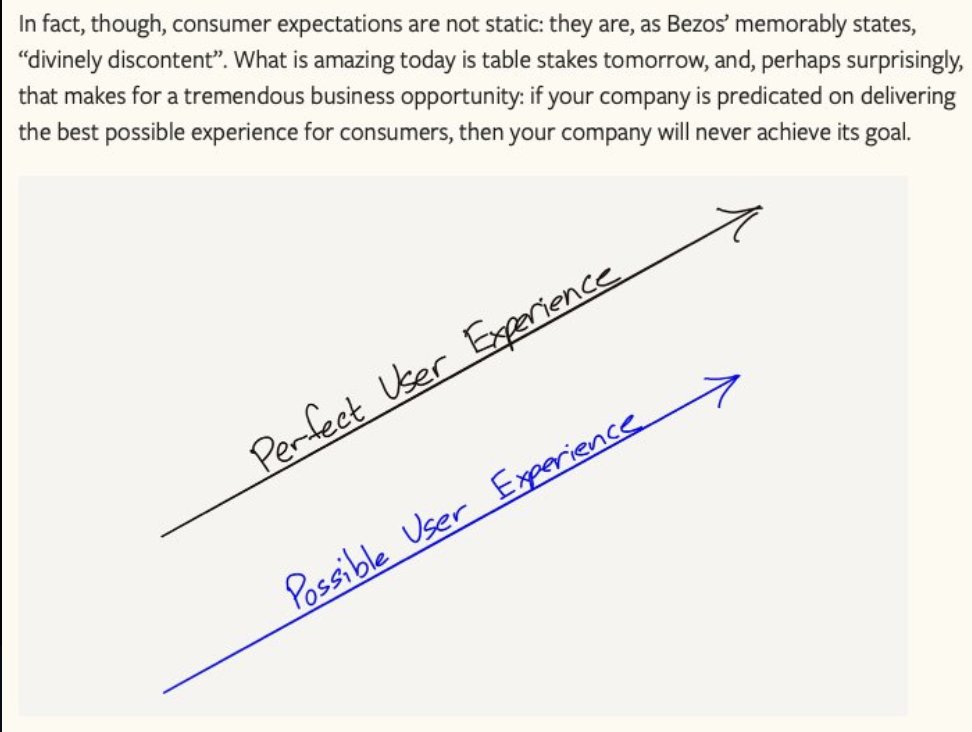
My point with this question was that today the user and customer expectations are high in many areas, and there are very few new novel markets like AI (crypto before that) that can be more of the wild west. But as those markets mature, you are again fighting against higher quality bars. As Bezos stated this, consumer expectations are ever increasing or “divinely discontent”,
So my advice would be to focus more on how you deliver a product that exceeds those expectations.
Don't spend your energy on running great experiments instead what would make the experience great.
Sidenote: On the iOS apps vs backup battery system also I disagree. Battery backup system buyers can have very high standards, but they are also rational buyers knowing what they want. Many consumer iOS apps only succeed in more irrational ways. There is no spec sheet for social apps you can pull out from teenagers. You can try to understand them and build something, but if it doesn’t engage them your app fails. These apps are not needed, they are wanted. Most products are some kind of mix of rational and irrational needs. Logic and emotion.
Quality without a name
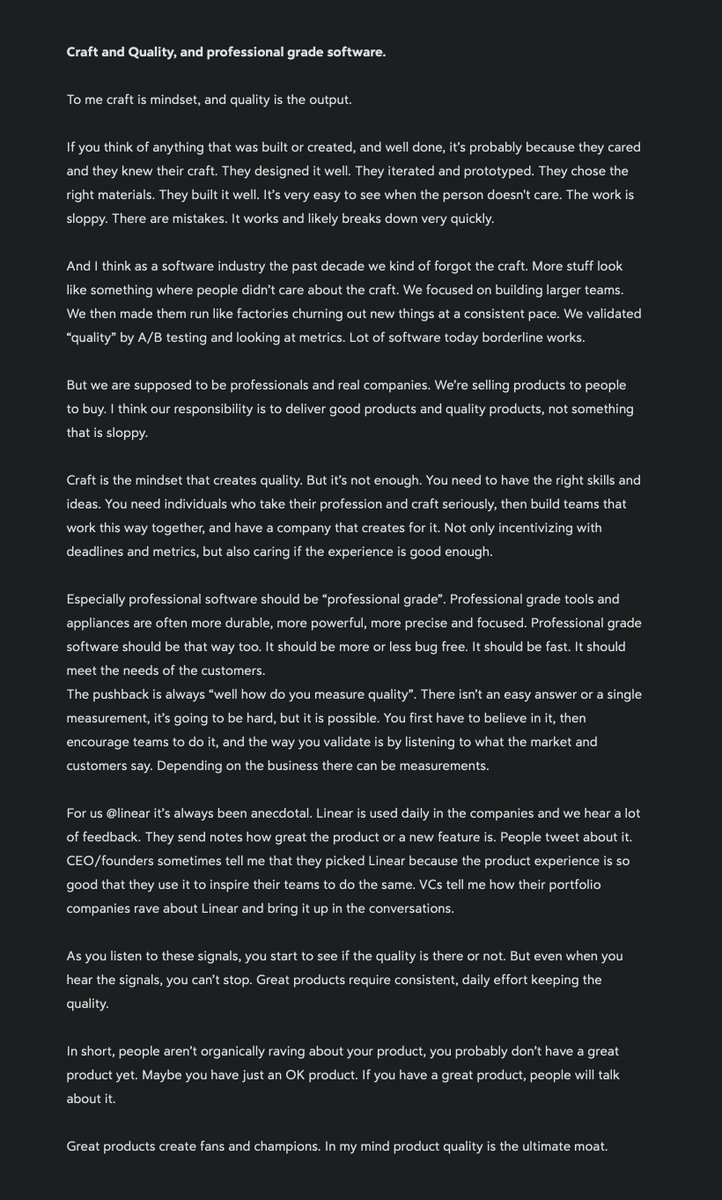
As companies grow, they often have a hard time with quality, and usually just give up on it. Main reason is that quality is something which cannot be easily measured or defined. As the companies scale, the way they operate or make decisions, are based more on measurements. They start flying with the dashboard instead of flying by looking out of the window because the former is easier to do in scale.
Christoper Alexander opens his book Timeless Way of Building, that in order to build with a timeless way, we first need to find the “quality without a name”.
What he is saying is that quality exists, it can be experienced and perceived, but it cannot be described by words. A town, place, or building that just feels good and natural.
You can spec that a door needs hinges and locks that function, but we all have experienced a wide range of very smoothly working, quality doors, and very janky working, bad quality doors.
Usually the quality doors happen because someone took the care to first build the door and all of its parts, and then install the frame and the door correctly, and kept it maintained over the years. Measurement like number of doors installed or times the door is used never gives you anything about how good it is.
This throws off many people in the tech world, where often things are seen as binary and belief that the world or anything can be reduced to mathematical formulas. It’s almost as if you have to stop thinking for a minute, and just focus on the experience.
The only way I know to promote quality in companies is to keep reminding people about the quality and why it matters. Most of us are in the retention business. We like to see our customers stick around, build trust and loyalty. Quality of the product, and customer is one the key drivers of that - yet many companies forget that.
So how to promote it? You can give examples of previous quality things the team has built, show other products or show your way of looking at things. When something feels quality, it often feels natural and you may even feel positively surprised. Quality is so rare generally that people are often surprised by it.
Quality rarely happens as an accident, it usually means someone is willing to go further building something that necessarily. At least, someone has to be motivated and allowed to do it, not forced to solely focus on some measurements.
Quality, brand and culture are some of those intangible things you need to create as a company founder.
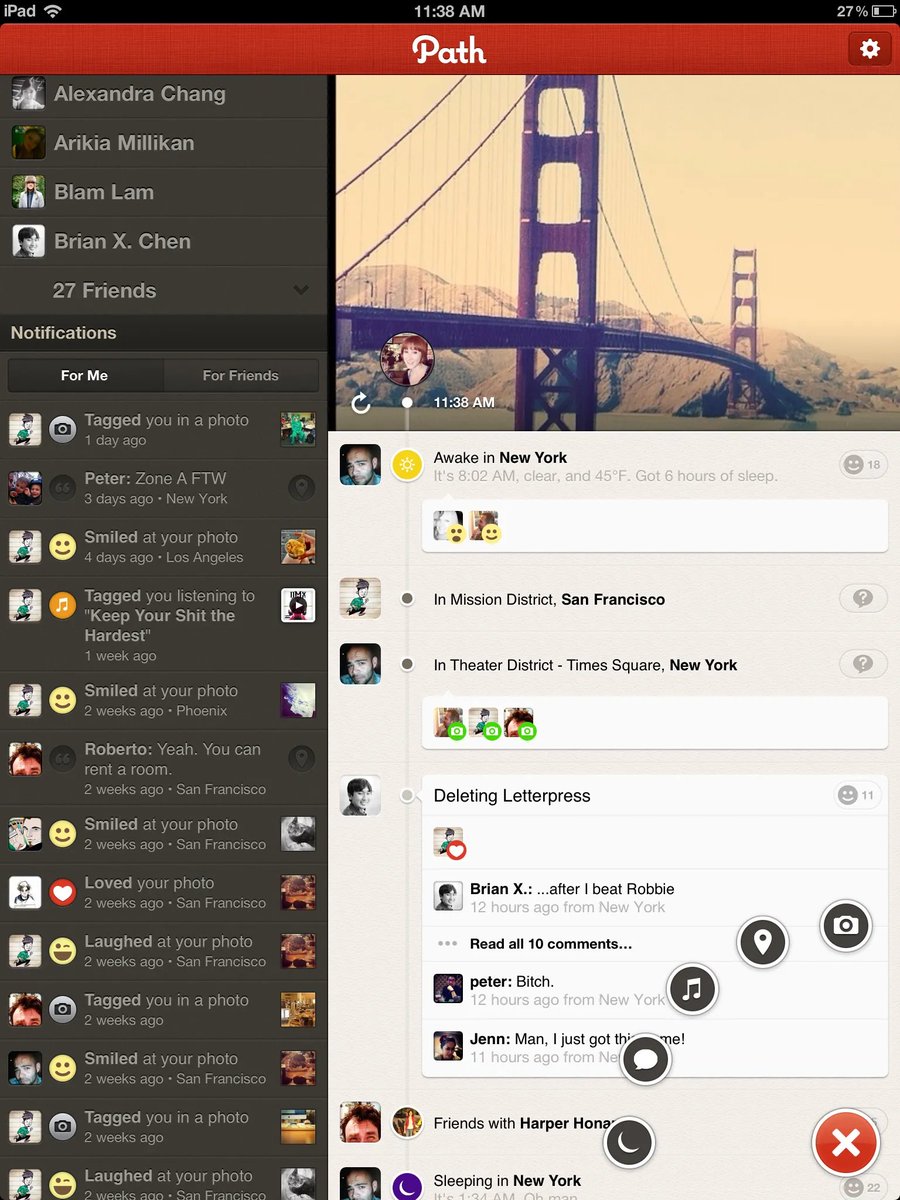
My father-in-law is a builder. He is insanely gifted. We were looking at a pre-iOS 7 app together years ago and I asked him what it would cost to build it today. I will never forget his answer…
"We can’t, we don’t know how to do it."
Bro you gotta build a huge company, move fast and break things, raise the biggest round at the highest valuation, grow user base worry about monetization later, turn down that big acquisition offer along the way, go big or go home bro