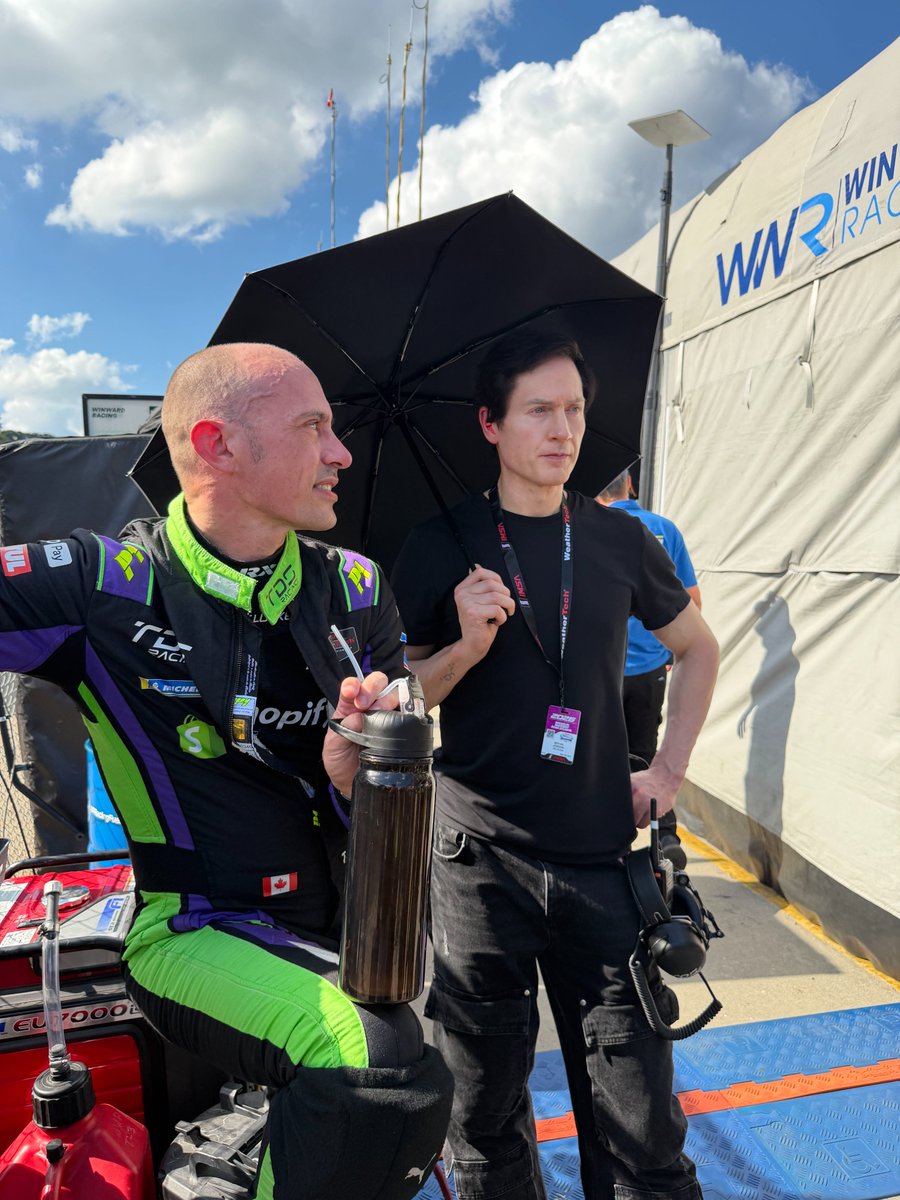
It’s feeling really magical inside of Shopify right now. It’s clearly the greatest time in the history of tech industry right now. I hope it feels similar everywhere else.
What Tobi is about to do today is one of the most insane things I’ve seen in athletic performance.
He will be racing for 2.5 hours straight. Before immersing myself in this sport for the past few days, I would have thought “oh that’s cool, he’ll be driving a fast car around a track.”
That is not what this is.
And why I have so much respect for him.
Tobi will be driving a car over 180 mph, experiencing up to 4.2 g of force. That will throw his body forward with 715 lbs of force and his head by 67 lbs.
Braking action requires up to 200 lbs of leg force.
The cockpit will average 104-122°F (40 to 50°C). His multi-layer suit barely allows for evaporation. This will cause his core body temperature to reach 102°F. I achieved this same body temp after 200°F of dry sauna for 34 min. It’s overwhelming. His heart rate will beat between 140-170 bpm.
He will sweat up to 170 fl oz (5 kg), losing 11 lbs of body weight. Some classes run driver cooling systems. His LMP2 doesn't.
Under these conditions, he will need to maintain perfect concentration for the entire 2.5 hours. He’s fighting for tenths of a second on every turn and every stretch.
One small slip up and trouble awaits.
Today it’s even more intense… it’s raining. The track is wet, scrambling everything.
He has to maintain spatial memory of every other car on the track, the complicated rules to avoid penalty, and constantly strategize overtaking other drivers, communicate with his team on the radio, watch for debris, be aware of slightest nuances of his car, and anticipate other drivers.
He did a practice run on Thursday and then a qualifying race yesterday, when he emerged from the car, he was a different human. Unrecognizable from the person who entered the car. Beaming with something like an omnipresence of reality.
We celebrate those who are especially good at kicking balls, shooting balls into baskets, and running with balls. What Tobi will do today is alien to those. I struggle to think of a sport equally as demanding.
Tobi and I have a lot in common. We’ve both built companies. We both spend a lot of time at the keyboard trying to organize the world in ways that we find beautiful. We both love data, method, and analysis. We both have a love for continuous improvement and will endure any pain required to achieve that next goal.
What I’ve not experienced is the unmatched flow state Tobi tells me he drops into when under these racing conditions.
I deeply understand what it means to achieve a 102°F core body temperature after 34 min in a 200°F dry sauna. I also know what 3 g’s feels like from being a pilot. These are extremely intense psychological states.
I know what it means to apply 200 lbs of pressure with my legs.
What I’ve never experienced is all these things, at the same time, for 2.5 hours straight, while maintaining perfect focus.
He is new to car racing. Late by racing standards. DHH got him into it a few years ago. During this first year of racing, he endured to overcome the extreme motion sickness that accompanies the physical and mental violence of the sport.
The race starts at noon eastern. Tobi will be driving for the first 2.5 hours and then @dhh will drop in, followed by Mathias Beche. The race will conclude at 10 pm.
I’ll be in the pit watching as all the data streams in from his car and body and imagining what it’s like to be in that car.
Although you pay for AI by the token, that's not the unit of inference, because you get more problem solving per token as models improve. Someone needs to define the unit, perhaps using a chain of increasingly hard problems, each pair of which can be solved by a single model.
The sooner you accept you know nothing, the better your trading will be. The concept of being "clever" is tied closely to identity -- if you are wrong, you are no longer clever.
We explored this concept in depth on the @1000xPod. It's one reason that experts often get major shifts wrong. When conventional wisdom fails, only those with a blank slate or open mind can adapt. The "experts" cannot because doing so would threaten their hard earned knowledge.
I highly suggest checking out the episode, it's filled with useful frameworks. One thing that I do to get use out of these conversations is keep a running list of all the "rules" I have for myself. Some are contradictory, but if you review them regularly you end up making better decisions overall.
Full episode here: https://t.co/GKnXbSOLRV
Travis Kalanick's rule for pacing a company's ambition:
"I'm constantly creating problems. 'Hey, let's do Uber in China.' And you don't have a full understanding of that problem when you create it. If you create a problem, you have to solve it."
"I have this framework I call the meta problem. The derivative of your problem creation must be less than or equal to the derivative of your problem solving."
"If it's not, you have a real problem. You're underwater."
"You're guessing at what your capacity is to solve problems, and you're guessing six months, 12, 18 months ahead. When you get it really wrong, you must stop all problem creation so that you can get back above water."
@travisk@bhorowitz@eriktorenberg
Claude Fable 5 will be available again globally tomorrow.
After a series of productive conversations with the US government, we're redeploying the model with a new set of classifiers to target and block more cybersecurity tasks. In the near term, some routine tasks like coding and debugging will fall back to Opus 4.8. We’ll continue to refine these classifiers over the coming weeks to reduce false positives and better distinguish genuine misuse from legitimate requests.
We’ve also begun drafting a consensus framework—with Amazon, Microsoft, Google, and other Glasswing partners—for assessing the severity of AI jailbreaks and how AI developers should respond to them. We invite other industry partners and model providers to join us in this effort.
Finally, we’re scaling up our collaboration with the US government on model testing and safeguards. This will include pre-release access to models and safeguards for evaluation, information sharing on jailbreaks and misuse, and dedicated resources for joint research.
Thank you to our users for your patience, and to our partners across the government, industry, and the research community who worked alongside us to make Fable 5 available again.
Read our full blog: https://t.co/VHyum831ri
Today was my last day at Bloomberg. I joined on Jun 8, 2020 in the middle of the COVID pandemic on @tracyalloway’s referral. These 6 years were a tremendously rewarding experience! I’m deeply grateful to my Bloomberg colleagues and friends. Now onto something new! Stay tuned! 🙏
Contra Citrini
Even if this scenario plays out in part or in whole, consumer surplus gains will be enormous and completely outweigh the negative effects of short term labor displacement. Long term, I agree with SV sentiment that more jobs will be created than lost if the economy makes this transition. This is a classic case of Bastiat’s seen versus unseen dynamic. Even under the most pessimistic scenarios, as human labor loses total market value, there is still scarcity in human time. For example, a painting done by a human is proof-of-work on this scarcity and should carry significant premium once AI art is fully commoditized. You can extrapolate this concept into all things which require human time where the output/product produced is not desired purely for functional purposes.
Lastly, @Citrini7 makes the case for accelerative or runaway economic collapse as AI disintermediates everything and recycles capital back into itself. Yet there does exist an anti-inductive effect which puts a cap or asymptote against runaway effects which is the cost of electricity. In other words, if we let AI just run unimpeded as an optimizer over all of society, it eventually stops once the next marginal optimization is less valuable than the cost of the next unit of electricity consumed by it to do this optimization. So there can be no runaway effects unless AI is able to super-linearly increase and harness its own energy. In other words, you need some level of exponential self-replication, at least of the power supply.
In any case, great article by Citrini. They might be right about SaaS but I remain more optimistic overall about the broader state of things. In fact, it would take something like what Citrini suggests to get the growth needed to finally come out from under the national debt problem which otherwise weighs down on the shoulders of the younger generations.
tldr: The article has some mistakes but if it happened like that, it’s actually a good thing anyway.
As far as I know everything is fine with MtGox. The trustee is moving coins to a different wallet in preparation of the distribution that will likely happen this year, there is no imminent sale of bitcoins happening.