Inspired by 75 Hard, I’m doing 100 Important (my creation). I’ll share some details later, but today is day one of 100 days of the important task of taking care of myself, including:
*Step one: following my eating program (staying under 15 total carbs and under 75 protein.)
*Step two: walking the dogs twice a day and doing one other type of exercise.
As I say, there are other steps inspired by/modeled after 75 Hard which I’ll share later.
But today is day one.
Nigerian minister recounts deadly Christmas Eve attacks amid fears of more impending violence this coming season:
“They go to the church FIRST. Hunt the pastor. Burn it down.”
“25 pastors killed. Dozens more kidnapped.
3-year-old Purity was the ONLY survivor in her village. Her mother hid her behind a curtain before she was killed.”
This is persecution in Nigeria. And it's not over.
Don't scroll past. Share it.
🚨 Muslims are now impersonating police vehicles in Scottsdale, Arizona. Notice the red and blue flashing lights on the side and on the top of his truck
The symbols are the Islamic Republic of Iraq and the eagle is the coat of arms of Iraq. The script is in Arabic
People need to grasp the seriousness of what’s going on in America
I have confirmed this vehicle is not associated with law enforcement so this is a Muslim impersonating law enforcement or running their own Sharia force
The Electoral College is why a farmer in Iowa matters as much as a banker in Manhattan.
Anybody trying to scrap it doesn't want a fairer system.
They want you to stop mattering.
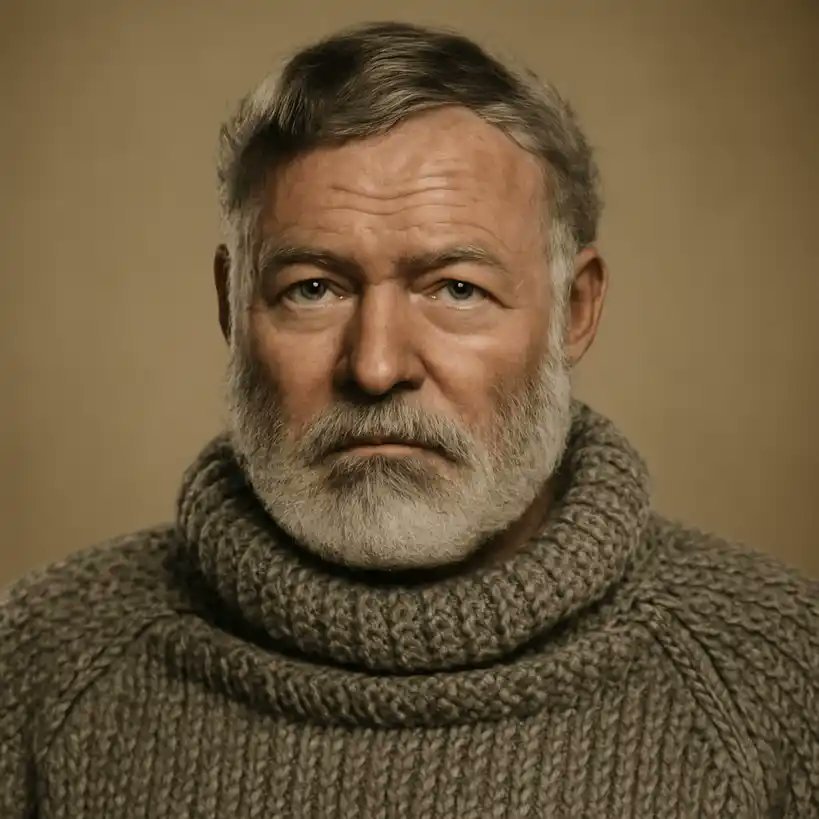
In December 1960 the most famous writer in the world was checked into the Mayo Clinic under his own doctor's name, officially for his blood pressure, and given up to fifteen rounds of electric shock to the brain, and when he came out he could no longer write a sentence, and six months later he was dead.
Ernest Hemingway was 61. He had the Nobel Prize, the Pulitzer, the houses in Cuba and Idaho, and a head that had been battered more times than anyone could count. He had been blown up by a mortar in Italy in 1918, split his skull open in a London car crash in 1944, been thrown from a motorcycle by a shell in France the same year, and walked away from two plane crashes in Africa on consecutive days in 1954, the second leaving fluid leaking from his skull. He drank enormously. By 1960 he was paranoid, convinced the FBI was following him, unable to finish the Paris memoir he had nearly completed.
The Mayo psychiatrist, Howard Rome, treated it as depression and gave him the treatment of the day. Electroconvulsive therapy was the modern answer in 1960, quicker than analysis and tidier than the lobotomy it had replaced. Hemingway went home to Ketchum in January.
He was worse. Asked to write a single line for a presentation volume for the new President Kennedy, he sat at his desk for a week, could not do it, and wept that it just won't come anymore. In April his wife Mary found him in a state that terrified her, and he was flown back to Rochester for another course of shocks.
At the Mayo he told his friend A.E. Hotchner what the treatment had done. His memory was his capital, he said, the thing his whole trade was built on, and they had wiped it and put him out of business. "It was a brilliant cure but we lost the patient."
The clinic discharged him at the end of June as improved. On the morning of 2 July 1961, at home in Ketchum, he took his own life.
The psychiatrist who has studied his head injuries most closely, Andrew Farah, argues that the man in Rome's office was not simply depressed but living in a brain wrecked by a lifetime of concussions and drink, and that electricity was the last thing it needed. The FBI files released in the 1980s showed he really had been watched for years, which is a hard way to learn that a patient's paranoia was partly a report.
None of that got a hearing in 1960. The diagnosis was in the textbook, the treatment was in the textbook, and the patient's complaint that it was taking his mind was in the textbook too, listed as a side effect, expected and temporary.
They treated the most observant man in American letters for being wrong about what he was seeing, and the last thing he saw clearly was what they had done to him.
I asked 50 Japanese people, ages 9 to 91, one question.
"What do you admire most about Americans?"
Here are the top answers.
10. "They clap when the plane lands." (Office worker, 34)
9. "They say 'I love you' every time they hang up the phone. Even men. Even to other men." (Taxi driver, 61)
8. "A stranger told me she liked my shoes. Then she just walked away. She didn't want anything." (High school girl, 16)
7. "They thank the bus driver when they get off." (Bus driver, 55. He got emotional saying this.)
6. "They tell you their whole life story in the grocery line. I know about one man's divorce, his boat, and his knee surgery. We knew each other for four minutes." (My mother, 64)
5. "They stand for the anthem at a children's baseball game." (Little League coach, 47)
4. "When they lose, they shake hands and say 'good game.' And they mean it." (Sota, 12)
3. "They fly the flag on a regular Tuesday. No holiday. Just because." (Nurse, 28)
2. "They help a stranger push a car out of the snow, then leave without saying their name." (My cousin's husband, 52, who got stuck in Colorado once)
And the number one answer came from the oldest person I asked. My grandfather. He's 91.
He thought about it for a long time.
Then he said:
"They still believe tomorrow will be better than today."
I asked him what he meant.
"In 1946, we had nothing," he said. "The American soldiers I met were young and far from home. But they acted like the future was coming, and it was going to be good. After a while, we started to believe them."
I asked him if he thought Americans still believe that.
He nodded slowly.
"Tell them," he said, "not to stop."
@glennbeck People should really understand, they’ve gotten the idea of shouting, “Shame! Shame!” from the movies and TV shows, but it’s never the good guys that do that.