Statins didn't protect the brain.
For years, people have been told a statin might also lower their risk of dementia. That idea came mostly from studies that simply compared people who happened to take statins with people who didn't, and those comparisons are easy to fool.
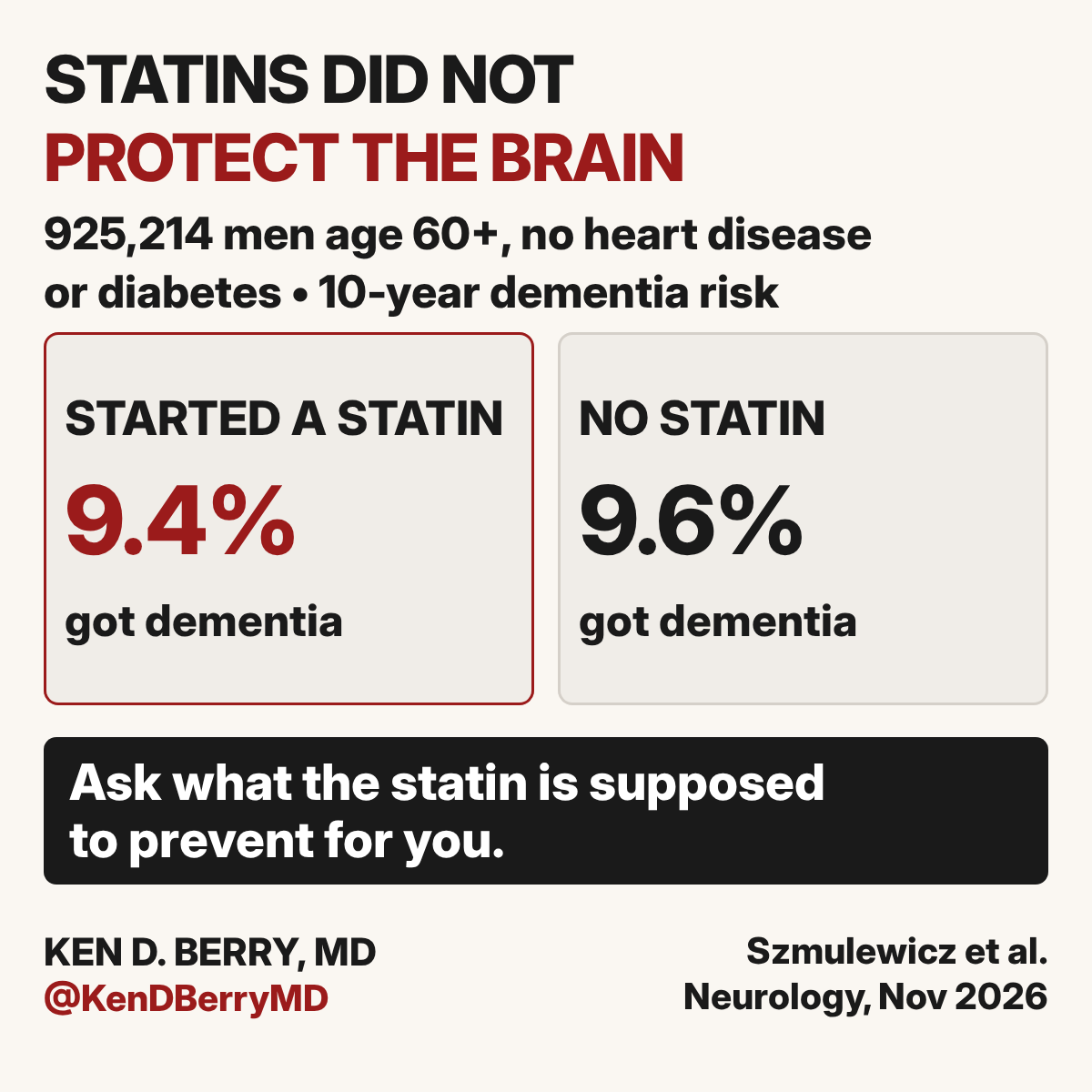
This week, researchers from Harvard and the VA checked it a much more careful way. They used the health records of men 60 and older who had no heart disease, no diabetes and no dementia, and set the comparison up the way a clinical trial would be: 81,599 men who started a statin versus 843,615 who didn't, followed for 10 years.
After 10 years, 9.4% of the statin group had been diagnosed with dementia, compared with 9.6% of the men who never started one. The authors' own conclusion is that statins don't meaningfully change the risk of dementia.
It's still an observational study, and it was all men. It didn't show the statin hurt the brain, either. It just didn't protect it.
So if you were told a statin would help protect your memory, that promise didn't hold up here. If you're healthy and your doctor wants to start you on one, ask exactly what it's supposed to prevent for you, and by how much.
Study (Neurology, November 18, 2026): https://t.co/MhmZZ1QANt
Statin Deception Exposed: What the Research Reveals
https://t.co/TnqefKYq9A
There’s a whole conversation about statins, cholesterol, brains and dementia
But that convo misses the important detail: pregnenolone
Cholesterol downstream conversion needs some more love and attention
I often finding myself looking at a patient's LDL-c/pregnenolone ratio as a clearer marker of their cellular uptake of thyroid hormone/T3 over thyroid labs
cholesterol to pregnenolone requires a lot of t3
when correcting this, patients cholesterol will normalize and their pregnenolone increases, often without using a statin/ezetemibe or even enhancing existing lipid therapies
Autism symptoms cut in a third, IQ increased by 70 points on gluten free, casein free diet.
Fascinating case report, what she was given:
◇ Gluten free, casein free diet
◇ Mostly organic, unprocessed foods
◇ IV immunoglobulin (for low antibodies, frequent infections)
◇ High B vitamin multivitamin
◇ Methyl B12 injections
◇ Nebulized glutathione
◇ Methionine (had methionine synthase polymorphism)
◇ Low dose naltrexone
◇ Isoprinosine
◇ Mesalamine (for gut inflammation)
◇ Vitamin D3
◇ 5-HTP
◇ Methylfolate
◇ Taurine + high dose B6 (for seizures)
◇ Oral GABA
◇ Ketogenic diet using MCT oil as the main fat
Her language came back almost right away on the gluten and casein free diet.
On the MCT keto diet she lost 60 pounds, her seizures nearly stopped, and her stereotypies went away completely.
Amazing what can happen when gut health, mitochondrial function, and methylation pathways are optimized.
Last month, my family and I moved house. Naturally, that came with all the usual administration, including transferring our broadband to the new address.
I contacted @virginmedia , who informed me that they couldn’t provide services at our new address because they didn’t cover the area.
They confirmed, IN WRITING, (7th October) that my contract would be cancelled at absolutely no cost to me.
On the 6th of November, Virgin Media helped themselves to £306.88 from my bank account.
I called them, explained the situation, and they admitted it was a mistake. They assured me the money would be refunded…in 28 BUSINESS DAYS
TODAY, they have randomly taken ANOTHER £306.88!
That’s £613.76 taken from my bank account in less than two weeks, despite confirming in writing that I owed them absolutely nothing.
So, this morning, I made my EIGHTH phone call to Virgin Media in three weeks.
And would you believe it?
The advisor (Ramesh) said that the original refund hasn’t even been activated yet!
And the SECOND £306.88 they’ve taken?
Apparently, that’s going to take another 21–28 days to refund (once they start the process)
Now, thankfully, I’m in a position where I have multiple income streams, and my wife works too. We’re managing to keep our heads above water, although, like many…only just.
For many families, having £613.76 wrongly taken from their account could genuinely mean going without food, falling behind on bills or being unable to heat their homes.
And what are Virgin Media’s solutions?
“Sorry, you’ll have to wait 21–28 business days.”
Absolutely disgraceful!
(I did contact my bank and they told me that as Virgin have stated that they will refund it, there’s “nothing they can do”.
A little side note.
Between Virgin Media and my bank, I’ve now made TEN phone calls trying to resolve this.
Not once have I spoken to somebody based in the UK.
Every single call has gone through an outsourced call centre, and the language barriers have made an already infuriating situation ten times worse.
I’ve also sent SIX emails. Four to Virgin Media and two to my bank.
NOT ONE has received a response
My advice to anyone considering Virgin Media?
Don’t go near them!
And Virgin Media, if anybody from your company happens to read this, perhaps you’d like to explain why you’re perfectly capable of taking £613.76 from somebody’s account at a moments notice but apparently need SIX WEEKS to give it back?
Absolutely shameful.
@grok how are they allowed to get away with this?
For about 50 years, Alzheimer's research has centered on two proteins: amyloid plaques and tau tangles. A newer theory argues they may be passengers, not drivers, and that the real problem is the brain's energy system.
Researchers at the University of Kentucky's Sanders-Brown Center on Aging recently pulled this into one framework called metabolic inflexibility. This is a synthesis of existing evidence, not a single trial. It's a theory, and I'll flag where it's still unproven.
First, the brain's fuel problem.
Your brain is about 2% of your body weight but burns roughly a fifth of your energy. It also has almost no fuel reserve. Muscle and liver store energy. The brain lives hand to mouth, pulling from your bloodstream second by second.
That only works if the brain is flexible. Glucose is its staple, but a healthy brain can switch to backups like lactate and ketones (fuels made from fat) and move energy to whichever regions are working hardest.
Think of a hybrid car. Run out of gas and it shifts to the battery. An inflexible brain has lost the battery.
What the theory proposes:
• Alzheimer's brains show failing glucose use years before symptoms, which is why researchers see energy failure as an early event rather than a late side effect.
• The energy failure runs in two phases: an early overheated phase where the brain burns glucose faster than normal, then a later crash into low energy use once compensation runs out.
• Immune cells in the brain called microglia switch to a fast, inefficient way of burning glucose when amyloid appears, so they consume far more than their share.
• The brain gets about 20% of the body's energy but stores almost none, so neurons starved by that competition have no fallback.
• Anti-amyloid drugs, the first to clear plaques from the brain, slow decline without halting it, which fits a disease with more than one engine.
How does the cascade work?
First, amyloid appears and the microglia mobilize. They shift to the inefficient fuel mode and monopolize the local glucose supply.
Second, neurons can't store fuel or easily switch to a backup, so they lose out. Astrocytes, the support cells that normally deliver backup fuel, stop doing it at the same time.
Third, the starved, stressed brain makes more amyloid and tau and clears them less well. That worsens the glial crisis and further erodes the ability to switch fuels. The loop feeds itself, which may be why the disease accelerates.
This also resolves a puzzle. Brain imaging studies have found Alzheimer's energy use both elevated and depressed. The theory says they were looking at the same disease on opposite sides of the tipping point.
What should you do with this?
Metabolic flexibility isn't only a brain trait. It's a measurable, trainable property of the whole body that declines with age and metabolic disease. The levers are familiar:
• Aerobic exercise builds mitochondria and fat-burning capacity
• Resistance training adds muscle that disposes of glucose
• Spacing meals and allowing real fasting windows makes your body practice switching fuels
• Protecting sleep, and keeping visceral fat, insulin resistance, and inflammation in check
The disease people fear most may be continuous with the metabolic health you can already measure and train. The brain may not fail from running out of fuel. It may fail from losing the ability to switch.
People with the biggest blood sugar dip after breakfast ate 312 more calories over the next 24 hours than people with the smallest dip. A study of 1,070 adults suggests the crash, not the spike, is what predicts hunger.
No other nutrient in your blood moves as fast as glucose. It can climb within minutes of a meal and fall just as quickly. The spike gets most of the attention. This paper asks whether we were watching the wrong half of the curve.
Here is what the researchers did.
A team from King's College London, Massachusetts General Hospital, the University of Leeds, and others ran the PREDICT 1 study. They recruited 1,010 adults in the UK and 100 in the US, aged 18 to 65, with no diabetes. The US group served as a replication cohort.
For two weeks at home, everyone wore a continuous glucose monitor. Participants ate standardized breakfasts that differed in carbohydrate, fat, protein, and fiber, and they ate many of them twice, on different days. Then they fasted for three hours before eating freely and logging everything in an app.
The final dataset covered 8,624 standardized meals and 71,715 free-living meals.
Why does this design matter? Most appetite studies happen in a lab, where food and behavior are tightly controlled. This one captured people eating on their own schedules, which is messier but closer to real life. The repeated breakfasts also let the researchers compare each person to themselves.
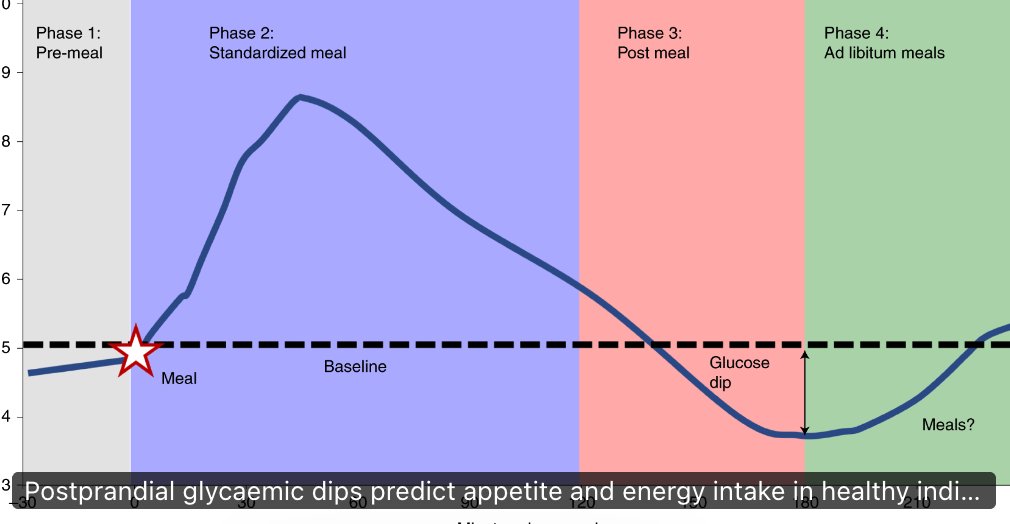
The key measure was the glucose dip. After a meal, blood sugar rises, peaks, then falls. Some people rise and then settle back to where they started. Others rise and then fall below their starting level about two to three hours later. The dip is how far that lowest reading falls below baseline, as a percentage. After a pure glucose drink it averaged 19%.
Call the second group the big dippers. The researchers compared their dip against the conventional measures: the size of the peak in the first two hours, and the total area under the glucose curve.
What they found:
• Comparing the largest-dip quartile with the smallest, the big-dip group ate 312 more calories over 24 hours (95% CI 226 to 398)
• The big-dip group started eating again 24 minutes sooner and reported a 9% larger rise in hunger at hours 2 to 3
• Across people, dip size correlated with 24-hour calorie intake at r = 0.27 and with intake in hours 3 to 4 at r = 0.19
• The dip predicted later calorie intake about as well as participants' own ratings of how hungry they felt
• Peak glucose and the area under the curve were weaker predictors, and peak glucose was slightly negatively correlated with intake in hours 3 to 4 (r = -0.16)
• Within the same person eating the same breakfast on two days, a bigger dip still tracked with more eating: r = 0.08 for hours 3 to 4 and r = 0.06 for 24 hours
That last result matters most for skeptics. If some people are simply hungrier and also crash harder, the link could be about the person and not the dip. Comparing a person to themselves removes that explanation. The effect shrinks, but it survives.
How could a dip drive hunger?
First, a carbohydrate-rich meal raises blood sugar and triggers insulin, the hormone that moves glucose out of the blood and into cells.
Second, the response can overshoot. Blood sugar falls below where it started.
Third, the brain monitors glucose. A falling level is read as a fuel shortage and switches on feeding circuits. This is the old glucostatic hypothesis, proposed by Jean Mayer in 1953, which fell out of favor partly because high glucose did not clearly suppress eating.
Think of it like a fuel gauge that reacts less to how full the tank is and more to how fast the needle is dropping.
In this dataset, the largest dips followed the glucose drink, which also had the biggest spike. So spike and dip are linked, but only loosely (r = 0.12). A big spike does not reliably mean a big crash.
Now the limits.
The effects are fairly modest. An r of 0.27 means the dip accounts for roughly 7% of the variation in daily intake (my arithmetic). Appetite has many drivers, and this is one of them.
The US cohort showed the same direction but was small. Most associations did not reach statistical significance there, and none of the within-person results did. For the 24-hour link, the US estimate was r = 0.21 with P = 0.065. That looks like a consistent trend, but it is not a replication in the strict sense.
This is observational. People did not get assigned to dip more or less, so the study shows association, not cause. No one tested whether blunting a dip reduces eating.
The team did not measure appetite hormones or insulin during the at-home meals, so the mechanism above is inferred. Calorie intake was self-reported. Sleep and physical activity were not included in the models, and both affect glucose and appetite. The sample was 97% white, and the study followed intake for one day, so it cannot say whether people compensate over weeks.
What does this mean for you?
Someone eats cereal, toast, or a pastry for breakfast, feels fine for a while, and is hungry again by mid-morning, hunting for a snack. It is easy to call that a willpower problem. This study offers another reading: their blood sugar rose quickly, then fell below where it began, and the body answered that drop by pushing them to eat.
It also helps explain why the same food can behave so differently from person to person. Picture one person whose glucose barely dips after a bowl of oatmeal and another whose glucose crashes after the same bowl. The standardized, repeated breakfasts in this study were built to capture exactly that kind of individual difference. It is one reason continuous glucose monitors can be informative. They show not just how high a meal sends your glucose, but how far it falls afterward.
What might shift the shape of the curve? Meals built around protein and fat, with fewer refined carbohydrates, generally produce a smaller rise and a gentler return. That is the expectation from broader glucose physiology. I would treat it as a reasonable thing to test on yourself, not a result from this paper, since no one here tested whether changing a meal reduces the dip and the eating that follows.
This also offers one possible explanation for why foods with high glycemic load, like sugary drinks and potatoes, are linked to weight gain in other studies. The spike might not be the problem. The crash that follows might be what sends you back to the fridge. This study did not test that directly.
If you keep feeling hungry a couple of hours after eating, it is worth asking whether that meal sent your blood sugar up and then down below where it started.
Twin studies say Alzheimer's is 60 to 80% heritable. Common DNA variants were only explaining about 5% of it. A new Nature study of 2.8 million people puts that figure at 16%.
That gap has bothered geneticists for years. Some argued there was little genetic risk left to find beyond APOE, the best-known Alzheimer's gene. Others argued over 1,000 variants must be involved. This paper tests which camp was right.
Here is what the researchers did.
The Psychiatric Genomics Consortium Alzheimer's group pooled 30 cohorts. That included 109,479 people with Alzheimer's, 74,141 proxy cases, and about 2.6 million controls.
Proxy cases are people who don't have the disease themselves but reported that a parent did. Each parent shares half your DNA, so you can use their diagnosis as a stand-in. This matters because Alzheimer's strikes late, and most biobank volunteers are still too young to have it.
The study is a genome-wide association study (GWAS). It scans millions of common DNA spelling differences and asks which ones show up more often in people with the disease. Each hit marks a region of the genome, called a locus, that nudges risk up or down.
Sample ancestry was 91% European, 5% African, 3% East Asian, and under 1% each admixed American and South Asian.
What they found:
• 127 risk loci in total, and 48 of them are new
• A heritability estimate of 16% with a newer statistical method, versus 6% with the older standard method on the same data
• A polygenic score (a single risk number built from thousands of variants) that explained an average of 12.8% of risk variation in European cohorts, and up to 16.9% in the best one
• In people over 65, the top 10% of the score had a sevenfold higher Alzheimer's prevalence than the bottom 10%, and a threefold higher prevalence than the whole sample
• Alzheimer's-linked genes that were more active in microglia (the brain's immune cells) in patients, with microglia the only cell type that held up after correction (P = 1.58 × 10^-6)
• 17 of the new genes already interact with approved drugs for other conditions, though only five had been tested as Alzheimer's targets
Why did the old estimate come in so low?
Heritability is the share of differences in risk between people that comes from their DNA. The older standard way to estimate it from GWAS data is called linkage disequilibrium score regression, or LDSC. It works by checking how strongly each variant's signal tracks with its neighbors on the genome, and it assumes risk comes from thousands of variants, each with a tiny and similar effect.
Alzheimer's doesn't look like that. One variant, APOE-ε4, explains about 6% on its own.
Think of it like estimating a choir's volume by assuming every singer is equally quiet. A single soloist breaks the assumption, and the total comes out too low.
The authors tested this directly. They simulated a trait with an Alzheimer's-like architecture in UK Biobank genotypes, with one large-effect variant plus 1,000 small ones. LDSC underestimated the true heritability. The newer method (SBayesRC), which allows for a mix of big and small effects, recovered it once the APOE region was handled separately.
A second check points the same way. The polygenic score explained more variance (about 13%) than LDSC said was theoretically possible for all common variants combined.
So what do the new genes tell us about biology? The paper's logic runs in three steps.
First, they matched each locus to its most likely gene. They combined machine learning predictions, links between DNA variants and gene activity, and earlier exome studies.
Second, they asked which brain cell types use those genes most. Microglia kept coming up. Genes turned up in microglia in patients were enriched for genetic risk. Genes turned down in certain neurons were too, though that neuron signal weakened to nominal after correcting for general neuronal downregulation. The authors say it may not be specific.
Third, they grouped genes by pathway. Immune activation, lipid binding, amyloid breakdown, and cell adhesion returned, as in earlier studies. Five processes were new to GWAS, including glutathione metabolism (oxidative stress handling) and sphingolipid metabolism (fats that shape cell membranes).
A few genes stood out as drug candidates. SYK and AXL help microglia respond to amyloid. QPCT makes the exact amyloid modification that donanemab, an approved antibody, targets. Eight of the 48 new loci couldn't be tied to any known pathway, which hints at biology nobody has described yet.
Now the limits.
The data are 91% European. APOE-ε4 effect sizes ranged from an odds ratio of 1.7 in African ancestry to 3.4 in East Asian ancestry. But even European cohorts varied a lot, so cohort differences may explain much of that spread. The polygenic score also performed worse outside European ancestry, so it can't yet be applied evenly across populations.
The 16% figure assumes a 5% lifetime prevalence. Assuming 20%, which is closer to the rate in people over 84, it rises to roughly 25%. The number depends on that choice.
Proxy cases make up 40% of all cases, and parent reports can be wrong. The authors report that proxy and clinical results agreed closely (genetic correlation 0.99), but diagnosis accuracy is a real caveat.
These are associations. A locus points to a region, and the gene assignment is a prediction. The drug target list is a hypothesis list, and two of the five tested targets failed in earlier human or mouse work.
Finally, the polygenic score isn't a diagnostic. It shifts group-level risk. Most new variants change odds by only a few percent each. Prediction at the individual level is still limited.
What does this mean for you?
If you have a family history, your risk is genuinely shaped by DNA, and more of it is common variation than people thought. But common variants are not destiny. Each one nudges risk slightly, and none replaces the lifestyle and vascular factors that also matter.
For the field, the finding that microglia keep appearing is a push to look beyond amyloid removal, which has delivered limited symptom relief so far.
8 most critical metabolic therapies for mental illness. Ordered by overall impact (personal list, based on my experience). These put my bipolar disorder into remission.
1. Ketogenic diet, preferably carnivore
2. Cut out drugs & alcohol
3. Physical exercise (hard cardio + weights)
4. Sunlight exposure first thing in the morning, throughout the day, in evening
5. Keep stress low
6. Sleep
7. Prayer, meditation, spiritual life
8. Time with others
Most doctors believe keto diets or ketogenic therapy means elevated cardiovascular risk.
A new study in Cardiology and Therapy looked at that assumption in nearly 10,000 patients. And guess what? They found the exact opposite! 🧵
Are the millers going to say they just obeyed orders?
They have a lot of power.
Worst case scenario they get an "enforcement order" not a prison sentence.
Doing some work for a paper and looking at the stats on the chronic disease burden among adults. According to the CDC,
"Approximately 6 in 10 young, 8 in 10 midlife, and 9 in 10 older US adults report 1 or more chronic conditions."
Sadly the recent growth is seen in the young population. We've got work to do.......understatement of the year.
https://t.co/u59YbeSMac