📜 Au début du XXe siècle, une femme mariée pouvait travailler toute la semaine... sans avoir le droit de disposer librement de son salaire. Une réalité aujourd'hui difficile à imaginer.
Nous sommes dans une usine française en 1905. Le bruit des machines couvre les conversations. Une ouvrière termine sa journée après des heures de travail. Elle a gagné son salaire. Pourtant, selon la loi de l'époque, l'argent qu'elle rapporte n'est pas entièrement sous son contrôle. Son statut juridique limite fortement son autonomie financière.
📍 Avant 1907, le Code civil place la femme mariée dans une situation de dépendance importante vis-à-vis de son époux. Cette organisation reflète la société du XIXe siècle et ses conceptions du mariage.
Les revendications progressent lentement. ⚖️ Des juristes, des parlementaires et des associations réclament des réformes. Le débat gagne en visibilité. Finalement, la loi du 13 juillet 1907 marque une étape importante. Elle reconnaît à la femme mariée le droit de disposer librement de son salaire. Cette évolution paraît modeste aujourd'hui, mais elle constitue alors une avancée majeure. D'autres réformes suivront au fil du XXe siècle. Les droits économiques et civils des femmes continueront de s'élargir progressivement.
🔍 Ce que peu de gens savent... La loi de 1907 n'a pas immédiatement créé une égalité complète. Selon les historiens, de nombreuses restrictions demeurent pendant plusieurs décennies. Par exemple, l'autonomie financière des femmes reste limitée dans de nombreux domaines. Il faudra attendre les années 1960 pour que plusieurs obstacles juridiques majeurs disparaissent. Cette lente évolution montre que les transformations sociales importantes se construisent souvent par étapes successives plutôt que par un changement unique.
⚡ L'histoire des droits des femmes en France rappelle que certaines libertés considérées comme évidentes aujourd'hui sont en réalité très récentes. Elles sont le résultat de décennies de réformes et de débats.
Most people think AI is about learning tools.
It’s not.
2026 will reward people who learn systems.
The winners won’t be the ones using ChatGPT casually.
They’ll be the professionals who know how to combine AI into leverage.
Here’s what will separate the top 1% in the AI era:
1. Prompt Engineering
Knowing how to think clearly, structure instructions, and communicate with AI like a strategic operator.
2. AI Workflow Automation
Replacing repetitive work with automated systems that run 24/7.
3. AI Agents
Building AI that can reason, execute tasks, and collaborate across workflows with minimal supervision.
4. RAG (Retrieval-Augmented Generation)
Connecting AI to your company knowledge, PDFs, databases, and internal documents to create real business intelligence.
5. Custom GPTs & Fine-Tuning
Turning generic AI into specialized AI trained around your expertise, industry, or brand.
6. Multimodal AI
The future isn’t text only.
AI will see, hear, speak, analyze video, and understand context across formats.
7. AI Video Generation
Content creation is being compressed from weeks into minutes.
One person can now operate like an entire media company.
8. AI Tool Stacking
The biggest productivity gains come from connecting tools into one intelligent ecosystem.
9. LLM Evaluation & Management
Companies won’t just need AI users. They’ll need people who know how to measure accuracy, reliability, cost, and performance.
The uncomfortable truth:
AI is no longer a “nice skill to have.”
It’s becoming the new operating system for modern work.
The gap between people who deeply understand AI and those who don’t will become massive over the next 24 months.
You do not need to become an engineer.
But you must become AI-native.
Because in the near future:
• Average professionals will compete with AI
• Smart professionals will work with AI
• Elite professionals will deploy armies of AI
The opportunity has never been bigger.
Neither has the risk of standing still.
Sign up at https://t.co/I4zR8aXXi5 for a free AI diagnostic & newsletters / follow @10xme_biz on X to learn more about AI.
Clever… or crossing the line?
A story’s been making the rounds:
A man allegedly found a loophole in the system.
He bought a fully refundable first-class ticket, not to fly, but to eat.
Every day, he walked into the VIP lounge, enjoyed premium meals like any other passenger… then simply rebooked his flight for the next day instead of boarding.
He repeated this over 300 times.
No flights taken.
No money lost.
Just one long buffet run.
When the airline finally caught on, he cancelled the ticket and walked away with a full refund.
So the question is:
Was he exploiting the system…
Or just playing the game better than everyone else?
Because in a world built on rules,
the real advantage often comes from understanding where they bend.
Most people are using AI wrong.
They’re trying to find the one best tool.
But the real advantage?
It comes from building a stack.
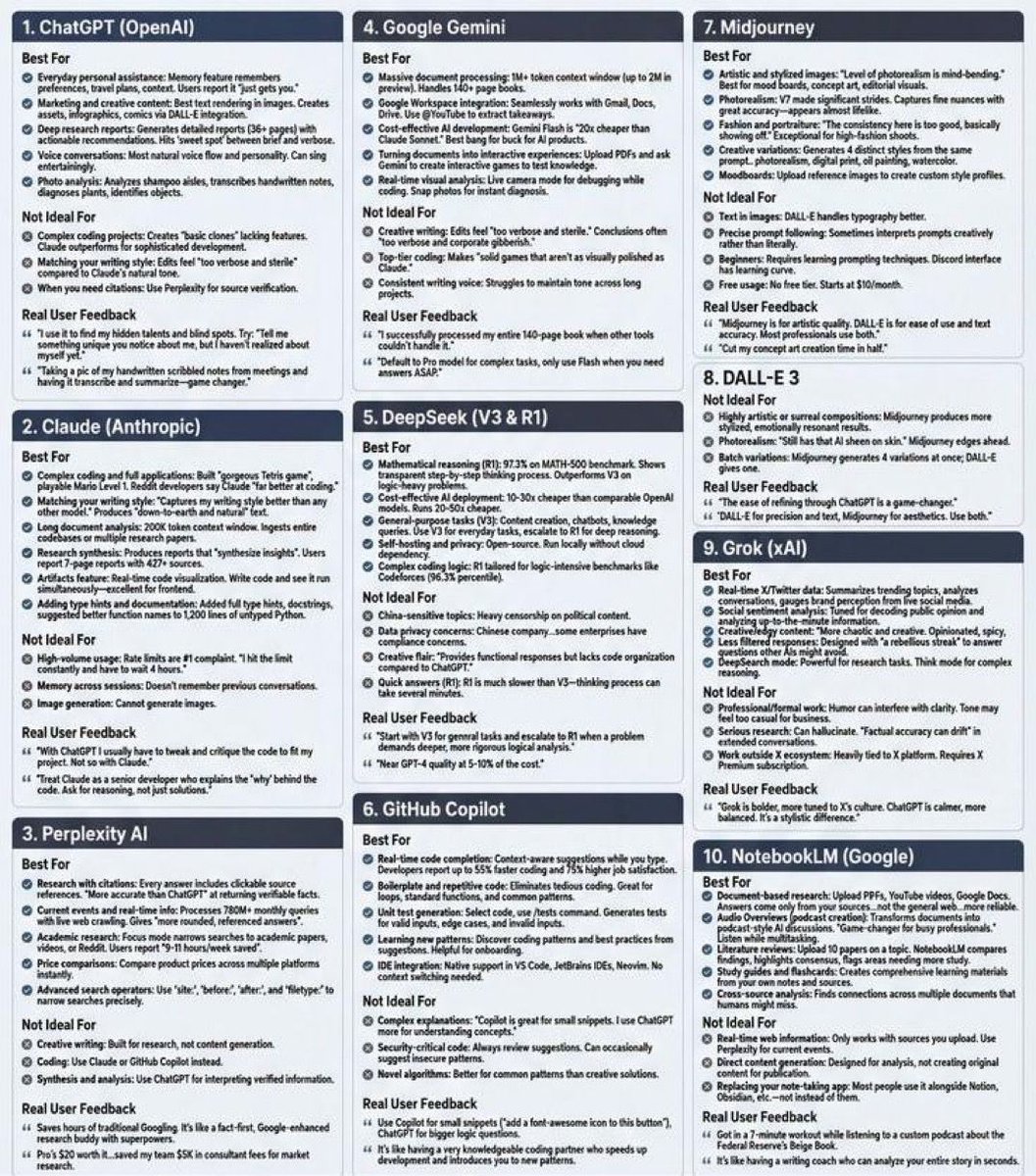
That image going around comparing tools like OpenAI’s ChatGPT, Anthropic’s Claude, Google’s Gemini, and others…
It’s helpful.
But it misses the bigger point.
These aren’t competitors.
They’re roles in a system.
Here’s how top operators actually use them:
→ ChatGPT = your strategist
→ Claude = your writer
→ Perplexity = your researcher
→ Gemini = your data processor
→ Midjourney = your visual engine
→ DeepSeek = your cost-efficient backend
→ Copilot = your builder
→ Grok = your trend radar
→ NotebookLM = your knowledge synthesizer
Individually, they’re tools.
Together, they’re a company.
Here’s what this looks like in practice:
1.Use Perplexity to gather real data
2.Use Grok to find what’s trending
3.Use ChatGPT to structure your angle
4.Use Claude to write with depth and emotion
5.Use Midjourney to create scroll-stopping visuals
6.Use ChatGPT again to refine and optimize
That’s not “using AI.”
That’s building a content engine.
And here’s the shift most people haven’t made yet:
AI is no longer a productivity tool.
It’s a leverage layer.
• One idea → 10 pieces of content
• One workflow → repeatable system
• One person → full-scale execution team
The people who win won’t be the ones who use AI.
They’ll be the ones who orchestrate it.
If you’re still using just one tool…
You’re not behind.
But you are under-leveraged.
2015:
Surrounded by people.
Always connected.
Never alone.
2020:
Circles got smaller.
Distance became normal.
And something inside us started to crack.
2026:
Alone… but not really.
Now we sit with
ChatGPT
Claude
Gemini
Perplexity
Grok
Always available.
Always responsive.
Always “there.”
But here’s the uncomfortable truth:
Technology is filling the gap…
not replacing what we lost.
AI can answer your questions.
It can help you think.
It can even feel like companionship.
But it cannot replace
real laughter,
real presence,
real connection.
The future isn’t about choosing between humans and AI.
It’s about balance.
Use AI to become smarter.
Faster.
More capable.
But don’t forget to be human.
Because in a world where you can talk to machines anytime…
real connection becomes your greatest advantage.
How to Use Claude the Right Way (Get better answers in minutes)
Claude is far more useful when you set it up once and feed it the right context. Do a little organization up front and you’ll stop getting generic or inconsistent responses. Follow these steps to optimize Claude for real work.
Before you type
- Turn on Extended Thinking (or the highest-capacity setting available). This gives Claude more compute and depth for complex tasks.
- Choose the best model you have access to (e.g., Opus 4.6 or the most capable available).
- Open a Cowork (not a blank chat). Cowork sessions can access and keep context from files and folders.
- Point the Cowork to your project folder so Claude can read your files.
Build your folder structure
Create one master folder (e.g., “Claude-Work”) and inside it make these subfolders:
- ABOUT ME — who you are, how you write, preferences.
- PROJECTS — one subfolder per active project.
- TEMPLATES — your best past work and preferred structures.
- OUTPUTS — where Claude saves final drafts, exports, and files.
Files to create inside ABOUT ME
Put these files in the ABOUT ME folder so Claude can learn your voice and constraints:
- about-me.md — what you do day-to-day (not your resume).
- my-voice.md — tone guidance, phrases you like/dislike, 2–3 short writing samples.
- my-rules.md — firm rules Claude must follow (e.g., “ask first, show plan, never delete without approval”).
- Real examples of your work — paste actual finished pieces, not descriptions.
Tip: One excellent, relevant file is worth more than dozens of random uploads.
Set it once, never again (global instructions)
Use Cowork → Settings → Edit Global Instructions and paste something like:
- “I’m [Name], [Role]. Read my files before every task.”
- “Ask questions before executing. Show a plan first.”
- “Never delete files without my explicit approval.”
This tells Claude to always check your stored context and to clarify before acting.
Stop doing these things
- Don’t write endless long prompts for every task — let Claude use your stored context.
- Don’t skip the folder setup — it’s the single best investment of time.
- Don’t use a plain chat when Cowork is available — Cowork enables file-aware behavior.
- Don’t expect Claude to know you without files — provide examples and rules.
Workflow tips
- Start each task by asking Claude to show a short plan and the questions it needs answered.
- Use your TEMPLATES folder for prompts or structures you often reuse (subject lines, case studies, briefs).
- Keep the ABOUT ME files updated as your priorities or voice change.
- For sensitive info, use caution — don’t store secrets in shared or insecure spaces.
Example global instruction (copy/paste)
“I’m [Name], [Role]. Before doing any work: 1) Read the files in the ‘Claude-Work’ folder; 2) Ask clarifying questions; 3) Show a short plan for approval; 4) Follow rules in my-rules.md; 5) Never delete or overwrite files without explicit permission.”
Spend 30–60 minutes setting this up and you’ll save hours of rework. Claude becomes a reliable collaborator when it has access to the right context, explicit rules, and a stable folder structure.










![alvinfoo's tweet photo. How to Use Claude the Right Way (Get better answers in minutes)
Claude is far more useful when you set it up once and feed it the right context. Do a little organization up front and you’ll stop getting generic or inconsistent responses. Follow these steps to optimize Claude for real work.
Before you type
- Turn on Extended Thinking (or the highest-capacity setting available). This gives Claude more compute and depth for complex tasks.
- Choose the best model you have access to (e.g., Opus 4.6 or the most capable available).
- Open a Cowork (not a blank chat). Cowork sessions can access and keep context from files and folders.
- Point the Cowork to your project folder so Claude can read your files.
Build your folder structure
Create one master folder (e.g., “Claude-Work”) and inside it make these subfolders:
- ABOUT ME — who you are, how you write, preferences.
- PROJECTS — one subfolder per active project.
- TEMPLATES — your best past work and preferred structures.
- OUTPUTS — where Claude saves final drafts, exports, and files.
Files to create inside ABOUT ME
Put these files in the ABOUT ME folder so Claude can learn your voice and constraints:
- about-me.md — what you do day-to-day (not your resume).
- my-voice.md — tone guidance, phrases you like/dislike, 2–3 short writing samples.
- my-rules.md — firm rules Claude must follow (e.g., “ask first, show plan, never delete without approval”).
- Real examples of your work — paste actual finished pieces, not descriptions.
Tip: One excellent, relevant file is worth more than dozens of random uploads.
Set it once, never again (global instructions)
Use Cowork → Settings → Edit Global Instructions and paste something like:
- “I’m [Name], [Role]. Read my files before every task.”
- “Ask questions before executing. Show a plan first.”
- “Never delete files without my explicit approval.”
This tells Claude to always check your stored context and to clarify before acting.
Stop doing these things
- Don’t write endless long prompts for every task — let Claude use your stored context.
- Don’t skip the folder setup — it’s the single best investment of time.
- Don’t use a plain chat when Cowork is available — Cowork enables file-aware behavior.
- Don’t expect Claude to know you without files — provide examples and rules.
Workflow tips
- Start each task by asking Claude to show a short plan and the questions it needs answered.
- Use your TEMPLATES folder for prompts or structures you often reuse (subject lines, case studies, briefs).
- Keep the ABOUT ME files updated as your priorities or voice change.
- For sensitive info, use caution — don’t store secrets in shared or insecure spaces.
Example global instruction (copy/paste)
“I’m [Name], [Role]. Before doing any work: 1) Read the files in the ‘Claude-Work’ folder; 2) Ask clarifying questions; 3) Show a short plan for approval; 4) Follow rules in my-rules.md; 5) Never delete or overwrite files without explicit permission.”
Spend 30–60 minutes setting this up and you’ll save hours of rework. Claude becomes a reliable collaborator when it has access to the right context, explicit rules, and a stable folder structure.](https://pbs.twimg.com/media/HElPLG8WYAEKND1.jpg)


