Four years ago today, Xanadu achieved quantum computational advantage with our quantum computer, Borealis.
Borealis solved a highly complex math problem in just 2 minutes -- a task that would take the world’s best classical supercomputers 7 million years to complete.
🔗👇
DID YOU LISTEN ANON?
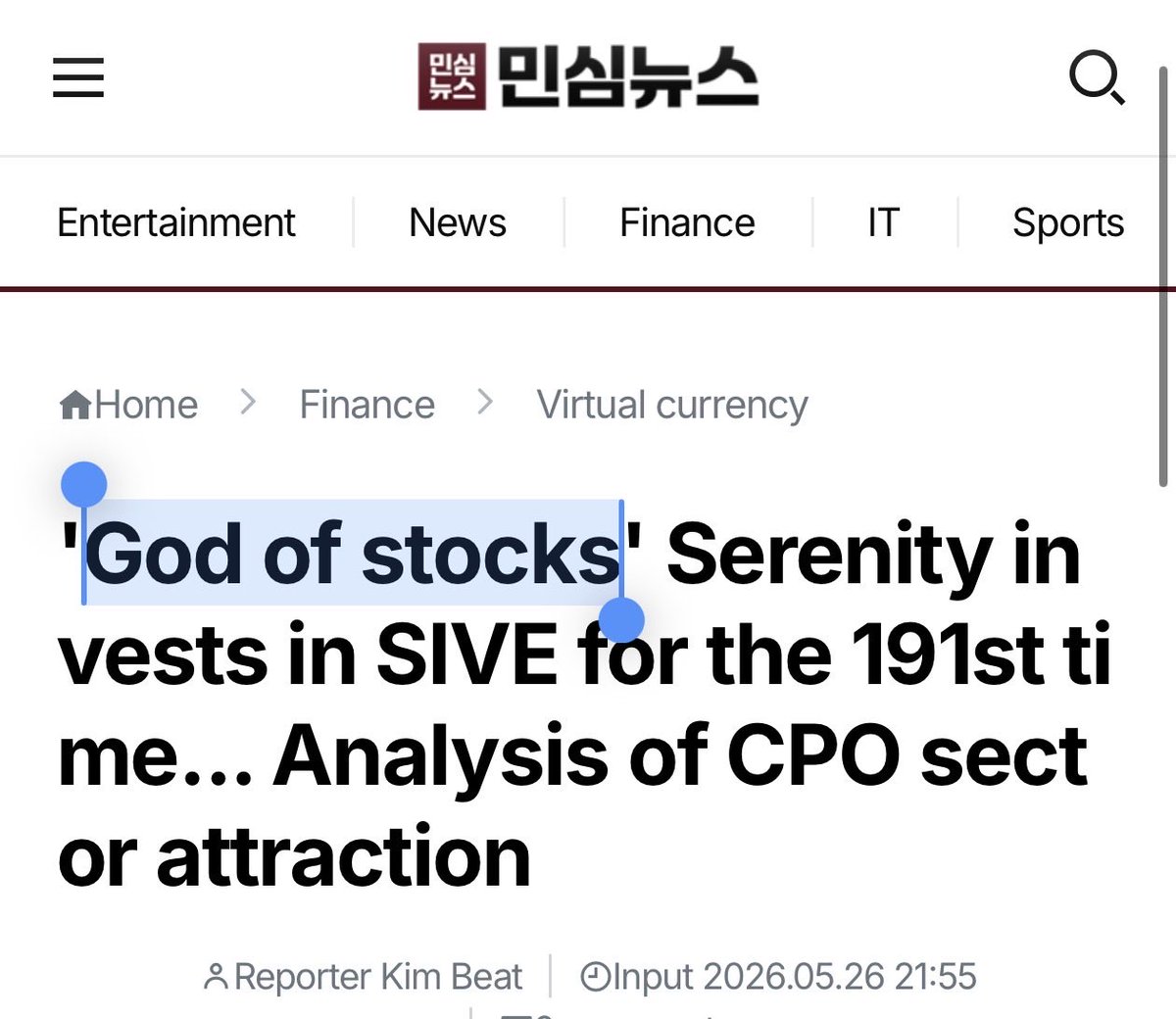
Reuters: New Sivers x GFS strategic collaboration.
$SIVE has now announced its lasers will be integrated into reference designs built on Globalfoundries Silicon Photonics Platform.
For pluggable optical transcivers, CPO, and SiPH.
This is fundamentally the most groundbreaking news for Sivers in history.
As Broadcom, Nvidia, Marvell, AMD, and anyone who goes through GFS silicon photonics has Sivers embedded as a default laser route.
I personally think this news alone should easily 2x or 3x Sivers market cap over the medium term, given how fundamental this is to their revenue.
To have Sivers be the standard laser route for the many hyperscalers that use the world's leading photonics foundry.
Heading to APS DAMOP 2026? Don’t miss presentations and poster sessions from Infleqtion scientists throughout the week.
Our team will be sharing work spanning laser cooling, optical clocks, and neutral atom quantum computing architectures. Swipe through for session details.
Featured presentations & posters:
🔹 Tobias Bothwell
“Blue-detuned magneto-optical trap of cesium for laser cooling and optical transport with static magnetic fields”
🗓 June 2 | 10:30–10:42 AM
📍 Room 552 AB
🔹 Dan Cole
“Demonstration of an architecture for neutral atom quantum computing combining in-place, nearest-neighbor entangling operations with mid-circuit qubit rearrangement”
🗓 June 3 | 2:24–2:36 PM
📍 Ballroom B
🔹 Martin Lichtman
“A Rb-Cs Quantum Computing Testbed”
🗓 June 3 | 2:36–2:48 PM
📍 Ballroom B
🔹 Martin Lichtman Poster Session
“Quantum Computing using Rb and Cs”
🗓 June 3 | 4:00–6:00 PM
📍 Exhibit Hall B
🔹 Andrew Kortyna Poster Session
“Time-transfer applications of a commercially available optical clock: bistatic and multistatic radar enhancement”
🗓 June 3 | 4:00–6:00 PM`
📍 Exhibit Hall B
🔹 Tobias Bothwell & Dan Cole Poster Session
“Blue-detuned magneto-optical trap of cesium for laser cooling and optical transport with static magnetic fields”
🗓 June 4 | 4:00–6:00 PM
📍 Exhibit Hall B
Come connect with the team at Booth #302 during the conference: https://t.co/RSHPmYd1SL
#APSDAMOP26
$INFQ just locked in a 10x from here.
thank you Jensen Huang.
@Infleqtion was just named by Nvidia $NVDA as a partner deploying its new Ising AI models for quantum computing.
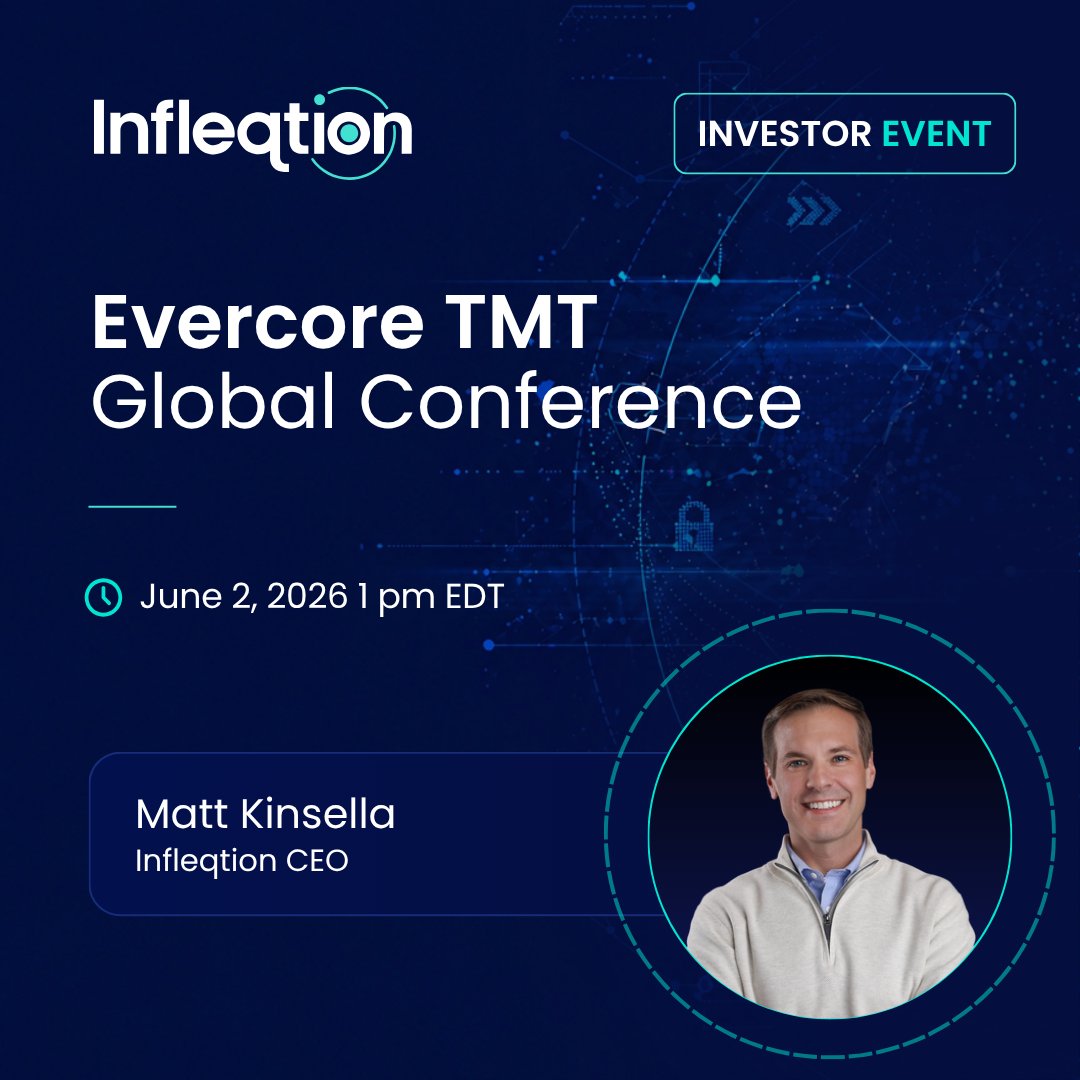
Infleqtion ($INFQ) CEO Matt Kinsella will participate in a fireside chat at Evercore’s TMT Conference on June 2 at 1:00 p.m. ET, engaging with investors and sharing Infleqtion’s vision for scaling quantum computing, sensing, and software technologies.
The webcast will be available at this link: https://t.co/34cUd11peD
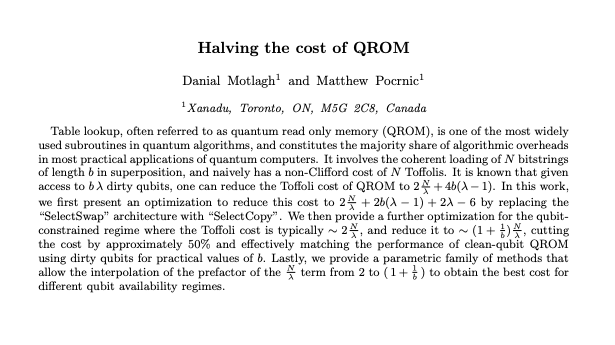
Loading classical data into a quantum computer just got 50% cheaper.
This work by Danial Motlagh and Matthew Pocrnic (@mpocrnic97) introduces a new method that slashes the Toffoli gate overhead required for Quantum Read-Only Memory (QROM).
🔗👇
$MRVL earnings were a bullish indicator on the broader CPO theme (and $SIVE as the likely laser supplier).
- “Scale-up interconnect represents one of the newest and most strategically important opportunities emerging in AI infrastructure.”
CPO thematically go brrr
- Confirmation Celestial was selected by T1 hyperscaler for scale up.
I’ve found Celestial $AMZN warrants in the past)… so probably Amazon.
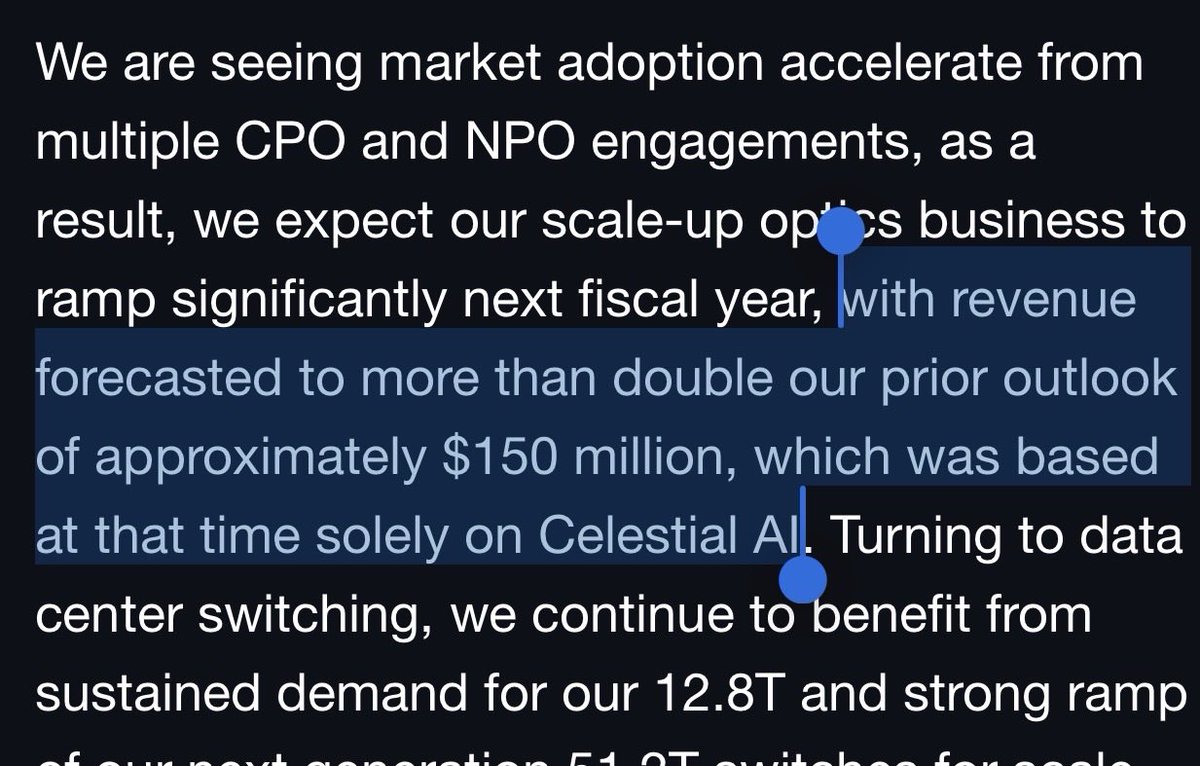
- Scale-up optics revenue next year should be more than 2x prior ~$150M outlook with Celestial
Forward revenue ramp expectations go brrr.
- Celestial team plus $MRVL optics team was a “home run”.
Marvell sees celestial as growth vector, upstream celestial suppliers go brr
- $MRVL is now focused on bringing Celestial to high volume manufacturing.
Volume ramp indicator
If you don’t recall, there was OSINT mapping $SIVE directly to Celestial, not through $POET.
So Celestial forward growth is a volume ramp indicator for Sivers lasers.
RF signals are increasingly vulnerable to jamming, spoofing, and interference that conventional antenna systems weren't built to handle. Infleqtion's Quantum Spectrum platform uses Rydberg atoms to detect signals across the full RF spectrum in a single aperture, with active field programs in the U.S., U.K., and Australia already underway.
Interesting Engineering broke down how the technology works and what it could mean for GPS-free navigation, electronic warfare, drone detection, and beyond.
Read here: https://t.co/mWlq9gwqiK
Everyone is chasing $SIVE or looking for the next
$AEHR or $AXTI.
I think I found it… Not one. But two. Both sitting at the exact chokepoint.
This is maybe my favourite trade ideas the market hasn’t priced yet:
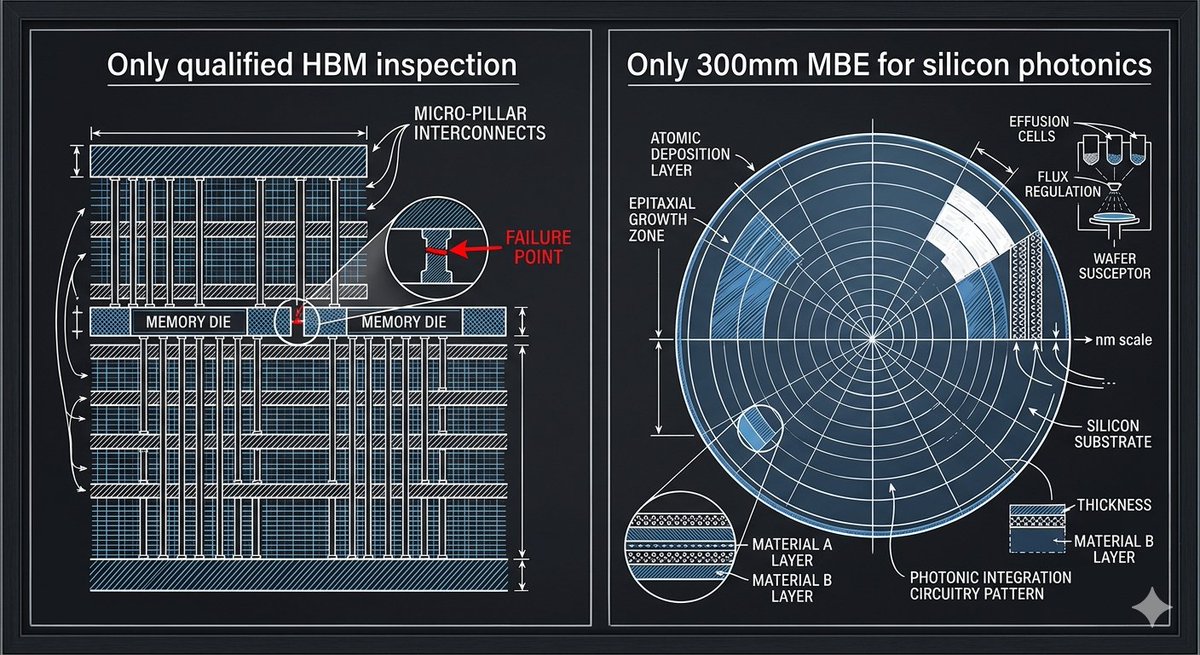
CONSTRAINT 1: HBM inspection AI chips are not a single piece of silicon.
A modern $NVDA GPU is a stack. A logic die at the bottom. Four to eight HBM memory dies bonded on top.
Each memory die connected to the next through thousands of through-silicon vias, copper pillars drilled through the chip itself.
Then that entire memory stack gets attached to the logic die through thousands more micro-pillar interconnects.
Each pillar is smaller than a human hair. One defective pillar.
One. That’s all it takes to kill a $40,000 AI GPU package.
No buffer. No workaround. The whole unit is scrap.
And here’s the constraint that makes this critical right now:
HBM supply is sold out through at least 2027. No significant new capacity comes online until late 2027. There is no spare capacity. Every die that gets made needs to reach a GPU. A defect found late in the process isn’t a minor setback, it’s a $40,000 unit written off with nothing to replace it.
So the industry doesn’t sample-inspect HBM stacks.
It performs 100% INSPECTION. Every device. Every pillar. Every generation.
As HBM advances from HBM3e to HBM4, the die gets larger, the micro-pillar density increases, and the inspection requirement becomes more complex, not less.
There is one company with qualified equipment for this job at a leading US memory manufacturer.
$COHU - Cohu Inc.
Their Neon platform performs full 6-sided optical inspection of every HBM device using proprietary AI-trained software, defect recognition trained specifically on each customer’s device architecture.
You can’t buy a competitor’s system and retrain it in a quarter. The switching cost is measured in years.
The numbers:
→ $488M cash. No dilution risk.
→ Orders up 163% year-over-year Q1 2026
→ $750M pipeline. 5 customers in active qualification.
→ HBM revenue guidance raised from $15M to $80–100M in a single year
The market is pricing this as a test equipment cycle recovery.
The correct frame: the only qualified inspection bottleneck in the HBM supply chain.
Test equipment multiple: 3–4x EV/Revenue. AI infrastructure bottleneck multiple: 7–10x.
CONSTRAINT 2: Silicon photonics fabrication Copper wires are hitting their physical limit inside AI data centers.
Moving data between GPUs at the speeds AI training requires generates heat, signal loss, and power draw that copper interconnects can no longer handle efficiently. The industry’s answer is silicon photonics, lasers built directly onto chips, transmitting data as light instead of electrons.
Co-packaged optics (CPO) embeds those lasers directly into AI switches. Forecast penetration: from near-zero today to 35% of all optical networking by 2030.
Every one of those lasers is grown using a process called molecular beam epitaxy; MBE. A process that deposits semiconductor materials one atomic layer at a time, under ultra-high vacuum, with tolerances measured in atoms.
The problem: the entire industry’s MBE infrastructure was built for 150mm and 200mm wafers. Silicon photonics runs on 300mm production lines, the same wafer size used in leading-edge logic fabs.
There was no MBE system compatible with 300mm production lines.
Until $ALRIB built one.
Meet ROSIE; Riber Oxide on Silicon Epitaxy is the first MBE platform engineered specifically for 300mm silicon photonics production lines. No other equipment company makes this.
The first two systems were ordered in 2025. ROSIE 2 the dual-chamber production version, goes into manufacturing in 2026.
This is Year 0 of the ramp. Analyst consensus price target: €6. Current price: €15+.
The gap exists because analysts are modeling Riber as a €40M scientific instruments company.
Not one single sell-side model contains ROSIE as a separate revenue line.
Silicon photonics is a $17B market by 2035. Riber’s current revenue: €40M. Market cap: €320M (~$340M USD).
If ROSIE becomes the production standard for 300mm silicon photonics the way MOCVD became the standard for LED manufacturing, the revenue trajectory and the multiple both re-rate from here.
Two constraints. Two chokepoints. One sits between every HBM die and every AI GPU that ships.
The other is the only equipment that can grow the lasers replacing copper in AI infrastructure. Both are being priced on the wrong metrics.
The market finds them eventually.
This is not financial advice. Do your own due diligence.
For full disclosure I haven’t taken a position myself, yet.
They are both on my watchlist. I'm considering adding one of them to mmy short-term portfolio.
$ALRIB looks like the most asymmetrical setup. A potential ten-bagger.
$COHU the more safe-play. 3-5X. A potential
$OUST look a like setup.
@ParadisLabs any thoughts? I can’t call out @aleabitoreddit since I’m blocked, apparently.
I'm also curious on other great investors perspective here: @moninvestor@Kaizen_Investor and @daniel_koss
-BP
Good call:
" $XNDU: Xanadu. IPO'd March 2026. First pure play photonic quantum computing company on public markets. Photons transmit quantum data over long distances, which is critical for networking quantum machines together. If quantum networking becomes the bottleneck (and I think it will), photonic architectures have a natural advantage."
Quantum Computing Has Captured Wall Street’s Attention.
“I started out a skeptic, but my belief that quantum computing will commercialize has increased meaningfully in the past year and a half. I feel like we are on the cusp.” https://t.co/jqGkbTvVnl
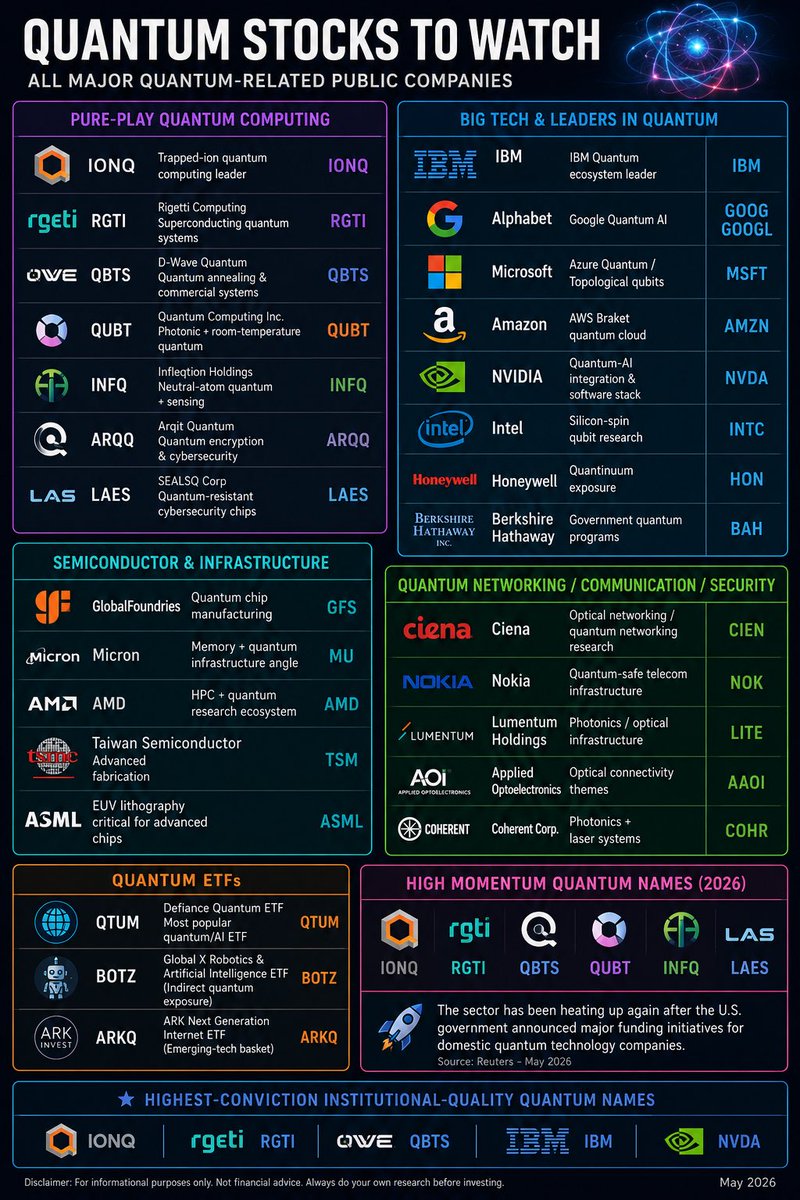
QUANTUM COMPUTING — The Full Sector Map. Every Play. One Post.
PURE-PLAY QUANTUM
$IONQ → Trapped-ion leader. Best-in-class qubit fidelity. Customers include Airbus, AstraZeneca, Hyundai. 256-qubit demo targeted 2026. The institutional-grade pure-play.
$RGTI → Superconducting quantum systems. Highest beta in the sector. When quantum runs, $RGTI moves violently. Active momentum name right now.
$QBTS → D-Wave Quantum. Annealing-based architecture. Most commercially de-risked pure-play — already generating optimization revenue with real enterprise clients.
$QUBT → Photonic + room-temperature quantum. Q1 2026 revenue up from $39K → $3.7M YoY. Acquired Luminar Semiconductor for $110M. Vertically integrated photonics + quantum platform taking shape. Executing quietly.
$INFQ → Neutral-atom quantum + sensing. One of the least-covered names in the sector. Neutral-atom architecture is gaining credibility as a scalable path to fault tolerance. Early but worth watching.
$ARQQ → Quantum encryption and post-quantum cybersecurity. The national security angle. As quantum breaks classical encryption — this becomes critical infrastructure.
$LAES → Quantum-resistant cybersecurity chips. Hardware-level protection against quantum decryption. Defense + enterprise security tailwind.
BIG TECH
$IBM → Most mature public quantum roadmap. 1000+ qubit processors live. Fault-tolerant systems targeted ~2029. Every enterprise quantum conversation starts here.
$GOOGL → Willow chip demonstrated a landmark quantum error correction milestone. Google doesn’t lose science races. This is a long-term compounder with quantum upside baked in.
$MSFT → Topological qubit breakthrough. Azure Quantum as the monetization layer. Full-stack quantum integrator play for the enterprise cloud era.
$AMZN → AWS Braket quantum cloud. Positioned as the access layer for quantum-as-a-service. Already charging enterprises for quantum compute access today.
$NVDA → Quantum-AI software stack integration. CUDA for quantum is the longer-term thesis. $NVDA doesn’t need to win quantum — it needs to be the layer everything runs on top of.
$INTC → Silicon-spin qubit research. The most scalable long-term architecture thesis — leveraging existing CMOS manufacturing. Slow, but strategically important.
$HON → Majority stake in Quantinuum — the most commercially advanced quantum hardware + software company currently private. When Quantinuum IPOs, $HON re-rates hard.
$BAH → Booz Allen Hamilton. Deep in U.S. government quantum programs. Every federal quantum contract flows through firms like this. The picks-and-shovels of government quantum.
SEMICONDUCTOR & INFRASTRUCTURE
$GFS → GlobalFoundries. Quantum chip manufacturing capabilities. As quantum hardware scales, fab demand follows.
$MU → Memory + quantum infrastructure angle. Quantum systems require extreme classical compute support — $MU sits in that stack.
$AMD → HPC + quantum research ecosystem. High-performance classical compute is the co-processor to every near-term quantum system.
$TSM → TSMC. Advanced fabrication is the foundation of every quantum chip roadmap. No quantum at scale without $TSM.
$ASML → EUV lithography critical for next-generation quantum chip manufacturing. The irreplaceable chokepoint in advanced semiconductor production.
QUANTUM NETWORKING / OPTICAL / SECURITY
$CIEN → Optical networking backbone + quantum networking research. Quantum communication requires ultra-low-noise optical infrastructure — $CIEN is already there.
$NOK → Nokia building quantum-safe telecom infrastructure. Nation-state cyber threats are accelerating the quantum-safe network upgrade cycle.
$LITE → Photonics and optical infrastructure. Quantum and photonics are deeply intertwined.
$AAOI → Optical connectivity. Riding both the AI and quantum photonics buildout simultaneously.
$COHR → Photonics + laser systems. Lasers are fundamental to trapped-ion and photonic quantum architectures.