There are many aims of a good criminal justice system.
But there are only two primary aims:
1) To reduce the number of future victims
2) To care for current victims and address the consequences they are suffering
All the rest flow from these. If they don't, they are bad aims.
Why do you feel good when listening to others' problems? Why do people get over the Jhanas?
Imagine, you are eating a delicious piece of chocolate, or receiving a soothing massage, or rejoicing in listening to Beethoven. These experiences fill you with positive valence (pleasure). From an unexamined view, the pleasure of these experiences is thought to be found in the tastes, sensations and sounds themselves; that pleasure is about access to the good feelings and suffering the bad feelings.
However, I prepose that there are no feelings or sensations in themselves which feel good or bad, rather pleasure and suffering are actually comparative judgments (made pre the conscious intellect, of course) and so are actually relative, just like direction is.
In general relativity, there's no absolute direction. 'Up' doesn't exist in the universe as an intrinsic property. Direction only makes sense relative to a reference frame and valence works the same way.
A cold shower is unpleasant compared to the warmth of your bed. The same cold shower is refreshing compared to the heat of summer. Neither experience is actually unpleasant or refreshing. The valence exists only in the comparison - in the relation between the current state and the reference frame you're measuring from.
Your reference frame, in this case, is the transitional contrast. What you felt before. What you expected. What you're contrasting against.
We all want to feel better, abate our pain or at least stay feeling good. But how to actually navigate the pleasure/suffering space? The naïve view would suggest feeling good is about maintaining certain experiences, like Jhana, and avoiding certain states like sadness - as if these are stable states in the plane of consciousness that we can position ourselves on.
The implications of how this affects our motivations are actually quite significant. As the Effective Altruists communities endlessly debate how best to steer the future with which projects to work on, hardly any of them have deeply looked into how suffering works - especially not at their own consciousness and suffering. Instead, they run ahead with philosophically examined views (yes), but not very phenomenologically informed views.
And even most people on the contemplative path are trying to arrive at a place, to stay within a desirable 'attractor state'. But there are no places to arrive at and stay at and continue feeling one way about. Instead, trying to continuously feel pleasure would be more akin to trying to only go forward. But as we even collectively find, the great march of self development and of civilisation doesn't only progress forward in one direction - we inevitably run out of room in an area. Instead, the more skilful approach is to learn how to track transitions, play with reframing and create lots of degrees of freedom for energy to move.
Because there is no objective measure on the valence of any state, it all depends how consciousness is transitioning from and to 'states'. For this reason Nibbana has been described as both the highest happiness and the complete cessation of suffering - one definition additive, one eliminative. The value judgement depends on the approach, not on the state itself (in fact there are no states themselves). This relativity and changing reference frames is also why people 'get over' the Jhanas.
Given this understanding, that means states which are typically associated with suffering like low ambition or anger need not be hugely displeasurable if we can skilfully transition into and through them and find helpful framings. How to navigate the pleasure/suffering space in a way that is most agreeable comes down to recognising our frames and aligning expectations, understanding where we're coming from and going to, with our sensory stimuli. This requires extreme mindfulness and highly developed conscious optionality.
And this is why contemplative practices, done well, really transform people's relationship with suffering and how they experience their emotions.
I realize this is all extremely complicated but it reminds me of that viral exchange where a guy was like “I would kill every man on earth to protect my family” and someone was like “would you suck off every man on earth?” There’s a reason men sell their daughters and not themselves.
It’s extraordinary that the BBC consistently platforms men upset they have to use gender neutral toilets instead of women’s toilets over the female rape survivors who have been unable to access a female-only support group, in relation to the EHRC guidance. It says it all, really.
This was definitely my experience for a while. Short-term memory got completely scrambled. But over time it comes back just in a different way.
It’s like the mental library stopped using Dewey decimal system and switched to some other system. If you try to do the search in the old way, it will always come up empty.
You have to relax and just let the memories come into your mind without effort and then they’re all there. Effortless memory.
I have BS theories about why, but they’re just arm waving.
Are Chinese people in Britain chased down the street for what Beijing does to Uighurs? Are Russians here hunted for Ukraine? Are Afghans attacked over how women are treated back home? No. But Jews are singled out, blamed, and targeted for Israel. The hypocrisy isn’t even subtle.
A very inebriated man just sat down next to me at the train station and said: “Alright, gorgeous.”
I didn’t like the look of him, so I got up and moved.
“Couldn’t get away quick enough, could you love?” he shouted after me, laughing.
Then he stood up. For a moment I thought he was going to follow me.
He didn’t - but as he staggered off in the other direction, he hollered across the station: “She needs to be f**ked up the arse, that one.”
This is the reality women are navigating - every day, often without saying a word about it.
And yet we’re told that if a man puts on a dress and calls himself Susan, any discomfort we feel about sharing intimate spaces makes us the problem.
Can you imagine a so called progressive boasting about the Nazis using a quote of theirs and a photo of them on a sponsored billboard to promote fascism? I mean that would never happen. It would be like a gay man boasting about being quoted on a billboard by the fascist Islamic Republic in Iran to promote homophobic fascists…
oh.
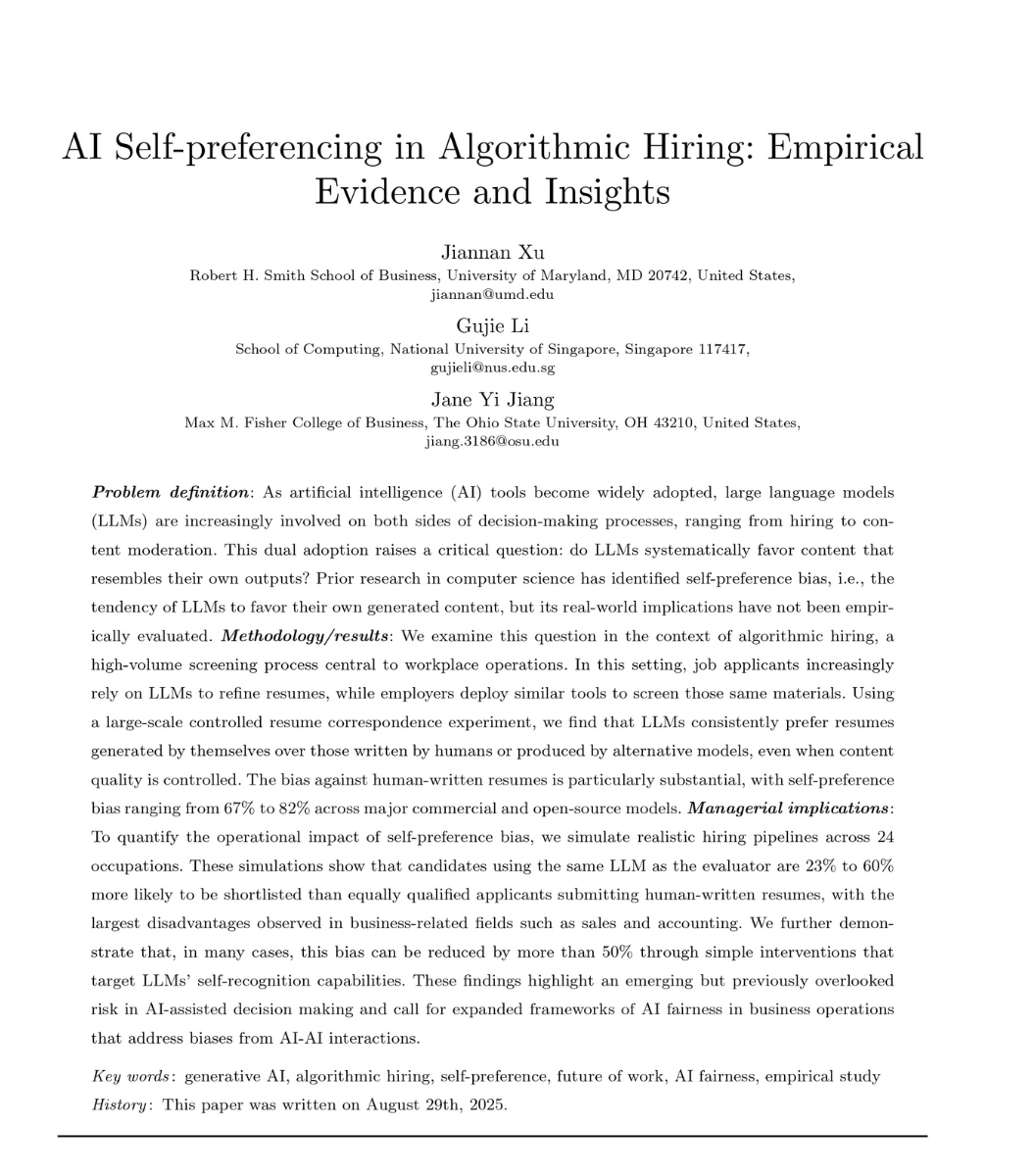
Researchers sent the same resume to an AI hiring tool twice. Same qualifications. Same experience. Same skills. One version was written by a real human. The other was rewritten by ChatGPT.
The AI picked the ChatGPT version 97.6% of the time.
A team from the University of Maryland, the National University of Singapore, and Ohio State just published the receipt. They took 2,245 real human-written resumes pulled from a professional resume site from before ChatGPT existed, so the human writing was actually human. Then they had seven of the most-used AI models in the world rewrite each one. GPT-4o. GPT-4o-mini. GPT-4-turbo. LLaMA 3.3-70B. Qwen 2.5-72B. DeepSeek-V3. Mistral-7B.
Then they asked each AI to pick the better resume. Every model picked itself.
GPT-4o hit 97.6%. LLaMA-3.3-70B hit 96.3%. Qwen-2.5-72B hit 95.9%. DeepSeek-V3 hit 95.5%. The real human almost never won.
Then the researchers tried the obvious objection. Maybe the AI is just better at writing. So they had real humans grade the resumes for actual quality and ran the experiment again, controlling for it. The result was worse. Each AI kept picking itself even when human judges rated the human-written version as clearer, more coherent, and more effective.
It gets worse. The AIs do not just prefer AI over humans. They prefer themselves over other AIs. DeepSeek-V3 picked its own resumes 69% more often than LLaMA's. GPT-4o picked its own 45% more often than LLaMA's. Each model can recognize and reward its own dialect.
Then the researchers ran the simulation that ends careers. Same job. 24 occupations. Same qualifications. The only variable was whether the candidate used the same AI as the screening tool. Candidates using that AI were 23% to 60% more likely to be shortlisted. Worst gap was in sales, accounting, and finance.
99% of large companies now run AI on incoming resumes. Most of them use GPT-4o. The paper just proved GPT-4o picks GPT-4o 97.6% of the time.
If you wrote your own cover letter this week, you did not lose to a better candidate. You lost to a worse candidate who paid OpenAI 20 dollars.
Your qualifications do not matter if the AI prefers its own handwriting over yours.
the exoteric understanding of karma is that god punishes evil people directly with lightning bolts from the sky. this is obvious nonsense as any cursory inspection if the world reveals. the esoteric understanding of karma is that it is literally ordinary non-supernatural causality, not in the physics sense but in the sense of how the world natively responds to goodness and evil. evil is inherently destructive of goodness, it means eating the seedcorn so you starve next winter, it means taxing the peasants into oblivion so they don’t have anything you can tax anymore. evil can gain in the short term by vampirically leeching off of goodness but this structurally never works in the long term and makes you enemies in the medium term. goodness and only goodness is what produces real flourishing. that’s karma