Our paper STRIDE was accepted to ICML 2026!
We post-train LLMs to optimize proteins & molecules by emitting a chain-of-thought of atomic edits (INSERT / DELETE / REPLACE). Levenshtein-shortest-path SFT + GRPO-style RL. Boosts protein optimization success from 42% → 89%.
Our paper Soft-Rank Diffusion was accepted to ICML 2026!
Prior permutation-diffusion methods use riffle-shuffle forward processes that are abrupt and scale poorly with n. We instead lift permutations to continuous soft ranks in [0,1]ⁿ and run a reflected Brownian bridge, paired with a contextualized Plackett–Luce decoder. Big gains on long-sequence sorting and TSP.
AI-Personalized Medicine
@agupta
The cost of genome sequencing has fallen faster than Moore's Law, and agents can now analyze personalized health data to generate highly accurate, user-specific suggestions.
We think these shifts will bring about a revolution in care delivery, and a wide variety of startups will support every step of that ecosystem.
We’re hiring a Founding Head of Strategy, Data & Partnerships at @CellTypeInc
We’re building a biological world model — foundation models that simulate human biology and power the agentic drug company.
Help take this into the world.
Strategy × data x partnerships × frontier biotech/AI
🔗 https://t.co/81ffQBxxbg
CellType is hiring founding engineers! Biology is one of the biggest unsolved frontiers for AI. Join us building foundation models and agentic systems for drug discovery. If you want to push the frontier of AI for science, we'd love to talk.
https://t.co/Bjj7yIS9nn
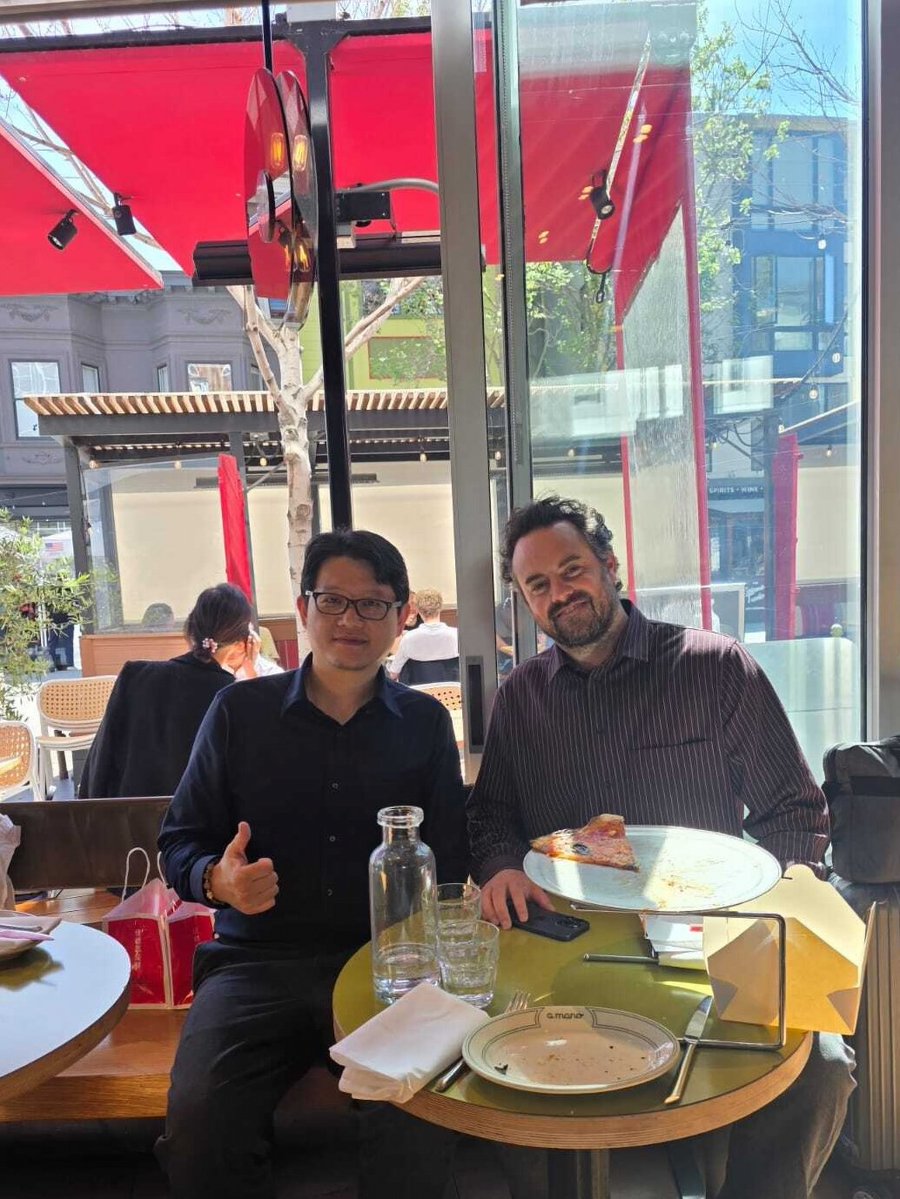
Great finally meeting Taylor Hsu from Senhwa Biosciences in person in San Francisco. Their drug CX-4945 was identified in our screen out of 4,000 compounds. Now CellType and Senhwa are partnering to further develop it together — exciting things in the pipeline!
https://t.co/setuKMGxdG
This is the thesis behind @CellTypeInc. You can't just prompt an LLM to design a drug. You need a simulator that can evaluate whether a design actually works—and then use that feedback to train models that get better at the hard direction.
Paper: https://t.co/3DgpyY7MPf
LLMs can ace science exams and explain complex mechanisms. But can they actually do science—design a molecule, a dosing regimen, or a gene circuit that works?
We built SciDesignBench, a benchmark for testing frontier LLMs on scientific design tasks grounded in real simulators. The core finding is that models that can talk fluently about science still struggle when asked to produce designs that actually satisfy quantitative targets. We also propose a simulator-feedback RL recipe that improves performance on these tasks.
Paper: https://t.co/PqxmdPrGii 🧵
The elegant part is that the same asymmetry that makes inverse design hard also suggests the fix. Scientists have already built forward simulators for many of these problems. Those simulators can be repurposed as RL environments: propose a design, evaluate it, learn from the reward.
In our case studies, training on simulator feedback lets a small 8B model outperform much larger frontier models on selected scientific design tasks.
We are thrilled to announce CellType's strategic partnership with Senhwa Biosciences! We're using our models to accelerate their clinical oncology drug, CX-4945, unlocking novel mechanisms to make tumors more visible to the immune system. https://t.co/FooliO4wU8
Keep working in your local environment while CellType Agent Pro offloads heavy GPU jobs to CellType Cloud.
Run protein folding, molecular simulations, single-cell models, and other GPU-heavy bio workflows without managing your own GPU stack.
Try it at https://t.co/1y8ysuTatK
People kept telling us they wanted to run the CellType Agent but didn't have the compute. So we built CellType Agent Pro — GPU compute, plus an on-prem option for teams with sensitive data.
https://t.co/1y8ysuTatK
We teach models to reason about biology.
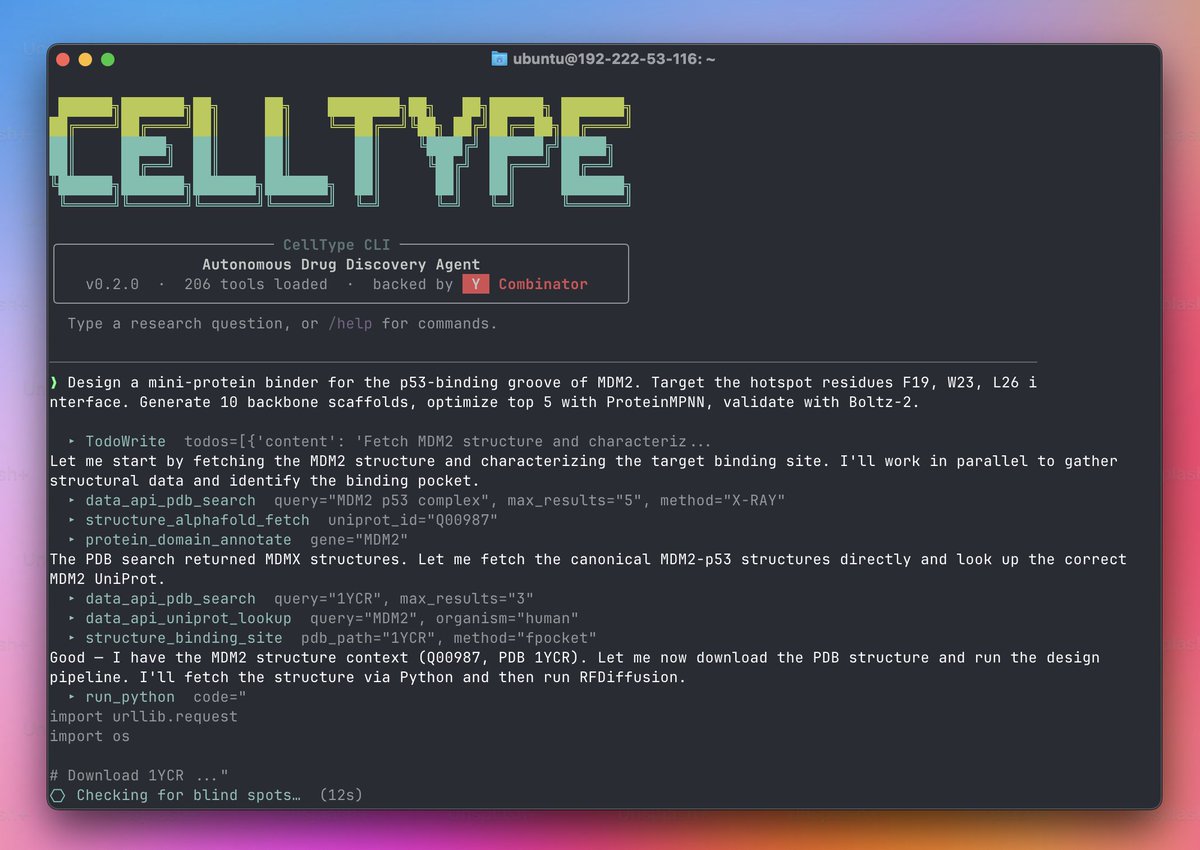
Today we're open-sourcing the tool we built to run that science.
Think Claude Code, but for drug discovery.
pip install celltype-cli





![david_van_dijk's tweet photo. Our paper Soft-Rank Diffusion was accepted to ICML 2026!
Prior permutation-diffusion methods use riffle-shuffle forward processes that are abrupt and scale poorly with n. We instead lift permutations to continuous soft ranks in [0,1]ⁿ and run a reflected Brownian bridge, paired with a contextualized Plackett–Luce decoder. Big gains on long-sequence sorting and TSP.](https://pbs.twimg.com/media/HHPuzXdXkAA2voH.jpg)