Coding is no longer the moat. Non-technical founders now ship AI apps with Bubble, Glide, and Softr wired straight to AI APIs.
The stack is visual, the intelligence is rented.
Build yours this weekend.
BTC chart forming a tight range again. Where do you see the breakout?
Spot volume is thinning while funding stays neutral across majors.
Range compression like this usually precedes a violent move. Stay sharp.
Eight years of clinical programs reveal the real blocker: no reusable coordination layer. But the essay's thesis that AI capability isn't the problem misses this: without shared rails, even perfect AI stays program-speci
Most ETH maximalists are just exit liquidity for BTC maxis. Before you ape:
1. Where's the liquidity?
2. Where's invalidation?
3. What's the R/R?
Answer those or stay sidelined.
reentrancy still drains more value than any other bug class.
checks-effects-interactions plus a reentrancy guard blocks nearly all of them.
audits are cheap next to a drained pool.
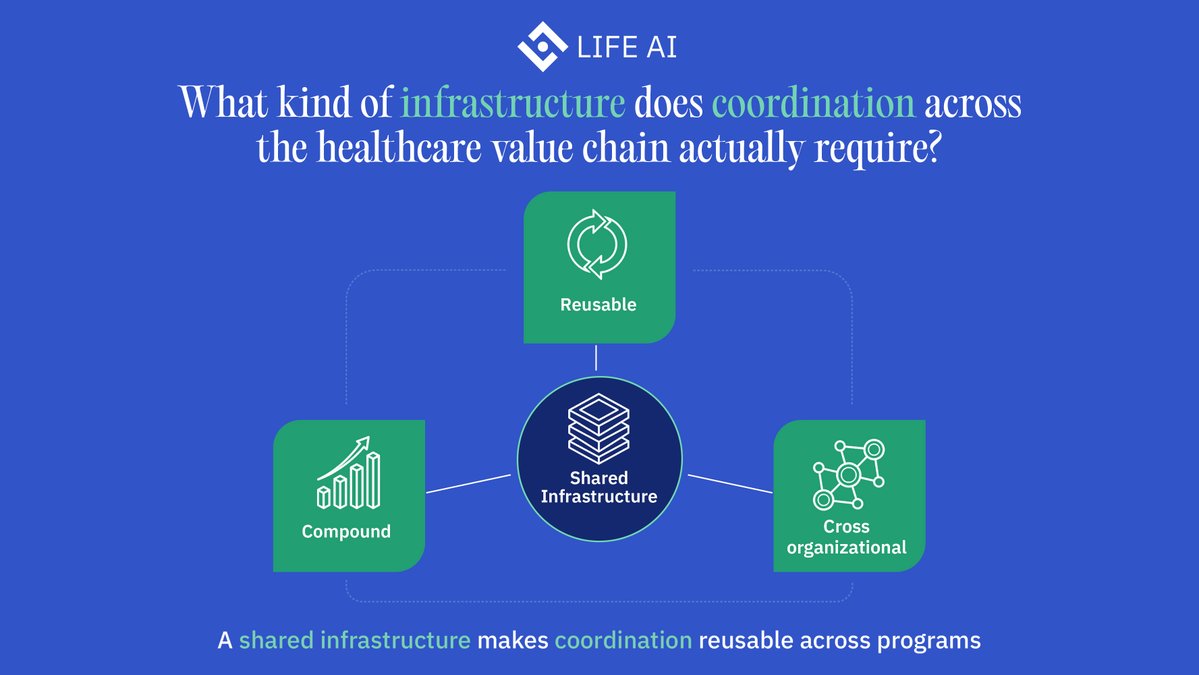
What kind of operational infrastructure does coordination across the healthcare value chain actually require?
Eight years of building clinical programs across Southeast Asia, working with governments, hospital networks, and pharmaceutical companies, produced one consistent finding: the challenge is not the absence of capable AI. It is the absence of operational infrastructure that makes coordination reusable across programs.
Without that infrastructure, coordination remains highly program-specific, especially in drug development, where multiple key players must work together across the development process.
The infrastructure this requires has three properties.
It has to be reusable. Clinical programs should move from bespoke projects to reusable rails, with shared coordination rails replacing bespoke integration at every site.
It has to compound. Every application should strengthen the model, the network, and the protocol, building greater capacity across the ecosystem over time.
It has to enable coordination among independent actors. Hospitals, doctors, labs, pharma sponsors, regulators, patients, and AI builders can contribute services, validation, and clinical execution without surrendering operational sovereignty.
At Life AI, we are building an operating infrastructure for drug development around these requirements, bringing together AI-driven discovery, wet-lab screening, and clinical validation.
What kind of operational infrastructure does coordination across the healthcare value chain actually require?
Eight years of building clinical programs across Southeast Asia, working with governments, hospital networks, and pharmaceutical companies, produced one consistent finding: the challenge is not the absence of capable AI. It is the absence of operational infrastructure that makes coordination reusable across programs.
Without that infrastructure, coordination remains highly program-specific, especially in drug development, where multiple key players must work together across the development process.
The infrastructure this requires has three properties.
It has to be reusable. Clinical programs should move from bespoke projects to reusable rails, with shared coordination rails replacing bespoke integration at every site.
It has to compound. Every application should strengthen the model, the network, and the protocol, building greater capacity across the ecosystem over time.
It has to enable coordination among independent actors. Hospitals, doctors, labs, pharma sponsors, regulators, patients, and AI builders can contribute services, validation, and clinical execution without surrendering operational sovereignty.
At Life AI, we are building an operating infrastructure for drug development around these requirements, bringing together AI-driven discovery, wet-lab screening, and clinical validation.
$200B in Treasuries may move onchain. Ondo's USDY and OUSG let institutions earn yield via tokenized T-bills.
Tokenized RWAs hit $12B this year, with Ondo leading the pack.
The TradFi-DeFi bridge is no longer a thesis.